永赢卫星ETF

Search documents
跨境和行业ETF逆势“吸金”
Shang Hai Zheng Quan Bao· 2026-02-23 18:37
Group 1 - The capital flow in the A-share market has shown a divergent trend since the beginning of 2026, with broad-based ETFs experiencing significant outflows while industry and cross-border ETFs have attracted substantial inflows [1][2] - As of February 13, 2026, the net inflow for cross-border ETFs reached 63 billion yuan, while industry ETFs such as chemical, non-ferrous metals, and satellite sectors have seen strong capital inflows [1][2] - The total net outflow from equity ETFs in the A-share market amounted to 846.46 billion yuan by February 13, 2026, with major outflows concentrated in large-scale broad-based ETFs [1][2] Group 2 - Fund managers remain optimistic about the technology sector, viewing it as a core investment theme for 2026, particularly in the context of artificial intelligence (AI) advancements [3][4] - The AI sector is perceived as a significant driver of productivity and is considered a key variable in the new industrial revolution, with expectations for continued growth and innovation in China [3][4] - Despite recent market adjustments, the long-term upward trend of the A-share market is expected to persist, with a focus on AI as a primary investment narrative [3][4]
1月14只ETF扩容逾百亿 释放什么信号?
2 1 Shi Ji Jing Ji Bao Dao· 2026-02-03 13:07
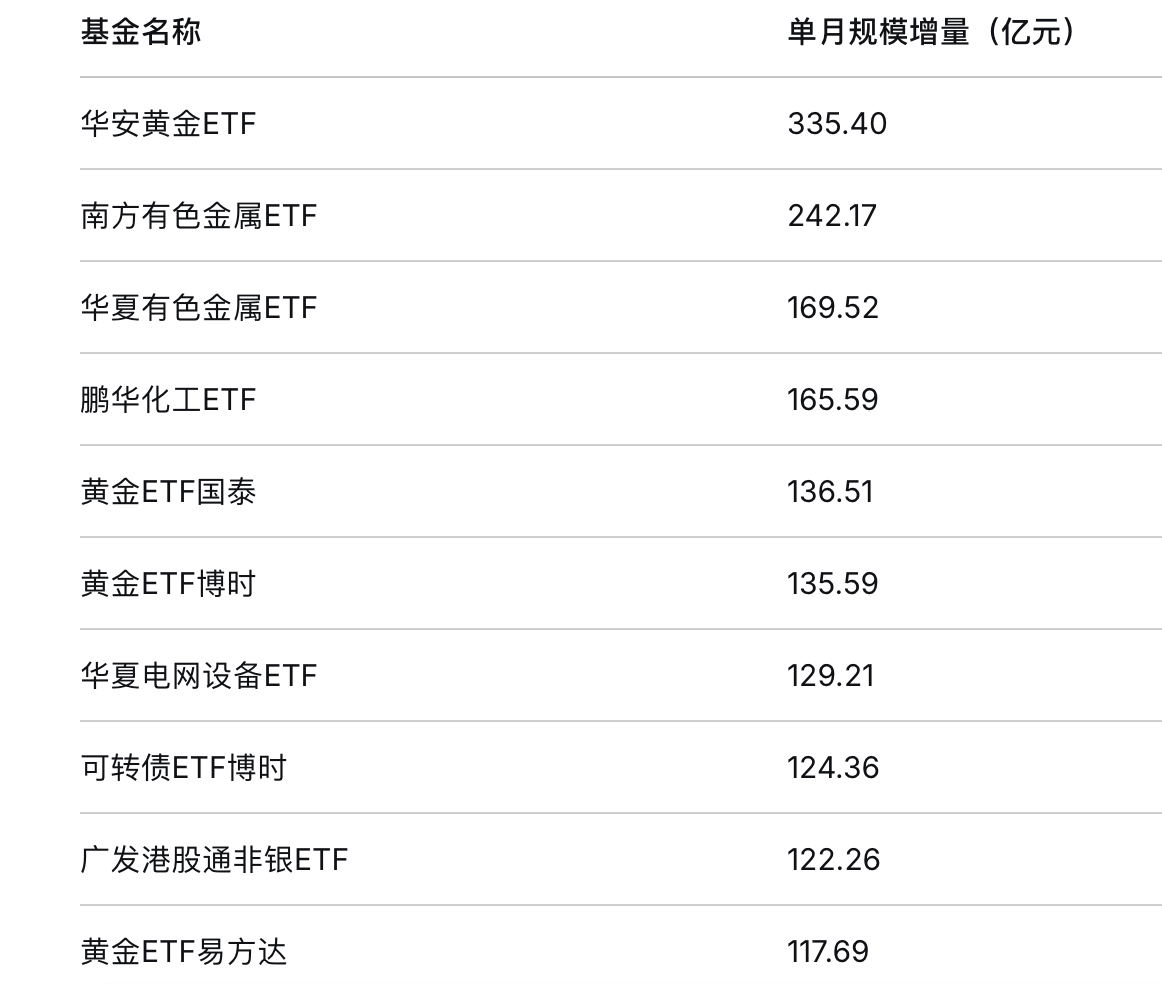
Core Insights - In early 2026, ETF fund flows showed significant divergence, with core broad-based ETFs experiencing large net outflows, while industry-themed ETFs gained popularity and saw substantial inflows [1][9] - The preference for industry-themed ETFs highlights a consensus among investors regarding the support from industrial policies and the positive fundamentals in specific sectors [1][6] ETF Performance - As of January 31, 2026, 14 ETFs had their scales increase by over 10 billion yuan, including 7 stock ETFs, 4 commodity ETFs, 2 cross-border ETFs, and 1 bond ETF [3] - Notable increases in scale included the Huaan Gold ETF (335.4 billion yuan), Southern Nonferrous Metals ETF (242.17 billion yuan), and Huaxia Nonferrous Metals ETF (169.52 billion yuan) [4][7] - The stock ETFs that saw significant scale growth were primarily industry-focused, indicating a market signal for bullish sentiment in related sectors [5][6] Market Trends - The overall ETF fund flow in January 2026 reflected a structural shift, with significant net outflows from core broad-based ETFs and inflows into industry-specific ETFs and gold [9][10] - The A-share market experienced a transition from exuberance to cooling, with the Shanghai Composite Index surpassing 4100 points before entering a consolidation phase [9][11] Investment Strategies - Institutions suggest that the market in February will likely experience volatility, with a focus on "growth and cyclical" dual strategies while being cautious of overheating sectors [11][12] - Recommended investment strategies include focusing on global manufacturing recovery, traditional industry improvements, and technology growth, particularly in AI applications and robotics [12][13]

股票ETF成交活跃 行业主题产品“吸金”显著
2 1 Shi Ji Jing Ji Bao Dao· 2026-01-27 13:18
Core Viewpoint - The A-share market is experiencing a cooling trend, leading to a significant shift in ETF investments from broad-based ETFs to sector-specific ETFs, with substantial net outflows from major broad-based ETFs and inflows into thematic ETFs [1][2][3] Summary by Sections ETF Market Dynamics - As of January 23, 2026, the total net outflow from the CSI 300 ETF and the CSI 1000 ETF reached 336.9 billion and 78 billion respectively since the beginning of the year, while thematic ETFs, particularly in resources and technology, attracted a total of 158.5 billion in net inflows [1][4] - The week of January 12-16 saw a net outflow of 141.6 billion from stock ETFs, which increased to 333.1 billion in the following week, marking a historically significant outflow [1][2] Performance of Broad-based vs. Thematic ETFs - From January 19-23, the CSI 300 ETF experienced a net outflow of 237.3 billion, while the CSI 1000 ETF and the SSE 50 ETF saw outflows of 71.7 billion and 36.1 billion respectively [2] - The net outflows for the CSI 300 ETF, CSI 1000 ETF, and SSE 50 ETF from January 5-23 were approximately 336.9 billion, 78 billion, and 56.2 billion respectively [2] Institutional Investor Behavior - Institutional investors hold a significant portion of ETFs, with over 1.5 trillion in ETF holdings reported as of the end of Q4 2025, primarily in the CSI 300 ETF [3] - Despite the outflows, the CSI 300 ETF remains a major holding for institutional investors, with an estimated 1 trillion still held in ETFs by these investors [3] Sector-specific ETF Inflows - Thematic ETFs, particularly in sectors like non-ferrous metals and chemicals, have seen strong inflows, with 50 ETFs collectively attracting 158.5 billion from January 5-23 [4][5] - Notably, three ETFs exceeded 10 billion in net inflows, including the Southern Non-ferrous Metals ETF (12.6 billion), Huaxia Power Grid Equipment ETF (11.9 billion), and Penghua Chemical ETF (10.3 billion) [5] Market Outlook - Analysts suggest that the shift in ETF investments indicates a structural rebalancing rather than a complete exit from the market, which may lead to deeper market trends and structural opportunities [7][8] - The current market dynamics suggest a transition from valuation recovery to a phase driven by fundamentals, with a focus on sectors with clear industry trends and performance support [8]
A股重磅!宽基ETF连续出现净赎回,有“巨无霸”份额回落至“924”行情之前,多只科创、创业板系ETF份额缩水,发生了啥?
Jin Rong Jie· 2026-01-20 08:57
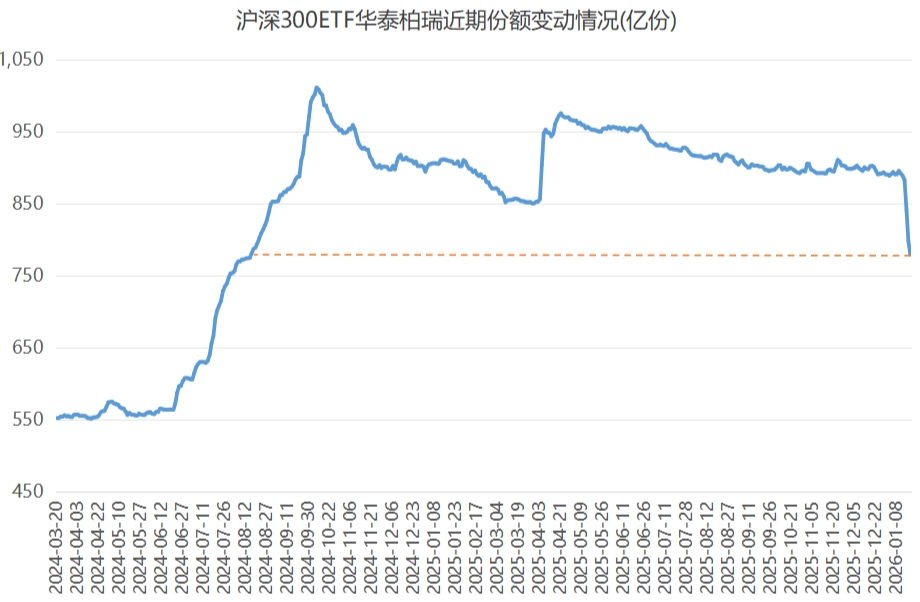
Group 1 - Recent net redemptions in A-share broad-based ETFs have drawn market attention, with significant outflows recorded on January 15 and 16, totaling 687 billion and 863 billion respectively, marking the highest single-day outflows in history [1] - As of January 19, four out of six major broad-based ETFs saw their shares decline by over 10% in the last three trading days, with the largest, Huatai-PB CSI 300 ETF, dropping to 778.63 billion shares, a scale of approximately 369.2 billion, the lowest since August 2024 [1] - The ChiNext and STAR Market ETFs also experienced significant declines, with the E Fund STAR 50 ETF and E Fund ChiNext ETF seeing share reductions of 34.55% and 20.22% respectively [3] Group 2 - In contrast to the outflows from broad-based ETFs, certain commodity, cross-border, and narrow-based ETFs attracted significant inflows, with the Southern Nonferrous ETF being the only product to receive over 10 billion in net inflows, totaling 100.87 billion, driven by rising base metal prices [3] - Other ETFs such as Yongying Satellite ETF, Harvest Software ETF, and GF Media ETF also received net inflows exceeding 6 billion [3] - According to CITIC Securities, the impact of ETF redemptions on individual stocks was significant, with main board, ChiNext, and STAR Market stocks experiencing sell-offs of 946 billion, 334 billion, and 265 billion respectively during the peak outflow days [3] Group 3 - Regulatory measures have been implemented to cool down the market following rapid price increases and overheated sentiment, including raising the minimum margin requirement for margin trading from 80% to 100% [5][6] - The China Securities Regulatory Commission emphasized the need for comprehensive market monitoring and timely counter-cyclical adjustments to maintain market stability and prevent excessive volatility [6] - There are differing views on the long-term outlook for A-shares, with some analysts suggesting the potential for a slow bull market due to reforms, while others remain skeptical about escaping historical volatility patterns [7]




“ETF通”再迎扩容,新纳98只ETF中近四成环比放量
第一财经· 2026-01-19 13:57
Core Viewpoint - The expansion of the ETF Connect on January 19 has added 98 new ETFs, bringing the total to over 360, marking a significant increase of over 30% and providing cross-border investors with new investment opportunities [2][3]. Group 1: ETF Connect Expansion - 98 ETFs were officially included in the Northbound Stock Connect, with 54 added to the Northbound Shanghai Stock Connect and 44 to the Northbound Shenzhen Stock Connect [3]. - The inclusion of the CSI A500 ETF and various thematic ETFs related to aerospace, high-end manufacturing, and artificial intelligence has diversified investment options for investors [2][3]. - The total trading volume on the first day of expansion exceeded 738 billion yuan, with nearly 40% of the products seeing increased trading volume compared to previous periods [4]. Group 2: Market Impact and Future Trends - The expansion is expected to enhance the A-share allocation tools for foreign investors and attract more professional investors and incremental capital to the domestic ETF market, thereby increasing China's capital market's international influence and competitiveness [4]. - The trading heat and transaction amounts of the ETF Connect have been steadily increasing, with projections indicating that by 2025, northbound funds through the ETF Connect will reach approximately 8165.82 billion yuan, a 76% increase from 2024 and over six times that of 2023 [6]. - Factors driving the increased popularity of the ETF Connect include policy support, mechanism optimization, enhanced market liquidity, diversified investor demand, product innovation, and improved market sentiment [6].

“ETF通”再迎扩容,新纳98只ETF中近四成环比放量
Di Yi Cai Jing· 2026-01-19 12:18
Group 1 - The core viewpoint of the news is the expansion of the ETF Connect, which now includes 98 new ETFs, bringing the total number to over 360, marking a significant increase of over 30% [1][2] - The newly included ETFs cover a range of sectors, including popular themes such as aerospace, high-end manufacturing, and artificial intelligence, enhancing investment options for cross-border investors [1][2] - The trading volume on the first day of the expansion exceeded 738 billion yuan, with nearly 40% of the products seeing increased trading activity compared to previous periods [1][3] Group 2 - The expansion involved 29 fund companies, with notable contributions from major players like Huaxia Fund and E Fund, which added 14 and 10 ETFs respectively [2] - The inclusion of the CSI A500 ETF has garnered significant attention, with several funds related to it exceeding 40 billion yuan in scale [2][3] - The ongoing development of the ETF Connect since its launch in July 2022 has led to a steady increase in trading activity and product diversity, making ETFs a crucial tool for cross-border asset allocation [4][5] Group 3 - Future projections indicate that by 2025, northbound funds through the ETF Connect are expected to exceed 8165.82 billion yuan, representing a 76% increase from 2024 and over six times the amount from 2023 [5] - The trading volume is anticipated to remain high, with monthly transactions expected to consistently surpass 600 billion yuan, reflecting sustained interest from investors [5] - Factors driving the increased popularity of the ETF Connect include policy support, enhanced market mechanisms, and diversified investor demand, which collectively contribute to the deep integration of market rules and investor structures between the two regions [6]
资本热话 | ETF市场开年狂飙:万亿巨头诞生,科技赛道受捧
Sou Hu Cai Jing· 2026-01-15 09:36
Core Insights - The ETF industry is experiencing a significant expansion, with A-share market trading reaching historical highs and ETF total scale increasing to 6.24 trillion yuan as of January 13, marking a surge of 221.7 billion yuan in just half a month [2][4] - The emergence of the first trillion-yuan ETF manager, Huaxia Fund, signifies a milestone in the industry, with the second-largest player, E Fund, trailing by less than 100 billion yuan [6][7] - The competition among leading institutions has evolved beyond mere market share to include product standardization, investor returns, and ecosystem development [2][9] Market Performance - A-share market remains robust, with daily trading volumes consistently exceeding 3 trillion yuan, reaching nearly 4 trillion yuan on January 14 [4] - The ETF market is a key channel for capital inflow, with stock ETFs being the primary drivers of growth, adding over 220 billion yuan since the beginning of the year [4][5] - Technology-related sectors, including satellite and media, are attracting significant investment, with specific ETFs receiving over 80 billion yuan in net inflows [4][5] Fund Management Trends - The top three ETF managers control over 40% of the total market, with Huaxia Fund leading at over 1 trillion yuan, followed by E Fund and Huatai-PB [6][7] - The rapid growth of these leading firms is attributed to both net subscriptions and net asset value increases, with Huaxia Fund growing by 360.8 billion yuan and E Fund by 326.3 billion yuan in the past year [8] - Smaller ETF managers face challenges, with many having assets below 10 billion yuan, highlighting a trend of resource concentration among top firms [8] Competitive Landscape - The competition in the ETF market is shifting towards diversified strategies, including product naming standardization and enhanced dividend policies [9][10] - Recent announcements of significant dividend distributions by major funds indicate a trend towards improving product attractiveness [9] - The industry is witnessing a wave of rebranding efforts, with several funds standardizing their product names to enhance clarity and marketability [9] Future Outlook - The ETF market is expected to continue its rapid growth, driven by increasing penetration of public funds in asset allocation and a growing acceptance of index investing among investors [10] - Future competition will likely focus on the comprehensive capabilities of fund managers, emphasizing the importance of research, operations, and service integration [10]

近三个交易日权益类ETF净申购额超470亿元
Sou Hu Cai Jing· 2026-01-15 00:50
Group 1 - The total net subscription amount for equity ETFs from January 9 to January 13 reached 47.303 billion yuan [1] - Popular thematic ETFs saw significant interest, with the GF Media ETF net subscription amounting to 7.064 billion yuan, the Yongying Satellite ETF at 4.901 billion yuan, and the Southern CSI 1000 ETF at 4.193 billion yuan [1] - Other ETFs such as the Southern Nonferrous Metals ETF, Harvest Software ETF, and Fortune Satellite ETF also had net subscriptions exceeding 2 billion yuan [1] Group 2 - Hong Kong stock thematic ETFs also attracted attention, with the Fortune Hong Kong Internet ETF net subscription at 2.475 billion yuan and the GF Hong Kong Non-bank ETF at 1.539 billion yuan [1] - The Huatai-PB Southern Dongying Hang Seng Technology ETF and the E Fund Hong Kong Stock Connect Innovative Drug ETF both had net subscriptions exceeding 1.1 billion yuan [1]
超百亿资金借道ETF入市 场外基金热度也显著升温
Shang Hai Zheng Quan Bao· 2026-01-15 00:42
Group 1 - Over 120 billion yuan of net subscriptions for equity ETFs were recorded for three consecutive trading days from January 9 to 13, totaling over 470 billion yuan [1][2] - On January 13, the net subscription amount for equity ETFs reached 146.31 billion yuan, with previous days showing 127.14 billion yuan on January 12 and 199.58 billion yuan on January 9 [2] - Popular theme ETFs saw significant inflows, including 70.64 billion yuan for GF Media ETF, 49.01 billion yuan for Yongying Satellite ETF, and 41.93 billion yuan for Southern CSI 1000 ETF [2] Group 2 - Several ETFs experienced rapid growth in scale, surpassing 10 billion yuan, with GF Media ETF increasing from 26.43 billion yuan to 107.67 billion yuan by January 13, 2026 [3] - Yongying Satellite ETF grew from 66.6 billion yuan to 155.92 billion yuan, while Jiashi Software ETF increased from 60.25 billion yuan to 101.67 billion yuan [3] Group 3 - The popularity of off-market funds has surged, with some funds announcing limits on subscriptions due to reaching their scale control limits [4] - For instance, the asset net value of the China Europe Small Cap Growth Mixed Fund exceeded its control limit of 2 billion yuan, leading to a partial confirmation of subscription applications at a rate of 47.84% [4] - Fund companies like Debang and Yongying have also announced adjustments to their subscription limits for certain funds [4] Group 4 - New funds are frequently ending their fundraising early, with announcements from E Fund and Tianhong regarding the early closure of several ETFs and mixed funds [5] - The investment outlook for 2026 highlights artificial intelligence as a key area, with opportunities in overseas computing power, domestic computing power, and AI large models [5] - Other investment themes include commercial aerospace, humanoid robots, quantum computing, and controlled nuclear fusion, along with AI hardware and satellite communication [5]
ETF市场开年狂飙
Di Yi Cai Jing Zi Xun· 2026-01-14 16:09
Group 1 - The A-share market has seen a significant increase in trading activity, with daily transaction volumes reaching historical highs, surpassing 30 trillion yuan for four consecutive days [2][3] - The total scale of ETFs in the market has reached 6.24 trillion yuan as of January 13, marking an increase of 221.7 billion yuan since the end of last year, indicating a rapid expansion [3][4] - Stock ETFs have been the primary driver of this growth, with over 220 billion yuan added to their scale since the beginning of the year, supported by net inflows exceeding 25 billion yuan [3][4] Group 2 - The emergence of the first trillion-yuan ETF manager, Huaxia Fund, marks a milestone in the industry, holding over 10.08 trillion yuan in ETF assets, accounting for 16.16% of the total market [6][7] - E Fund follows closely with over 9.17 trillion yuan in ETF assets, while the third-largest, Huatai-PB Fund, has 6.43 trillion yuan, highlighting a significant concentration of resources among top firms [6][7] - The top three firms collectively manage over 2.57 trillion yuan, representing more than 40% of the total market scale, indicating a trend of resource concentration towards leading institutions [6][8] Group 3 - The ETF market is evolving beyond mere scale competition, with firms focusing on product naming standardization, dividend distribution, and ecosystem development [9][10] - Dividends have become a crucial method for funds to reward investors, with significant distributions announced, including a record single dividend of 11 billion yuan from Huatai-PB's ETF [10] - The industry is witnessing a wave of name changes for ETFs to enhance product recognition and reduce selection costs for investors, with several leading firms already implementing these changes [10][11] Group 4 - Smaller ETF managers face significant challenges, with 27 out of 58 firms having less than 10 billion yuan in assets, indicating a tough competitive landscape [8][9] - The competition is shifting towards a comprehensive evaluation of fund managers' capabilities, including research, operations, and service quality, rather than just asset size [11][12] - The future of the ETF market is expected to remain robust, driven by increasing penetration of public funds in asset allocation and a growing acceptance of index investing among investors [11]