
万家工业有色ETF

Search documents
单日涨超4.8%,这只ETF逆袭
Zhong Guo Ji Jin Bao· 2026-02-11 11:54
Core Viewpoint - The cross-border ETFs, particularly rare metal ETFs, have shown strong performance, with significant increases in their values, indicating heightened market interest in these assets [1][5][6]. ETF Performance - On February 11, A-shares exhibited mixed trends, with small metals and oil and gas extraction sectors performing well, while the film and cinema sector experienced a pullback [2]. - A total of 640 stock ETFs (including cross-border) rose, with notable gains in rare metal ETFs, while 713 stock ETFs declined, particularly in the film and media sectors [3][4]. Cross-Border ETF Highlights - Cross-border ETFs performed exceptionally well, with the Huaxia Nikkei ETF surging by 4.85%, leading the market. Other Nikkei ETFs also saw significant increases, indicating growing interest in Japanese stock assets [6]. - The Huaxia Nikkei ETF and Huaxia Nikkei 225 ETF both exceeded 2 billion yuan in scale, while the E Fund Nikkei 225 ETF and ICBC Nikkei ETF surpassed 1.8 billion yuan and 1 billion yuan, respectively [6]. Rare Metal Sector - The rare metal sector experienced a comprehensive surge, with the Jiashi Rare Metal ETF rising by 3.86%, followed closely by ETFs from ICBC Credit Suisse, GF, and Huafu, which increased by 3.79%, 3.78%, and 3.53%, respectively [9]. - The Jiashi Rare Metal ETF is the largest in scale, exceeding 6.5 billion yuan, followed by GF Rare Metal ETF at over 5.1 billion yuan [9]. - Industry experts suggest that limited reserves and increasing demand from sectors like renewable energy and semiconductors may lead to a continued upward trend in rare metal prices [9]. Broader Metal Industry Trends - The non-ferrous metal industry chain also saw gains, with the Taikang Non-Ferrous ETF rising by 3.19%, and other ETFs in the sector showing similar upward trends [10]. Fund Flow Insights - On February 10, broad-based ETFs experienced a net outflow of over 10.6 billion yuan, with significant outflows from the CSI 300 Index and other major indices [11][12]. - The top sectors for fund inflows included media, rare earths, and robotics, while the largest outflows were from the CSI 300 Index and the ChiNext 50 Index [12].

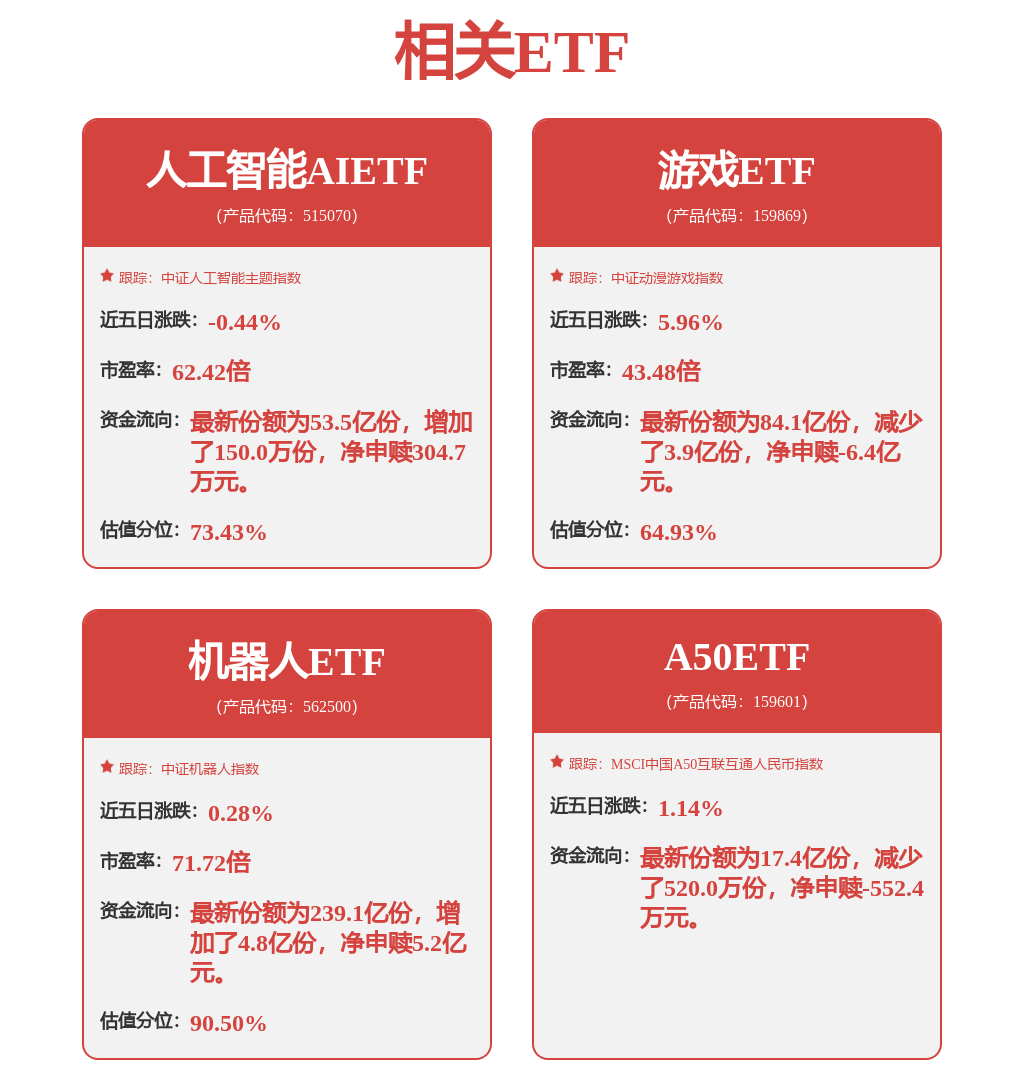
“ETF通”再迎扩容,新纳98只ETF中近四成环比放量
第一财经· 2026-01-19 13:57
Core Viewpoint - The expansion of the ETF Connect on January 19 has added 98 new ETFs, bringing the total to over 360, marking a significant increase of over 30% and providing cross-border investors with new investment opportunities [2][3]. Group 1: ETF Connect Expansion - 98 ETFs were officially included in the Northbound Stock Connect, with 54 added to the Northbound Shanghai Stock Connect and 44 to the Northbound Shenzhen Stock Connect [3]. - The inclusion of the CSI A500 ETF and various thematic ETFs related to aerospace, high-end manufacturing, and artificial intelligence has diversified investment options for investors [2][3]. - The total trading volume on the first day of expansion exceeded 738 billion yuan, with nearly 40% of the products seeing increased trading volume compared to previous periods [4]. Group 2: Market Impact and Future Trends - The expansion is expected to enhance the A-share allocation tools for foreign investors and attract more professional investors and incremental capital to the domestic ETF market, thereby increasing China's capital market's international influence and competitiveness [4]. - The trading heat and transaction amounts of the ETF Connect have been steadily increasing, with projections indicating that by 2025, northbound funds through the ETF Connect will reach approximately 8165.82 billion yuan, a 76% increase from 2024 and over six times that of 2023 [6]. - Factors driving the increased popularity of the ETF Connect include policy support, mechanism optimization, enhanced market liquidity, diversified investor demand, product innovation, and improved market sentiment [6].

“ETF通”再迎扩容,新纳98只ETF中近四成环比放量
Di Yi Cai Jing· 2026-01-19 12:18
Group 1 - The core viewpoint of the news is the expansion of the ETF Connect, which now includes 98 new ETFs, bringing the total number to over 360, marking a significant increase of over 30% [1][2] - The newly included ETFs cover a range of sectors, including popular themes such as aerospace, high-end manufacturing, and artificial intelligence, enhancing investment options for cross-border investors [1][2] - The trading volume on the first day of the expansion exceeded 738 billion yuan, with nearly 40% of the products seeing increased trading activity compared to previous periods [1][3] Group 2 - The expansion involved 29 fund companies, with notable contributions from major players like Huaxia Fund and E Fund, which added 14 and 10 ETFs respectively [2] - The inclusion of the CSI A500 ETF has garnered significant attention, with several funds related to it exceeding 40 billion yuan in scale [2][3] - The ongoing development of the ETF Connect since its launch in July 2022 has led to a steady increase in trading activity and product diversity, making ETFs a crucial tool for cross-border asset allocation [4][5] Group 3 - Future projections indicate that by 2025, northbound funds through the ETF Connect are expected to exceed 8165.82 billion yuan, representing a 76% increase from 2024 and over six times the amount from 2023 [5] - The trading volume is anticipated to remain high, with monthly transactions expected to consistently surpass 600 billion yuan, reflecting sustained interest from investors [5] - Factors driving the increased popularity of the ETF Connect include policy support, enhanced market mechanisms, and diversified investor demand, which collectively contribute to the deep integration of market rules and investor structures between the two regions [6]
资金涌入有色板块,“金属风暴”席卷全球商品市场
Di Yi Cai Jing· 2026-01-15 02:26
Group 1: Market Overview - The global metal futures market has started 2026 strongly, with significant inflows into the non-ferrous metal sector driven by supply concerns and capital market dynamics [1] - Prices of copper and nickel have surged due to supply disruptions, with analysts indicating that the sustainability of this price increase will depend on global economic recovery and supply-demand rebalancing [1][2] Group 2: Nickel Market Dynamics - Nickel prices have reached a new high, primarily due to production cuts in Indonesia, the world's largest nickel supplier, which plans to reduce its output target from 379 million tons to 250 million tons, a decrease of 34% [2] - Despite the anticipated demand of 3.82 million tons and production of 4.09 million tons in 2026, the market is currently experiencing a supply surplus, with high inventory levels exerting long-term pressure on prices [2][3] Group 3: Copper Market Dynamics - Copper prices have also reached record highs, with a cumulative increase of over 5% since the beginning of 2026, driven by structural supply shortages and accelerating demand from sectors like electrification and data centers [4] - Events such as strikes at Canadian copper mines and delays in production at other sites have heightened concerns over copper supply [4][5] Group 4: Investment Trends - Significant capital has flowed into the non-ferrous metal sector, with various ETFs seeing substantial net inflows, indicating strong investor interest [7][8] - The domestic market has seen a historical breakthrough in the non-ferrous metal sector, with a 94.73% increase in the sector's A-share market in 2025, and many stocks doubling in value [7] Group 5: Future Outlook - Analysts suggest that macroeconomic factors, including lower-than-expected U.S. inflation data and geopolitical uncertainties, will continue to support the valuation of the non-ferrous metal sector [8] - The Chinese government's encouragement of mergers and restructuring in key industries like aluminum and copper smelting is expected to enhance industry concentration and pricing power, providing a long-term boost to the sector [8]
两大赛道,猛烈“吸金”
Shang Hai Zheng Quan Bao· 2026-01-09 04:51
Group 1: Non-ferrous Metals Sector - The non-ferrous metals sector has seen significant inflows into ETFs, with notable funds like Wanji Industrial Non-ferrous ETF surpassing 10 billion yuan in scale [1][3] - As of January 7, 2026, major non-ferrous metal ETFs received substantial net inflows: Southern Non-ferrous Metal ETF (2.39 billion yuan), Huaxia Non-ferrous Metal ETF (1.44 billion yuan), and Dachen Non-ferrous ETF (0.93 billion yuan) [3] - Factors driving the non-ferrous metals sector include improved supply-demand dynamics and the global trend of "re-industrialization," alongside geopolitical tensions affecting resource supply [1][4] Group 2: Commercial Aerospace Sector - The commercial aerospace sector has also attracted significant investment, with the Yongying Satellite ETF rising by 6.2% and leading the market [5][6] - As of January 7, 2026, the Yongying Satellite ETF and the Zhaoshang Satellite Industry ETF each gained over 1 billion yuan in net inflows since the beginning of the year [6] - The commercial aerospace sector is expected to accelerate in 2026, driven by policy support, IPOs of leading companies, and heightened strategic value due to geopolitical factors [6]
万家基金贺方舟:新能源和AI对不同有色金属需求的拉动有较大差异
Zhong Zheng Wang· 2026-01-07 14:56
Group 1 - The overall impact of new energy and AI on the non-ferrous metal sector is structural and real, but the "demand value" varies significantly among different metals [1] - For copper, significant investments are required for infrastructure related to new energy generation, electric vehicle charging networks, and AI data centers, indicating a systemic and rigid demand [1] - JPMorgan estimates that AI alone will add 2.6 million tons of copper demand by 2030 [1] Group 2 - The growth in global photovoltaic (PV) installations has indeed created solid industrial demand for silver [1] - However, advancements in PV technology are leading to a rapid decrease in silver paste consumption per solar cell, dropping from approximately 130 mg per cell in 2019 to about 65 mg per cell in 2023 [1] - Consequently, the growth rate of silver demand may lag behind the growth rate of PV installations [1]
万家基金贺方舟:建议将工业有色视为一种“战略资源资产”
Zhong Zheng Wang· 2026-01-07 13:57
Core Viewpoint - The long-term investment perspective on industrial non-ferrous metals should be viewed as a "strategic resource asset" benefiting from global liquidity easing and the future of electrification and digitalization, rather than merely a cyclical commodity [1] Group 1: Market Outlook - The manager is optimistic about the medium to long-term performance of the non-ferrous metals sector [1] - The Federal Reserve entering a rate-cutting cycle is favorable for dollar-denominated non-ferrous metals [1] - Supply-side disruptions, including accidents in South American and Central African copper mines, have led to tight supply, exacerbated by the recent mining accident at Indonesia's Grasberg copper mine [1] Group 2: Demand Factors - The demand for industrial metals is continuously rising, driven by energy transition and the AI wave [1]
万家基金贺方舟:金价长期有支撑
Zhong Zheng Wang· 2025-10-16 13:53
Group 1 - The core viewpoint of the article highlights that gold price fluctuations are primarily influenced by real interest rates, the US dollar index, and risk aversion sentiment [1] - The article notes that the increase in gold prices this year is attributed to multiple factors, including heightened global uncertainty, rising recession expectations in the US, and ongoing market volatility prompting investors to seek more stable asset allocations [1] - The article emphasizes that the persistent US debt issues and increasing "credit cracks" further contribute to the demand for gold as a safe-haven asset [1] Group 2 - Looking ahead, the article suggests that central bank gold purchases and the trend of "de-dollarization" provide long-term support for gold prices [1] - It also mentions that unresolved geopolitical risks and the ongoing direction of monetary easing will continue to underpin gold prices in the long term [1]