
富国卫星ETF

Search documents
股票ETF成交活跃 行业主题产品“吸金”显著
2 1 Shi Ji Jing Ji Bao Dao· 2026-01-27 13:18
Core Viewpoint - The A-share market is experiencing a cooling trend, leading to a significant shift in ETF investments from broad-based ETFs to sector-specific ETFs, with substantial net outflows from major broad-based ETFs and inflows into thematic ETFs [1][2][3] Summary by Sections ETF Market Dynamics - As of January 23, 2026, the total net outflow from the CSI 300 ETF and the CSI 1000 ETF reached 336.9 billion and 78 billion respectively since the beginning of the year, while thematic ETFs, particularly in resources and technology, attracted a total of 158.5 billion in net inflows [1][4] - The week of January 12-16 saw a net outflow of 141.6 billion from stock ETFs, which increased to 333.1 billion in the following week, marking a historically significant outflow [1][2] Performance of Broad-based vs. Thematic ETFs - From January 19-23, the CSI 300 ETF experienced a net outflow of 237.3 billion, while the CSI 1000 ETF and the SSE 50 ETF saw outflows of 71.7 billion and 36.1 billion respectively [2] - The net outflows for the CSI 300 ETF, CSI 1000 ETF, and SSE 50 ETF from January 5-23 were approximately 336.9 billion, 78 billion, and 56.2 billion respectively [2] Institutional Investor Behavior - Institutional investors hold a significant portion of ETFs, with over 1.5 trillion in ETF holdings reported as of the end of Q4 2025, primarily in the CSI 300 ETF [3] - Despite the outflows, the CSI 300 ETF remains a major holding for institutional investors, with an estimated 1 trillion still held in ETFs by these investors [3] Sector-specific ETF Inflows - Thematic ETFs, particularly in sectors like non-ferrous metals and chemicals, have seen strong inflows, with 50 ETFs collectively attracting 158.5 billion from January 5-23 [4][5] - Notably, three ETFs exceeded 10 billion in net inflows, including the Southern Non-ferrous Metals ETF (12.6 billion), Huaxia Power Grid Equipment ETF (11.9 billion), and Penghua Chemical ETF (10.3 billion) [5] Market Outlook - Analysts suggest that the shift in ETF investments indicates a structural rebalancing rather than a complete exit from the market, which may lead to deeper market trends and structural opportunities [7][8] - The current market dynamics suggest a transition from valuation recovery to a phase driven by fundamentals, with a focus on sectors with clear industry trends and performance support [8]
A股ETF开年火热,32只主题ETF涨超20%
3 6 Ke· 2026-01-15 12:03
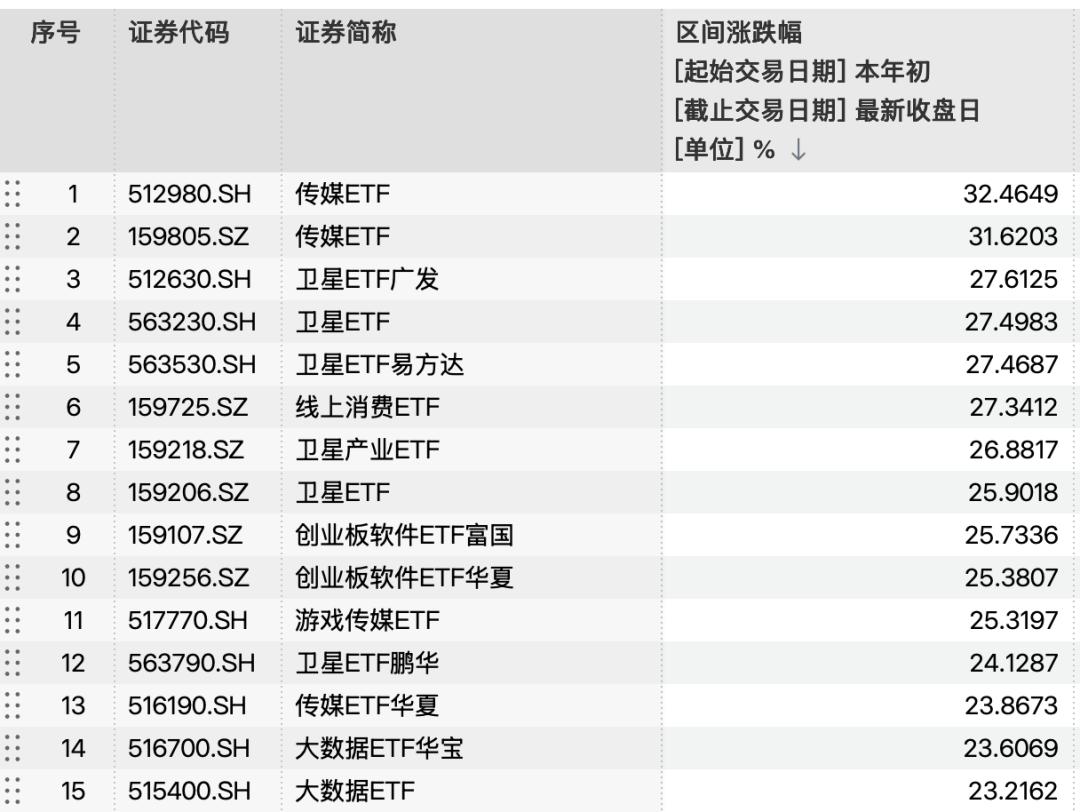
Core Viewpoint - The A-share market has experienced a "spring surge" at the beginning of 2026, with ETFs showing significant growth and a rare trend of "limit-up" occurrences in multiple products [1][5]. Group 1: ETF Market Overview - The total scale of ETFs in the market has increased from 6 trillion yuan to 6.24 trillion yuan, a growth of over 2245.82 billion yuan since the beginning of the year [2][3]. - Stock ETFs have been the main contributors to this growth, with an increase of over 2000 billion yuan, surpassing the 4 trillion yuan mark, reaching 4.05 trillion yuan [2][3]. - In contrast, bond ETFs have seen a decline of 761.53 billion yuan, and money market ETFs have decreased by 196.98 billion yuan [2]. Group 2: Performance of ETFs - The net value performance of various industry-themed ETFs has significantly outperformed major indices, with the media, satellite, and defense sectors showing notable gains [3][4]. - As of January 14, 2026, the media sector ETFs, such as the GF Media ETF and Penghua Media ETF, have recorded increases of 32.46% and 31.62%, respectively [4]. - Satellite-themed ETFs have also performed well, with the GF Satellite ETF leading with a 27.61% increase [3][4]. Group 3: Fund Flow Dynamics - There is a clear divergence in fund flows, with broad-based ETFs like the CSI A500 experiencing a net outflow of nearly 180 billion yuan, while thematic ETFs in sectors like non-ferrous metals and cross-border investments are attracting capital [7][8]. - The trend of passive investment is increasing, with more investors shifting from public funds to thematic ETFs, indicating a growing interest in sector-specific investments [7][9]. Group 4: Institutional Activity - Institutional investors are actively participating in the ETF market, with public funds moving away from homogeneous competition to focus on niche themes, resulting in the approval of 14 new ETF products since the beginning of 2026 [9]. - Leading fund management companies, such as Huaxia Fund, have seen significant growth in ETF management scale, surpassing 1 trillion yuan, indicating a trend towards increased concentration in the ETF management industry [9].

近三个交易日权益类ETF净申购额超470亿元
Sou Hu Cai Jing· 2026-01-15 00:50
Group 1 - The total net subscription amount for equity ETFs from January 9 to January 13 reached 47.303 billion yuan [1] - Popular thematic ETFs saw significant interest, with the GF Media ETF net subscription amounting to 7.064 billion yuan, the Yongying Satellite ETF at 4.901 billion yuan, and the Southern CSI 1000 ETF at 4.193 billion yuan [1] - Other ETFs such as the Southern Nonferrous Metals ETF, Harvest Software ETF, and Fortune Satellite ETF also had net subscriptions exceeding 2 billion yuan [1] Group 2 - Hong Kong stock thematic ETFs also attracted attention, with the Fortune Hong Kong Internet ETF net subscription at 2.475 billion yuan and the GF Hong Kong Non-bank ETF at 1.539 billion yuan [1] - The Huatai-PB Southern Dongying Hang Seng Technology ETF and the E Fund Hong Kong Stock Connect Innovative Drug ETF both had net subscriptions exceeding 1.1 billion yuan [1]
超百亿资金借道ETF入市 场外基金热度也显著升温
Shang Hai Zheng Quan Bao· 2026-01-15 00:42
Group 1 - Over 120 billion yuan of net subscriptions for equity ETFs were recorded for three consecutive trading days from January 9 to 13, totaling over 470 billion yuan [1][2] - On January 13, the net subscription amount for equity ETFs reached 146.31 billion yuan, with previous days showing 127.14 billion yuan on January 12 and 199.58 billion yuan on January 9 [2] - Popular theme ETFs saw significant inflows, including 70.64 billion yuan for GF Media ETF, 49.01 billion yuan for Yongying Satellite ETF, and 41.93 billion yuan for Southern CSI 1000 ETF [2] Group 2 - Several ETFs experienced rapid growth in scale, surpassing 10 billion yuan, with GF Media ETF increasing from 26.43 billion yuan to 107.67 billion yuan by January 13, 2026 [3] - Yongying Satellite ETF grew from 66.6 billion yuan to 155.92 billion yuan, while Jiashi Software ETF increased from 60.25 billion yuan to 101.67 billion yuan [3] Group 3 - The popularity of off-market funds has surged, with some funds announcing limits on subscriptions due to reaching their scale control limits [4] - For instance, the asset net value of the China Europe Small Cap Growth Mixed Fund exceeded its control limit of 2 billion yuan, leading to a partial confirmation of subscription applications at a rate of 47.84% [4] - Fund companies like Debang and Yongying have also announced adjustments to their subscription limits for certain funds [4] Group 4 - New funds are frequently ending their fundraising early, with announcements from E Fund and Tianhong regarding the early closure of several ETFs and mixed funds [5] - The investment outlook for 2026 highlights artificial intelligence as a key area, with opportunities in overseas computing power, domestic computing power, and AI large models [5] - Other investment themes include commercial aerospace, humanoid robots, quantum computing, and controlled nuclear fusion, along with AI hardware and satellite communication [5]
持续“吸金” 科技方向ETF规模大增
Shang Hai Zheng Quan Bao· 2026-01-13 18:34
Core Viewpoint - The Chinese technology sector has seen significant capital inflow in 2026, driven by strong performance in various technology-related ETFs and positive market sentiment towards the long-term growth potential of the sector [1][2][4]. Group 1: ETF Inflows - Several technology-focused ETFs have attracted substantial net inflows this year, with the Yongying Satellite ETF leading at 4.79 billion yuan, followed by the Guotai Semiconductor Equipment ETF at 3.014 billion yuan and the Fuguo Satellite ETF at 2.824 billion yuan [1][2]. - Other ETFs, including the Fuguo Hong Kong Internet ETF and Huatai-PB Hang Seng Technology ETF, have also seen significant inflows, with amounts exceeding 1 billion yuan [1][2]. Group 2: Market Performance - The performance of technology indices has been strong, with the Shenwan Computer and Shenwan Electronics indices rising by 14.13% and 5.7% respectively, while the Hang Seng Technology Index increased by 6.41% [2]. - In the U.S. market, Alibaba and Baidu stocks have outperformed the Nasdaq index, rising by 13.46% and 16.53% respectively, compared to the Nasdaq's 2.12% increase [2]. Group 3: Growth Potential - Foreign institutions express confidence in the long-term growth logic of the Chinese technology sector, highlighting the potential for continued market performance in 2026 [4]. - Key sub-sectors such as robotics, autonomous driving, and commercial aerospace are expected to experience significant growth, driven by technological advancements and increasing policy support [5][6]. Group 4: AI and Emerging Technologies - The integration of AI across various industries is anticipated to be a transformative process over the next 3 to 5 years, with core companies in the AI sector currently valued reasonably without entering bubble territory [5]. - Specific applications of AI, such as smart glasses and autonomous driving, are identified as having high growth potential, with ongoing technological breakthroughs and market expansion [6].


卫星产业站上风口 相关ETF持续“吸金”
Shang Hai Zheng Quan Bao· 2026-01-11 21:52
Group 1 - The satellite industry is experiencing strong performance, with related ETFs attracting significant capital inflows, indicating substantial mid-to-long-term investment value due to policy support, technological breakthroughs, and market demand [1][2] - As of January 7, 2025, the Yongying Satellite ETF and the China Merchants Satellite Industry ETF have each received over 1 billion yuan in net inflows this year, while the Fortune Satellite ETF and the E Fund Satellite ETF have attracted 965 million yuan and 385 million yuan respectively [1] - The total net inflows for the Yongying Satellite ETF since Q4 2025 amount to 5.257 billion yuan, with the China Merchants Satellite Industry ETF and the Fortune Satellite ETF receiving 1.627 billion yuan and 1.22 billion yuan respectively [1] Group 2 - The strong performance of the satellite sector is attributed to multiple factors, including key technological breakthroughs, clear national strategies, sustained industrial demand, and active market recognition [2] - The Ministry of Industry and Information Technology supports new models like "mobile direct satellite" applications, aiming for over 10 million satellite communication users by 2030 and issuing satellite internet licenses to multiple operators [2] - The commercial space sector is expected to see a surge in IPOs following the revision of the fifth set of standards on the Sci-Tech Innovation Board, which includes commercial aerospace [2] Group 3 - Institutions are particularly focused on companies' future strategies in the commercial aerospace sector, with companies like Unisoc highlighting their advancements in products for this strategic area [3] - The successful launch of the Zhuque-3 rocket is seen as a critical solution to the long-standing issue of insufficient heavy-lift capacity in China's commercial aerospace, potentially accelerating satellite communication network deployment [3] - The satellite industry is anticipated to enter a new development phase driven by strong policy support and ongoing industrial progress, presenting mid-to-long-term investment opportunities [3]


两大赛道,猛烈“吸金”
Shang Hai Zheng Quan Bao· 2026-01-09 04:51
Group 1: Non-ferrous Metals Sector - The non-ferrous metals sector has seen significant inflows into ETFs, with notable funds like Wanji Industrial Non-ferrous ETF surpassing 10 billion yuan in scale [1][3] - As of January 7, 2026, major non-ferrous metal ETFs received substantial net inflows: Southern Non-ferrous Metal ETF (2.39 billion yuan), Huaxia Non-ferrous Metal ETF (1.44 billion yuan), and Dachen Non-ferrous ETF (0.93 billion yuan) [3] - Factors driving the non-ferrous metals sector include improved supply-demand dynamics and the global trend of "re-industrialization," alongside geopolitical tensions affecting resource supply [1][4] Group 2: Commercial Aerospace Sector - The commercial aerospace sector has also attracted significant investment, with the Yongying Satellite ETF rising by 6.2% and leading the market [5][6] - As of January 7, 2026, the Yongying Satellite ETF and the Zhaoshang Satellite Industry ETF each gained over 1 billion yuan in net inflows since the beginning of the year [6] - The commercial aerospace sector is expected to accelerate in 2026, driven by policy support, IPOs of leading companies, and heightened strategic value due to geopolitical factors [6]
科技板块强势领衔A股走高 细分赛道布局利器富国卫星ETF今日首发
Zhong Guo Jing Ji Wang· 2025-08-26 02:55
Group 1 - The A-share market has shown strong performance, with the Shanghai Composite Index reaching a nearly 10-year high of 3883.56 points on August 25, up 1.51% from the previous day [1] - The technology sector has been the main driver of this rally, with significant gains in telecommunications (76.56%), electronics (48.20%), defense and military (44.76%), computers (41.13%), and media (40.55%) [1] - The launch of the satellite ETF by the leading public fund company, FuGuo Fund, aims to help investors seize investment opportunities in the satellite industry [1] Group 2 - The satellite ETF closely tracks the CSI Satellite Industry Index, which focuses on the entire satellite industry chain and includes 50 listed companies involved in satellite manufacturing, launching, communication, navigation, and remote sensing [2] - As of August 25, the index's constituent stocks are primarily from high-tech sectors, with defense and military accounting for 53.45%, computers 15.01%, electronics 12.56%, and communication equipment 11.63% [2] Group 3 - The satellite industry index is dominated by small and mid-cap tech companies, with 46 stocks having a total market capitalization below 50 billion yuan, representing 88.15% of the index [3] - The overall R&D investment in the satellite industry index has significantly increased, with R&D expenses rising from 4.1 billion yuan in 2022 to 24 billion yuan in 2024, accounting for 13.39% of revenue [3] - The satellite industry index has shown a cumulative increase of 82.21% since September 19, 2024, outperforming the Shanghai Composite Index (42.92%) and the CSI 500 Index (55.77%) [3] Group 4 - The satellite industry represents a frontier technology development direction with clear strategic value and vast market potential, driven by policies and technology [4] - China's satellite launch demand is expected to exceed 1,000 satellites between 2025 and 2030, with the domestic market size projected to surpass 100 billion yuan and an annual compound growth rate of 26.8% [4] - FuGuo Fund continues to deepen its focus on the technology sector, expanding its product offerings in various tech themes, including the newly launched satellite ETF [4]