
易方达恒生港股通高股息低波动ETF

Search documents
基金早班车丨债基领衔红包潮,全年分红已破2150亿
Sou Hu Cai Jing· 2025-12-03 00:39
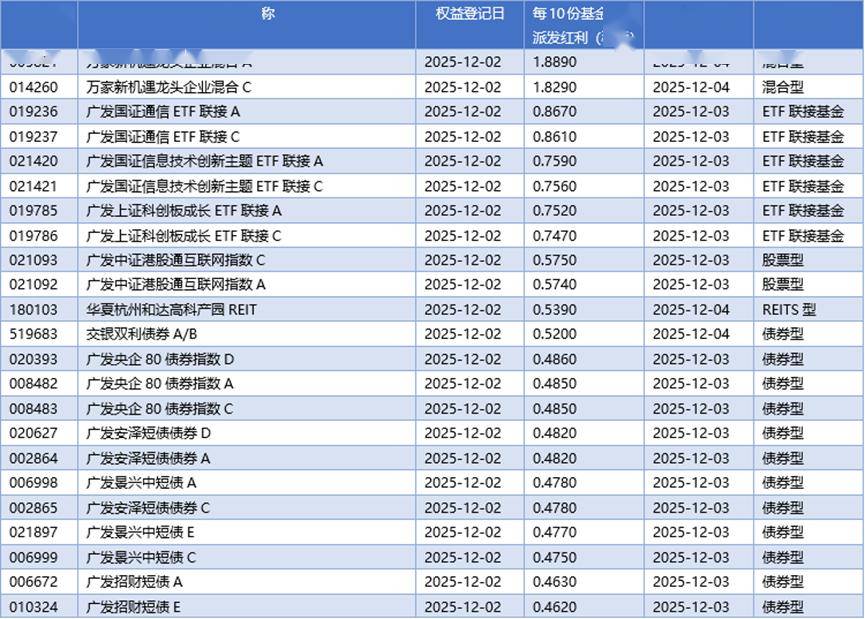
Core Insights - Public funds have distributed significant dividends this year, with over 3,300 funds distributing a total of approximately 215.52 billion yuan, surpassing last year's total in terms of quantity, frequency, and amount [1] - Bond funds have contributed over 150 billion yuan, maintaining their position as the main contributors, while equity products have also increased distributions due to favorable market conditions [1] - The A-share market experienced a decline on December 2, with major indices closing lower, and over 3,700 stocks falling [1] Fund News - On December 2, six new funds were launched, primarily bond and ETF-linked funds, while 40 funds distributed dividends, mostly from bond types [2] - The most significant dividend payout was from the Wanji New Opportunity Leading Enterprises Flexible Allocation Mixed Securities Investment Fund, distributing 1.8890 yuan per 10 shares [2] - A total of 27 public funds have lined up 34 new products for December issuance, with equity funds still dominating [2] - As the year-end approaches, expectations for a cross-year market rally are rising, with many institutions anticipating an influx of capital [2] Fund Performance - The best-performing fund on December 2 was the Guotou Ruijin Silver Futures (LOF) A, with a daily growth rate of 2.8362% [5] - In the stock fund category, the Tianhong Hang Seng Hong Kong Stock Connect High Dividend Low Volatility Index C led with a daily growth rate of 1.4659% [5] - The top bond fund was the Ping An Huijia Pure Bond Fund C, with a daily growth rate of 0.1078% [5] - The top mixed fund was the Hengsheng Qianhai Hong Kong Stock Connect Value Mixed C, achieving a daily growth rate of 1.1787% [5]

鲍杰离任易方达基金旗下3只基金
Zhong Guo Jing Ji Wang· 2025-12-01 08:16
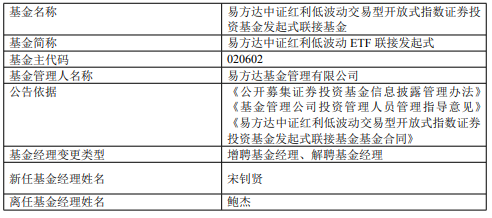
Core Viewpoint - E Fund announced the departure of Bao Jie from three ETFs, indicating a management change that may impact fund performance and investor sentiment [1] Group 1: Fund Manager Changes - Bao Jie has left his position as a fund manager for E Fund's three ETFs: E Fund CSI Dividend Low Volatility ETF, E Fund Hang Seng Stock Connect High Dividend Low Volatility ETF, and E Fund CSI Hong Kong-Shanghai-Shenzhen 300 ETF [1][2] - New fund managers have been appointed: Song Zhaoxian for the E Fund CSI Dividend Low Volatility ETF and Liu Yanfang for the E Fund CSI Hong Kong-Shanghai-Shenzhen 300 ETF [2] Group 2: Fund Performance - E Fund CSI Dividend Low Volatility ETF has a year-to-date return of 6.98% and 6.68%, with a cumulative net value of 1.1896 yuan [1] - E Fund Hang Seng Stock Connect High Dividend Low Volatility ETF has a year-to-date return of 26.04% and a cumulative net value of 1.5561 yuan [1] - E Fund CSI Hong Kong-Shanghai-Shenzhen 300 ETF has a year-to-date return of 19.54% and 19.21%, with a cumulative net value of 1.4114 yuan [1]
年底行情深度解析,跨年行情的“黄金周期”应该如何布局?
Sou Hu Cai Jing· 2025-11-14 07:59
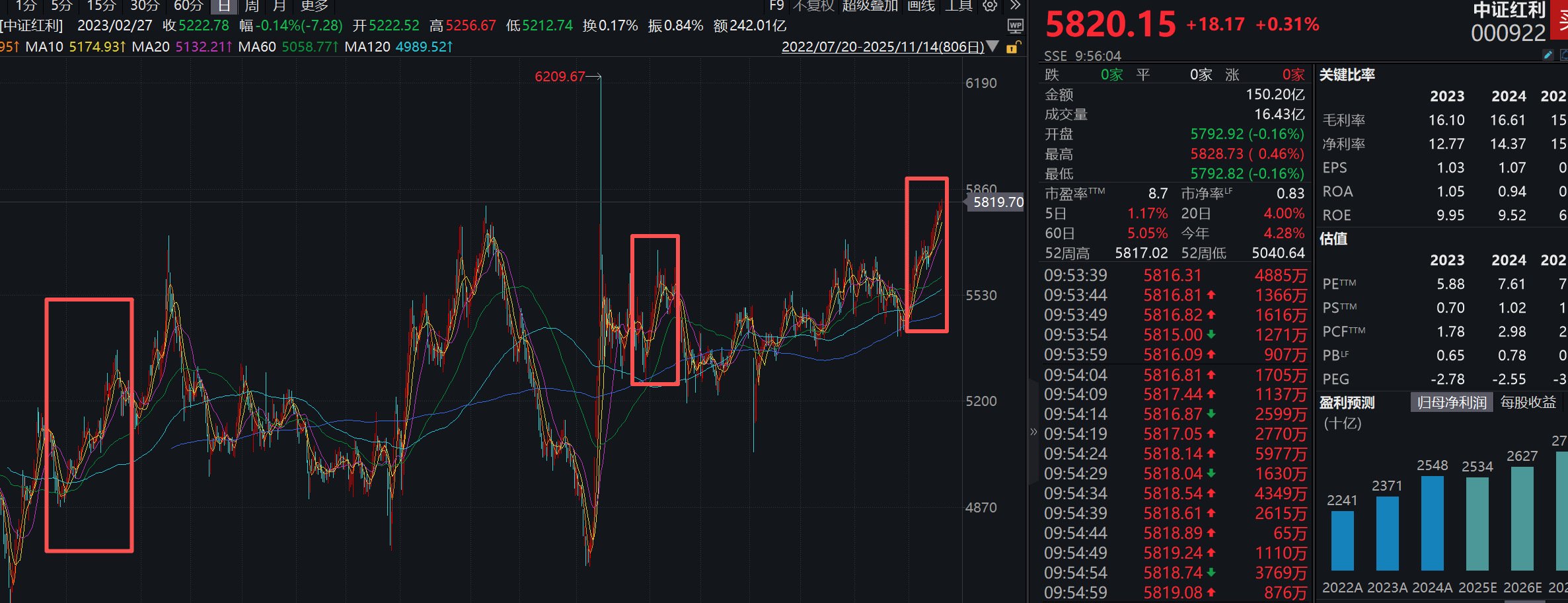
Core Viewpoint - The market is experiencing an upward trend with the Shanghai Composite Index breaking a 10-year high at 4030.40 points, leading to discussions on whether investors should switch sectors as the year-end approaches [1] Market Trends - The market is currently in a policy vacuum period, with strong sectors like semiconductors, AI, and chips showing lackluster performance recently [1] - Historical patterns indicate that value stocks such as banks, non-bank financials, and food and beverage sectors have a win rate exceeding 70% during the year-end period (November-December) [3] - The banking sector saw a 9.36% increase in December 2024, while technology sectors like computers and electronics gained a 15% increase in January 2023 [3] Sector Performance - The Consumer sector, particularly the liquor segment, has shown strong performance despite pressure from fundamentals after the third-quarter reports [1] - The China Securities Dividend Index tends to perform well before year-end, indicating a potential shift in market focus [1] Investment Strategies - Two key investment tracks are highlighted: 1. **Cyclical Recovery in Undervalued Industries**: Traditional industries are seeing improvements in supply-demand dynamics, with sectors like white goods, engineering machinery, and commercial vehicles being identified as having global competitive advantages [6] 2. **Defensive High-Dividend Strategies**: High-dividend assets are viewed as a stabilizing force in investment portfolios, particularly in uncertain market conditions [10] Fund Performance - The China Securities Major Consumer Index has nearly doubled in size since 2023, with the Huatai-PineBridge China Securities Major Consumer ETF leading with a scale exceeding 20 billion [7] - The demand for long-term dividend investments remains strong, driven by the ongoing asset shortage in the banking sector [11] Index and Fund Recommendations - The S&P Hong Kong Stock Connect Low Volatility Dividend Index and the Hang Seng High Dividend Low Volatility Index are recommended for investors seeking stable growth and risk diversification [12][13]
红利策略热度不减!港股红利ETF成资金布局重点
券商中国· 2025-06-13 09:05
Core Viewpoint - The article highlights the increasing popularity of Hong Kong dividend ETFs as a key investment strategy amid rising interest in dividend investments, with significant inflows and performance metrics indicating strong market interest [1][2][8]. Group 1: Performance of Hong Kong Dividend ETFs - As of June 11, the overall scale of dividend ETFs has increased by over 20 billion yuan this year, with several Hong Kong dividend ETFs achieving net growth exceeding 1 billion yuan [1][3]. - Notable performers include the Morgan Stanley S&P Hong Kong Low Volatility Dividend ETF, which saw a net increase of 5.071 billion yuan, and the Huaan Hang Seng Hong Kong Central State-Owned Enterprise Dividend ETF, which grew by 1.636 billion yuan [3][4]. Group 2: Advantages of Hong Kong Dividend Assets - Hong Kong dividend assets offer a dual characteristic of "bond-like yield + equity flexibility," making them an attractive option for investors seeking both defense and returns in a complex market environment [2][5]. - The dividend yield of the CSI Hong Kong Stock Connect High Dividend Investment Index stands at 7.95%, significantly higher than the 10-year government bond yield of 1.70%, providing a stable income source in a low-interest-rate environment [6]. - The valuation of the CSI Hong Kong Stock Connect High Dividend Investment Index is low, with a price-to-earnings ratio (TTM) of just over 6, making it a cost-effective investment opportunity compared to the Hang Seng Index and CSI Dividend Index [7]. Group 3: Market Dynamics and Future Outlook - The article notes that the Hong Kong dividend sector is experiencing a re-evaluation phase due to multiple favorable factors, including policy support, valuation advantages, and inflows from southbound capital [8][10]. - The resilience of the Hong Kong market is expected to continue, supported by improved asset supply structure and quality, as well as liquidity trends amid the return of overseas capital [9]. - The Hong Kong government has implemented several supportive policies aimed at enhancing market liquidity and attractiveness, which are expected to further focus attention on Hong Kong central state-owned enterprise dividends [10][11].
提前结募 份额大增 红利主题基金备受青睐
Shang Hai Zheng Quan Bao· 2025-05-23 19:32
Group 1 - The popularity of dividend-themed funds is increasing, with several funds announcing early closure of fundraising and many ETFs reaching historical highs in share volume [1][2] - Fund managers are modifying dividend distribution rules to enhance attractiveness to investors, increasing the frequency of dividend payouts [3][4] - The total scale of dividend funds has significantly increased, surpassing 250 billion yuan, with a notable rise in ETF shares [3][5] Group 2 - Recent data indicates that dividend assets are likely to attract institutional allocation, aligning with regulatory encouragement for long-term investments [5][6] - Research shows that dividend assets have a higher success rate compared to broad market indices when held for longer periods, with over 70% success rate for holding periods exceeding one year [6]