星链卫星互联网

Search documents
马斯克狂想,在月球造卫星“弹弓”
3 6 Ke· 2026-02-25 07:35
Group 1 - The core idea of the article revolves around Elon Musk's proposal to launch satellites from the Moon using electromagnetic catapults to create a dedicated AI data center satellite network in Earth orbit [1][2] - Musk's vision includes establishing a satellite assembly factory on the Moon and a giant electromagnetic launch system to deliver satellites to low Earth orbit [1][2] - The motivation behind this ambitious plan stems from Musk's concerns about the limitations of Earth's energy supply for AI deployment, as he believes that space offers abundant solar energy to address these challenges [1] Group 2 - SpaceX has submitted an application to the Federal Communications Commission to deploy a system of up to 1 million satellites in low Earth orbit, aimed at supporting high-performance computing needs for AI [2] - The proposed satellites will operate at altitudes between 500 to 2000 kilometers, powered by solar energy, and will communicate with each other and with SpaceX's Starlink satellites via laser [2] Group 3 - Electromagnetic catapult technology is a new launch method that uses electromagnetic force to accelerate objects to high speeds, potentially reducing launch costs by up to 90% to below $500 per kilogram [3] - This technology allows for rapid reloading and charging, supporting multiple launches per day, which is strategically significant for deploying large satellite constellations [3] Group 4 - The theoretical advantages of launching from the Moon include lower energy requirements due to reduced gravity and lack of atmospheric resistance, as well as access to abundant solar energy [4] - However, significant technical challenges remain, including the engineering scale of the launch system, the precision of the launch process, and the energy demands for frequent launches [5][6]
估值1.25万亿美元 SpaceX或将上市 面向海量个人投资者发售股票
Jin Rong Jie· 2026-02-16 10:33
Group 1 - SpaceX is set to officially initiate its listing process, opening a stock sale channel for a large number of individual investors, allowing ordinary investors to participate in the commercial space industry [1] - Following the merger with xAI, SpaceX's valuation has reached $1.25 trillion, with operations spanning reusable rocket launches, Starlink satellite internet, artificial intelligence research, and orbital data center systems [1] - SpaceX has submitted an application to the U.S. Federal Communications Commission for an orbital data center system, planning to deploy over 1 million satellites to build the world's first space AI computing infrastructure [1] Group 2 - The Starlink business of SpaceX has expanded its coverage to over 150 countries and regions, with a user base growing to 8 million, demonstrating a validated commercial operating model [1] - The opening of stock sales to individual investors will break the previous investment threshold of private equity stages, enabling more ordinary investors to share in the benefits of the commercial space industry's growth [1] - The global commercial space sector is in a rapid development cycle, driven by policy support, technological breakthroughs, and capital investment, with the listing process of leading companies marking significant milestones in the industry's evolution [1]
100万颗卫星!马斯克要在太空做什么?
Huan Qiu Wang· 2026-02-04 03:13
Core Viewpoint - SpaceX, led by Elon Musk, has submitted an application to the FCC to deploy a system of up to 1 million satellites in low Earth orbit to create an orbital data center network aimed at supporting AI and high-performance computing needs [1][3]. Group 1: Satellite Deployment and Technology - The proposed satellites will operate at altitudes between 500 to 2000 kilometers, powered by solar energy, and will communicate with each other via lasers and with SpaceX's Starlink satellite internet to ensure high-speed data transmission [1][3]. - The feasibility of deploying 1 million satellites is questioned, as there are currently about 15,000 satellites in orbit globally, making such a large-scale deployment seem unlikely [3][5]. Group 2: Challenges and Considerations - The success of this satellite deployment heavily relies on SpaceX's development of the next-generation reusable heavy-lift rocket, Starship, which is expected to be operational this year [5]. - Experts highlight multiple challenges, including satellite operation and maintenance, orbital congestion, space debris risks, and regulatory scrutiny, which complicate the large-scale deployment of satellites [5][7]. - There are significant unresolved issues regarding the energy supply for the data centers, the required area for solar panels, heat dissipation for numerous chips, and the impact of cosmic radiation on chips and computing [5][7]. Group 3: Strategic Moves and Financial Aspects - SpaceX has acquired xAI, an AI startup also owned by Musk, to integrate innovative resources across AI, rockets, and space internet sectors, which is aimed at more effectively building the orbital data center [7]. - SpaceX's main business includes the manufacturing and launching of rockets and satellites, while xAI operates the chatbot Grok and is expected to complete its integration with the social platform X by 2025 [7]. - Musk plans to push for SpaceX's initial public offering (IPO) in mid-June, with an expected fundraising of up to $50 billion, which could represent a significant funding pathway for the company [7].

马斯克申请部署100万颗卫星
Jing Ji Guan Cha Wang· 2026-02-04 02:48
Core Viewpoint - SpaceX, led by entrepreneur Elon Musk, has submitted an application to the Federal Communications Commission (FCC) to deploy a system of up to 1 million satellites in low Earth orbit to create an orbital data center network supporting artificial intelligence (AI) and high-performance computing needs [1] Group 1: Satellite Deployment Plan - The proposed satellites are planned to operate at altitudes between 500 to 2000 kilometers in low Earth orbit, powered by solar energy [1] - Communication between the satellites will primarily occur via lasers, ensuring high-speed data transmission and connectivity with SpaceX's Starlink satellite internet [1] - This initiative aims to lower operational and maintenance costs while reducing the energy consumption and environmental impact associated with traditional ground data centers [1] Group 2: Feasibility Concerns - Current data indicates that there are approximately 15,000 satellites launched and in orbit globally, making SpaceX's target of 1 million satellites significantly higher than the existing number [1] - The feasibility of achieving such a large-scale deployment remains questionable given the current satellite landscape [1]
A股:2.5亿股民注意!美联储降息+睡不着觉了,你知道为什么吗
Sou Hu Cai Jing· 2025-12-11 16:26
Group 1 - The Federal Reserve's interest rate cut is expected to mark the beginning of a global monetary easing cycle, with other central banks likely to follow suit, leading to a "big liquidity" era [3] - Historical data indicates that during the Fed's rate-cutting cycles, northbound capital typically experiences sustained net inflows into A-shares, with recent trends showing a net inflow of 12.6 billion yuan over the last three trading days [3] - The dual drivers for the A-share market are identified as "liquidity bull" due to global liquidity excess, and "technology bull" benefiting high-tech industries like AI and robotics from lower financing costs [3] Group 2 - SpaceX's valuation of $1.5 trillion for its IPO signifies a major shift in the commercial space sector, with its business model demonstrating a clear path to profitability through vertical integration of rocket launches, satellite internet, and data services [5] - The domestic space industry is rapidly advancing, with successful launches and new policies supporting commercial space initiatives, indicating a transition from state-led to a more integrated military-civilian approach [5] - The commercial space sector is expanding from satellite manufacturing to ground equipment and data applications, with leading companies entering the order fulfillment phase [10] Group 3 - Current investment opportunities are concentrated in three main areas: AI hardware, commercial space, and undervalued consumer stocks, with AI hardware being the most certain direction due to high demand for components like optical modules and PCBs [10] - The commercial space sector is evolving, with head companies like Aerospace Electronics and China Satellite entering a phase of order fulfillment, while the consumer sector is benefiting from seasonal demand and policy support [10] - Caution is advised against speculative stocks lacking performance support, particularly in the commercial space sector where small-cap companies may be vulnerable to market shifts [10] Group 4 - The key technical level for the market is identified at 3936 points, with a breakout expected to challenge the 4000-point mark, while 3890 points serves as a strong support level [13] - The growth style remains dominant, with a focus on core assets in technology, particularly in optical modules and satellite payloads, as well as in commercial space materials and ground equipment [14] - Recommended portfolio allocation suggests 70% focus on technology and space sectors, 20% on cyclical materials, and 10% for flexible participation in consumer rotation [15]

特斯拉,大消息!通过
Xin Lang Cai Jing· 2025-11-07 14:04
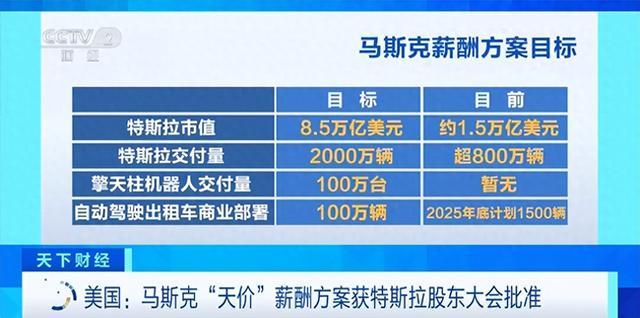
Core Points - Tesla's annual shareholder meeting approved CEO Elon Musk's ambitious compensation plan, which could potentially yield nearly $1 trillion in stock options over the next decade if specific performance targets are met [1][2] - The approval came with 75% of voting shareholders in favor, despite some opposition from major shareholders like the Norwegian sovereign wealth fund [2][4] Summary by Category Compensation Plan - Musk's compensation plan requires achieving several milestones, including increasing Tesla's market value to $8.5 trillion from approximately $1.5 trillion, and delivering 20 million vehicles compared to over 8 million currently [2] - Additional targets include deploying 1 million autonomous taxis and delivering 1 million Optimus humanoid robots, with no prior deliveries of the latter [2] Market Reaction - Following the announcement of the approval, Tesla's stock price rose approximately 2% in after-hours trading on the same day [1] Musk's Position - Musk had previously threatened to leave Tesla if the compensation plan was rejected, indicating a potential shift of focus to his other ventures, including xAI, SpaceX, and Neuralink [4]

华为立功了,折叠屏首发卫星上网,中国版“星链”比马斯克更厉害
Xin Lang Cai Jing· 2025-07-30 08:22
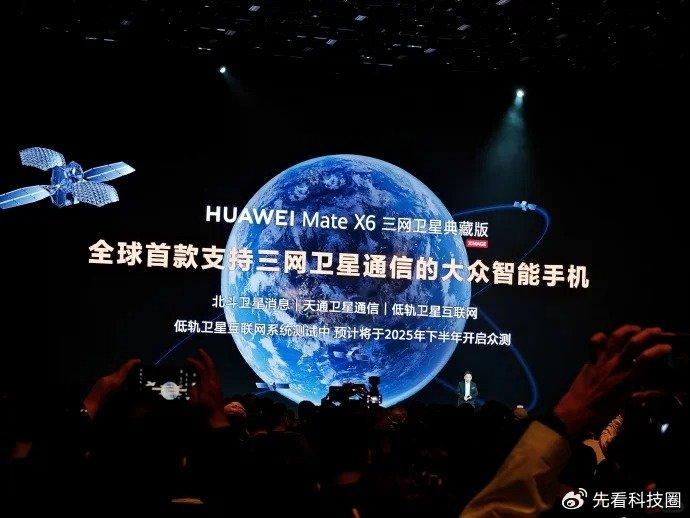
Core Viewpoint - Huawei is set to launch a new smartphone, the Mate X6, featuring "three-network satellite communication" technology, which allows users to send messages, make calls, and access the internet via satellites, potentially outperforming SpaceX's Starlink [1][3]. Group 1: Product Launch and Features - Huawei's Mate X6 three-network satellite edition smartphone was officially announced on November 26, 2024, supporting Beidou satellite messaging, Tiantong satellite communication, and low Earth orbit (LEO) satellite internet services [3]. - The Mate X6 is expected to be available for consumer testing in the second half of 2025, although specific details are still under testing [3][5]. - The upcoming Mate Xs extraordinary model is anticipated to be the first in China to offer direct satellite internet connectivity, utilizing low Earth orbit satellites [10]. Group 2: Satellite Technology Overview - Beidou satellites combine high and medium orbits and can send short messages and images using advanced compression algorithms and neural network feature extraction [6]. - Tiantong satellites are high-orbit satellites that provide broader coverage and stable communication without the need to switch satellites, primarily supporting calls and text messages [6][8]. - Low Earth orbit satellites, while offering lower latency and higher bandwidth, are more expensive and have shorter orbital lifespans compared to high-orbit satellites [10][12]. Group 3: Market Competition and Pricing - The competition in the low Earth orbit satellite market is intense, with countries like the US, UK, and China vying for advantageous positions [12]. - SpaceX's Starlink requires thousands of satellites for global coverage, with ongoing costs for satellite replacements, leading to high service fees for users [14]. - Huawei's satellite internet service is expected to have a monthly cost of at least several dozen yuan, including a limited data package for emergency use [14].