普惠型医疗险

Search documents
从“广覆盖”到“精准化”,走出红海博弈
Bei Jing Shang Bao· 2025-12-14 15:39
Group 1 - The report "Inclusive Finance: Breaking the Deadlock and New Situations" highlights the latest policy achievements in inclusive finance and the transition from "broad coverage" to "precision" in financial services, focusing on the needs of vulnerable groups [1] - As of Q3 2025, the balance of consumer loans excluding personal housing loans reached 21.29 trillion yuan, a year-on-year increase of 4.2%, with an addition of 306.2 billion yuan in the first three quarters [3] - The balance of inclusive small and micro enterprise loans surpassed 30 trillion yuan by March 2024 and reached 36.5 trillion yuan by Q3 2025, showing a cumulative growth rate of 241.3% over six years [3] Group 2 - The insurance sector has achieved 100% coverage of insurance services in towns, with an average of one insurance outlet per town, addressing diverse protection needs through inclusive insurance [3] - The public fund industry reached a historical high of 36.74 trillion yuan by the end of September 2025, benefiting from the ongoing development of inclusive finance [3] - The challenges faced by inclusive finance include product homogenization, pricing competition, and overlapping customer bases, particularly affecting banks and insurance companies [4] Group 3 - The consumer finance sector is experiencing intense competition, leading to issues such as "multiple borrowing" and "excessive credit" due to some institutions lowering loan rates and relaxing risk control standards [5]


从破冰到重构 解锁普惠金融新路径
Bei Jing Shang Bao· 2025-12-10 15:44
Core Insights - Inclusive finance is transitioning from "incremental expansion" to "quality improvement and efficiency enhancement," becoming a key topic in the financial sector to fulfill social responsibilities and stimulate market vitality [1] Group 1: Current Trends in Inclusive Finance - The Beijing Commercial Brand Conference focused on "Financial New Forces Innovating Consumption Power," highlighting the importance of financial institutions' practical experiences and digital empowerment in enhancing inclusive finance [3] - China's economy is at a critical stage of transformation, with financial needs from small and micro enterprises, individual businesses, rural areas, and vulnerable groups identified as both pain points and focal points for inclusive finance [3] - A multi-layered support system for inclusive finance has been established, including monetary policy tools, fiscal subsidies, and differentiated regulatory assessments, aimed at alleviating the "reluctance to consume" issue [3] Group 2: Challenges and Market Dynamics - As the inclusive finance market transitions from a "blue ocean" to a "red ocean," financial institutions face increased competition and challenges, particularly in customer acquisition and risk management [4] - The banking sector is experiencing pressure as it struggles with the difficulty of finding new clients, while the insurance industry faces challenges in accurately pricing inclusive health insurance products due to a lack of data [4] - The consumer finance sector is caught in a dilemma of "internal competition and risk coexistence," with some institutions lowering loan rates and relaxing risk control standards to capture market share, leading to issues like "multiple borrowing" and "over-lending" [4] Group 3: Future Directions and Innovations - The 2025 Beijing Financial Forum report on inclusive finance outlines the latest policy directions and showcases breakthroughs in product design and service models across various financial institutions [4] - The forum also addressed how to navigate the "red ocean" and foster a "new blue ocean" for consumption, emphasizing the role of advanced technologies like big data and artificial intelligence in empowering inclusive finance [6] - The next decade is expected to focus on the reconstruction of inclusive finance, moving towards deeper levels of "precision," "sustainability," and "ecological integration" [6]

普惠十年记
Bei Jing Shang Bao· 2025-12-10 11:53
Core Insights - The development of inclusive finance in China has transitioned from "having" to "quality" over the past decade, with a focus on precision and sustainability [1][13] - The balance of inclusive finance has reached 36.5 trillion yuan, doubling since the end of the 13th Five-Year Plan, with a year-on-year growth of 12.1% [3][4] - The next decade will emphasize enhancing service quality and addressing challenges such as customer homogeneity and rising risk management costs [1][12] Group 1: Achievements in Inclusive Finance - Financial services have expanded to rural areas, achieving coverage in every village and town, with significant growth in loans to small and micro enterprises [3][5] - By the end of 2024, the balance of agricultural loans reached 51.36 trillion yuan, a year-on-year increase of 9.8%, surpassing general loan growth [3][4] - The average interest rate for newly issued inclusive loans dropped to 4.13%, a decrease of 33 basis points from the previous year [3][4] Group 2: Challenges and Market Dynamics - The inclusive finance sector is transitioning from a "blue ocean" to a "red ocean" market, facing increased competition and saturation [10][12] - Banks are struggling with the challenge of identifying new clients, particularly in rural areas where small businesses often lack collateral [10][12] - The insurance sector faces difficulties in accurately pricing inclusive health insurance products due to a lack of data on previously uncovered populations [11][12] Group 3: Future Directions - The focus for the next decade will be on creating a high-quality inclusive finance ecosystem that supports small and micro enterprises, agriculture, and social welfare [13][14] - A new coordination mechanism for supporting small and micro enterprises is being established to enhance the connection between banks and businesses [14][15] - The development of a multi-layered, differentiated organizational structure is essential for building a high-quality inclusive finance system [15][16]

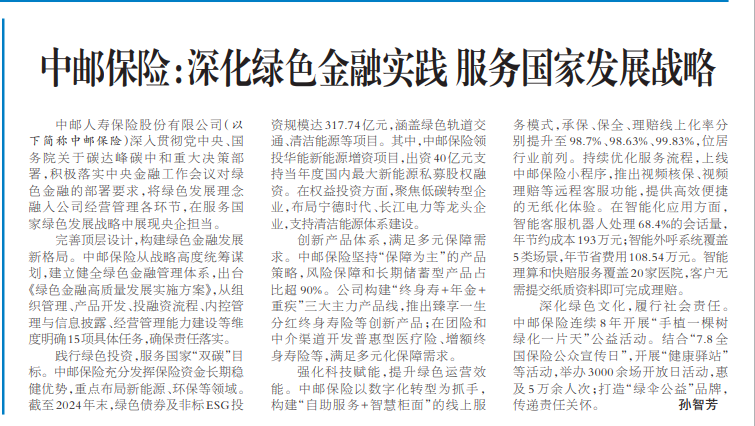
中邮保险:深化绿色金融实践服务国家发展战略
Zhong Guo Huan Jing Bao· 2025-09-17 03:12
Core Viewpoint - China Post Life Insurance Co., Ltd. actively implements the national strategy for carbon peak and carbon neutrality, integrating green development concepts into its operations and showcasing its responsibilities as a state-owned enterprise [1][2]. Group 1: Green Finance Development - The company has established a comprehensive green finance management system and released the "Implementation Plan for High-Quality Development of Green Finance," outlining 15 specific tasks across various dimensions to ensure accountability [1]. - By the end of 2024, the scale of green bonds and non-standard ESG investments is expected to reach 31.774 billion yuan, covering projects in green rail transportation and clean energy [1]. - The company led a 4 billion yuan investment in Huaneng New Energy's capital increase project, supporting the largest private equity financing in the domestic renewable energy sector for the year [1]. Group 2: Product Innovation and Technology Empowerment - The company maintains a product strategy focused on "protection as the main priority," with over 90% of its products being risk protection and long-term savings types [2]. - The main product lines include "whole life insurance + annuity + critical illness," with innovative products like the "Zhenxiang Lifetime Dividend Whole Life Insurance" being launched [2]. - The digital transformation has led to an online service model with self-service and smart counters, achieving online processing rates of 98.7% for underwriting, 98.63% for policy maintenance, and 99.83% for claims, ranking among the industry leaders [2]. Group 3: Social Responsibility and Green Culture - The company has conducted the "Plant a Tree, Green a Piece of Sky" public welfare activity for eight consecutive years, promoting environmental responsibility [2]. - It has organized over 3,000 open day events benefiting more than 50,000 people, alongside initiatives like the "Health Station" during the National Insurance Publicity Day [2]. - The "Green Umbrella Public Welfare" brand has been established to convey a sense of responsibility and care within the community [2].