景顺长城鼎益A

Search documents
“业绩为王”时代来了,哪些基金经理有被降薪可能?
Xin Lang Cai Jing· 2025-12-08 04:16
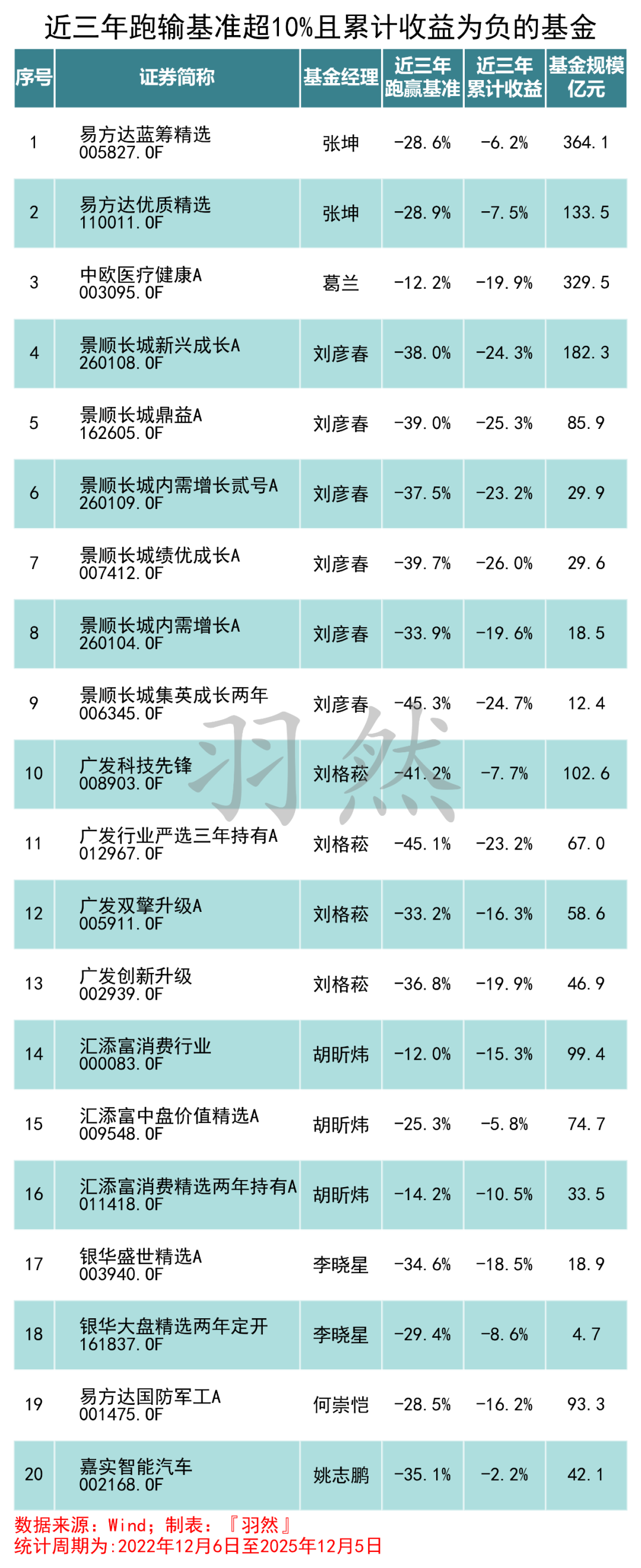
Core Viewpoint - The new guidelines for fund manager compensation will significantly tie salaries to performance, marking a shift towards a performance-driven culture in the public fund industry [2][6]. Summary by Relevant Sections Performance-Based Compensation - The new regulations require fund managers' performance pay to be closely linked to three-year performance metrics, with mandatory salary reductions of at least 30% for products that underperform their benchmarks by over 10% and incur losses [2][6]. - This change indicates a decline in the reliance on the "star fund manager" phenomenon, emphasizing that performance will now be the primary measure of success in the industry [2][6]. Impact on Fund Managers - A number of prominent fund managers, particularly those managing actively managed equity funds exceeding 20 billion, are at risk of salary reductions due to poor performance over the past three years [2][7]. - Specific funds that have crossed the performance threshold include: - E Fund Blue Chip Selection: underperformed by 28.6% with a cumulative loss of 6.2% [3][10]. - E Fund Quality Selection: underperformed by 28.9% with a cumulative loss of 7.5% [3][10]. - Other funds managed by Liu Yanchun and Liu Gesong also show significant underperformance [5][10]. Cultural Shift in the Industry - The new guidelines represent not just a salary adjustment but a cultural transformation within the industry, encouraging absolute return strategies and a focus on risk management and positive returns rather than merely relative rankings or asset growth [5][11]. - The emphasis will shift towards a more rational evaluation of fund managers' past performances, moving away from blind admiration for top performers to a focus on their long-term profitability [6][11]. - The era of high salaries disconnected from performance is coming to an end, prompting both fund managers and investors to reassess the meaning of "performance" in terms of actual returns [6][11].

金融产品每周见:消费行业基金:从投资能力分析到基金经理画像-20251107
Shenwan Hongyuan Securities· 2025-11-07 15:30
1. Report Industry Investment Rating No relevant content provided. 2. Core Views of the Report - Based on fund holdings, consumption - related funds can be classified into five types, with most fund managers adopting the "segmented track (mainly liquor)" strategy [3]. - Consumption - related funds can generate relatively stable excess returns in the long - term compared to the sector index, are relatively good at stock - picking in certain industries, and it's difficult to identify their stock - picking ability for consumer stocks compared to all - industry funds [3]. - When comparing consumption - related funds with different style characteristics from seven dimensions, high turnover may lead to high returns recently, high - ROE style funds usually have high dividend attributes, etc. [3]. - To screen the observation list of consumption - related funds, quantitative indicators such as excess performance momentum, performance in favorable and unfavorable environments, stock - picking ability, etc. can be referred to [3]. 3. Summary According to the Directory 3.1 Classification of Consumption - Related Funds - The classification method is based on the fund's full - position data and heavy - position stock data in a certain sector. For consumption funds, some Hong Kong stocks are additionally included. Most of the top 10 consumption - related funds in terms of scale have some commonalities in allocation [6]. - Consumption - related funds are classified into five types: consumption + satellite, sector rotation, segmented track, consumption rotation, and consumption equilibrium, with "segmented track (mainly liquor)" being the most commonly adopted strategy [3]. 3.2 Holding Characteristics: Can Consumption - Related Funds Create Positive Excess Returns? - As a whole, consumption - related funds have similar performance to the consumption sector index before 2025, and have achieved certain excess returns compared to the index since this year [22]. - Consumption - related funds are relatively good at stock - picking in industries such as household appliances, textile and apparel, agriculture, forestry, animal husbandry and fishery, etc., and have prominent excess returns in some industries during certain periods [23][26]. - It's difficult to determine whether consumption - related fund managers have stronger stock - picking ability for consumer stocks compared to all - industry funds [28]. - Consumption - related funds prefer to allocate liquor in food and beverage, and their individual - stock allocation is relatively stable. They had positions in new - consumption stocks earlier [36]. - Through cluster analysis, different types of consumption - related funds can be identified, such as those focusing on agriculture, forestry, animal husbandry and fishery, those focusing on liquor investment, etc. [39] 3.3 Comparison of Consumption - Related Funds with Different Style Characteristics - In terms of turnover trading, high - turnover consumption - related funds have better short - term performance recently, and some liquor - themed funds with low turnover have return drag. In the long - term, both high - and low - turnover funds have excellent performers [42][44]. - In terms of holding style, funds with high ROE generally have high dividend attributes. Different segmented tracks have significant differences in market - value styles [48][52]. - In terms of holding popularity, the structure of market - preferred stocks in the consumption sector has changed significantly, and there are excellent performers in various types of products [53]. - In terms of left - and right - side investment, consumption - related funds are generally on the right side of the market median, and there are excellent performers on both sides [59]. - In terms of stock - picking ability, by calculating the skewness, kurtosis, and mean/standard deviation of stock - picking returns, funds with strong stock - picking ability can be found [60][62]. - In terms of adaptability to different market environments, different types of products show different adaptability results, and there are products with strong performance in favorable or unfavorable environments [63][65]. - In terms of segmented - track rotation, there are both products with good and poor rotation effects among consumption - related funds [71]. 3.4 Observation List of Consumption - Related Funds - The screening of the observation list refers to quantitative indicators such as excess performance momentum, performance in favorable and unfavorable environments, stock - picking ability, left - and right - side investment ability, and segmented - track rotation effect. Other factors such as the fund manager's tenure and fund scale are also considered [75]. - The observation list includes funds like E Fund Long - Term Value, Cathay Pacific Consumption Optimization, Changxin Multi - Benefit, etc. [3][76]
广发高端制造A三年跌53%垫底,管理费累计4.56亿,刘格菘或面临浮动费改大考
Xin Lang Ji Jin· 2025-05-07 08:37
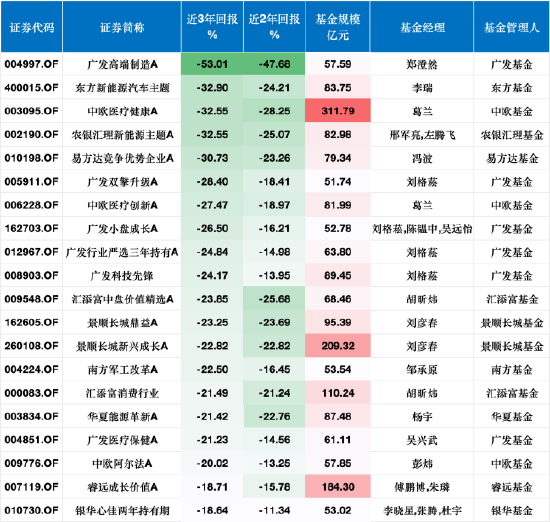
Core Viewpoint - The China Securities Regulatory Commission (CSRC) aims to address the issue of high management fees in public funds despite poor performance through a floating management fee mechanism, highlighting the industry's long-standing problem of "guaranteed returns" regardless of fund performance [1]. Group 1: Fund Performance and Management Fees - The report indicates that the fund "Guangfa High-end Manufacturing A" has the worst three-year return at -53.01%, while it collected management fees totaling 456 million yuan over the same period [3]. - "China Europe Medical Health A," with a scale of 31.179 billion yuan, experienced a 32.55% decline in three-year performance but still charged 2.2 billion yuan in management fees [3]. - The trend shows that larger funds tend to incur greater losses while charging higher fees, raising concerns about the reasonableness of fees relative to fund managers' performance [3][4]. Group 2: Fund Manager Performance - Fund manager Liu Gesong's funds have underperformed, with a three-year return of -27% and a two-year return of -17%, significantly lagging behind the CSI 300 index [4]. - The total assets under Liu's management decreased by 5.7% to 32.171 billion yuan as of the end of the first quarter of 2024 [4]. - The floating management fee reform may lead to a significant reduction in management fee income for fund managers like Liu, as poor performance could result in a "double whammy" effect [4]. Group 3: Industry Outlook - The CSRC's reform is expected to shift the focus of fund companies from merely pursuing scale to emphasizing investment returns, marking a significant change in the industry [11]. - The industry may witness a trend where stronger firms thrive while smaller institutions face accelerated elimination, making investment research capabilities and risk control systems increasingly critical [11]. - In the long run, more competitive products are likely to attract additional capital and new investors, benefiting investors and promoting sustainable industry development [11].