智神星一号火箭

Search documents
又一商业火箭企业 完成IPO辅导
Shang Hai Zheng Quan Bao· 2026-01-24 06:30
Core Viewpoint - The commercial rocket companies in China are accelerating their IPO processes, supported by new regulations that clarify the listing path for these enterprises [2][3]. Group 1: IPO Progress - Blue Arrow Aerospace's IPO application has been accepted by the Shanghai Stock Exchange, with a fundraising target of 7.5 billion yuan for reusable rocket capacity and technology enhancement projects [2]. - Other commercial rocket companies, including Tianbing Technology, Xinghe Power, and Interstellar Glory, have also updated their IPO counseling progress reports, indicating a collective movement towards public offerings [2][3]. Group 2: Regulatory Support - The Shanghai Stock Exchange issued guidelines for commercial rocket companies, outlining requirements such as technological milestones and commercial viability, which are essential for meeting the fifth set of listing standards [2][3]. - The inclusion of commercial aerospace in the "1+6" reform in June 2025 has lowered the profitability threshold for these companies, facilitating their entry into the capital market [2][3]. Group 3: Technological Developments - 2026 is expected to be a critical year for Chinese commercial rocket companies, with multiple medium to large rockets set for their maiden flights and recovery validations [3]. - The successful implementation of reusable technology is a key challenge for the domestic rocket industry, with specific milestones required for IPO applications [3][4]. - Blue Arrow Aerospace's Zhuque-3 rocket has already conducted a successful recovery test, while other companies are preparing for their own orbital and recovery validations in 2026 [3][4].

政策引导资本赋能商业航天迈向新阶段
Zhong Guo Zheng Quan Bao· 2026-01-22 20:56
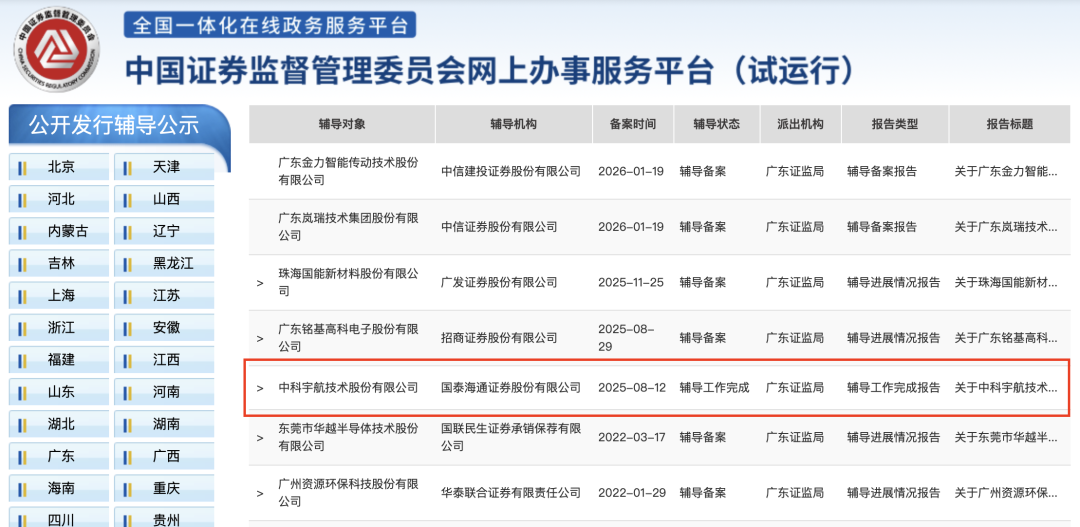
Core Viewpoint - The Chinese commercial space industry is entering a new phase focused on large-scale launches and commercial closure, with significant breakthroughs expected in rocket capacity over the next 3 to 5 years [1] Group 1: Industry Developments - By 2025, China's commercial space sector is projected to complete 50 launches, accounting for 54% of total space launches, with 25 of those being commercial rocket launches and 311 commercial satellites entering orbit, representing 84% of all satellites [1] - The rapid acceleration of capitalization in commercial space enterprises is evident, with Blue Arrow Aerospace's IPO application accepted by the end of 2025 and Zhongke Aerospace completing its listing guidance in January 2026 [1][2] - The launch of the Long March 12 rocket on January 19, 2026, marks a significant step in commercial rocket testing, with major models expected to undergo critical tests or first flights in 2026 [1] Group 2: Technological Advancements - Star River Dynamics plans to conduct recovery tests for its reusable rocket "Zhishen-1" in 2026, while other companies like Eastern Space and Tianbing Technology are also targeting 2026 for key flight tests [2] - The shift from customized to industrialized satellite manufacturing is highlighted by Galaxy Aerospace, which has reduced satellite production cycles by 80% and aims for an annual output of 100 satellites weighing 1000 kg each [3] - The successful suborbital flight test of Zhongke Aerospace's "Lihong-1" on January 12, 2026, demonstrates the potential for microgravity research applications in fields like biomedicine [3] Group 3: Market Dynamics - The increasing frequency of rocket launches and reusable rocket tests is expected to alleviate the "many satellites, few rockets" bottleneck in the industry [2] - The Shanghai Stock Exchange's guidelines for commercial rocket companies have clarified the path for IPOs, directly influencing the progress of leading enterprises [2] - The industry is anticipated to undergo a reshuffle in the coming years, with a greater emphasis on the performance and delivery capabilities of rocket companies [4] Group 4: Future Outlook - Significant advancements in reusable rocket technology and launch efficiency are expected by 2026, with ongoing improvements in commercial launch facilities and processes [4] - The industry is calling for more refined regulatory frameworks to address the challenges posed by large-scale and high-frequency operations [4] - Capital plays a crucial role in the high-risk, high-investment commercial space sector, with early-stage funding being essential for industry development [5]
商业火箭企业IPO迎利好 中大型复用火箭成“硬条件”
Zhong Guo Zheng Quan Bao· 2026-01-10 05:08
Core Viewpoint - The recent issuance of the Shanghai Stock Exchange's guidelines for commercial rocket companies marks a significant regulatory milestone, clarifying the path for these companies to go public and emphasizing the importance of reusable rocket technology in the industry [1][3]. Group 1: Regulatory Guidelines - The guidelines consist of 14 articles that detail the specific requirements for commercial rocket companies applying for the fifth set of listing standards on the Sci-Tech Innovation Board [1]. - A key requirement is that applicants must demonstrate successful orbital insertion of payloads using medium to large reusable rockets as a prerequisite for listing [3][7]. - The guidelines aim to signal a strong emphasis on technological innovation and the commercialization of space technology [1][3]. Group 2: Industry Trends - The global commercial space industry is transitioning from state-led initiatives to commercialization, focusing on high-frequency, low-cost launches [3]. - By 2025, private rocket companies in China are expected to execute 23 launch missions, successfully placing 324 satellites into orbit, highlighting the rapid growth of the sector [3]. - The establishment of clear listing standards is expected to accelerate the pace of IPOs among commercial rocket companies, with several firms already in the process [4][5]. Group 3: Company Developments - Blue Arrow Aerospace's IPO application was accepted by the Shanghai Stock Exchange, indicating a significant step in the commercialization of the industry [4]. - Other leading companies, such as Star Glory and Tianbing Technology, are also actively pursuing IPOs, with Star Glory having initiated its preparations as early as 2020 [5]. - The competitive landscape is characterized by diverse technological paths, with companies like Blue Arrow and Star Glory focusing on achieving full-chain breakthroughs from successful launches to reliable recovery [10][11]. Group 4: Technical Challenges - The guidelines do not mandate the completion of recovery technology validation before application, but they emphasize the importance of reusable technology as a competitive edge in the industry [7]. - Achieving reliable rocket recovery remains a significant technical challenge, with complexities in design and engineering that require a systematic approach [8][10]. - The successful implementation of reusable technology is crucial for meeting the increasing demand for high-frequency, large-capacity, and low-cost launches in the future [7][10]. Group 5: Future Outlook - The year 2026 is anticipated to be a pivotal year for commercial space launches in China, with several companies preparing for significant milestones in their launch capabilities [12]. - The guidelines are expected to direct capital and resources toward companies that have clear models and core technologies, fostering a competitive environment focused on engineering realization and reliability enhancement [12].
广东博众:这一产业发展趋势明确且加速
Sou Hu Cai Jing· 2025-12-10 05:59
Core Insights - The commercial aerospace sector is transitioning from a niche field to a vibrant growth area, driven by policy, technology, and application advancements [1][3] - A comprehensive policy framework has been established to support the development of commercial aerospace, including the establishment of a dedicated Commercial Aerospace Department by the National Space Administration [1] - Local governments are actively promoting the industry, with initiatives like Beijing's "Rocket Street" and the establishment of aerospace industrial bases in regions like Anhui and Shandong [1] Policy Developments - The inclusion of commercial aerospace in government work reports marks a significant policy shift, laying a solid foundation for industry growth [1] - The establishment of a policy system covering the entire industry chain is underway, enhancing the sector's development potential [1] - The supportive attitude from the government has stimulated social capital participation, transforming commercial aerospace into a market-driven industry [1] Technological Advancements - Breakthroughs in core technologies are alleviating development bottlenecks in commercial aerospace [3] - The successful vertical landing and return test of the Zhuque-3 rocket and the upcoming maiden flight of reusable rockets like the Zhishenxing-1 are notable advancements [3] - The operationalization of the Hainan commercial aerospace launch site completes a critical component of the industry [3] Market Applications - The expansion of application scenarios is enhancing the market value of commercial aerospace [3] - Low Earth orbit satellite constellations are providing signal coverage in previously underserved areas, enabling mobile satellite data transmission [3] - Commercial satellites are aiding precision irrigation in agriculture, facilitating a shift towards smart farming practices [3] - Satellite IoT services are improving operational efficiency in sectors like engineering machinery and marine fisheries [3] - International collaborations are accelerating, with Chinese commercial aerospace companies signing agreements with multiple countries to expand their global market presence [3]

我国三大万颗星座计划,推动商业航天进入高速发展期
Huan Qiu Wang· 2025-12-06 01:21
Core Insights - The global satellite internet constellation is rapidly developing, with major players including Starlink, GW constellation, G60, Honghu-3, OneWeb, and Kuiper, particularly highlighting the advancements of SpaceX's Starlink project which has launched over 10,000 satellites as part of a planned 42,000 satellites [1] - China is also making significant strides with three major satellite constellation plans, including China Star Network (GW constellation), Shanghai Yuanxin (G60 Qianfan constellation), and Blue Arrow Hongqing Technology (Honghu-3 constellation), aiming to launch a total of 116 satellites by October 2025 [1] - The commercial space industry is characterized by market-driven activities where enterprises, including private and mixed-ownership companies, invest, operate, and bear risks across the entire aerospace value chain, covering technology R&D, manufacturing, launching, and application [1] Industry Developments - The report indicates that the launch schedule for national rockets like Long March 12, Long March 8A, and Long March 6 modified is tight due to other national space missions, leading to slower than expected overall launch progress [3] - There is an urgent need for high-capacity, low-cost, and reliable reusable rockets, with new commercial rocket models such as Zhuque-3, Tianlong-3, and others expected to debut by the end of 2025, which could accelerate the deployment of domestic low-orbit satellite constellations [3] - The satellite manufacturing process is evolving towards modular design, automated testing, and mass assembly, which is expected to release production capacity, while rocket launches are transitioning to reusable, low-cost, and high-capacity models, indicating a shift from validation to engineering application and large-scale development [3]