智能中台

Search documents
教育部:2026年将系统推进人工智能教育和应用
Zhong Guo Jing Ying Bao· 2025-12-30 17:15
Core Viewpoint - The Ministry of Education plans to advance the integration of artificial intelligence (AI) in education, with policies expected by 2026 to create a future-oriented educational system [1] Group 1: AI in Education Strategy - The Ministry of Education will implement a national digital education strategy 2.0 starting in 2025, emphasizing AI as a key strategic direction [1] - AI literacy will be integrated into general education across different educational stages to cultivate high-quality talent for the intelligent era [1][2] - Over 1,000 AI courses have been aggregated on the national smart education public service platform to meet diverse learning needs [2] Group 2: Pilot Programs and Applications - Pilot programs for AI in education are being steadily advanced, with 7 provinces in the eastern region and 20 cities in the central and western regions participating [2] - A total of 509 AI education base schools have been established to explore innovative practices in AI application [2] Group 3: Safety and Ethical Considerations - The Ministry of Education has incorporated AI safety into the overall educational safety framework, developing assessment indicators for AI application safety [3] - The national education big data center and intelligent middle platform have been launched to support the digital education strategy, focusing on integrated, intelligent, and international approaches [3][5] Group 4: Data-Driven Educational Evaluation - The big data center will analyze student learning processes and needs, supporting differentiated teaching and personalized evaluation [4] - It will also provide data for adjusting academic disciplines and innovating talent cultivation models based on talent growth patterns and societal demand changes [4] Group 5: Intelligent Middle Platform - The intelligent middle platform serves as a shared "intelligent toolbox," integrating AI capabilities, data services, and algorithm modules for reusable components [5] - It aims to provide precise data-driven support for teaching and learning, facilitating collaborative research and promoting quality teaching models [6]
又升级啦!国家智慧教育平台有这些新变化
Xin Lang Cai Jing· 2025-12-30 12:58
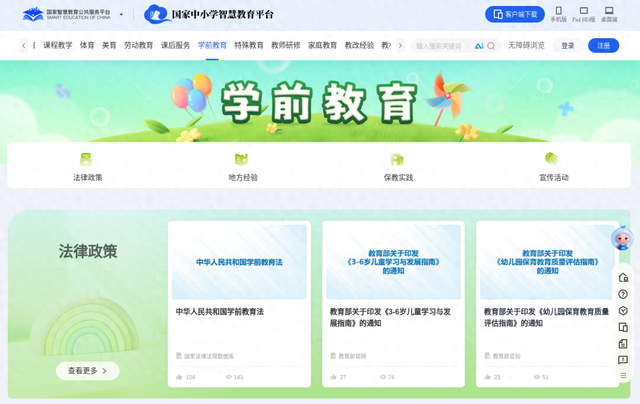
Core Insights - The Ministry of Education held a press conference to discuss the progress of digital education during the 14th Five-Year Plan, highlighting the launch of new sections in the National Smart Education Platform, including early childhood education and graduate education [1][2]. Group 1: Early Childhood Education - The early childhood education section focuses on the developmental characteristics of young children, targeting kindergarten principals, teachers, and parents, with 427 resources launched in four categories: legal policies, local experiences, educational practices, and promotional activities [1]. Group 2: Graduate Education - The graduate education section integrates multiple stakeholders and offers high-quality resources, including columns on party building, academic lectures, and cutting-edge research, along with a dedicated intelligent assistant to support innovative and academic services [2][4]. Group 3: National Education Big Data Center - The National Education Big Data Center connects universities, provincial education departments, and the Ministry of Education, facilitating data sharing across over a hundred projects and aggregating hundreds of billions of education data points to create a "digital map" of education [6]. Group 4: Intelligent Middleware - The intelligent middleware serves as the core of the national platform's intelligent operation, utilizing standardized interfaces and modular packaging to achieve centralized integration, unified scheduling, and on-demand supply, supporting educational intelligence across various scenarios [8].

科大国创股价下跌3.03% 旗下大模型获昇腾鲲鹏双认证
Jin Rong Jie· 2025-08-08 17:30
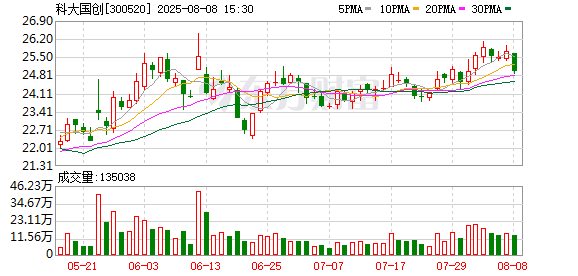
Group 1 - The stock price of Keda Guochuang on August 8 was 24.95 yuan, down 0.78 yuan, representing a decline of 3.03% [1] - The trading volume on that day was 135,000 hands, with a transaction amount of 338 million yuan [1] - Keda Guochuang focuses on software development, with business areas including artificial intelligence and big data [1] Group 2 - The company announced that its products, including the Xingyun large model and Jiuzhang AI platform, received Ascend compatibility certification, while its data middle platform and intelligent middle platform received Kunpeng compatibility certification [1] - A subsidiary of the company recently received government subsidy funding of 5 million yuan [1] Group 3 - On August 8, the net outflow of main funds for Keda Guochuang was 61.3747 million yuan, with a cumulative net outflow of 175 million yuan over the past five days [1]

科大国创:科大国创星云大模型、九章AI平台等获得了昇腾兼容性相关认证
Zheng Quan Ri Bao Wang· 2025-08-08 12:10
Core Insights - Keda Guochuang (300520) announced on August 8 that its Xingyun large model and JiuZhang AI platform have received Ascend compatibility certification [1] - The company's data middle platform and intelligent middle platform have obtained Kunpeng compatibility certification [1] - The AIGCLogic large model intelligent agent platform has also received Kunpeng technology certification [1]
科大国创:公司AIGCLogic大模型智能体平台获得了鲲鹏技术认证
Mei Ri Jing Ji Xin Wen· 2025-08-08 07:44
Group 1 - The company, Keda Guokuan, confirmed its collaboration with Huawei's Ascend and Kunpeng technologies, achieving compatibility certifications for its products [2] - Keda Guokuan's Star Cloud Model and Nine Chapters AI platform received compatibility certifications related to Ascend technology [2] - The company's data middle platform and intelligent middle platform obtained compatibility certifications for Kunpeng technology [2] Group 2 - The AIGCLogic large model intelligent platform developed applications such as "Home Decoration Broadband Assistant" and "Foreign Trade Intelligent Agent," which received Ascend technology certifications [2]
AI赋能保险业变革:从经验到数据智能驱动的跨越
Huan Qiu Wang· 2025-05-06 08:17
Core Insights - The insurance industry is undergoing a transformation driven by the integration of artificial intelligence (AI) technologies, as highlighted by Wang Min, the Executive Vice President of ZhongAn Insurance, at the 2025 Insurance Technology Summit [1] - The summit's theme focused on the strategic advancement and application innovation of AI in the insurance sector, marking a shift from the internet era to the AI era [1] Group 1: AI's Impact on Financial Services - The application of large language models is reshaping the operational philosophies, business logic, and value creation models of financial institutions, leading to two significant trends: precision in financial services and cross-industry ecological collaboration [2][4] - Financial services are becoming more precise, with banks optimizing credit assessment systems using real-time business data and social media dynamics, while brokerages leverage knowledge graphs for market predictions [2] - Cross-industry collaborations are emerging, such as insurance companies partnering with healthcare platforms to develop preventive insurance based on real-time health data [4] Group 2: Transformation in the Insurance Sector - The rise of large language models is prompting a fundamental shift in the insurance industry from experience-driven to data intelligence-driven approaches [4] - ZhongAn Technology has developed an intelligent platform tailored to the insurance sector, utilizing over 600 million user data points and creating more than 200 specialized AI agents [4] - The internal AI platform of ZhongAn is being utilized over 50 million times monthly, demonstrating significant engagement and application [4] Group 3: AI Applications and Efficiency Gains - AI is being integrated across the entire value chain of ZhongAn, from product design and marketing to underwriting, claims, quality inspection, and internal IT management [5] - The implementation of AI has drastically reduced product configuration time from several days to hours and decreased costs by 80% [5] - AI-driven customer service has achieved a 95% accuracy rate, with a 90% intervention rate, resulting in significant cost savings [5] Group 4: Future Directions and Collaborative Efforts - The insurance industry is expected to experience fundamental changes in core elements like risk pricing due to advancements in AI, leading to a reshaping of business models and organizational structures [6] - Differentiated technology strategies are recommended for various sizes of insurance companies, with larger firms focusing on AI infrastructure investment and smaller firms emphasizing tool-based applications for efficiency [6] - ZhongAn Technology aims to build an AI ecosystem through collaborations, including the establishment of an "AI + Insurance Joint Laboratory" with partners to enhance model capabilities and integrate technology into insurance operations [6]