
智能引擎3.0

Search documents
中国连锁经营协会释放信号:AI 驱动渠道服务全面升级
Sou Hu Cai Jing· 2026-02-02 07:20
Core Insights - The article emphasizes the transformative impact of AI on customer service and user experience, shifting the focus from traffic and efficiency to service experience and deepening user relationships [1][10]. Group 1: Large Enterprises Leading Service Chain Reconstruction - Leading companies are deeply integrating AI into their core business channels, significantly enhancing operational efficiency and creating unprecedented service scenarios that build user loyalty and competitive barriers [3]. Group 2: Alibaba's Tmall - Tmall is upgrading its engine for the 2025 Double 11 event, transforming its AI system into a "smart retail hub" that enables precise matching of 20 billion products with hundreds of millions of consumers and coordinates offline inventory from millions of stores [4]. - The AI system addresses efficiency bottlenecks by constructing a decision-making hub that comprehensively understands products and users [4]. - The platform's recommendation click-through rate increased by 10%, and merchant advertising ROI improved by 12%, with some brands experiencing order growth of several times in stores integrated with flash purchase [4]. - This practice marks the entry of e-commerce competition into the "computing power dividend" era, where AI becomes a foundational infrastructure for retail [4]. Group 3: Carrefour - Carrefour collaborates with Google Cloud to create a digital expert and chief content officer using generative AI, achieving a conversion rate of up to 70% [5]. - The AI-driven "wine steward" interacts with customers to understand their needs and recommends wine from a database, while the "personalized showcase" generates content based on user behavior [6]. - The AI wine steward's conversion rate is remarkably high at 70%, and the automated content generation significantly enhances team productivity [6]. Group 4: L'Oréal - L'Oréal's AI beauty advisor "Beauty Genius" on WhatsApp provides personalized services 24/7, accumulating over 480,000 conversations [7]. - This tool integrates L'Oréal's research database and product catalog to offer personalized consultations, virtual try-ons, and product recommendations [7]. - Consumers who interacted with the AI advisor showed significantly higher conversion rates and average order values compared to those who did not [7]. Group 5: Ctrip - Ctrip's "AI Trip Planner" simplifies complex travel planning into a one-stop, personalized smart service [8]. - The assistant uses Ctrip's vertical model and real-time data to predict user interests and optimize routes, significantly enhancing decision-making efficiency by 40% [8]. - This service integrates various resources into a unified smart interface, reinforcing Ctrip's core value as a one-stop platform [8]. Group 6: Small and Medium Enterprises Innovating with AI - Many small and medium enterprises are leveraging deep insights into vertical markets to achieve innovative breakthroughs in user service through agile AI applications [10]. Group 7: Tingmei Xiaowu - Tingmei Xiaowu transforms thousands of stores into personalized skincare service centers using an AI skin detection device, creating a closed-loop service model [11]. - The transformation leads to a repurchase rate exceeding 60% and a conversion rate over 30%, with some stores experiencing several times growth in performance [11]. - This practice establishes a new standard for "human-centered service" in physical retail by applying AI deeply in service processes [11]. Group 8: Bottle Planet - Bottle Planet employs an AI-based user analysis and co-creation mechanism to enhance traditional tasting channels and upgrade user service experiences [12]. - This mechanism allows AI to analyze user feedback and generate optimized strategies, creating a sustainable feedback loop for product refinement [12]. - The practice expands the channel's function from a transaction point to a relationship maintenance and value co-creation interface, providing a lightweight path for deepening channel value [12]. Conclusion - As algorithms begin to understand needs and data flows can anticipate expectations, service becomes a starting point for building trust, transforming cold efficiency into perceivable care, and shifting the value focus from scale and speed to depth and relationships [13].


携程2026开年:深陷“反垄断”旋涡,为何它还敢给员工发千万补贴?
Xin Lang Cai Jing· 2026-01-16 07:08
Core Viewpoint - Ctrip is under investigation by the State Administration for Market Regulation for antitrust issues, including big data price discrimination and exclusive agreements, which has caused a significant market reaction [2][11]. Group 1: Regulatory Investigation - The State Administration for Market Regulation has officially launched an antitrust investigation into Ctrip, citing industry issues such as big data price discrimination and exclusive agreements [2][11]. - Following the announcement, Hong Kong stocks fell sharply, reflecting market concerns about Ctrip's practices as a major player in the domestic OTA market [2][11]. - Ctrip has responded by stating it will actively cooperate with the investigation, indicating a shift towards compliance in the platform economy [2][11]. Group 2: Employee Welfare - Amid the regulatory scrutiny, Ctrip is noted for its generous employee benefits, which include a childbirth subsidy of 50,000 yuan for employees who have been with the company for three years [6][12]. - The company also offers 100,000 to 150,000 yuan in subsidies for female employees seeking egg freezing and assisted reproductive services, emphasizing a commitment to being "female-friendly" [6][12]. - Ctrip maintains a hybrid work model, which has garnered positive reactions from employees, contrasting with the pressures of traditional work schedules [6][12][13]. Group 3: Technological Innovation - Ctrip's newly launched "Smart Engine 3.0" signifies its ambition to evolve beyond a simple intermediary platform, leveraging AI to enhance user experience [4][14]. - The AI assistant can generate comprehensive travel plans in seconds, utilizing past consumer behavior and real-time data to provide tailored solutions [7][19]. - Ctrip is implementing AI-driven monitoring to address pricing transparency issues, aiming to detect violations before user complaints arise [7][19]. Group 4: International Business Growth - Ctrip's international business (Trip.com) has seen significant growth, with its share surpassing 14% in 2025, even outperforming major competitors like Booking in Southeast Asia [8][16]. - The company is expanding its global footprint through initiatives like the "First Go China" inbound tourism project and coverage of 20 million travel points worldwide [8][16]. - As Ctrip represents "Chinese service" on the global stage, it carries heightened expectations and responsibilities beyond mere ticket booking [8][16]. Conclusion - Ctrip is at a critical juncture in 2026, facing regulatory challenges while simultaneously investing in employee welfare and technological advancements [17]. - The antitrust investigation may serve as a necessary transformation for Ctrip, while its focus on innovation and human-centric policies could pave the way for a new era in the industry [17].
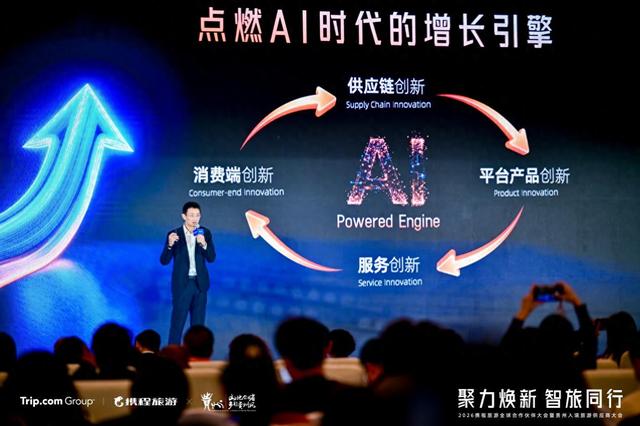
从竞争到共生:携程AI智能引擎3.0规模化赋能伙伴增收
Huan Qiu Wang· 2026-01-07 02:55
Core Insights - Ctrip's AI-driven "Smart Engine 3.0" has achieved large-scale application, resulting in over 10% order growth for merchants and a 38% GMV growth for core partners, indicating a strategic shift towards empowering ecosystem partners for efficiency and revenue growth [1][3] Group 1: AI Tools and Their Impact - The newly launched "CTRIPS Fusion Model" has provided over 10% order growth in group travel scenarios by making traffic allocation logic transparent, allowing merchants to optimize specific factors for increased exposure [3] - The AI dual-mode shopping guide system handles 80% of pre-sales inquiries, enabling customer service to focus on high-value transactions, thus significantly freeing up human resources for partners [3] - AI video generation tools for team travel routes have drastically reduced traditional video production costs, allowing partners to create a large volume of personalized marketing materials at near-zero marginal costs [3] Group 2: Addressing Service and Experience Challenges - Ctrip has improved the Net Promoter Score (NPS) for team travel services by over 20 percentage points through the "fitting NPS" mechanism and AI interventions, enhancing customer repurchase rates and word-of-mouth recommendations [3] - The company aims to solve fundamental operational challenges for partners, thereby increasing customer loyalty and continuous traffic flow [3] Group 3: Strategic Market Positioning - In the car rental sector, Ctrip is avoiding price wars by implementing "Worry-Free Rental" standards and directing traffic towards quality products and merchants, demonstrating that empowering good products can yield higher conversion returns [4] - Ctrip's CEO emphasizes that innovation is about creating incremental value for the industry, with all AI investments and model upgrades aimed at enhancing partner efficiency and revenue growth [4]

2025年5月以来携程入境团队人次实现5倍增长
Bei Jing Shang Bao· 2026-01-06 13:17
Group 1 - The core viewpoint is that the inbound tourism market in China is entering a "golden window period," with inbound group travel becoming a new growth engine for tourism companies [1] - Policies such as visa exemptions and transit visa waivers are continuously optimized, facilitating foreign tourists' travel to China [1] - The inbound tourism market in China is expected to reach a scale of $180 billion by 2030, but its current contribution to GDP is still less than 0.5%, indicating significant growth potential [1] Group 2 - The tourism platform is becoming a key hub connecting domestic travel agencies with international customers by building a global product matrix and implementing refined scenario operations and cross-border integrated marketing [1] - Ctrip's inbound team travel has seen a fivefold increase in visitor numbers since May 2025, with daily order volume increasing eightfold, demonstrating strong momentum [1] - The tourism industry is undergoing a profound transformation from "traffic-driven" to "experience-driven" due to the deep application of AI technology and the rapid growth of the inbound tourism market [1] Group 3 - Personalized travel demands are being captured and responded to more accurately through multimodal AI technology, which can understand text, voice, images, and videos [2] - AI has improved recommendation effectiveness by 8%, significantly enhancing product recommendation rates for merchants, with a 20-fold increase in efficiency compared to previous manual operations [2] - Ctrip's AI-driven "Smart Engine 3.0" has achieved large-scale application, bringing over 10% order growth to merchants and enabling core partners to achieve a GMV growth rate that outpaces the market by 38% [2]