智谱AutoGLM

Search documents
2025年第51周:数码家电行业周度市场观察
艾瑞咨询· 2025-12-30 00:07
Industry Environment - In 2025, a stark contrast is observed between the "Six Little Dragons" in Hangzhou and the "Invisible Champions" in Shenzhen, with Hangzhou focusing on narrative and traffic operation while Shenzhen emphasizes technical refinement and a pragmatic approach [3] - The AI landscape is witnessing a competition akin to the Android vs. Apple battle, with the launch of the open-source AI Agent model AutoGLM by Zhiyu, which supports cross-device operations and aims to prevent AI monopolies [4] - The AI glasses market is experiencing intense competition, with major players like Google and Alibaba entering the fray, focusing on vertical scenarios and data control, despite consumer hesitance [5] - The evolution of IoT in China is shifting towards emotional value, driven by the "loneliness economy," with AI emotional products gaining traction among young consumers [6] - The humanoid robot sector is facing scrutiny over its reliance on remote control rather than autonomous intelligence, with significant discrepancies between market sentiment and actual order volumes [8] AI Transformation in Healthcare - The modern healthcare system is grappling with digital transformation challenges, necessitating a comprehensive overhaul of data governance and decision-making processes to effectively integrate AI [9] AI Unicorn IPO Race - Domestic AI unicorns MiniMax and Zhiyu are preparing for IPOs in Hong Kong, marking a shift from technology to commercialization, with significant backing from industry giants [10] AI Content Creation - The rise of "manga dramas" as a new content form is driven by AI technology, significantly lowering production costs and attracting major IP and platform players [12] AI Companion Toys Market - The AI companion toy market is rapidly growing but facing challenges of high return rates due to low emotional connection and user experience issues [13] Small Home Appliances Industry - The small home appliance sector is experiencing a bifurcation, with companies like Delmar adjusting strategies amid declining performance, while others expand production and explore overseas markets [14] AI Model Competition - The AI model landscape is diversifying into three camps, with ByteDance's Doubao leading in user engagement, DeepSeek excelling in technology, and Alibaba's Tongyi Qianwen focusing on practical applications [16] Future of AI - The year 2026 is projected to be pivotal for AI, transitioning to an "AI-native" era characterized by natural language interaction and autonomous task completion [17] AI Agent Development - The AI Agent market is expected to grow significantly, with applications across various sectors, although companies face challenges in implementation and compliance [18] Humanoid Robot Development - Japan is re-entering the humanoid robot development race, aiming for prototype release by 2030, intensifying global competition in the sector [19] AI Toys and Emotional Economy - Major tech companies are entering the AI toy market, which is projected to grow significantly, but face challenges related to pricing and user experience [21] AI Mapping Services - AI is becoming central to the mapping industry, with major players like Baidu and Gaode launching AI strategies, but user experience and privacy concerns remain critical issues [22] AI Investment Trends - The AI investment landscape is evolving, with figures like Duan Yongping advocating for rational participation and practical applications of AI technology [31] Apple’s Entry into Robotics - Apple is accelerating its entry into the humanoid robot market, aiming to leverage its brand and manufacturing capabilities, despite facing significant challenges [32] Robotics and AI Commercialization - Companies like Yundongchu Technology are securing funding to advance embodied intelligence technologies and expand market applications [34]



合集回顾:手机智能体的来龙去脉 4个问题带你看
2 1 Shi Ji Jing Ji Bao Dao· 2025-12-12 00:49
Core Insights - The article discusses the evolution of mobile AI assistants, highlighting their transition from basic chatbots to advanced personal assistants capable of performing tasks on behalf of users, thus reshaping the AI ecosystem [1][3][4] Group 1: Core Capabilities - Mobile AI assistants are changing the reliance on traditional apps, with major brands like Xiaomi, Honor, Vivo, OPPO, Huawei, and Samsung integrating their own AI assistants into devices [3][4] - Initial capabilities of these AI assistants were overhyped, with real-world success rates for tasks like food delivery being below 3% for most [3][4] - Two main technical routes for mobile AI assistants are identified: intent frameworks that require app cooperation and GUI agents that simulate user actions, with the latter being more prevalent [4][5] Group 2: Privacy and Security - The use of screen-reading capabilities by mobile AI assistants raises significant privacy concerns, as they can access sensitive information like chat logs and banking details [6][7] - The transfer of control to AI assistants poses risks, including potential misinformation and execution errors, which could lead to legal issues [6][7] - Systemic data security risks arise from high-privilege applications operating without external oversight, leading to potential misuse [7][8] Group 3: Commercial Dynamics - The competition between internet apps and mobile AI assistants is intensifying, with concerns that AI could replace human interactions, impacting app engagement metrics and advertising revenues [10][11] - The introduction of AI assistants like Doubao has sparked discussions about the future of app ecosystems and the potential for apps to become mere tools for AI [10][11] - The ongoing struggle for control over user data and the implications of AI's role in transactions highlight the need for clear regulations and responsibilities [12][13] Group 4: Future Considerations - The article emphasizes the necessity for transparent authorization mechanisms and clear accountability in AI operations to establish trust and legitimacy [13][14] - Proposals for giving AI assistants a distinct identity and establishing a regulatory framework are discussed as potential solutions to current challenges [14][15]
“逃离”中国的Manus,可能白跑了
Guan Cha Zhe Wang· 2025-08-15 11:12
Core Insights - Manus, an AI product by Butterfly Effect, gained significant attention after its launch in March 2025, but faced controversy and speculation regarding its operational status following a mass layoff and removal from domestic platforms [1][3][4] - The company completed a $75 million Series B funding round led by Benchmark, raising its valuation to $500 million, with plans to expand into international markets [3][4] - Political pressures in the U.S. regarding investments in Chinese AI companies have created uncertainty for Manus, with potential implications for its funding and operational strategy [2][6][9] Funding and Valuation - Butterfly Effect secured $75 million in funding from Benchmark, a prominent Silicon Valley venture capital firm, which has previously invested in successful companies like Uber and Twitter [3] - The funding raised Manus's valuation to $500 million, with the capital intended for expansion into markets such as the U.S., Japan, and the Middle East [3] Operational Changes - Following the funding, Manus relocated its headquarters to Singapore and significantly reduced its domestic workforce, retaining only about one-third of its original staff [1][3][4] - The company's domestic operations were abruptly halted, leading to speculation about its future in China and the impact of U.S. investment scrutiny [1][2][4] Market Competition - The AI landscape in China is rapidly evolving, with competitors like Zhipu AI and ByteDance launching similar products, which may diminish Manus's market advantage if it attempts to re-enter the domestic market [2][10][12] - Manus's pricing strategy and technology may not be competitive against emerging domestic alternatives that offer free or lower-cost solutions [10][12][13] Political and Regulatory Environment - The U.S. government's increasing scrutiny of investments in Chinese technology sectors poses a significant risk to Manus, as evidenced by the Biden administration's Executive Order aimed at limiting such investments [6][9] - Benchmark's investment in Manus is viewed as a potential challenge to U.S. regulatory frameworks, with strong political opposition to perceived "asset transfers" to China [2][7][9] Future Prospects - Manus's ability to return to the Chinese market is complicated by the presence of established competitors and the potential for reduced user demand due to its pricing and operational challenges [10][12] - The company's initial strategy of targeting international markets may be undermined by the hostile regulatory environment in the U.S., raising questions about its long-term viability [14]

现象级产品不断涌现,Agent赛道有望迎拐点,AI人工智能ETF(512930)、消费电子ETF(561600)回调蓄势,配置机遇备受关注
Sou Hu Cai Jing· 2025-05-30 03:48
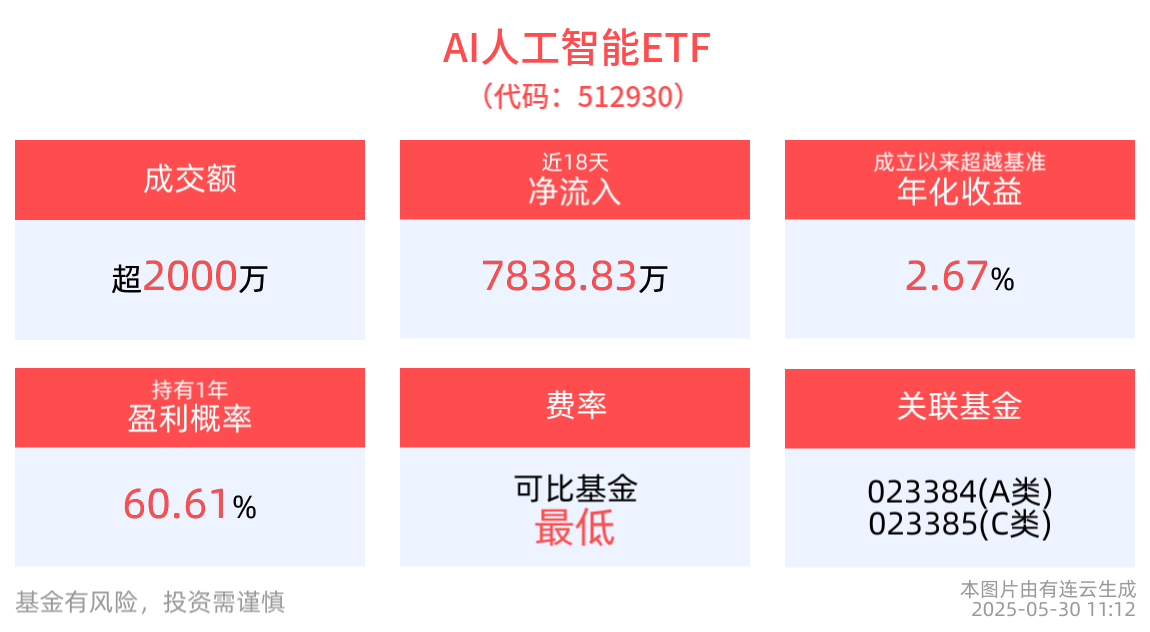
Group 1: AI Industry Insights - The China Securities Artificial Intelligence Theme Index (930713) decreased by 1.82% as of May 30, 2025, with notable stock movements including Stone Technology (688169) up by 0.96% and Zhongke Xingtu (688568) down by 9.16% [1] - The AI Artificial Intelligence ETF (512930) fell by 1.69%, with a latest price of 1.28 yuan, but showed a 2.12% increase over the past month [1] - The AI Artificial Intelligence ETF has seen a net inflow of 78.39 million yuan over the last 18 trading days, averaging 4.35 million yuan per day [1] - The AI sector is entering a 3.0 phase, focusing on the large-scale deployment of agents (intelligent entities), with 2025 potentially being the year of agents [6] Group 2: Consumer Electronics Sector - The China Securities Consumer Electronics Theme Index (931494) declined by 2.11% as of May 30, 2025, with East Mountain Precision (002384) leading the decline at 3.97% [3] - The Consumer Electronics ETF (561600) decreased by 1.94%, with a latest price of 0.76 yuan, but has increased by 24.72% over the past year [3] - The Consumer Electronics ETF has seen a significant growth in scale, adding 11.11 million yuan in the past month, ranking second among comparable funds [3] Group 3: Online Consumption Sector - The China Securities Hong Kong-Shanghai Online Consumption Theme Index (931481) fell by 2.20% as of May 30, 2025, with notable stocks like Zhangqu Technology (300315) up by 6.89% [4] - The Online Consumption ETF (159793) decreased by 1.46%, with a latest price of 0.88 yuan, but has shown a 1.49% increase over the past month [4] - The index tracks 50 companies involved in online shopping, digital entertainment, online education, and telemedicine, reflecting the overall performance of the online consumption sector [7]