暖气片

Search documents
苏韵润疆 产业为桥 以协作之“力”激活伊犁全面发展新动能
Xin Hua Ri Bao· 2025-12-30 23:52
Core Insights - The collaboration between Jiangsu and Xinjiang is transforming the economic landscape of the Ili River Valley through various industrial projects and employment initiatives, enhancing local livelihoods and fostering sustainable development [1][4][17] Group 1: Industrial Development - Jiangsu's assistance has led to the establishment of 96 aid projects with a total funding of 1.276 billion yuan, focusing on building a robust industrial support system in the Ili region [1] - The Ili County textile industrial park has grown to host 22 textile and apparel companies, achieving an output value of over 2.5 billion yuan in 2024, a 43% increase year-on-year, and employing 4,067 people, with 76% being ethnic minorities [2][15] - The XuZhou (Kuytun) Technology Industrial Park has reported an annual output value exceeding 3.8 billion yuan in 2024, becoming a model for cross-regional cooperation [3] Group 2: Employment and Skills Training - Jiangsu's initiatives have created over 9,031 jobs in 2024, with a 17% increase from the previous year, and 5,700 of these jobs are held by ethnic minorities [15][16] - The establishment of a vocational training base has trained 9,432 individuals in various skills, significantly improving employment opportunities for local residents [11][10] - A job fair organized in May 2025 provided 2,000 job opportunities across various sectors, with an average salary of 5,000 yuan, showcasing the commitment to diverse employment options [14] Group 3: Agricultural and Consumer Products - The "Su Agricultural Science" brand has successfully launched a raspberry juice product, achieving over 1,000 orders within five days, highlighting the potential of local agricultural products in the market [7] - The establishment of the "Su Yun Yi Qing · Ili Specialty Agricultural Products Marketing Center" has facilitated partnerships with 68 cooperatives and enterprises, enhancing the sales of Ili's agricultural products [8] - Jiangsu's support has led to the establishment of 49 rural revitalization demonstration points, promoting various economic crops and benefiting over 20,000 farmers [3] Group 4: Investment and Economic Growth - Jiangsu's investment in Ili has resulted in over 90 billion yuan in industrial output, with 16 enterprises achieving over 1 billion yuan in annual output [6] - The successful landing of projects like the 450,000-spindle textile project has pushed the textile industry output in Ili to over 8 billion yuan [5] - Jiangsu's collaboration has attracted significant investments from various sectors, including a 3.5 billion yuan heating and ventilation industrial park, expected to create over 400 jobs upon completion [5] Group 5: Cultural and Tourism Development - The development of tourism infrastructure is projected to attract over 12.5 million visitors by 2025, significantly boosting local employment in hospitality and related sectors [15] - Jiangsu's initiatives have transformed winter tourism, generating 30,000 jobs in the winter season alone, as local residents capitalize on tourism opportunities [15]
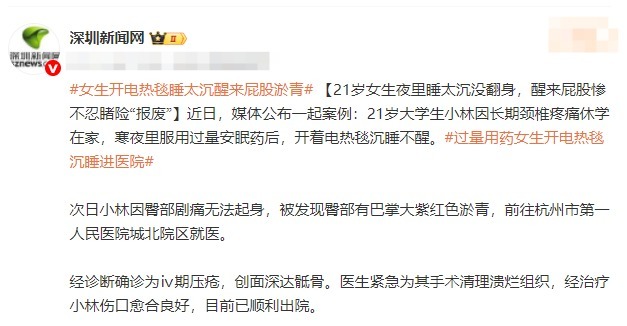
V观话题丨开电热毯睡太沉醒来屁股淤青!天冷了,你会正确使用取暖神器吗?
Xin Lang Cai Jing· 2025-12-23 04:36
Core Viewpoint - The article highlights the risks associated with using heating devices such as electric blankets, particularly the potential for low-temperature burns, as evidenced by a recent case involving a university student who suffered severe skin damage due to prolonged use of an electric blanket [1]. Group 1: Incident Overview - A 21-year-old university student experienced severe skin damage (IV stage pressure sore) after using an electric blanket while under the influence of sleep medication [1]. - The incident has sparked discussions among netizens regarding the quality and safety of electric blankets [3][4]. Group 2: Prevention Guidelines - Recommendations for preventing low-temperature burns include controlling the temperature of heating devices and avoiding direct skin contact [5]. - Users are advised to turn off heating devices after warming the bed and to monitor skin sensations for any discomfort [5]. - In case of skin redness or discomfort, immediate cooling with running cold water or gel products is recommended, and severe cases should seek medical attention [6].

买家电有了新去处!金义新区加速释放消费潜力
Sou Hu Cai Jing· 2025-07-08 12:07
Group 1 - The opening of the Jinhua Sixth Space Super Electric Mall marks a strategic project for the Sixth Space Home Group, covering over 20,000 square meters and attracting more than 60 domestic and international top appliance brands, achieving over 80% occupancy rate [1] - The mall aims to create a comprehensive electric appliance shopping center that serves Jinhua and the surrounding regions, leveraging trends such as "aesthetic economy" and "experience economy" to enhance customer attraction [1] - As of the end of June, the shopping center has received over 5,000 visitors and generated sales exceeding 20 million yuan [1] Group 2 - The Jinhua Zhongran and Jinhua Yipinhui Life Technology Co., Ltd. have recently reopened their Gold Yi branch, offering various promotional activities and services such as kitchen renovations and home delivery within 48 hours [3] - The company provides a full-cycle service for consumers, from safety inspections to equipment updates, adapting to changing market demands [5] - The collaboration between "Yipinhui" and Jinhua Zhongran aims to offer professional gas appliance services and has earned recognition as a quality enterprise in the commerce sector [5] Group 3 - The openings of the Sixth Space Electric Mall and Yipinhui Gold Yi branch enhance consumer choices and convenience, injecting new vitality into the home appliance market [6] - Jinyi New District has been actively optimizing commercial layouts and expanding market space, achieving a 100.7% fund utilization rate and a 165.4% fund write-off rate in the old-for-new consumer program, contributing to a consumption scale growth of over 2.3 billion yuan [6]

经销商是什么?如何有效管理?
Sou Hu Cai Jing· 2025-06-20 08:08
Core Viewpoint - The relationship between manufacturers and distributors is often fraught with challenges, including lack of trust and communication issues, which can hinder effective market expansion and product distribution [1][5]. Group 1: Role of Distributors - Distributors act as essential partners in the commercial ecosystem, facilitating the movement of products from manufacturers to various markets, thus saving costs and providing localized services [3]. - They help manufacturers reduce expenses associated with direct retail operations, such as rent and labor costs, by leveraging local resources for distribution [3]. - Distributors possess localized knowledge that enables them to effectively market products to regional consumers, which manufacturers may struggle to replicate [3]. Group 2: Pain Points in Managing Distributors - Manufacturers often face challenges in monitoring distributor inventory, leading to issues such as excess stock and product wastage [5][7]. - There is a lack of transparency in sales data, with distributors sometimes providing misleading information about inventory levels and sales performance [7]. - Conflicts can arise between distributors in different regions, leading to pricing inconsistencies and market confusion [7]. Group 3: Solutions for Effective Distributor Management - Implementing digital tools can break down information barriers, allowing for real-time data sharing and inventory management, which can significantly reduce stockouts [8]. - Standardizing processes through digital systems can minimize errors in order management, leading to improved efficiency and reduced complaints from distributors [10]. - Utilizing data analytics can help identify market trends and adjust strategies accordingly, enhancing sales performance [12]. Group 4: Building Collaborative Relationships - Establishing a scoring system for distributors can incentivize performance and encourage them to expand their market reach, benefiting both parties [14]. - Smart management systems can track logistics and prevent unauthorized sales across regions, reducing conflicts and fostering a more cooperative environment [14]. - Transparency in data sharing can rebuild trust between manufacturers and distributors, leading to a more collaborative approach to achieving mutual goals [17].