
板栗酒

Search documents
唐山焕彩记:解码重工业城市转型方程式
Xin Lang Cai Jing· 2026-02-01 19:21
Core Insights - Tangshan is leveraging its 229.7 km coastline to develop a marine economy, focusing on marine engineering, port logistics, and comprehensive utilization of seawater, aiming to create a distinctive marine industry cluster [1] - The city is committed to low-carbon transformation and sustainable development, with significant achievements in ecological restoration and the establishment of green manufacturing systems [1] - Tangshan's agricultural sector is thriving, with a projected grain production of 60.37 billion pounds in 2025, driven by modern agricultural practices and product diversification [3] - The cultural and tourism industry in Tangshan is enhancing consumer engagement and employment, with a forecast of over 8 million tourists in 2025, marking a 19.6% increase [4] - The integration of various industries, such as marine, technology, and agriculture, is fostering high-quality development and innovation in Tangshan [5] Industry Developments - The automation and smart technology in the port operations at Tangshan Port are significantly improving efficiency, with the first fully automated container berth in Hebei province saving costs and labor [6] - The intersection of technology and cultural tourism is creating immersive experiences for visitors, enhancing the appeal of Tangshan's tourism offerings [7] - The modern aquaculture industry in Tangshan is combining ecological practices with renewable energy, showcasing a sustainable model for rural revitalization [8] Economic Performance - Tangshan has achieved a GDP surpassing 1 trillion yuan, becoming the first city in Hebei to reach this milestone, with leading indicators in per capita income and investment in key projects [9] - The city has met or exceeded all core innovation metrics during the 14th Five-Year Plan, with over 1,800 high-tech enterprises contributing to its economic transformation [9] - Continuous improvements in public services and urbanization rates are enhancing the quality of life for residents, positioning Tangshan as a model for green transformation [9] Future Outlook - Tangshan aims to further enhance its economic structure and develop new productive forces over the next five years, focusing on industrialization, information technology, and agricultural modernization [10] - The city plans to strengthen its innovation capabilities and improve the commercialization of technological achievements, aiming to lead in development methods within the province [10] - Efforts will be made to enhance social welfare and environmental quality, with a commitment to achieving carbon peak targets and improving ecological conditions [11]
看河北青龙十万“栗工”怎样炒香“一颗栗”
Xin Lang Cai Jing· 2026-01-01 19:47
Core Insights - The article highlights the transformation of Qinglong County's chestnut industry through innovative agricultural practices, technology integration, and e-commerce development, leading to significant economic growth and rural revitalization. Group 1: Agricultural Innovation - Qinglong County has adopted a comprehensive approach to chestnut cultivation, integrating planting, processing, and sales to enhance agricultural productivity and economic stability [1] - The introduction of scientific pruning and water-fertilizer management techniques has significantly improved chestnut yields, with coverage of improved varieties exceeding 80% [2] - The "Centennial Ancient Tree Adoption Program" has been launched to protect ancient chestnut trees while providing sustainable income channels for farmers [2] Group 2: Processing and Value Addition - The establishment of automated production lines at companies like Qinhuangdao Baifeng Food Co., Ltd. has increased the value-added of chestnut products, with exports exceeding $5 million annually [3] - The county has diversified its product offerings, introducing over 100 new products such as chestnut noodles and chestnut wine, enhancing the overall industry resilience [3] Group 3: E-commerce Development - Qinglong County has implemented a "three-level" logistics system to support e-commerce, resulting in over 4,000 rural e-commerce businesses generating sales exceeding 2 billion yuan annually [4] - The "Satisfaction Qinglong" regional public brand has gained recognition, with chestnut products being sold in over 30 countries, contributing to the county's economic growth with an annual output value exceeding 1.6 billion yuan [4] Group 4: Talent Development - A collaborative training system involving universities, enterprises, and government has been established to enhance skills in chestnut cultivation, processing, and e-commerce [6] - Over 1,000 training sessions have been conducted, benefiting more than 100,000 chestnut farmers, and fostering a skilled workforce of over 100,000 individuals across various sectors [6]
“红”“绿”交织 幸福“靠山”(乡情村貌)
Ren Min Ri Bao Hai Wai Ban· 2025-08-06 22:47
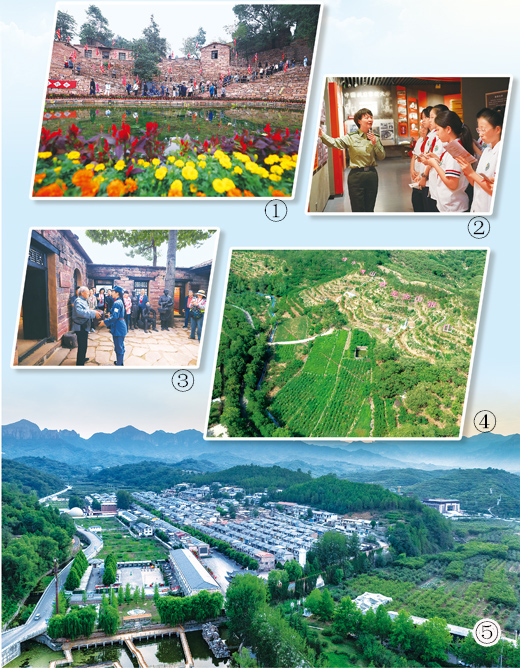
Core Viewpoint - The article highlights the transformation of Qian Nanyu Village from a barren land to a green and prosperous community, emphasizing the integration of red revolutionary culture and green ecological development as a model for sustainable growth [5][10][17]. Group 1: Historical Significance - Qian Nanyu Village is historically significant as it was the site of the Chinese People's Anti-Japanese Military and Political University, where over 200,000 military and political cadres were trained during the war [6][7]. - The village has a memorial and a museum dedicated to the Anti-Japanese University, which serves to educate visitors about its historical importance and the struggles faced during that era [8][9]. Group 2: Ecological Development - The village has achieved a remarkable 90.7% forest coverage and 94.6% vegetation coverage, earning it the title of "the greenest place in Taihang Mountain" [5][10]. - A comprehensive plan was implemented to transform the barren land into a green area, involving extensive tree planting and soil conservation efforts, which included 126 million labor hours and significant community involvement [10][11]. Group 3: Economic Transformation - The village has diversified its economy by integrating agriculture with tourism, leading to an expected total income of over 200 million yuan in 2024, with per capita income reaching 18,600 yuan [19]. - The introduction of modern agricultural techniques has significantly increased the yield and quality of local produce, such as chestnuts, with export rates rising from 64% to 97% [14][15]. Group 4: Community Engagement and Tourism - Approximately 80% of families in the village are involved in eco-tourism and agritourism, contributing to the local economy and enhancing community engagement [19]. - The village has developed various tourist attractions, including eco-parks and historical sites, which have drawn increasing numbers of visitors, thereby boosting local businesses [18][19].

河北迁西举行迁西板栗精品示范园认购权竞拍活动
Zhong Guo Jing Ji Wang· 2025-05-29 09:24
Group 1 - The event held in Mianxi County showcased the development and potential of the chestnut industry, featuring activities such as a rights auction and tree adoption [1] - Over 150 participants from various research institutions and leading enterprises in the nut industry attended the event, indicating strong interest and investment in the chestnut sector [1] Group 2 - Mianxi County is recognized as "China's Chestnut Capital" with a cultivation area of 750,000 acres and an annual production of 80,000 tons, highlighting its significance in the national chestnut industry [2] - The "Mianxi Chestnut" trademark is the only geographical indication trademark in China's chestnut industry, with an industry output value exceeding 2.5 billion [2] - The county has developed over 430 chestnut cooperatives and 35 enterprises, including several key agricultural enterprises, establishing itself as a center for production, processing, and research in the chestnut industry [2] - Mianxi County aims to modernize its traditional chestnut industry by integrating cultural and technological advancements, expanding into related sectors such as medicinal herb cultivation and rural tourism [2]