植入式脑深部神经刺激系统

Search documents
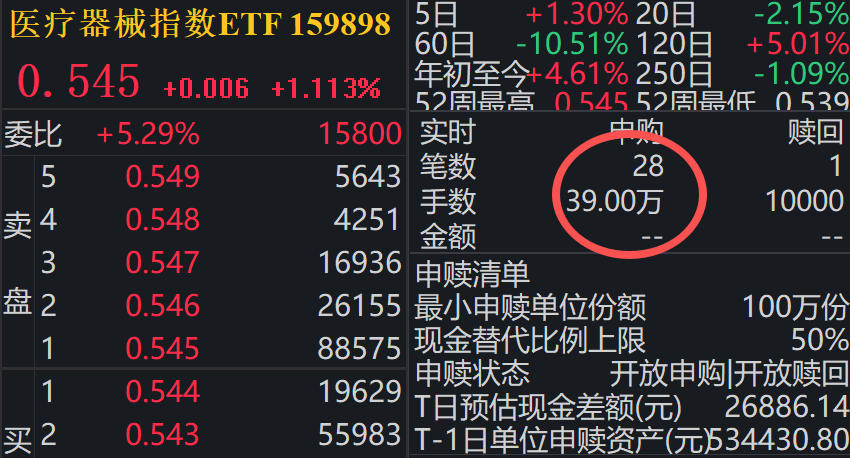
毫米级创伤!我国脑机接口里程碑式突破,医疗器械指数ETF(159898)逆势上涨1.11%
Jin Rong Jie· 2025-12-23 16:52
Core Viewpoint - The medical device sector is experiencing significant growth and investment opportunities, driven by recent regulatory approvals and technological advancements in brain-computer interface (BCI) technology [3][4][5]. Group 1: Market Performance - The medical device index ETF (159898) saw a 1.11% increase, with approximately 20 million yuan net inflow during trading [1]. - Key stocks in the medical device sector, such as Yirui Technology and Furu Medical, reported gains of 4.58% and 6.44% respectively, indicating strong market performance [1]. Group 2: Regulatory Developments - The National Medical Products Administration (NMPA) approved two high-value medical devices, enhancing clinical applications and technological development in the industry [3]. - Recent policies from major cities like Shanghai and Beijing aim to support the medical device industry, focusing on regulatory reforms and innovation [5]. Group 3: Technological Advancements - China has made significant progress in invasive brain-computer interface technology, becoming the second country after the U.S. to enter clinical trials [3]. - The global brain-computer interface market is projected to grow from approximately $2.62 billion in 2024 to $12.4 billion by 2034, with a compound annual growth rate of 17.35% [4]. Group 4: Investment Opportunities - Analysts suggest that the medical device sector may replicate the successful path of innovative pharmaceuticals, with a focus on innovation driving industry growth and global competitiveness [5]. - The medical device index ETF (159898) tracks a diverse range of leading companies in the sector, primarily focusing on A-share medical devices [7].




医药行业周报(2025/12/15-2025/12/19):本周申万医药生物指数下跌0.1%,关注国内药企出海动态-20251222
Shenwan Hongyuan Securities· 2025-12-22 10:36
Investment Rating - The report maintains a positive outlook on the pharmaceutical industry, indicating an "Overweight" rating for the sector [28]. Core Insights - The pharmaceutical sector has shown mixed performance, with the Shenwan Pharmaceutical and Biological Index down by 0.1% this week, while the Shanghai Composite Index increased by 0.03% [3][5]. - The overall valuation of the pharmaceutical sector stands at 29.2 times earnings, ranking 10th among 31 Shenwan primary industries [5][23]. Market Performance - The Shenwan Pharmaceutical and Biological Index ranked 22nd among 31 Shenwan primary sub-industries this week [3]. - The performance of various sub-sectors includes: - Raw materials (+0.5%) - Chemical preparations (-2.1%) - Traditional Chinese medicine (+0.2%) - Blood products (-0.3%) - Vaccines (-0.9%) - Other biological products (-0.7%) - Medical devices (+1.4%) - Medical consumables (+2.3%) - In vitro diagnostics (-0.8%) - Pharmaceutical distribution (+4.7%) - Offline pharmacies (+5.6%) - Medical research outsourcing (-0.9%) - Hospitals (+4.2%) [5][6]. Recent Key Events - Changchun High-tech signed an exclusive licensing agreement for GenSci098 with Yarrow, with potential milestone payments reaching up to $1.365 billion [10]. - Hansoh Pharmaceutical entered a multi-regional exclusive licensing agreement for Amivantamab with Glenmark, with potential payments exceeding $1 billion [12]. - Hengrui Medicine's subsidiary Kailera initiated three global Phase III clinical trials for HRS-9531, targeting obesity with and without diabetes [17]. - The FDA confirmed the legality of NMN as a dietary supplement, reversing a previous ban [15]. - The first invasive brain-machine interface for treating addiction-related mental disorders was approved in China [16]. Investment Opportunities - The report suggests focusing on domestic innovative drug companies due to the recovery of the CRO investment environment, highlighting companies such as Tigermed, Nossan, and others [2]. - As 2025 approaches its end, it is recommended to pay attention to valuation shifts in companies like WuXi AppTec, Hengrui Medicine, and others [2].


脑机接口技术加速从实验室走向临床,中国又有新突破
2 1 Shi Ji Jing Ji Bao Dao· 2025-12-17 12:41
Core Viewpoint - The approval of the invasive brain-computer interface (BCI) product by Jingyu Medical Technology marks a significant milestone in the treatment of drug addiction, particularly for opioid dependence, showcasing the potential of BCI technology in serious medical applications [1][2][3]. Group 1: Product and Technology - Jingyu Medical's invasive brain deep stimulation system is the first globally approved BCI product for treating addiction-related mental disorders, specifically targeting difficult-to-treat moderate to severe opioid addiction [1][2]. - The system utilizes a dual-target technology to stimulate key brain areas, namely the nucleus accumbens and the anterior limb of the internal capsule, providing a new treatment option for patients [2][3]. - Clinical studies indicated that after implantation, patients showed improvements in negative emotions associated with addiction, with a 62.5% non-recurrence rate after 10 years of follow-up for the first batch of cases [2][3]. Group 2: Industry Landscape - The BCI industry is characterized by a diversified competitive landscape, with invasive and non-invasive technologies being developed for various applications, including medical and consumer sectors [4][6]. - Invasive BCIs are primarily focused on medical applications, while non-invasive BCIs are being utilized in consumer products and industrial applications [4][6]. - The global BCI market is projected to reach approximately $2.46 billion in 2024 and exceed $10.8 billion by 2033, with a compound annual growth rate (CAGR) of 16.5% [5]. Group 3: Future Trends and Challenges - The BCI industry is expected to experience rapid development, with trends including accelerated technology integration, expanded application scenarios, and improved industry chain collaboration [7]. - Despite the promising outlook, the industry faces challenges such as technical barriers, ethical considerations, and the need for regulatory compliance [8]. - Jingyu Medical plans to initiate international multi-center clinical trials to contribute to global addiction treatment solutions, aiming for BCI technology to become a standard treatment method for neurological disorders [9].
又2款创新器械获批:质子治疗系统与脑深部刺激系统
思宇MedTech· 2025-12-16 10:10
Core Insights - The National Medical Products Administration (NMPA) has approved two innovative medical devices for market launch: a proton therapy system from Varian Medical Systems and a deep brain stimulation system from Jingyu Medical Technology [2][3]. Proton Therapy System - The proton therapy system consists of an accelerator subsystem and a treatment subsystem, designed for treating solid malignant tumors and specific benign diseases. It features a cantilevered design that saves space and improves treatment efficiency [4][6]. - Varian Medical Systems Particle Therapy Company, a subsidiary of Varian Medical Systems, focuses on the research, production, and application of proton therapy technology. Varian was acquired by Siemens Healthineers for $16.4 billion in 2021, becoming a significant part of Siemens' business [6]. Deep Brain Stimulation System - The approved products from Jingyu Medical include an implanted deep brain stimulator, an electrode lead, and an extension lead, which together form a deep brain stimulation system aimed at treating opioid addiction [7][16]. - This system targets the nucleus accumbens and the anterior limb of the internal capsule, providing auxiliary treatment for patients with severe opioid addiction, thus filling a technological gap in physical interventions for opioid addiction treatment [16][18]. - Jingyu Medical Technology, established in 2011, specializes in deep brain stimulation systems and has received regulatory approvals for devices used in treating Parkinson's disease, obsessive-compulsive disorder, depression, and drug addiction [18].