
橡胶(RU)

Search documents
橡胶:转向偏空思路
Wu Kuang Qi Huo· 2026-01-10 13:29
1. Report Industry Investment Rating No information provided about the industry investment rating. 2. Core Views of the Report - The rubber market should shift to a bearish mindset. The subsequent supply and demand positive factors are diminishing, and it is easy for the rubber price to reach a phased high from January to February according to seasonal patterns. The high premium of RU over NR increases the price risk of RU [10][12]. - The revision of the NR delivery rules by the Shanghai International Energy Exchange is expected to increase the delivery quality and quantity of NR, making it more in line with the needs of the tire industry and rubber traders [15]. - The price of rubber is expected to turn bearish, and attention should be paid to the opportunity of going long on the NR main contract and shorting RU2609 for band - trading [17]. - The postponement of EUDR will lead to a series of reactions such as inventory reduction in the stocking links of rubber and tire factories, which is a short - term negative factor for demand [18]. 3. Summary by Directory 3.1. Weekly Assessment and Strategy Recommendations - In January, it is still the winter storage season, but the subsequent supply and demand positive factors are decreasing. From January to February, it is easy for the rubber price to reach a phased high according to seasonal patterns. The high premium of RU over NR increases the price risk of RU. The reports on January 4, 8, and 9 have all indicated the downward risk of the rubber price [12]. - The Shanghai International Energy Exchange has revised the NR delivery rules, which are expected to improve the quality of physical delivery commodities, standardize packaging and production processes, and optimize the management of inspection validity periods in the delivery process. It is beneficial to increase the delivery quantity of NR [15]. - The market logic: the bulls are mainly based on the expectation of winter storage in China and the positive expectation of Chinese policies, while the bears' main reasons are the dull demand reality and the expectation of poor demand due to the tariff - increasing policy. The export of rubber from Thailand and Cote d'Ivoire has increased. In the medium term, the policy expectation is the key. The rubber price is gradually turning bearish, and attention should be paid to the opportunity of going long on the NR main contract and shorting RU2609 for band - trading [17]. - Strategy recommendation: for the hedging strategy, go long on the NR main contract and short RU2609, with a profit - loss ratio of 1.5:1, for an indefinite period. If the spread is above 3250, gradually build positions and conduct repeated band - trading [19]. 3.2. Spot - Futures Market - Rubber maintains its usual seasonality, with prices prone to decline in the first half of the year. In 2018, 2019, and 2020, the price decline occurred earlier. In 2023, the rubber price was lower than the industry's expectation and below the rubber farmers' cost for a long time [26]. - The overseas demand expectation for rubber is marginally weakening, while the Chinese demand is stable [31]. 3.3. Profit and Ratio - The ratios of rubber to various commodities, such as copper, Brent crude oil, rebar, iron ore, the Shanghai Composite Index, and the ChiNext Index, are generally normal, without special values or points of concern [41][44][48]. 3.4. Cost Side - The market generally believes that the cost of cup rubber in Thailand is 30 - 35 Thai baht, the cost of Hainan full - latex in China is 13,500 yuan, and the cost of Yunnan full - latex in China is 12,500 - 13,000 yuan. The rubber maintenance cost is a dynamic concept. When the rubber price is high, rubber farmers are more motivated to maintain, and the cost is high; when the price is low, the cost is low [52]. 3.5. Demand Side - The full - steel tire and semi - steel tire opening rates show no special values or points of concern [57]. - The prosperity of trucks and commercial vehicles is slowly improving from a low level, and the subsequent demand is expected to gradually recover, which will affect the supporting tires. The commercial vehicle sales correspond to the domestic supporting demand [60]. - The export of truck tires is booming, but the subsequent demand is expected to decline slightly [63]. 3.6. Supply Side - Most of the rubber import data sources were last updated in December 2021, and the import data is less analyzable after the 2020 pandemic [67]. - The supply of rubber from major producing countries is generally normal, without special values or points of concern [71][75][78]. - In November 2025, the rubber production was 1,167.7 thousand tons, a year - on - year decrease of 5.40% and a month - on - month decrease of 0.49%. The cumulative production was 10,263 thousand tons, a cumulative year - on - year decrease of 0.24%. The export was 869.6 thousand tons, a year - on - year decrease of 7.42% and a month - on - month increase of 0.27%. The cumulative export was 8,837 thousand tons, a cumulative year - on - year increase of 0.73%. The consumption was 911.6 thousand tons, a year - on - year increase of 1.22% and a month - on - month increase of 1.24%. The cumulative consumption was 10,001 thousand tons, a cumulative year - on - year decrease of 0.86% [102][103]. 3.7. Butadiene and Related Products - The total capacity of butadiene with spot sales is 179.65 tons, accounting for 27.99%, and the total capacity without spot sales is 462.2 tons, accounting for 72.01%. The total capacity of butadiene rubber is 181.2 tons [117]. - Many butadiene production facilities have experienced maintenance, shutdown, and restart situations in 2025. Some production facilities have plans for future maintenance or shutdown [118]. - The weekly average operating load of butadiene rubber is 75.90%. Some enterprises have plans for shutdown or production reduction [119]. - In 2025, the new butadiene production capacity increased by 113 tons, with a growth rate of 16%. The new production capacity in Q4 2025 is expected to increase the supply of butadiene and decrease the processing profit. The import expectation of butadiene is high, which weakens the price [121][122]. 3.8. Ethylene and Related Products - In 2026 - 2027, many ethylene projects are expected to be put into production, with a total planned new capacity of 1,935 tons. During the 14th Five - Year Plan period (2026 - 2030), the Chinese ethylene industry will enter a new round of capacity expansion cycle [123][124]. - The new butadiene production capacity in 2026 is expected to be 62 tons, with a growth rate of 8.9%. The supply pressure of butadiene is expected to decrease, but it will still be under pressure, and butadiene rubber will still drag down the price among the four major rubber varieties [126][127].
广金期货重点品种资金流向与基差日报 20251208
Xin Lang Cai Jing· 2025-12-09 01:34
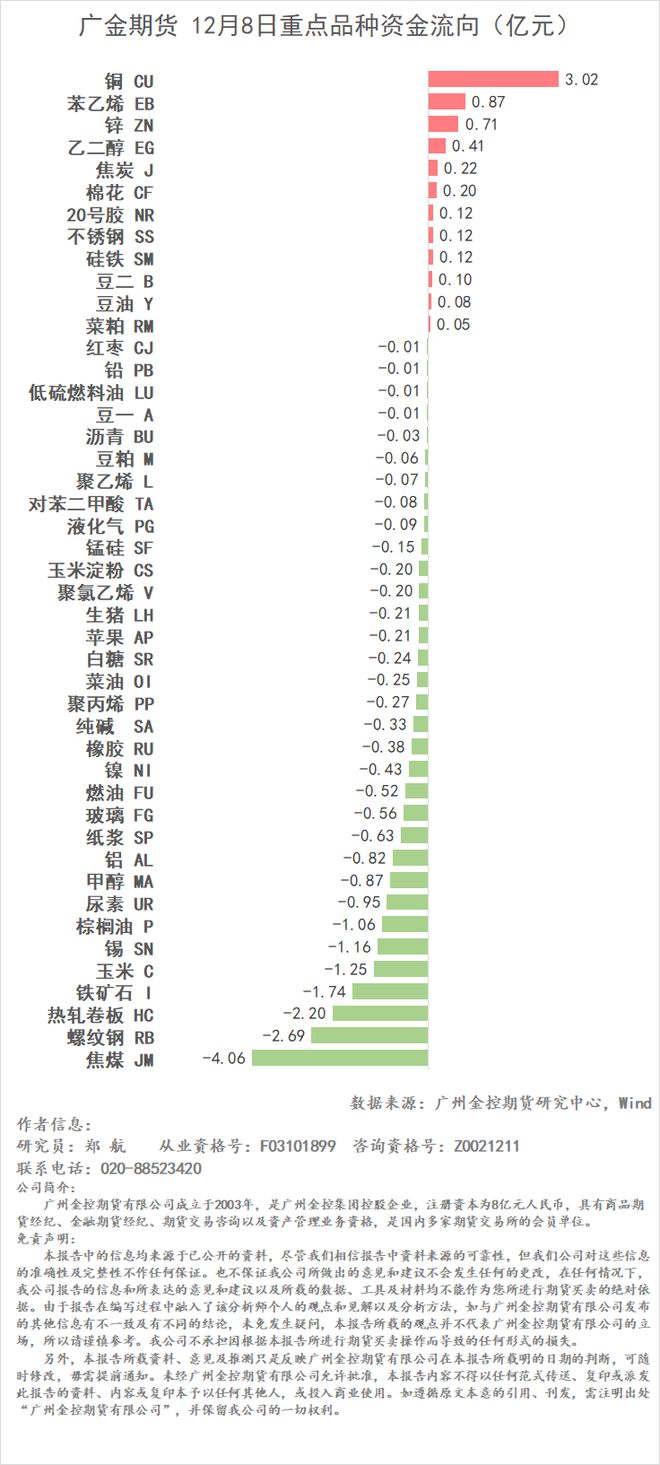
Core Viewpoint - The report provides an overview of the capital flow in various futures markets as of December 8, highlighting significant inflows and outflows across different commodities, indicating market trends and investor sentiment [1]. Group 1: Capital Flow Summary - Copper (CU) saw the highest capital inflow of 3.02 billion yuan, indicating strong investor interest [1]. - Styrene (EB) and Zinc (ZN) followed with inflows of 0.87 billion yuan and 0.71 billion yuan, respectively, suggesting positive market sentiment for these commodities [1]. - On the other hand, commodities like palm oil (P), tin (SN), and urea (UR) experienced significant outflows, with capital reductions of 1.06 billion yuan, 1.16 billion yuan, and 0.95 billion yuan, respectively, reflecting bearish sentiment [1]. Group 2: Price and Basis Rate Analysis - The report includes detailed pricing data for various commodities, such as iron ore (I) priced at 787 yuan per ton with a basis rate of 3.48% [5]. - The futures price for rebar (RB) is noted at 3280 yuan per ton, with a basis rate of 5.93%, indicating a positive outlook for this sector [5]. - The report also highlights the price movements of other commodities, such as aluminum (AL) and nickel (NI), with respective prices of 21920 yuan per ton and 122690 yuan per ton, showing slight declines in their basis rates [5].

期货品种周报:商品多空分化明显,关注多IC空IH、多原油空橡胶、多豆油空菜粕机会
对冲研投· 2025-12-01 02:17
Core Viewpoints - The article provides a comprehensive analysis of various futures markets, highlighting key products, market conditions, and potential trading opportunities across different sectors [2][3][4][5][6]. Group 1: Stock Index Futures - Key products include the Shanghai 50 futures (IH), CSI 300 futures (IF), CSI 500 futures (IC), and CSI 1000 futures (IM) [2]. - The market shows a "Good Curve Long" signal for IC and IM, indicating a strong bullish structure for small-cap indices, while IH and IF are in a "Maybe Curve Long" state, suggesting a more moderate outlook [2]. - The overall market is in a "Consolidation" phase, reflecting low volatility and unclear directional breakout [2]. Group 2: Government Bond Futures - Key products include 2-year (TS), 5-year (TF), 10-year (T), and 30-year (TL) government bond futures [3]. - All products exhibit a "Short" signal, indicating strong expectations for rising interest rates [3]. - The short-end bonds show negative rolling returns, reflecting concerns over tightening monetary policy, while long-end bonds are under pressure from inflation and fiscal policy [3]. Group 3: Precious Metals - Key products include gold (AU) and silver (AG) [4]. - Both metals are in a "Maybe Curve Short" state, but the market condition is "Long," indicating high prices with a bearish curve structure [4]. - The annualized rolling returns for gold and silver are negative, suggesting that prices are at historical highs and positions may be overly concentrated [4]. Group 4: Non-Ferrous Metals - Key products include copper (CU), aluminum (AL), zinc (ZN), nickel (NI), and tin (SN) [5]. - Copper and aluminum show no clear curve signals but are in a "Long" market state; zinc is "Maybe Curve Long," while nickel and tin are "Maybe Curve Short" [5]. - The rolling returns for copper and aluminum are negative, indicating strong fundamentals but high prices, while nickel and tin reflect concerns over oversupply [5]. Group 5: Black Metals - Key products include iron ore (I), rebar (RB), hot-rolled coil (HC), coke (J), and coking coal (JM) [5]. - Iron ore shows a "Good Curve Long" signal, while rebar and hot-rolled coil are in a "Maybe Curve Short" state [5]. - Iron ore's rolling return is high at 6.2%, indicating rebound potential, while demand weakness is reflected in negative returns for finished products [5]. Group 6: Energy and Chemicals - Key products include crude oil (SC), low-sulfur fuel oil (LU), fuel oil (FU), asphalt (BU), rubber (RU), plastic (L), and polypropylene (PP) [5]. - Crude oil and related products are in a "Curve Long" state, supported by geopolitical factors and OPEC+ production cuts [5]. - The rolling return for crude oil is positive, indicating an upward trend, while rubber and pulp show significant negative returns due to weak demand [5]. Group 7: Agricultural Products - Key products include soybean meal (M), soybean oil (Y), palm oil (P), rapeseed oil (OI), rapeseed meal (RM), corn (C), live hogs (LH), eggs (JD), white sugar (SR), and cotton (CF) [5]. - Soybean oil and palm oil are in a "Maybe Curve Long" state, while live hogs and eggs are in a "Curve Short" state [5]. - The rolling returns for oilseed products are positive, supported by biodiesel demand, while live hogs and eggs face pressure from oversupply [5].

期货品种周报:多铝空铜、沥青轻仓试多,关注黑色系产业链利润套利(螺矿比、焦螺比)
对冲研投· 2025-11-10 02:28
Group 1: Stock Index Futures Sector - Key Products: CSI 500 Futures (IC), CSI 1000 Futures (IM) - Bullish Outlook: Clear bullish sentiment supported by trading volume and open interest structure, but caution is advised for potential high-level pullbacks [1][2] Group 2: Government Bond Futures Sector - Key Products: 2-year, 5-year, 10-year, and 30-year government bond futures (TS, TF, T, TL) - Market Sentiment: Overall consolidation with a slight bearish bias [3][4] Group 3: Precious Metals Sector - Key Products: Gold (AU), Silver (AG) - Market Sentiment: Bearish consolidation; IC and IM show "Good Curve Long" structure with annualized rolling returns of 7.5% and 10.98%, significantly higher than SSE 50 and CSI 300 [5][6] - Trading Strategy: Hold long positions or add on dips, focusing on long-dated contracts of IC and IM; cross-product arbitrage suggested [5][6] Group 4: Non-Ferrous Metals Sector - Key Products: Copper (CU), Aluminum (AL), Zinc (ZN) - Market Sentiment: Significant differentiation; Aluminum shows the strongest fundamentals with tight supply-demand dynamics [9][10] - Trading Strategy: Long Aluminum and short Copper to capitalize on supply-demand gaps; light long positions in Zinc [9][10] Group 5: Black Metals Sector - Key Products: Iron Ore (I), Rebar (RB), Coking Coal (J) - Market Sentiment: Bearish outlook with negative returns for rebar and coking coal, indicating ongoing inventory pressure [13][14] Group 6: Energy and Chemical Sector - Key Products: Crude Oil (SC), Low Sulfur Fuel Oil (LU), Asphalt (BU), Rubber (RU) - Market Sentiment: Significant differentiation; Crude Oil and Low Sulfur Fuel Oil benefit from geopolitical factors and shipping demand [15][18] - Trading Strategy: Long SC/LU and short RU to exploit energy versus chemical dynamics [15][18] Group 7: Agricultural Products Sector - Key Products: Soybean Meal (M), Soybean Oil (Y), Palm Oil (P), Live Hogs (LH) - Market Sentiment: Overall bullish; soybean oil and palm oil benefit from biodiesel demand and weather disturbances in South America [21][22] - Trading Strategy: Long soybean oil/palm oil and short soybean meal to capitalize on oil-meal ratios; short live hogs due to oversupply [21][22] Group 8: Soft Commodities and Specialty Products - Key Products: Sugar (SR), Cotton (CF), Urea (UR), Industrial Silicon (SI) - Market Sentiment: Mixed; Urea supported by agricultural demand while Industrial Silicon faces supply pressure [27][28] - Trading Strategy: Long Urea and short Industrial Silicon to leverage agricultural demand against industrial supply [27][28] Group 9: Summary of Trading Strategies and Risk Control Recommendations - Long positions recommended in IC, IM, Urea, Aluminum, and oilseeds; short positions in Copper, Rebar, Rubber, Live Hogs, and Industrial Silicon [30]

广发期货日评-20250514
Guang Fa Qi Huo· 2025-05-14 07:40
Investment Ratings - Not provided in the report Core Views - The report provides a comprehensive analysis of various financial and commodity markets, offering specific comments and operation suggestions for different varieties based on their current market conditions, supply - demand relationships, and macro - economic factors [2]. Summary by Categories Financial - **Stock Index Futures**: For IF2506, the lower support of the index is stable, one can sell out - of - the - money put options to earn premiums; for IH2506, the index opens high and closes low with sectoral rotation. One can also buy September IM contracts on dips and sell September out - of - the - money call options with a strike price of 6400 for a covered strategy [2]. - **Treasury Bond Futures**: T2506 may fluctuate in the short term, with a wait - and - see approach. Focus on the capital market and economic data. Curve strategy suggests a steepening trade. The 10 - year and 30 - year treasury bond rates are around 1.66% and 1.92%, respectively, and are expected to fluctuate in the short term waiting for a driving force [2]. - **Precious Metals**: Gold is under short - term pressure with support around $3200 (¥745), and the sold out - of - the - money call options with a strike price above 800 can be held. Silver prices range between $32 - 33.5 (¥8000 - 8350), and an option straddle strategy can be tried [2]. Commodities - **Shipping**: With the easing of the Sino - US trade war, the spot price of the container shipping index (EC2506 for the European line) may rise. One can consider going long on the August contract or 8 - 10, 6 - 10 calendar spreads [2]. - **Steel**: The steel spot market is stabilizing with macro - level benefits. For RB2510, unilateral operations are on hold, and focus on the long - hot - rolled - coil short - raw - material arbitrage [2]. - **Iron Ore**: The increase in blast furnace maintenance may lead to a peak and decline in hot metal production. It is expected to trade in a range of 700 - 745 [2]. - **Coke and Coking Coal**: Coke prices are in a new round of price cuts, and coking coal is weak. One can go long on hot - rolled coil and short on coke or coking coal. The coal mine inventory is high, and there is still a possibility of price decline, with high hedging pressure in the futures market [2]. - **Energy and Chemicals**: - **Crude Oil**: The short - term oil price is likely to oscillate at a high level. The main contract of SC2507 has a range of [450, 510], and for options, one can buy volatility within the range [2][3]. - **Urea**: The inventory may be depleted faster, and the short - term futures price will oscillate at a high level in the range of [1850, 1950]. One can buy options to expand volatility [2]. - **PX and PTA**: Both are driven by strong supply - demand and tariff benefits, showing a strong trend. PX9 - 1 short - term calendar spreads and PX - SC spread expansion are recommended; for PTA, short - term 9 - 1 calendar spreads are considered, and a mid - term reverse view is taken [2]. - **Agricultural Products**: - **Palm Oil**: After a post - noon decline due to a negative MPOB report, it is expected to rebound above 8000 [2]. - **Sugar**: Based on the positive data from Brazil in late April, one can either stay on the sidelines or trade short on rebounds [2]. - **Cotton**: With the easing of the Sino - US trade war, attention should be paid to the resistance at 13500 [2]. - **Special Commodities**: - **Glass**: The market sentiment is pessimistic, and the 09 contract should be observed for a breakthrough at the 1000 - point level [2]. - **Rubber**: With the easing of Sino - US tariff conflicts, the price is expected to trade in the range of 14500 - 15500, and one can try shorting at the upper end of the range [2]. - **Industrial Silicon**: The spot price is stable, but the futures price is under pressure. A wait - and - see approach is recommended [2]. - **New Energy Commodities**: - **Polysilicon**: The industry fundamentals are expected to improve, and long positions or calendar spreads can be held [2]. - **Lithium Carbonate**: The trading is intense, and the price is expected to range between 62,000 - 66,000 [2].