
民用无人驾驶航空器

Search documents
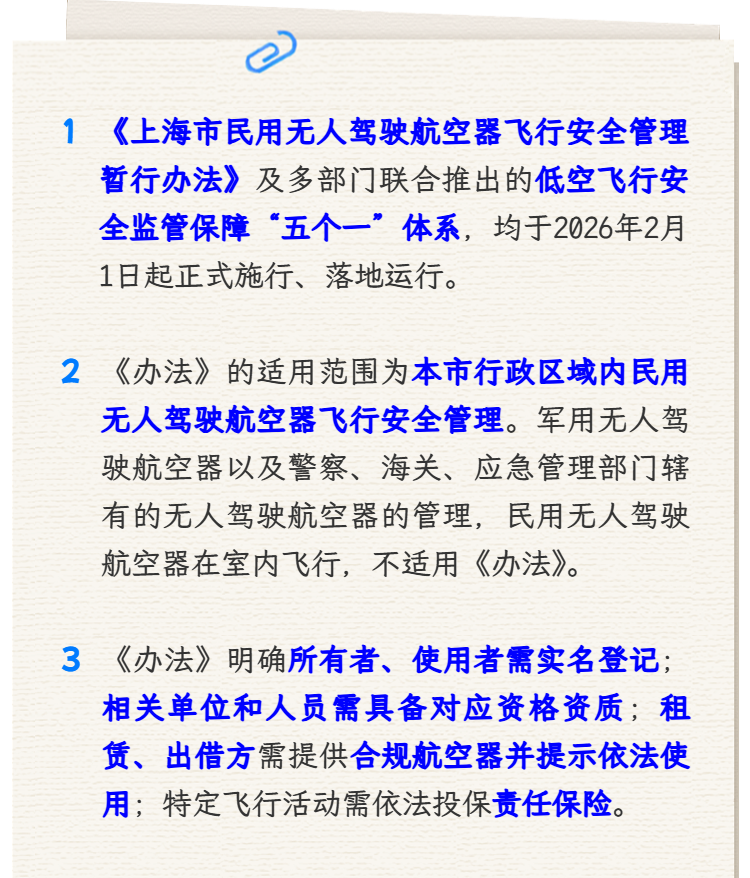
【提示】《上海市民用无人驾驶航空器飞行安全管理暂行办法》发布!“五个一”体系也将落地运行
Xin Lang Cai Jing· 2026-01-20 12:46
Core Viewpoint - The Shanghai Municipal Government has issued the "Interim Measures for the Safety Management of Civil Unmanned Aerial Vehicle Flights," effective from February 1, 2026, to regulate the operation of civil drones and promote the healthy development of the drone industry while ensuring aviation, public, and national security [1]. Group 1: Background and Purpose - The measures were developed in response to the rapid growth of the low-altitude economy and the widespread use of civil drones in various fields, which have significantly contributed to economic and social development. However, incidents of unauthorized drone flights have raised public safety concerns [3]. - The need for these measures arises from the implementation of national regulations, including the "Interim Regulations on the Management of Unmanned Aerial Vehicle Flights" issued on May 31, 2023, and the "Safety Management Rules for Civil Unmanned Aerial Vehicle Operations" by the Ministry of Transport, effective January 1, 2024 [3]. Group 2: Scope and Requirements - The measures apply to the safety management of civil unmanned aerial vehicle flights within the administrative region of Shanghai, excluding military drones and those operated by police, customs, and emergency management departments, as well as indoor flights [4]. - Owners and users of civil drones are required to register their identities and comply with qualifications for operating drones as stipulated in the national regulations. Rental operators must provide drones that meet legal and safety standards [4]. Group 3: Flight Activity Regulations - The measures specify which flight activities require prior approval and outline the application process, including submitting flight plans to air traffic management authorities at least 12 hours before the intended flight [5][6]. - A user-friendly application service will be available through the "Shangyin Ban" platform to facilitate the submission of flight activity applications and flight plan filings [6]. Group 4: Safety Management Provisions - Users of civil drones are held responsible for flight safety and must develop emergency response plans in accordance with national and local safety regulations [7][8]. - Drones must update safety data in real-time and cannot disable reporting functions during operation. Specific prohibitions, such as invading privacy, are also outlined [9][10]. - In case of abnormal situations during flight, operators are required to take immediate action and report to the municipal flight service agency [11]. Group 5: Implementation of the "Five Ones" System - The "Five Ones" system includes a collaborative mechanism for information sharing and joint regulation among various departments, aiming to enhance cross-sector governance [12]. - The measures will be supported by a comprehensive regulatory service platform launching on February 1, which will allow users to complete drone registration, flight applications, and experience zone reservations through a single interface [12][13].

民用无人机新国标发布
Xin Lang Cai Jing· 2026-01-19 18:12
Core Points - The Civil Aviation Administration of China (CAAC) has introduced new national standards for the registration and activation of civil unmanned aerial vehicles (UAVs) [1] - The new standards aim to ensure the legal and compliant operation of civil UAVs from the source [1] Group 1 - The new standard titled "Requirements for Real-name Registration and Activation of Civil Unmanned Aerial Vehicles" clarifies the procedures for real-name registration and activation [1] - The standard regulates manufacturers to develop information systems that facilitate real-name registration and activation [1] - The guidelines are designed to help UAV owners complete the registration process more conveniently [1] Group 2 - The standards apply to civil unmanned aerial vehicles that meet the specified criteria and are engaged in flying or related activities within China [1]
解读|让无人机“看得见”“管得住”
Zhong Guo Min Hang Wang· 2026-01-19 10:04
Core Viewpoint - The newly released national standard "Regulations on the Operation Identification of Civil Unmanned Aerial Vehicle Systems" aims to enhance the safety management of civil drones, set to be implemented on May 1, 2026, addressing the growing demand for operational management in the low-altitude economy [2][3]. Group 1: Background and Purpose - The development of the regulations is driven by the increasing number of drones and operators, as well as the expanding applications in agriculture, inspection, logistics, and other low-altitude business scenarios [3]. - The core principle of the regulations emphasizes "safety first," ensuring that drones can be effectively monitored and managed to promote safe and orderly development of the low-altitude economy [3][4]. Group 2: Key Provisions of the Regulations - The regulations require drones to actively report their identity, location, speed, and status throughout their operation, establishing technical standards for the design, production, and operation of drone identification systems [4]. - The regulations specify that the identification information does not include personal data, focusing solely on operational safety and public security [4]. Group 3: Scope and Management - The regulations apply to civil unmanned aerial vehicle systems and their identification systems, excluding large drones operating solely in controlled airspace and indoor drones [5]. - Two modes of operation identification are defined: broadcast and network, catering to different monitoring needs and enabling real-time tracking of drone activities [6]. Group 4: Implementation Timeline and Transition - The regulations will be implemented in phases, with a requirement for drones lacking identification capabilities to cease operations from May 1, 2026, and a transition period for existing drones to comply with the new standards [7]. - Manufacturers are required to provide upgrade solutions for drones to meet the identification requirements, ensuring compliance within a specified timeframe [7]. Group 5: Technical and Industry Impact - The regulations unify the technical requirements for identification systems, facilitating the integration of drones into the low-altitude airspace and air traffic management systems [8]. - The implementation of these regulations is expected to support the safe and orderly development of the low-altitude economy by providing a robust framework for operational visibility and safety oversight [8].
新修订的民用航空法,明年7月1日起施行
Xin Lang Cai Jing· 2025-12-27 05:18
Core Viewpoint - The newly revised Civil Aviation Law will strengthen the management of civil unmanned aerial vehicles (UAVs) and will take effect on July 1, 2026 [1] Group 1: Management of Civil UAVs - The revised Civil Aviation Law mandates that entities involved in the design, production, import, maintenance, and flight activities of civil UAVs must apply for airworthiness approval from the relevant civil aviation authority, except for those exempted by regulations [1] - Organizations producing civil UAVs are required to assign a unique product identification code to each UAV they manufacture, in accordance with national regulations [1] Group 2: Aviation Safety Enhancements - The revised law explicitly prohibits the use of lasers that could interfere with visual navigation aids at airports and lists specific behaviors that could negatively impact the electromagnetic environment of airports [1] - It allows aviation transport companies and civil airports to take necessary measures if their safety operation capabilities are insufficient [1] - The law also includes improvements to legal responsibilities and related provisions [1]
人大常委会 | 新修订的民用航空法自2026年7月1日起施行
Xin Hua She· 2025-12-27 04:29
Core Points - The National People's Congress Standing Committee approved a revised Civil Aviation Law, effective from July 1, 2026, aimed at regulating civil aviation activities and ensuring safety and order in the sector [1][2]. Group 1: Legislative Changes - The revised Civil Aviation Law consists of 16 chapters and 262 articles, aligning with the central government's decisions and adapting to new developments in the civil aviation industry [1]. - The law enhances regulations for civil unmanned aerial vehicles (UAVs), requiring entities involved in their design, production, import, maintenance, and operation to obtain airworthiness permits from the relevant authorities [1]. Group 2: Safety Measures - The law explicitly prohibits the use of lasers that could affect visual navigation aids at airports and outlines specific behaviors that could disrupt the electromagnetic environment of airports [2]. - It allows airlines and civil airports to take necessary measures when their safety operation capabilities are insufficient [2]. Group 3: Legal Responsibilities - The revised law also includes improvements to legal liability provisions, ensuring accountability within the civil aviation sector [3].
新修订的民用航空法,自2026年7月1日起施行
Xin Jing Bao· 2025-12-27 03:09
Core Viewpoint - The newly revised Civil Aviation Law, effective from July 1, 2026, aims to enhance the regulation of civil aviation activities, ensuring safety, order, and the protection of rights within the industry [1][2]. Group 1: Legislative Changes - The revised Civil Aviation Law consists of 16 chapters and 262 articles, aligning with the central government's decisions and adapting to new developments in the civil aviation sector [1]. - The law includes measures to support the high-quality development of the civil aviation industry, including the manufacturing, transportation, and low-altitude economy sectors [1]. Group 2: Management of Unmanned Aerial Vehicles - The law strengthens the management of civil unmanned aerial vehicles (UAVs), requiring entities involved in their design, production, import, maintenance, and operation to apply for airworthiness approval from the relevant authorities [1]. - Manufacturers of UAVs must assign a unique product identification code to each UAV produced, in accordance with national regulations [1]. Group 3: Aviation Safety Enhancements - The revised law explicitly prohibits the use of lasers that could affect the visual navigation aids at airports and lists specific behaviors that could disrupt the electromagnetic environment of airports [1]. - It allows airlines and civil airports to take necessary measures if their safety operation capabilities are insufficient [1]. Group 4: Legal Responsibilities - The revised Civil Aviation Law also includes improvements to the legal responsibility clauses, ensuring accountability within the civil aviation sector [2].
民用航空法修订:从事民用无人驾驶航空器飞行等应取得适航许可
Zhong Guo Xin Wen Wang· 2025-12-22 05:31
Core Viewpoint - The draft revision of the Civil Aviation Law emphasizes the necessity for obtaining airworthiness permits for activities related to civil unmanned aerial vehicles (UAVs) including design, production, import, maintenance, and flight operations [1] Group 1: Regulations on UAVs - Entities involved in the production of civil UAVs must assign a unique product identification code to each UAV produced [1] - The draft specifies that certain activities may be exempt from the requirement to obtain airworthiness permits, as per national regulations [1] Group 2: Passenger Rights Protection - Public air transport enterprises and airport operators are mandated to reasonably arrange capacity and allocate resources to minimize flight delays or cancellations caused by their own issues [1] - There is a requirement for timely and accurate information dissemination regarding flight delays or cancellations, including reasons and flight status updates to passengers [1] Group 3: Protection of Aviation Personnel - Aviation personnel's employers are required to establish comprehensive labor protection and health management systems to ensure the physical and mental well-being of aviation staff [1]
剑指“黑飞”“扰航”乱象,山东无人机新规下月起实施
Qi Lu Wan Bao· 2025-12-19 01:37
Core Viewpoint - The Shandong Provincial Government has issued the "Shandong Province Civil Unmanned Aerial Vehicle Public Safety Management Measures," which will take effect on January 1, 2026, marking the first provincial regulation in this area [1][3]. Group 1: Regulatory Framework - The regulation aims to address management challenges in the rapidly growing civil unmanned aerial vehicle (UAV) industry, which has seen significant development with 1,486 operational UAV and general aviation enterprises and 71,000 registered UAVs by the end of 2024 [2][3]. - The regulation is based on national laws and regulations, including the "Civil Aviation Law of the People's Republic of China" and the "Interim Regulations on the Flight Management of Unmanned Aerial Vehicles," and incorporates insights from other provinces [3][4]. Group 2: Management Responsibilities - The regulation outlines the responsibilities of various government departments, with public security agencies tasked with preventing and addressing violations of safety management regulations, while transportation departments handle low-altitude infrastructure and flight service guarantees [4][5]. - It emphasizes the management of UAV operators, including application for flight activities, behavior norms, and reporting obligations for abnormal situations [4][5]. Group 3: Dynamic Supervision and Legal Accountability - A low-altitude flight management service platform will be established for dynamic supervision and service of UAVs, covering the entire chain from production to registration and insurance [5][7]. - The regulation specifies legal responsibilities for violations, including fines ranging from 1,000 to 5,000 yuan for serious offenses [5][6]. Group 4: Safety Measures and Risk Assessment - The regulation mandates the establishment of a public safety risk assessment mechanism to evaluate potential risks associated with low-altitude infrastructure and traffic [7][8]. - It includes specific measures for managing airspace around public safety venues and civil transport airports to prevent disturbances [8].
破解“黑飞”“扰航”等安全监管难题,山东无人机新规2026年元旦起实施
Feng Huang Wang Cai Jing· 2025-12-18 07:35
Core Viewpoint - The "Shandong Province Civil Unmanned Aerial Vehicle Public Safety Management Measures" (hereinafter referred to as "Measures") was announced on October 31, 2023, and will take effect on January 1, 2026, aiming to address safety management issues in the rapidly growing civil UAV industry in Shandong Province [1][2]. Group 1: Regulatory Framework - The Measures establish that governments at or above the county level will coordinate public safety management for civil UAVs, detailing the responsibilities and operational mechanisms of relevant departments [2]. - Specific responsibilities are assigned to various departments, such as the police for preventing and handling violations, transportation for low-altitude infrastructure, and industrial departments for product oversight [2]. Group 2: Flight Safety Regulation - The Measures enhance management of civil UAVs and operators, clarifying responsibilities, qualification applications, flight approvals, behavioral norms, and reporting obligations for abnormal situations [2]. - It specifies ten behavioral norms for safe flying and nine prohibited actions, including unauthorized flights and illegal photography [2][3]. Group 3: Supervision and Management - A low-altitude flight management service platform will be established for dynamic monitoring and service of civil UAVs, covering the entire chain from production to insurance [3]. - The Measures impose obligations on e-commerce platforms selling UAVs to ensure compliance and strengthen source control [3]. Group 4: Legal Responsibilities - Violations of the Measures will result in penalties, including the cessation of flights for non-compliant UAVs, with law enforcement agencies responsible for enforcement [3]. - Accountability measures are outlined for officials who fail to perform their duties or abuse their power in public safety management [3].
山东首部无人机新规下月施行,明确违规飞行、违法拍摄等9项禁止行为
Qi Lu Wan Bao· 2025-12-18 05:55
Core Viewpoint - The Shandong Provincial Government has issued the "Public Safety Management Measures for Civil Unmanned Aerial Vehicles" which will take effect on January 1, 2026, marking the first provincial regulation in this area aimed at enhancing safety management and addressing existing regulatory gaps [1] Group 1: Legislative Background and Purpose - The rapid development of the civil unmanned aerial vehicle industry in Shandong has significantly contributed to economic and social progress, but issues such as unclear management responsibilities and insufficient regulatory mechanisms have hindered further growth [1] - The new regulation aims to supplement and improve existing national laws by addressing local conditions and ensuring effective implementation [1] Group 2: Key Provisions of the Regulation - The regulation consists of six chapters and 39 articles, focusing on four main areas: coordination of public safety management by county-level governments, management of unmanned aerial vehicles and operators, establishment of a low-altitude flight management service platform, and legal responsibilities for violations [2][3] - It specifies the roles of various government departments, including the police for safety violations, transportation for low-altitude infrastructure, and industrial departments for product oversight [2] - The regulation outlines the responsibilities of operators, including flight approval, behavior norms, and reporting obligations for unusual situations, as well as procedures for handling violations [2] - A dynamic regulatory and service platform will be established for comprehensive oversight from production to insurance, including specific requirements for e-commerce platforms selling or renting unmanned aerial vehicles [3] - Legal consequences for violations include the cessation of flights for non-compliant vehicles and accountability for officials who neglect their duties or abuse their power [3]