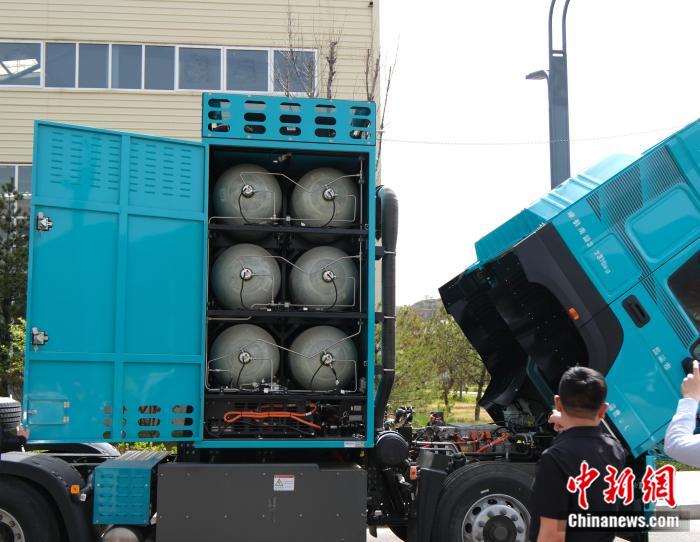
氢腾燃料电池

Search documents
绿氢,为何成为未来产业和新兴能源载体?
国家能源局· 2026-03-22 03:27
Core Viewpoint - The article emphasizes the strategic importance of green hydrogen as a key component in the future energy landscape, highlighting its role in achieving carbon neutrality and its potential for widespread application across various industries [1][2][5]. Group 1: Future Industries and Green Hydrogen - The Chinese government is focusing on future industries, including hydrogen energy, as part of its development strategy, with green hydrogen being identified as a crucial energy carrier [1][2]. - Green hydrogen is derived from renewable energy sources and is essential for achieving carbon neutrality, serving as a zero-carbon fuel and raw material across multiple sectors [2][5]. Group 2: Advantages of Green Hydrogen - Green hydrogen offers significant advantages over hydrogen produced from fossil fuels, including lower costs, higher efficiency, and no carbon emissions during production [5][6]. - The storage costs for hydrogen are significantly lower than those for energy storage batteries, making it a viable option for large-scale renewable energy storage [5][6]. Group 3: Applications of Hydrogen Energy - Hydrogen can be utilized in various applications, including hydrogen storage, as a raw material in chemical and metallurgical industries, and in hydrogen-powered systems such as fuel cells for vehicles and machinery [6][7]. - The development of hydrogen fuel cells has advanced significantly, with applications expanding to various sectors, including transportation and industrial machinery [7][8]. Group 4: Technological Breakthroughs - The hydrogen energy technology chain includes multiple stages such as renewable energy generation, hydrogen production, storage, and application, requiring a comprehensive technological framework [8][10]. - China has made progress in developing alkaline electrolysis technology for hydrogen production, with plans to establish a complete industrial chain by 2025 [8][11]. Group 5: Commercialization Challenges - The commercialization of green hydrogen faces challenges due to the complexity of its production, transportation, storage, and utilization processes, necessitating technological advancements and integration across various energy forms [11][12]. - Strategies for large-scale commercialization include utilizing surplus renewable energy for hydrogen production and integrating hydrogen with electricity and thermal energy systems [11][12]. Group 6: Innovative Projects - Recent breakthroughs include the development of a pure hydrogen gas turbine that can operate stably, significantly reducing carbon emissions compared to traditional power generation methods [14]. - The "Hydrogen Teng" fuel cell developed for extreme environments demonstrates the versatility and reliability of hydrogen technology, with potential applications in various sectors [15].


济南起步区今年将新开工建设一批新能源汽车产业项目
Qi Lu Wan Bao Wang· 2025-08-28 03:12
Group 1 - Jinan city is implementing the "Industrial Strong City Development Strategy" with a focus on advanced manufacturing projects in the new energy vehicle sector, aiming to accelerate the emergence of a trillion-yuan industrial cluster [1] - The new energy vehicle base of BYD in Jinan has produced eight models, contributing nearly 100 billion yuan in output value since its establishment in 2022 [1] - The Aishuo Solar Energy project has achieved a light-to-electricity conversion efficiency of over 24.4%, leading the international commercial component efficiency rankings for 30 consecutive months [1] Group 2 - The National Power Investment's hydrogen energy industrial base project is operating three production lines with an annual capacity of 1,000 units each for various fuel cells, expanding hydrogen energy applications [2] - The "Hydrogen Teng" fuel cell has been successfully deployed at the Antarctic Qinling Station, and commercial vehicles using fuel cells from the start-up area have been promoted in Shandong, Henan, and Hebei [2]

济南起步区目前已建在建绿色建筑约1400万平方米
Qi Lu Wan Bao Wang· 2025-07-12 02:10
Group 1: Environmental Initiatives - The Jinan Starting Area has been recognized as a national pilot for coordinated innovation in pollution reduction and carbon reduction, effective from December 2023 [1] - The area has achieved significant results in clean production audits, with nitrogen oxide emissions reduced by 15.8% and greenhouse gas emissions reduced by 18.6% [3] - The electrification rate of forklifts in the area has reached over 60%, and 77 non-operational vehicles meeting the National III emission standard have been eliminated [3] Group 2: Energy Transition - The total installed capacity of photovoltaic systems in the area has reached 37.1 MW, resulting in an annual reduction of 35,000 tons of greenhouse gases [5] - The "Hydrogen into Thousands of Homes" demonstration project has deployed 40 hydrogen heavy trucks and 16 hydrogen sanitation vehicles, reducing greenhouse gas emissions by 2,600 tons annually [5] - The area has developed a new comprehensive energy station, achieving full green electricity and zero carbon emissions [5] Group 3: Green Building Development - The area has established guidelines for green building design, requiring new constructions to meet at least a two-star green building standard [5] - Approximately 14 million square meters of green buildings are currently under construction, with high-star green buildings accounting for 78% of this total [5] - The Zero Carbon Smart Operation Center has been awarded the "Global Habitat Planning and Design Award" and is expected to generate 950,000 kWh annually upon operation [5] Group 4: Green Industry Growth - The area is actively developing the new energy vehicle industry and has launched a 10 GW high-efficiency solar cell production line [7] - The first pilot production line for perovskite solar cells in the province has been established, contributing to the upgrade of the energy structure [7] - The hydrogen energy industry is also being promoted, with the "Hydrogen Teng" fuel cell produced by Jinan Green Energy Company being utilized in international applications [7]
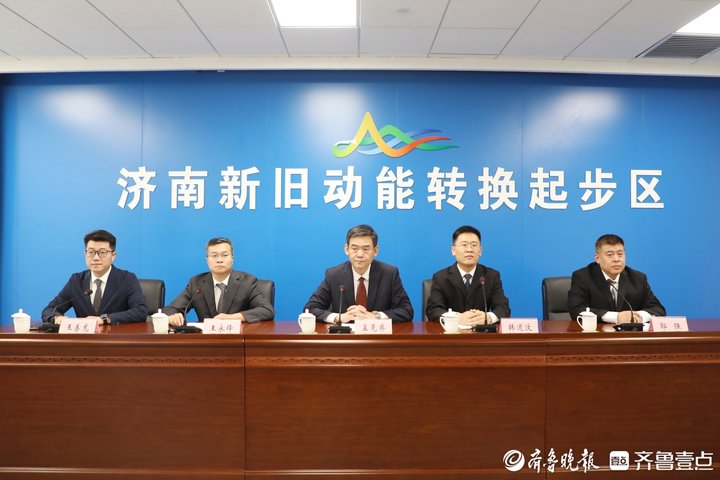
济南起步区推进减污降碳协同创新试点工作
Zhong Guo Jin Rong Xin Xi Wang· 2025-07-11 09:56
Group 1: Green Development Initiatives - Jinan is advancing the construction of a green, low-carbon, high-quality development pilot area, with significant progress in the new and old kinetic energy conversion zone [1] - The city has organized over 20 construction material companies to conduct clean production audits, achieving a reduction of nitrogen oxides by 15.8% and greenhouse gases by 18.6% [1] - Key enterprises are enhancing their clean production levels, with Jinan Dali Food replacing gas boilers with green steam and Jinan BYD achieving environmental performance standards [1] Group 2: Energy Transition - The region is focusing on energy transition by developing a low-carbon, efficient energy system, with a photovoltaic installed capacity reaching 37.1 MW, reducing greenhouse gas emissions by 35,000 tons annually [2] - The "Hydrogen into Thousands of Homes" demonstration project has deployed 40 hydrogen heavy trucks and 16 hydrogen sanitation vehicles, contributing to a reduction of 2,600 tons of greenhouse gases each year [2] - Shallow geothermal energy systems are being developed, with annual greenhouse gas reductions of 3,800 tons from the operation of innovative centers [2] Group 3: Green Building Development - Policies have been established to promote green building design and new construction technologies, requiring new buildings to meet at least two-star green building standards [2] - Approximately 14 million square meters of green buildings are currently under construction, with 78% being high-star-rated green buildings [2] - The International Standard Industrial Park's zero-carbon smart operation center has won a global award and is expected to generate 950,000 kWh annually [2] Group 4: Green Low-Carbon Industry - The city is actively developing the new energy vehicle industry, with Jinan BYD's products reaching numerous households [3] - The photovoltaic battery industry is expanding, with the launch of a 10 GW high-efficiency solar cell production line by Aishuo and a pilot production line for perovskite solar cells [3] - The hydrogen energy sector is also growing, with Jinan Green Energy Hydrogen Company producing fuel cells that are operational in remote locations [3]
碳路中国 | 中国氢能驶入快车道:3650万吨背后的绿色引擎
Zhong Guo Xin Wen Wang· 2025-06-07 05:10
Core Viewpoint - The hydrogen energy industry in China is transitioning from a conceptual stage to practical application, particularly in resource-rich cities like Lüliang, which is leveraging its abundant resources to develop a comprehensive hydrogen energy ecosystem [1][5][6]. Group 1: Industry Development - Lüliang has a significant annual production capacity of 38 million tons of coke and 3.5 billion cubic meters of unconventional natural gas, providing ample raw materials for hydrogen production [2]. - The local government has introduced 15 policy measures to support the hydrogen industry, including an annual funding of no less than 100 million yuan for hydrogen energy initiatives [4]. - Lüliang has established a hydrogen production capacity of 130,000 tons and operates 11 hydrogen refueling stations, with over 600 hydrogen fuel vehicles in operation [4]. Group 2: National Strategy - China's hydrogen energy development is guided by a long-term plan established in 2022, with over 560 hydrogen-related policies implemented across 22 provincial regions by 2024 [6][7]. - By 2024, China's hydrogen production and consumption scale is projected to reach 36.5 million tons, making it the largest globally, contributing over half of the world's renewable hydrogen production capacity [6][7]. Group 3: Market Dynamics - The global investment in clean hydrogen projects is expected to reach $75 billion by 2024, with the number of projects increasing significantly from 228 in 2020 to 1,572 [7]. - China has filed over 80,000 hydrogen-related patents, accounting for 27% of the global total, positioning itself as a leader in hydrogen technology [7]. Group 4: Practical Applications - Lüliang has successfully created a closed-loop network for hydrogen energy, integrating hydrogen extraction, purification, storage, and transportation for heavy-duty vehicles [8][9]. - The region's model of "hydrogen heavy trucks + long-distance transport" has proven commercially viable, significantly reducing operational costs and expanding to other regions [9][10].