
江淮钇为3

Search documents
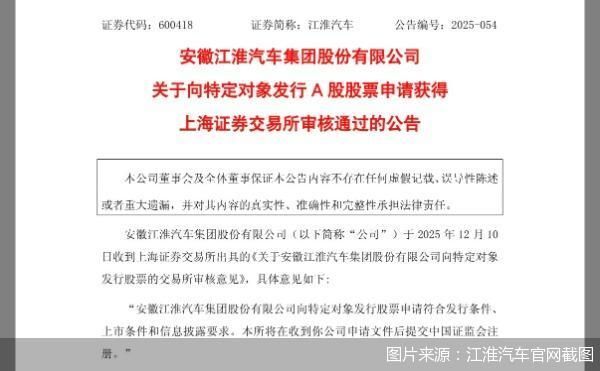
定增35亿元押注高端纯电,江淮汽车急于摆脱代工依赖症
Bei Jing Shang Bao· 2025-12-11 12:06
Core Viewpoint - Jianghuai Automobile is determined to pivot towards the high-end pure electric market to overcome its development challenges, as it has faced significant sales declines and operational losses in recent years [1][5][8]. Group 1: Financial Performance and Challenges - Jianghuai Automobile reported a 25.64% decline in new energy passenger vehicle sales in the first three quarters of the year, contributing to a cumulative loss exceeding 11 billion yuan over the past seven years [1][5]. - The company’s revenue for the first three quarters of 2025 was 30.87 billion yuan, a 4.14% year-on-year decrease, with a net profit loss of 1.43 billion yuan, marking a 329.43% decline compared to the previous year [5][6]. - The company has initiated a business integration strategy to unify its passenger vehicle brands, including MPVs and new energy vehicles, in response to ongoing financial pressures [5][6]. Group 2: Strategic Initiatives - Jianghuai Automobile plans to raise up to 3.5 billion yuan through a private placement to fund the development of a high-end intelligent electric platform, which is seen as crucial for its future growth [1][3][8]. - The new platform aims to support the development of a new generation of high-end intelligent electric vehicles, including sedans, SUVs, and MPVs [3][8]. - The company is collaborating with high-tech firms like Huawei to enhance its technological capabilities and product offerings [1][8]. Group 3: Market Position and Competition - Jianghuai's commercial vehicle segment has historically been its strength, accounting for 46.7% to 54.97% of revenue from 2023 to mid-2025, while the passenger vehicle segment has been a follower in the industry [2][5]. - The company’s reliance on oil-to-electric conversion technology has hindered its competitiveness in the new energy vehicle market, particularly against leading brands [2][8]. - Jianghuai's previous dependence on contract manufacturing for NIO has limited its investment in independent R&D, with R&D expenditures consistently around 4%-5% of revenue [7][8]. Group 4: Future Outlook - The high-end electric platform is viewed as Jianghuai's last hope for breaking through technological barriers and transitioning towards high-end electrification [8]. - The company aims to reduce its reliance on contract manufacturing and enhance its core technology development to avoid being constrained by external partners [8].


绿色引擎驶入乡野 五部门联合启动2025年新能源汽车下乡活动
Zheng Quan Ri Bao Wang· 2025-06-04 06:12
Core Viewpoint - The 2025 New Energy Vehicle (NEV) initiative aims to enhance rural transportation by promoting the adoption of NEVs, focusing on a green, low-carbon, intelligent, and safe travel system for rural residents [1][3]. Group 1: Initiative Overview - The initiative will feature 124 selected NEV models that meet rural needs, with activities including exhibitions and test drives [1][2]. - The program encourages collaboration among NEV manufacturers, service providers, and financial institutions to create integrated promotional schemes [1][2]. Group 2: Technological and Service Innovations - The initiative introduces an "online + offline dual-track" model to improve service accessibility in rural areas, utilizing cloud sales and live streaming for customer engagement [2]. - V2G technology will be implemented, allowing electric vehicles to interact with the grid, thus enhancing energy management and supporting renewable energy integration [2][3]. Group 3: Market Dynamics and Trends - The number of participating vehicle models has increased from 16 in 2020 to 124 in 2025, with a notable shift towards mid-to-high-end models [3]. - Despite a national NEV penetration rate of nearly 40%, rural areas lag behind with less than 20%, indicating significant growth potential in these markets [3]. Group 4: Economic and Ecological Impact - The initiative combines government subsidies and corporate discounts to lower the effective price of entry-level models to around 30,000 yuan, addressing agricultural transport needs [4]. - The program promotes the development of rural-specific vehicle models and integrates distributed energy resources into smart rural grids, contributing to carbon neutrality goals [4].
