汽车修补漆

Search documents
PPG四季度盈利未达预期
Zhong Guo Hua Gong Bao· 2026-02-02 03:21
Core Viewpoint - PPG Industries reported a significant year-on-year increase in net profit for Q4 2025, but adjusted earnings per share decreased by 6% to $1.51, falling short of market expectations of $1.58, indicating a cautious outlook on global industrial demand [1] Financial Performance - PPG achieved net sales of $3.91 billion in Q4, representing a 5% year-on-year growth [1] - Sales growth was observed across all regions, with industrial coatings sales increasing by 3% to $1.64 billion, high-performance coatings sales rising by 5% to $1.32 billion, and architectural coatings sales growing by 8% to $0.951 billion [1] Market Challenges - The decline in automotive refinish paint sales negatively impacted overall profitability, highlighting structural differentiation in end-market demand [1] - The CEO, Tim Knavish, indicated that demand in the European and global industrial end markets is expected to continue facing challenges [1] Growth Drivers - Future growth momentum is anticipated to come primarily from the aerospace coatings market, the Mexican architectural coatings market, and an increase in market share within the industrial coatings sector [1] - The company expects organic product sales to remain flat or achieve low single-digit growth for the year, with performance concentrated in the second half [1]

3440万辆创纪录!2025中国汽车产销引爆涂料行业百亿赛道
Xin Lang Cai Jing· 2026-01-15 14:09
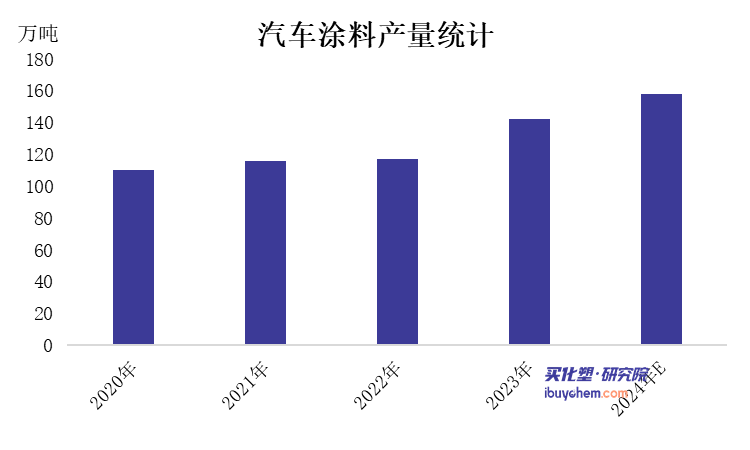
Core Insights - The Chinese automotive industry achieved a production and sales volume of 34.53 million and 34.40 million vehicles in 2025, marking a year-on-year growth of 10.4% and 9.4%, respectively, maintaining its position as the world's largest market for 17 consecutive years [1][27] - New energy vehicles (NEVs) reached a production and sales volume of 16.63 million and 16.49 million units, leading the global market for 11 years, with domestic new car sales accounting for 47.9% [1][27] - The automotive industry's growth has significantly boosted the upstream coatings industry, with an expected production of 1.74 million tons of automotive coatings and a market value of 64.5 billion yuan in 2025 [1][27] Automotive Coatings Market Overview - The automotive coatings market is segmented into original equipment manufacturer (OEM) coatings (44%), repair coatings (26%), component coatings (18%), and other coatings (12%) [3][30] - The OEM coatings market in China is projected to grow to approximately 28.5 billion yuan, with domestic brands increasing their market share in commercial vehicles to over 40% [4][32] - The repair coatings market is valued at around 16.8 billion yuan, with both domestic and foreign brands coexisting [4][32] Demand and Growth Drivers - The automotive coatings sector is closely tied to the automotive industry's performance, with passenger vehicle production and sales surpassing 30 million units for the first time in 2025, driving strong demand for coatings [7][34] - The commercial vehicle market is also recovering, with production and sales exceeding 4 million units, contributing to the growth of related coatings products [7][34] - Exports of Chinese vehicles exceeded 7 million units in 2025, a year-on-year increase of 21.1%, with NEV exports doubling to 2.615 million units, further stimulating coatings demand [7][34] Company Performance - In the first three quarters of 2025, Matsui's passenger vehicle coatings revenue surged by 87.57% to 149 million yuan, while Nippon Paint's automotive coatings revenue reached 1.995 billion yuan, up 4.4% [11][38] - BASF's Shanghai coatings division reported a revenue of 2.298 billion yuan in the first half of 2025, reflecting a 3.1% increase [11][38] - Domestic companies such as Donglai Technology, Jinlitai, and Yatu Gaoxin also reported revenue growth of over 5% [11][38] New Energy Vehicles and Functional Coatings - NEVs are driving a revolution in materials and processes, with a penetration rate approaching 50%, creating new demands for specialized coatings [14][41] - The need for protective coatings for power batteries requires extreme insulation, flame resistance, corrosion resistance, and thermal conductivity, leading to the emergence of a high-value segment for battery coatings [14][41] - The use of lightweight materials like aluminum and carbon fiber in NEVs presents new challenges for coatings in terms of adhesion and flexibility [14][41] Policy and Technological Drivers - Stricter environmental policies are pushing the industry towards greener technologies, with a focus on low-VOC coatings becoming mainstream [17][44] - The 2025 Central Economic Work Conference emphasized promoting green development, leading to the adoption of water-based and high-solid coatings [17][44] - Technological innovations driven by consumer demand for quality and safety are accelerating the development of high-value products such as self-repairing coatings and low-VOC interior coatings [19][46] Supply Chain and Domestic Market Dynamics - Foreign brands have historically held a 60% market share in China's automotive coatings market, dominating over 80% in high-end segments [22][49] - Recent strategic investments by major automotive manufacturers in domestic coatings companies are breaking this trend, providing local firms with valuable validation and order guarantees [23][50] - The "14th Five-Year Plan" encourages the development of strategic emerging industries, creating opportunities for domestic companies to accelerate their growth in the NEV sector [23][50] Future Outlook - The China Automotive Industry Association predicts that automotive sales will reach 34.75 million units in 2026, with NEV sales at 19 million units and exports at 7.4 million units [24][51] - Future competition will focus on environmental compliance, NEV market positioning, and supply chain autonomy [24][51] - The automotive coatings industry is transitioning from scale growth to high-quality development, with domestic brands poised to reshape the global competitive landscape [24][51]

数据差一倍,回款说不清,研发掺水分!雅图高新“带病”三闯IPO
Hua Xia Shi Bao· 2025-12-26 09:52
Core Viewpoint - Yatu High-Tech's financial data, particularly regarding its overseas income from the Russian market, has raised significant concerns due to discrepancies exceeding 100% compared to official statistics, leading to questions about the authenticity of its revenue and overall financial health [3][4][11] Financial Discrepancies - Yatu High-Tech's revenue from 2022 to 2024 is projected to grow from 554 million to 741 million yuan, with overseas sales consistently accounting for over 50% of total revenue, primarily driven by high-margin sales in Russia [3] - The reported income from the Russian market shows a staggering difference of 101.66% compared to data from the Russian tax authority, indicating potential issues with revenue recognition or data accuracy [4][5] Concerns Over Revenue Authenticity - A financial expert highlighted that the significant discrepancies in both revenue and asset data (with a 51.74% difference in asset totals) suggest deeper financial issues, such as asset inflation or improper cost accounting [4] - Yatu High-Tech's explanation for the discrepancies, attributing part of the revenue to direct exports rather than local subsidiaries, has not alleviated external concerns regarding the validity of its income [4][11] Third-Party Payment Anomalies - The company has reported a high proportion of third-party payments, peaking at 38% of total revenue, which is notably higher than industry peers, raising alarms about potential irregularities in financial practices [7][8] - The increase in third-party payments from overseas clients, particularly in Russia, has been attributed to foreign exchange controls, but the lack of proper documentation for these transactions has intensified scrutiny [7][8] R&D Expense Controversies - Yatu High-Tech's accounting treatment of R&D expenses has come under fire, particularly for including finished products in the "material consumption" category, which is atypical and raises questions about the legitimacy of reported R&D expenditures [9][10] - The significant fluctuations in the amounts reported for finished products versus raw materials over the years suggest possible manipulation of financial data to meet listing requirements [10] Regulatory Scrutiny - The North Exchange has expressed concerns about the authenticity of Yatu High-Tech's overseas revenue and has mandated a broader investigation into the company's financial flows, reflecting heightened regulatory vigilance [11] - As Yatu High-Tech progresses in its IPO journey, it faces not only regulatory inquiries but also the need to address investor skepticism regarding its financial integrity and governance practices [11]

【聚焦】阿克苏诺贝尔与艾仕得合并:能否改写全球格局?对同行带来哪些影响?
Sou Hu Cai Jing· 2025-12-02 04:44
Core Viewpoint - The merger between AkzoNobel and Axalta is set to create a leading global paint company valued at approximately $25 billion, significantly impacting the global coatings industry and its competitors [1][4]. Group 1: Merger Background - The merger discussions between AkzoNobel and Axalta date back to 2013, with AkzoNobel previously considering acquiring Axalta's high-performance coatings division [3]. - In 2017, AkzoNobel attempted to negotiate a merger with Axalta, but talks were halted due to Axalta's high asking price [3]. - Prior to the COVID-19 pandemic, Axalta was close to being acquired by PPG and private equity firm Clayton Dubilier for around $7.5 billion [4]. Group 2: Merger Details - The merger will be executed as an equal all-stock transaction, with AkzoNobel shareholders owning 55% and Axalta shareholders owning 45% of the new company [4][6]. - The combined sales revenue for 2024 is projected to be approximately $17 billion, positioning the new entity as the second-largest paint manufacturer globally, surpassing PPG [6][12]. Group 3: Market Position and Impact - The merger will create a company with a diverse product portfolio, including powder coatings, automotive coatings, and decorative paints, supported by 173 manufacturing plants and 91 R&D facilities globally [12]. - The new company will have a significant presence in key markets, particularly in automotive OEM coatings and automotive refinish markets, enhancing its competitive position [12][20]. - The merger is expected to reshape the competitive landscape, creating a leadership group of four major suppliers: Sherwin-Williams, PPG, AkzoNobel/Axalta, and Nippon Paint [19][20]. Group 4: Financial Performance and Projections - The projected revenue breakdown for the new company includes automotive refinish coatings at approximately $3.04 billion, decorative coatings at about $4.56 billion, and industrial coatings at around $3.04 billion [13][16]. - In the EMEA region, the new company is expected to generate about $7.27 billion, with significant revenue growth anticipated across all major regions [17][19].

美特化品企业三季度盈利艰难回升
Zhong Guo Hua Gong Bao· 2025-11-10 02:56
Core Insights - The major specialty chemicals producers in the U.S. reported challenging third-quarter earnings, with weak sales growth despite resilient end-market demand [1] Group 1: Sherwin-Williams - Sherwin-Williams reported a net profit increase of 3.3% year-over-year to $833.1 million, with net sales rising 3.2% to $6.36 billion [1] - Adjusted earnings per share (EPS) were $3.59, a 6.5% increase, exceeding analyst expectations of $3.44 [1] - The company narrowed its full-year adjusted EPS guidance from $11.20-$11.50 to $11.25-$11.45, with a projected adjusted EPS of $11.33 for 2024 [1] Group 2: Ecolab - Ecolab's net profit decreased due to last year's sale of its surgical equipment business; excluding this impact, adjusted EPS was $2.07, a 13% increase, meeting analyst expectations [1] - CEO Christophe Beck noted growth was driven by accelerated value pricing, volume growth, and strong operating margin expansion [1] - The company lowered its full-year adjusted EPS guidance to $7.48-$7.58, citing geopolitical and international trade policy impacts on short-term demand [1] Group 3: PPG Industries - PPG Industries achieved flat net profit with a slight sales increase; adjusted EPS was $2.13, surpassing analyst expectations of $2.08 [2] - Sales volume and price each increased by 1%, but the company lowered its full-year adjusted EPS guidance from $7.75-$7.85 to $7.60-$7.70 [2] - CEO Tim Knavish highlighted weakness in the automotive refinish paint business due to rising insurance rates affecting claims [2] Group 4: Axalta Coating Systems - Axalta reported an 8% increase in net profit to $11 million, despite a 2% decline in net sales to $1.3 billion [2] - Adjusted EPS grew by 6% to $0.67, exceeding analyst expectations of $0.64 [2] - The company revised its 2025 full-year sales forecast down to approximately $5.1 billion, from a previous range of $5.2 billion to $5.28 billion [2] Group 5: NXP Semiconductors - NXP Semiconductors reported a net profit of $70.5 million, a 10% year-over-year decline due to rising costs and unfavorable operating conditions [3] - Adjusted EPS was $0.72, down 6.5% and slightly below analyst expectations [3] - The company expects fourth-quarter sales to reach between $790 million and $830 million [3] Group 6: Stepan Company - Stepan Company reported a net profit of $10.8 million, a 54% year-over-year decline due to higher effective tax rates, depreciation, and interest [3] - Adjusted EPS was $0.48, down 53% and 22.5% lower than analyst expectations [3] - Despite a price increase and 1% volume growth, net sales increased by 8% to $590 million [3] Group 7: Formosa Plastics - Formosa Plastics reported third-quarter sales revenue of $542 million, a 49% year-over-year decline [3] - The company reported an adjusted GAAP net loss of $569 million [3] - Adjusted EBITDA was $236 million, a 17% increase [3]
雅图高新:毛利率连升 募投项目锚定长远增长
Zheng Quan Shi Bao Wang· 2025-10-20 04:57
Core Viewpoint - Yatu High-tech (872924.BJ) is set to go public on the Beijing Stock Exchange, showcasing strong financial performance and a solid growth strategy in the automotive repair paint sector, highlighting its long-term investment value [2][3]. Financial Performance - The company's gross profit margin is projected to increase from 35.39% in 2022 to 44.00% in 2024, driven by revenue growth from high-margin regions (mainly the U.S. and Russia), product structure upgrades, and effective raw material cost control [2]. - By the end of 2024, the company expects to have cash reserves of 370 million yuan, ensuring sufficient funds for business expansion [2]. - The net cash flow from operating activities is expected to exceed 350 million yuan from 2022 to 2024, indicating robust cash flow health [2]. - For the first nine months of 2025, the company forecasts revenue between 570 million to 610 million yuan, with net profit expected to be between 115 million to 125 million yuan, reflecting a year-on-year growth of 9.68%-17.38% and 11.57%-21.27% respectively, indicating strong growth certainty [2]. Industry Position - Yatu High-tech ranks third in the "Top 5 Automotive Repair Paint Brands in China" published by "Coating World," following international giants PPG and Axalta, showcasing its strong market position as a leading domestic brand [3]. - The company plans to raise 431 million yuan for five core projects, including the construction of a water-based paint intelligent production line to alleviate current capacity bottlenecks, and an upgraded R&D center focusing on low VOCs and new energy vehicle coatings [3]. - The digital integration center project aims to enhance supply chain and customer service efficiency, creating a synergistic growth pattern of "capacity + technology + channels" to further solidify its advantage in the automotive repair paint sector and explore new market opportunities in automotive interiors and rail transit coatings [3].
企业价值77亿欧元!巴斯夫出售重要业务多数股权
Xin Lang Cai Jing· 2025-10-11 04:58
Core Viewpoint - BASF has reached a binding agreement to sell the majority stake of its coatings business to a global investment firm, Carlyle Group, and Qatar Investment Authority for an enterprise value of €7.7 billion, expected to be completed by Q2 2026 [1] Group 1: Transaction Details - The transaction involves BASF's automotive original equipment manufacturer (OEM) coatings, automotive refinish coatings, and surface treatment business [1] - The total valuation of BASF's coatings business, including previously divested decorative coatings, is projected to be €8.7 billion [1] - Post-transaction, BASF will retain a 40% stake in the coatings business and will receive approximately €5.8 billion in pre-tax cash proceeds [1] Group 2: Business Overview - BASF's coatings business includes advanced solutions for automotive OEM coatings, automotive refinish coatings, and surface treatment products for metal, plastic, and glass substrates across various industries [1] - The business has a geographical presence in Europe, North America, South America, and Asia-Pacific, with projected sales of approximately €3.8 billion in 2024 [1] Group 3: Strategic Implications - This transaction is a significant step in BASF's "Winning with Purpose" corporate strategy aimed at unlocking the value of its "self-managed" businesses [1] - BASF plans to collaborate closely with Carlyle to enhance customer orientation and support the future development of the coatings business through ongoing investments in commercial operations, innovation projects, and organizational structure [1]

634亿!巴斯夫,再出售业务
DT新材料· 2025-10-10 16:04
Core Insights - BASF has entered into a binding agreement with Carlyle Group and Qatar Investment Authority (QIA) for the sale of its automotive coatings and surface treatment business, valued at €7.7 billion (approximately ¥63.44 billion), expected to close in Q2 2026 [2] - This transaction follows the sale of BASF's decorative coatings business in Brazil, Suvinil, and together, these projects value BASF's entire coatings division at €8.7 billion, with an enterprise value multiple of approximately 13 times [2] - The sale is part of BASF's strategic initiative to unlock value from its "self-owned business," while retaining a 40% stake in the coatings business and receiving about €5.8 billion in pre-tax cash proceeds upon completion [2] Business Operations and Future Plans - Carlyle will collaborate closely with BASF's management to enhance customer orientation and support the future development of BASF's coatings business through continuous investment in operational capabilities and innovation [3] - On October 8, BASF announced the launch of a new production line at its facility in Dilovası, Turkey, aimed at producing low VOC dispersions for construction coatings, addressing the growing demand in Turkey, the Middle East, and North Africa [3] - The new production line will utilize green electricity and a quality balance approach to reduce carbon footprint [3] Strategic Restructuring - BASF is simultaneously divesting from large-scale but potentially slow-growing or highly competitive end markets while concentrating resources on higher-margin specialty chemicals and green technologies [4] - The company is enhancing the resilience of its coatings raw material supply chain through expansions and upgrades at various sites in China, including Zhanjiang, Shanghai, Nanjing, and Chongqing [4]

亚太涂料产业复苏向“绿”
Zhong Guo Hua Gong Bao· 2025-09-16 03:02
Core Insights - The Asia-Pacific paint industry is experiencing a recovery, with a focus on "green" and "sustainable" development as key themes for future growth [2][3] Market Growth Trends - The Asia-Pacific region shows significant growth in the paint industry, with varying trends across countries. Vietnam's paint production is expected to reach 493 million liters in 2024, a year-on-year increase of 8.34% [3] - Malaysia's paint market has a compound annual growth rate (CAGR) of 13.6% since 2018, with an estimated total production of 495 million liters in 2024 [3] - Indonesia's paint market is projected to maintain steady growth, with an expected production of 105,860 tons in 2025, where water-based paints will account for nearly 70% [3] - The Philippines anticipates a growth of 4% to 6% in its paint industry by 2026, driven by protective, marine, and powder coatings [3] Global Market Projections - The global paint market is expected to see a CAGR of 3.0% in volume and 5.8% in sales revenue over the next five years, reaching 56.7 billion liters and $267 billion by 2029 [4] Policy and Demand Drivers - Government infrastructure and renovation projects are significant drivers for the paint industry in the Asia-Pacific region. Singapore's government has allocated SGD 60 million for promoting heat-reflective coatings by 2030 [5] - Indonesia's "3 million housing plan" aims to provide affordable housing for low-income groups, boosting local paint demand [5] - The Philippines' paint industry growth is supported by substantial government infrastructure investments, creating demand for high-performance protective coatings [5] Focus on Sustainability - The paint industry is increasingly emphasizing environmental friendliness. Australia's Paintback recycling program has processed over 56,000 tons of waste paint and packaging since its launch in 2016 [6] - Japan's paint industry is working towards carbon neutrality by 2050, with a focus on reducing CO2 emissions from the paint manufacturing sector, which is approximately 190,000 tons per year [7] - Several countries in the region are moving towards eliminating certain chemical components in paints, with Malaysia banning lead paints in 2020 and Indonesia and Vietnam progressing towards lead-free markets [7]
基础化工行业研究:多产品价格持续上行,地缘风险溢价上升
SINOLINK SECURITIES· 2025-06-15 07:47
Investment Rating - The report suggests a cautious outlook on the chemical industry, with a focus on price increases for specific products and potential investment opportunities in companies like Kangkuan and nitrated cotton [1][2]. Core Insights - The chemical market is experiencing price increases, with notable price adjustments for products such as chlorantraniliprole and Bacillus thuringiensis, indicating a favorable pricing environment [1][2]. - Geopolitical tensions, particularly the Iran-Israel conflict, have led to increased oil prices, which in turn affects the chemical sector positively by raising the prices of related products like methanol and strontium carbonate [2][3]. - The report highlights significant events impacting the industry, including the launch of a new production facility by China Pingmei Shenma Group, which could alter the competitive landscape in the nylon industry [3][4]. Summary by Sections Market Overview - The basic chemical index fell by 0.01%, outperforming the CSI 300 index by 0.24% this week, with strong performances from specific stocks [1][11]. - Brent crude oil averaged $69.45 per barrel, up 6.22% week-on-week, while WTI crude oil averaged $67.89 per barrel, up 7.17% [11]. Key Events - The report notes the successful negotiation of a major potassium fertilizer contract at $346 per ton, indicating a positive outlook for the potassium fertilizer market [1]. - The establishment of a new 100,000 tons/year production facility by China Pingmei Shenma Group marks a significant development in the nylon supply chain [3]. Price Movements - The report tracks price changes for various chemical products, with significant increases noted in sectors such as textile chemical products and compound fertilizers [11][12]. - The report indicates that the prices of methanol and strontium carbonate are gaining attention due to their correlation with rising oil prices [2][11]. Industry Trends - The report emphasizes the ongoing recovery in domestic and international demand for chemicals, particularly in the tire and rubber sectors, which are seeing a resurgence in production rates [27][28]. - The AI industry is also highlighted, with significant investments being made, indicating a broader trend of technological integration within the chemical sector [4].