
活力苏口服液

Search documents
去芜存菁 中药提质焕新生(大健康观察)
Ren Min Ri Bao· 2026-02-02 19:29
Core Viewpoint - A significant number of traditional Chinese medicine (TCM) products are expected to exit the market due to new regulations from the National Medical Products Administration, which will enforce stricter quality controls and require clearer safety information in product descriptions by July 2026 [1][2]. Regulatory Changes - The new regulations will not only affect the re-registration of TCM products but will also extend the regulatory scope to the entire production process, indicating a comprehensive tightening of quality oversight in the industry [1][3]. - As of May 2023, there are approximately 2,400 TCM manufacturers in China, with around 57,000 approved product numbers, but only about 40,000 are actively sold and have a significant market presence [2]. Impact on Market - The upcoming regulatory changes primarily target products with incomplete clinical safety data, low market share, or those that have not been produced for an extended period, suggesting minimal impact on the general public's access to TCM [2]. - Many TCM products that have established market presence and clinical usage are expected to meet the new requirements, as they have already undergone safety evaluations [2]. Quality Control - The new regulations aim to eliminate non-compliant and immature products from the market, thereby enhancing the overall quality of TCM available to consumers [3]. - Issues such as inconsistent quality due to varying production standards among numerous manufacturers are highlighted, emphasizing the need for stricter regulatory measures [3]. Importance of Product Descriptions - The significance of well-written product descriptions for TCM is underscored, as they must clearly communicate contraindications and potential interactions with Western medicines to avoid adverse effects [4][5]. - Recommendations include using clear and accessible language in product descriptions to ensure that patients and healthcare providers can easily understand the information [5]. Integration of TCM and Western Medicine - The integration of TCM and Western medicine is becoming more prevalent, with many Western practitioners learning to effectively use TCM products [7]. - The approach to patient care emphasizes understanding individual patient needs and avoiding unnecessary polypharmacy by selecting the most appropriate treatment options [7][8]. - TCM is increasingly adapting to modern medical practices, with efforts to align traditional remedies with contemporary scientific understanding [8]. Future Outlook - The ongoing regulatory improvements and the deepening collaboration between TCM and Western medicine are expected to enhance the vitality of TCM, contributing to both national health and global medical knowledge [8].
大批中成药将被淘汰
第一财经· 2026-01-27 13:47
Core Viewpoint - The article discusses the impending implementation of the State Drug Administration's regulations on traditional Chinese medicine (TCM) registration, which will significantly impact the market by eliminating over 70% of existing TCM products that lack clear safety information in their labeling [1][3]. Summary by Sections - The new regulation, referred to as the "life and death clause" for TCM, will take effect on July 1, 2026, and mandates that any TCM product with unclear safety information in its instructions will not be eligible for re-registration after three years from the regulation's enforcement [1][3]. - Currently, approximately 57,000 TCM products have valid approval numbers, with over 70% facing potential elimination due to safety information issues [1][3]. - A study indicated that in the 2018 version of the National Essential Medicines List, only 20.64% of TCM products had adverse reaction labels, 30.1% had contraindications, and a mere 1.07% addressed drug interactions, highlighting the reliance on vague statements for market circulation [1][3]. - The regulatory changes are aimed at ending the era of ambiguous disclaimers in TCM product labeling, compelling manufacturers to provide comprehensive post-marketing safety data [1][3]. - In addition to labeling requirements, the regulatory scope will extend to the entire TCM industry chain, with new regulations on the production supervision of TCM set to be enforced on March 1, 2026, raising industry entry barriers [4].


大批中成药将退出市场
2 1 Shi Ji Jing Ji Bao Dao· 2026-01-27 10:01
Core Viewpoint - The new regulations from the National Medical Products Administration (NMPA) will lead to the elimination of a significant number of traditional Chinese medicine (TCM) products from the market, with over 70% of existing approvals facing potential cancellation due to safety information issues [2][11]. Regulatory Changes - The "death clause" for TCM, effective from July 1, 2023, mandates that any product with unclear safety information in its instructions will not be re-registered after three years [2]. - The NMPA has already begun revising product instructions, requiring core safety information to be added to many commonly used TCM products [4]. - A new regulation on TCM production supervision will take effect on March 1, 2026, raising industry entry barriers and imposing stricter requirements on the entire supply chain [4]. Industry Impact - The TCM industry is experiencing a stark divide, with leading companies like Baiyunshan generating revenues of 61.606 billion yuan, while smaller firms struggle with revenues around 6 million yuan [6]. - The cost of compliance for smaller firms is substantial, with estimates suggesting that a traditional TCM product may require an investment of 20 million yuan over three years to meet safety data requirements [6]. - Major companies are proactively streamlining their product lines and focusing on core products, while many smaller firms are left with difficult choices regarding their market presence [6][12]. Market Dynamics - The regulatory changes are expected to lead to a significant consolidation in the TCM market, with predictions that 30% to 40% of TCM approvals may exit the market within the next 3 to 5 years [11][12]. - The dual approach of price regulation and re-registration requirements is tightening the market for low-quality TCM products, further reducing their viability [9][10]. - The future TCM market will likely see increased entry barriers, with only products demonstrating clinical value being supported by insurance [12]. Strategic Responses - Companies are advised to focus on three main strategies: conducting real-world studies to support safety data, applying for new drug status for promising products, and voluntarily canceling low-value approvals [12]. - The industry is expected to prioritize quality over quantity, with a shift towards products that can withstand scientific scrutiny and meet patient needs [12].

中成药再注册大考进入半年倒计时
2 1 Shi Ji Jing Ji Bao Dao· 2026-01-27 09:01
Core Viewpoint - The new regulations from the National Medical Products Administration (NMPA) regarding traditional Chinese medicine (TCM) registration are set to significantly impact the industry, with over 70% of existing TCM products potentially facing elimination due to safety information issues in their labeling [1][5]. Regulatory Changes - The "death clause" in the new regulations mandates that any TCM product with unclear safety information in its labeling will not be approved for re-registration after July 1, 2026 [1]. - The NMPA has already begun implementing these regulations, requiring several commonly used TCM products to supplement core safety information for re-registration [2]. - A new set of regulations for TCM production supervision will take effect on March 1, 2026, raising industry entry barriers and imposing stricter requirements on the entire supply chain [2]. Industry Dynamics - The TCM industry is experiencing a stark divide between leading enterprises and smaller firms, with significant revenue disparities; for instance, the top company, Baiyunshan, reported revenues of 61.606 billion yuan, while smaller firms averaged around 6 million yuan [3]. - The cost of compliance for smaller firms is substantial, with estimates suggesting that a traditional TCM product may require an investment of at least 20 million yuan over three years to meet safety data requirements [3]. - Leading companies like Yunnan Baiyao and Tongrentang are proactively streamlining their product lines and focusing on core products backed by clinical data, while many smaller firms are left with limited options [3][4]. Market Trends - The regulatory changes are expected to lead to a significant increase in industry concentration, with predictions that leading firms will retain over 70% of their core products, while mid-tier companies may lose half of their approvals within two years [4]. - A nationwide price regulation initiative is underway, targeting low-quality TCM products and establishing minimum treatment costs for various medications [4]. - The dual approach of safety data requirements and price regulation is anticipated to further compress the market for low-quality TCM products, pushing the industry towards a focus on quality over quantity [5]. Strategic Responses - TCM companies are advised to pursue three main strategies: conducting real-world studies to enhance safety data, reclassifying promising products as improved new drugs, and voluntarily canceling low-value approvals to concentrate on core offerings [6]. - The future TCM market is expected to see heightened entry barriers, with products lacking safety data losing market access, and reimbursement mechanisms favoring clinically valuable products [6]. - The ongoing regulatory overhaul is viewed as an opportunity for the industry to shed low-quality products and focus on those that can withstand scientific scrutiny and gain patient trust [6].
华神科技董事长黄明良等被警示,涉会计核算不规范、内控制度不完善
Sou Hu Cai Jing· 2025-05-21 16:24
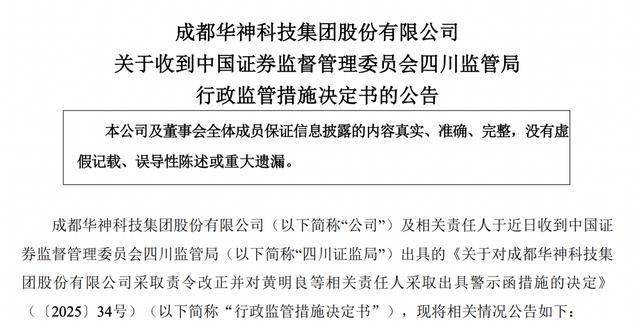
Core Viewpoint - Huasheng Technology (SZ000790) has received an administrative regulatory decision from the Sichuan Securities Regulatory Bureau due to various accounting and internal control issues, leading to a requirement for corrective measures and warnings issued to key executives [2][4][5]. Group 1: Accounting Issues - The company has been found to have irregular accounting practices, including misclassification of advertising expenses as intangible assets by its subsidiary Hainan Rongsheng Hong Technology Co., Ltd. in 2021 [2]. - In 2023, another subsidiary, Tibet Kangyu Pharmaceutical Co., Ltd., recognized revenue from medical device sales without actual transfer of control to customers, leading to subsequent returns [2]. - Additionally, sales expenses from Chengdu Yuanhong Mineral Water Co., Ltd. were incorrectly accounted for in other subsidiaries, affecting performance assessment accuracy [2]. Group 2: Non-operational Fund Occupation - In 2021, Hainan Huasheng Development Holding Co., Ltd., a subsidiary, prepaid non-main business contract funds, which were later returned after five months, during which some funds flowed into companies controlled by the actual controller, constituting non-operational fund occupation [3]. Group 3: Internal Control Deficiencies - The internal control systems of the subsidiaries are inadequate, with issues such as improper expense reimbursement documentation and non-compliance with procurement management protocols [3]. - The company lacks a robust internal control system for large non-main business expenditures, leading to non-operational fund occupation in 2021 [3]. Group 4: Executive Accountability - Key executives, including Huang Mingliang (Chairman and President), Li Jun (Vice President and CFO), and Song Gang (Vice President), have been held responsible for the identified accounting and internal control issues [4][5]. Group 5: Company Performance - In 2024, Huasheng Technology reported revenue of 864 million yuan, a year-on-year decrease of 13.89%, and a net profit attributable to shareholders of -6.69 million yuan, down 124.19% [8]. - In the first quarter of 2025, the company achieved revenue of 127 million yuan, a decline of 29.21%, with a net profit of -14.59 million yuan, a drop of 740.09% year-on-year [9].
华神科技(000790) - 2025年05月15日投资者关系活动记录表
2025-05-15 10:08
Group 1: Financial Performance - In 2024, the company's operating revenue decreased by 13.89%, resulting in a net loss due to intensified market competition and rising costs [3] - The decline in revenue and profit was primarily due to the contraction of the construction steel structure business and the ongoing trial production phase of the Shandong Lingkai project, which has not yet generated sales [3] Group 2: Market Position and Competitive Advantage - The company has a strong market presence in the pharmaceutical and health beverage sectors, with key products like Sanqi Tongshu Capsules and Biyuan Shu Oral Liquid included in the National Basic Medical Insurance Catalog [3] - The company ranks first in Chengdu's bottled drinking water market, leveraging unique mineral resources that enhance its product offerings [3] Group 3: Research and Development Focus - Future R&D efforts will concentrate on deepening the development of major traditional Chinese medicine products, particularly those with significant market influence [4] - The company aims to enhance product application range and efficacy stability through quality standard improvements [4] Group 4: Response to Industry Changes - The company is closely monitoring industry policy changes, such as medical insurance payment reforms, to ensure stable business development [4] - Strategies include expanding outpatient market channels and enhancing product quality management to mitigate policy risks [4] Group 5: Future Growth Strategies - The company is considering international market expansion based on strategic planning and market conditions, particularly for its core traditional Chinese medicine products [4] - Plans to extend the product line and develop related health products to meet diverse customer needs are in place [4]