
澳元(AUD)

Search documents
大宗商品价格与相关货币汇率的关系
Jin Tou Wang· 2026-02-06 05:53
Core Insights - The article discusses the relationship between commodity prices and currency movements, highlighting how price changes in various commodities can influence trade balances, currency demand, and ultimately exchange rates [1][5]. Group 1: Commodity Currency Relationships - Oil-related currencies such as CAD, NOK, and RUB are positively correlated with oil prices, leading to significant currency appreciation when oil prices rise [1]. - Currencies linked to non-ferrous metals like AUD and CLP are influenced by the prices of copper, aluminum, and iron ore, with rising commodity prices boosting mining exports and strengthening these currencies [2]. - Agricultural currencies like BRL, ARS, and AUD are positively correlated with the prices of soybeans, wheat, and beef, where export revenues directly impact currency strength [3]. - Gold typically has an inverse relationship with the USD index, while it also resonates with the safe-haven attributes of CHF and JPY [4]. Group 2: Constraints on Influence Relationships - Price movements driven by demand lead to synchronized currency strength, while supply disruptions benefit only the currencies of exporting countries [5]. - Central bank policies can amplify or limit currency appreciation in response to commodity price increases, depending on whether aggressive interest rate hikes are implemented [5]. - A strong USD index can suppress commodity prices and their associated currencies, weakening the positive correlation [5]. - Countries with high external debt and low foreign reserves may see financial risks offset the expected currency appreciation from commodity exports [6]. Group 3: Short-term Market Characteristics - Rapid spikes in commodity prices can lead to quick currency appreciation, attracting speculative capital [7]. - Divergence between commodity prices and currencies often indicates policy interventions, capital flows, or expectation discrepancies, suggesting potential for market correction [8]. - Seasonal cycles in commodity markets can create patterns of currency strength and weakness [9]. Group 4: Analysis and Trading Insights - Focus on commodities with high export dependency for stronger correlation effects [10]. - Monitor commodity futures spreads and trade data to validate currency-driven logic [11]. - Consider interest rate differentials, risk sentiment, and central bank communications to filter out noise from single commodity fluctuations [12]. - Distinguish between short-term price spikes and medium-term trends, with supply shocks indicating short-term movements and demand recovery supporting longer-term trends [13].
ATFX:澳洲联储加息25基点 澳元直线拉升
Xin Lang Cai Jing· 2026-02-03 11:13
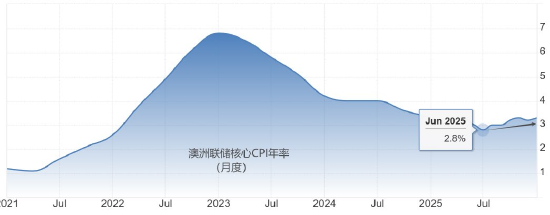
Core Viewpoint - The Reserve Bank of Australia (RBA) raised its benchmark interest rate by 25 basis points from 3.6% to 3.85%, marking its first rate hike since November 2023 and the first rate increase among central banks this year [1][8]. Group 1: Interest Rate Decisions - The RBA's decision to increase rates is driven by stronger-than-expected private demand, greater capacity pressures, and a tightening labor market [1][9]. - In contrast, the US Federal Reserve and the European Central Bank are in a rate-cutting cycle, highlighting a divergence in monetary policy between Australia and these regions [1][8]. Group 2: Economic Indicators - Australia's inflation is unstable with a potential for further increases, necessitating multiple rate hikes by 2026 to effectively manage inflation [1][4]. - The core Consumer Price Index (CPI) in Australia was reported at 2.8% in June 2025, the lowest since March 2022, but rose to 3.3% by December 2025, exceeding the moderate inflation target of 2-3% [4][15]. Group 3: Currency Market Impact - Following the RBA's rate hike, the AUD/USD exchange rate surged from 0.6964 to 0.7025, a rise of 61 basis points, driven by the divergence in monetary policy between the RBA and the Federal Reserve [1][8]. - The Australian dollar's strength is attributed to the relatively high benchmark interest rate of 3.85%, which is above the Federal Reserve's upper limit of 3.75%, making it attractive for international capital [9]. Group 4: Broader Economic Context - Australia's economy operates somewhat independently from the US and Eurozone, with limited influence from external policies, leading to a normal divergence in monetary policy [2][9].

全球外汇交易:美元开局遇冷-Global FX Trader_ Dollar's Cold Open
2026-02-02 02:22
Summary of Global FX Trader Conference Call Industry Overview - The report discusses the foreign exchange (FX) market dynamics, focusing on major currencies including USD, CNY, JPY, AUD, NZD, BRL, and Scandi FX. Key Points USD (United States Dollar) - The Dollar is expected to fall modestly this year due to strong but less exceptional US economic performance [1] - Recent volatility in trade and currency policies has significantly impacted the Dollar's performance, with new tariff threats shaking investor expectations [1] - FX volatility has increased similarly to last April, while rates and equities have not, prompting global investors to increase FX hedges [1] - The Dollar's recent decline is attributed to policy uncertainty, which is expected to persist [1] CNY (Chinese Yuan) - Gradual but sustained appreciation of CNY is anticipated, driven by its cheap valuation and manufacturing competitiveness [4] - Recent CNY appreciation has exceeded expectations, supported by policymakers' comments favoring flexibility in the exchange rate [4] - The new USD/CNY forecast path is adjusted to 6.90, 6.80, and 6.70 over 3, 6, and 12 months, respectively, which is stronger than previous forecasts [4] JPY (Japanese Yen) - USD/JPY experienced fluctuations due to a "rate check" by the NY Fed, impacting the currency's value [5] - The report emphasizes the importance of upcoming political developments in Japan, particularly regarding the Lower House election, which could influence the Yen's performance [5] - A cautious bearish outlook on the Yen is maintained, with potential for further upside if the ruling coalition gains a majority [5] Scandi FX (Scandinavian Currencies) - Both NOK and SEK have shown strong performance, driven by rising oil and natural gas prices [5] - The report suggests that the sell-off in EUR/SEK and EUR/NOK has overshot fundamentals, indicating a likely retracement [5] - Domestic macro events in Norway and Sweden may become more significant later in the year as financial conditions evolve [5][6] AUD & NZD (Australian and New Zealand Dollars) - AUD has outperformed NZD due to FX-specific factors rather than growth or policy expectations [8] - A trade recommendation to short AUD/NZD was closed at a potential loss, but long positions in NZD against USD are still favored [8] - The RBA is expected to hike rates, but the timing remains uncertain [8] BRL (Brazilian Real) - USD/BRL has trended lower, trading close to a forecast of 5.20, with expectations of continued pro-cyclical support from commodity prices [12] - The Brazilian central bank has opened the door to rate cuts, but the impact on BRL is expected to be limited due to elevated real rates [12] Trading Commodity Terms of Trade - A potential 10% increase in precious and industrial metals prices could benefit currencies like CLP, PEN, NOK, and CHF [16] - Investors are advised to consider long positions in CHF as a hedge against geopolitical risks and for potential gains from a rally in gold prices [16] FX Manipulation - The US Treasury's semiannual FX report includes Thailand in the Monitoring List, indicating a broader scope for FX investigations [19] - The report outlines a more flexible approach to defining currency manipulation, considering various economic factors [19] - Strengthened consequences for manipulators are highlighted, with potential recommendations for investigations into currency practices [19] Additional Insights - The report includes forecasts for various currency pairs, indicating expected movements over the next 3, 6, and 12 months [22] - The analysis emphasizes the importance of geopolitical developments and macroeconomic data in shaping FX trends [19][20] This summary encapsulates the key insights and forecasts from the conference call, providing a comprehensive overview of the current state and expectations for the FX market.
ETO Markets :澳元四连涨创15个月新高,通胀成央行“发令枪”
Sou Hu Cai Jing· 2026-01-07 05:50
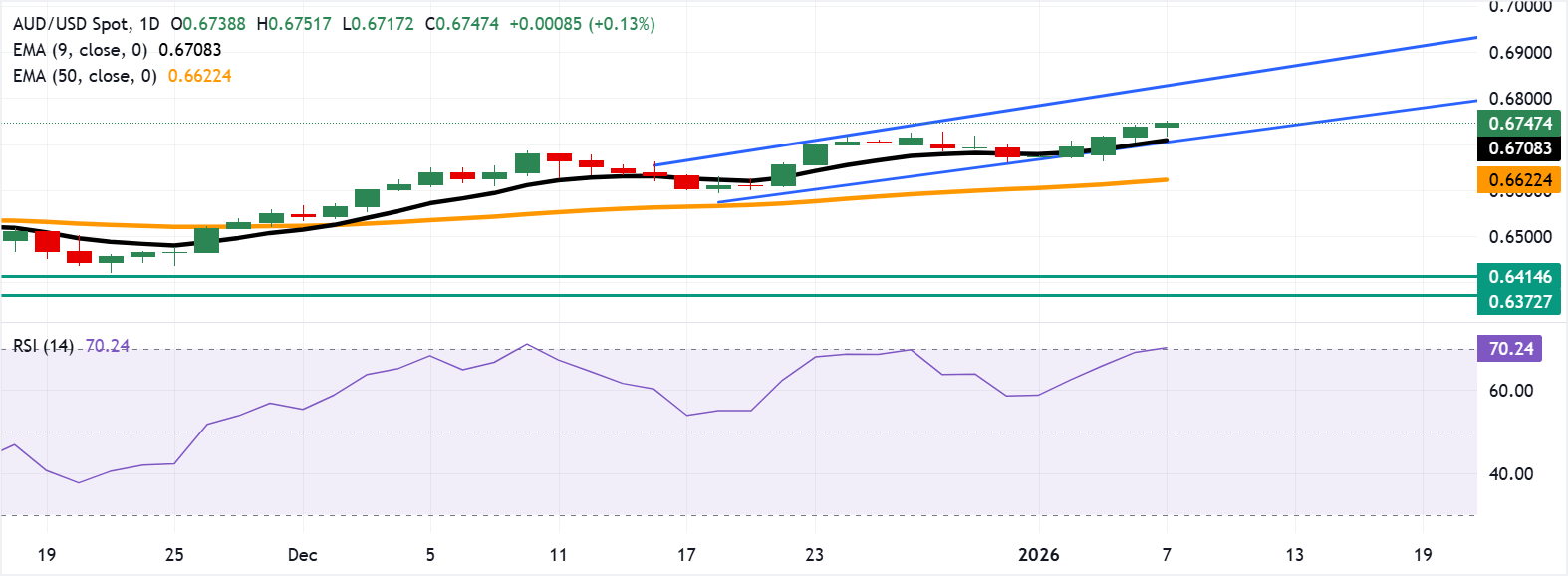
Group 1: Australian Dollar and Inflation Data - The Australian dollar (AUD) continues to rise against the US dollar (USD), achieving a four-day increase, driven by easing inflation data for November [1] - The November Consumer Price Index (CPI) in Australia increased by 3.4% year-on-year, down from 3.8% in October and below the market expectation of 3.7%, marking the lowest level since August [1] - The Reserve Bank of Australia (RBA) is expected to consider policy adjustments in its February meeting if core inflation rises by 0.9% or more [1][8] Group 2: Market Expectations and Economic Indicators - Market anticipates that the RBA's current policy adjustment cycle is not over, with inflation expected to remain high in the coming year [1] - The median CPI for the RBA increased by 0.3% month-on-month, with a year-on-year increase of 3.2% [1] - The market is closely watching upcoming economic data from the US, including the ISM services PMI and non-farm payroll data, which could influence Federal Reserve policy decisions [3][4] Group 3: Technical Analysis of AUD/USD - The AUD/USD is trading around 0.6750, reaching a 15-month high and breaking through this level, indicating an upward trend [9] - The technical analysis shows that the currency pair is in an ascending channel, but the 14-day Relative Strength Index (RSI) has reached 70, indicating an overbought condition [9] - Initial support for the AUD/USD is near the 9-day Exponential Moving Average (EMA) at 0.6708, with further support at the lower boundary of the ascending channel around 0.6700 [11]
G10 外汇策略 - 继续做空美元兑加元、澳元及英镑-G10 FX Strategy -Stay Short USD vs. CAD, AUD, and GBP
2025-11-10 03:34
Summary of Key Points from the Conference Call Industry and Company Overview - The conference call focuses on the foreign exchange (FX) market, specifically the G10 currencies, with a recommendation to maintain short positions on the US dollar (USD) against the Canadian dollar (CAD), Australian dollar (AUD), and British pound (GBP) [6][8][17]. Core Insights and Arguments - **Short USD Recommendations**: The company maintains a short USD position against GBP, CAD, and AUD, anticipating these currencies will strengthen as Federal Reserve (Fed) pricing adjusts [6][8]. - **Market Sentiment**: There is a bearish sentiment towards CAD and GBP, while growth expectations and positive fundamentals are expected to support AUD, CAD, and GBP [6][8]. - **Impact of US Government Shutdown**: A potential end to the US government shutdown could negatively impact the USD by restoring data flow and enhancing market confidence in a December Fed rate cut [6][9]. - **Global Growth Sentiment**: There is an improvement in global growth sentiment, with rising growth forecasts and higher Purchasing Managers' Indexes (PMIs) in major economies, creating a favorable environment for risk-sensitive currencies [6][11]. - **USD Positioning Risks**: Current options data indicates that USD positioning is at its most bullish level since January, which raises the risk of a pullback [6][13]. - **Fundamental Trajectory for USD**: The fundamental outlook for the USD remains unchanged, with expectations of rising unemployment and front-end yields moving against the USD as the Fed is projected to implement four additional rate cuts [10][11]. Additional Important Insights - **Positive Outlook for AUD, CAD, and GBP**: - AUD is supported by a robust growth outlook, continued immigration inflows, and fiscal tailwinds, with 2-year Australian yields now on par with 2-year US Treasury yields [15]. - CAD is expected to benefit from an expansionary budget and well-priced trade negotiations with the US [15]. - GBP positioning is seen as stretched, with potential for a decline in GBP-negative premiums as fiscal concerns ease [16]. - **Trade Recommendations**: - Maintain short USD/CAD at 1.4130 with a target of 1.34 and stop at 1.44 [19]. - Maintain long GBP/USD at 1.3137 with a target of 1.39 and stop at 1.27 [19]. - Maintain long AUD/USD at 0.6490 with a target of 0.69 and stop at 0.63 [19]. - **Valuation Methodology and Risks**: The report includes a detailed list of current trade ideas, entry levels, rationales, and associated risks [20]. This summary encapsulates the key points discussed in the conference call, highlighting the strategic recommendations and market outlook for the G10 currencies.