猪后腿肉

Search documents
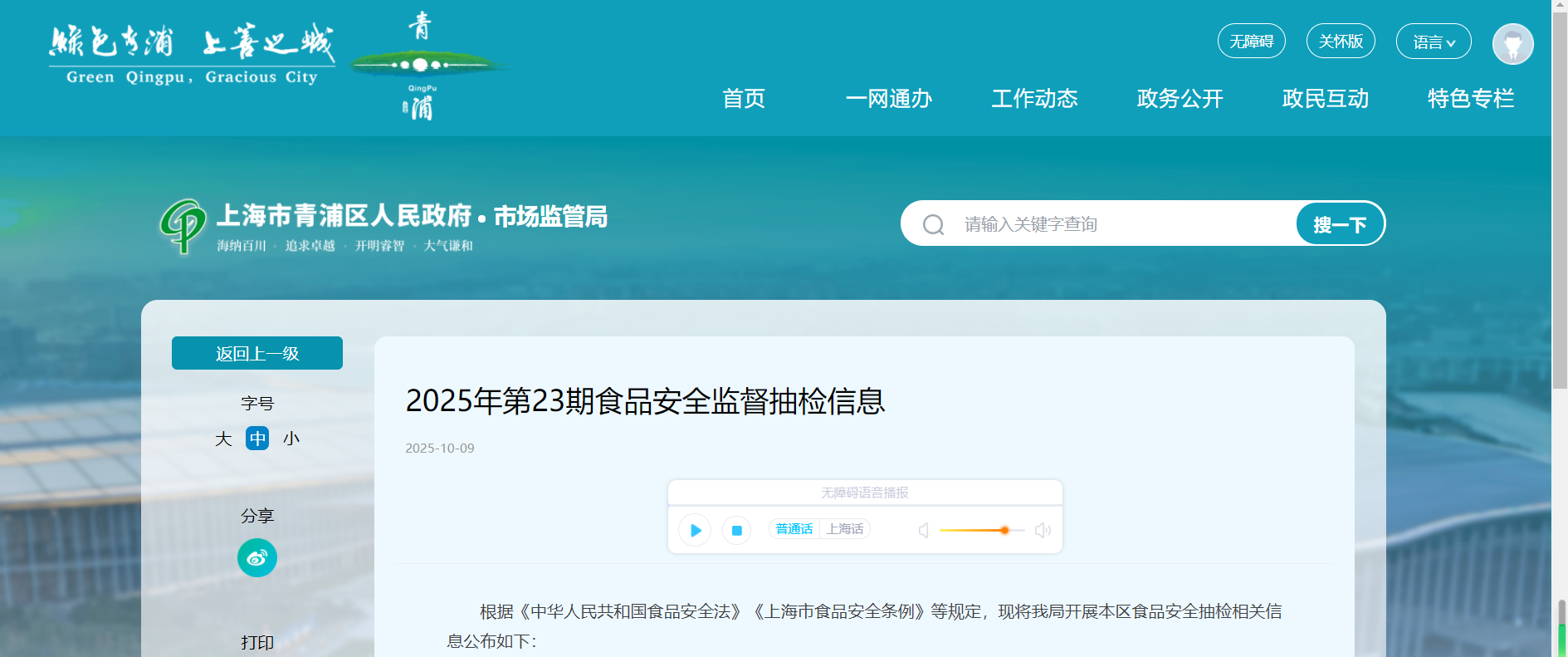
【上海市】2025年第23期食品安全监督抽检信息
Zhong Guo Zhi Liang Xin Wen Wang· 2025-10-10 06:33
Core Points - The Shanghai Qingpu District Market Supervision Administration conducted a food safety inspection, testing a total of 110 batches, with 105 passing and 5 failing [2][6] - Legal actions have been initiated against the producers of the non-compliant food products [2] Summary of Compliant Products - A total of 105 batches of food products were found to be compliant, including items such as carrots, cashews, squid, and various types of noodles and dairy products [2][3][4] - The compliant products were sourced from various producers located in Shanghai and other provinces, indicating a diverse supply chain [3][4] Summary of Non-Compliant Products - Five batches of food products were identified as non-compliant, with specific issues related to pesticide residues and antibiotic contamination [6] - The non-compliant products included items such as lychees, yam, and shrimp, with detected pesticide levels exceeding the permissible limits [6]

鸭肉卷冒充牛肉卷、鸡腿变鸡翅根……校园食品安全典型案例公布
Zhong Guo Xin Wen Wang· 2025-09-11 02:48
Core Viewpoint - The Supreme People's Court of China has published a series of judicial interpretations and typical cases to enhance food safety in schools, particularly focusing on the protection of minors and addressing issues related to food safety violations in educational institutions [1][2][3]. Group 1: Judicial Interpretations and Legal Framework - The Supreme People's Court has issued several judicial interpretations to improve the legal framework for handling food safety criminal cases, particularly in schools and surrounding areas [1]. - The interpretations emphasize harsher penalties for food safety violations that target minors, reflecting a commitment to safeguarding student health [1][2]. Group 2: Typical Cases Overview - Eight typical cases related to food safety in schools have been selected for publication, covering criminal, civil, and administrative cases [1][2]. - The cases illustrate a comprehensive judicial approach to food safety, addressing issues from food suppliers to school canteens, and highlighting various types of violations [1][2]. Group 3: Case Highlights - Case 1: A restaurant owner was sentenced to seven years for using sodium nitrite in school meals, resulting in severe food poisoning among students [7][8]. - Case 2: A supplier was sentenced to seven months for selling duck meat disguised as beef to school canteens, with sales amounting to over 120,000 yuan [10][11]. - Case 3: An official was sentenced for embezzling funds intended for student nutrition programs by substituting chicken legs with cheaper chicken wings [14][15]. - Case 4: A school successfully terminated a contract with a food service provider due to repeated food safety violations [19][20]. - Case 5: A supermarket was ordered to pay punitive damages for selling expired food to students, highlighting the need for accountability in food retail [24][25]. - Case 6: A food supplier was penalized for providing rice with unclear production dates and false labeling, emphasizing the responsibility of producers for accurate product information [28][30]. - Case 7: A meat supplier faced penalties for selling pork contaminated with chloramphenicol, reinforcing the importance of compliance with food safety standards [33][34]. - Case 8: A court annulled an administrative penalty against companies involved in unlicensed food distribution, stressing the need for clear accountability in food service operations [38][39]. Group 4: Implications and Significance - The publication of these cases serves to deter food safety violations in schools and promotes a culture of accountability among food suppliers and service providers [1][2][3]. - The judicial interpretations and case outcomes reflect a commitment to the strict enforcement of food safety laws, particularly in protecting the health of minors [2][3].
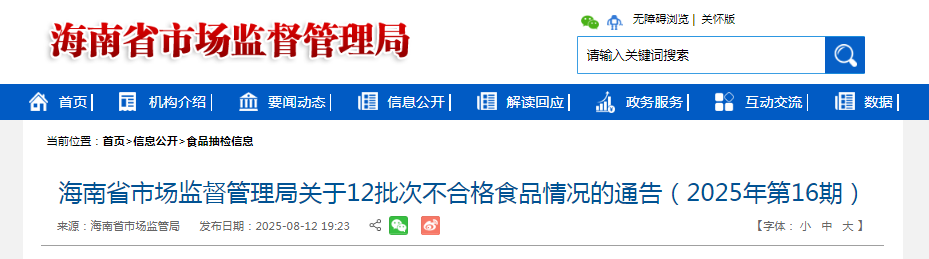
海南省市场监督管理局关于12批次不合格食品情况的通告(2025年第16期)
Zhong Guo Zhi Liang Xin Wen Wang· 2025-08-13 08:53
Core Viewpoint - The Hainan Provincial Market Supervision Administration reported that out of 806 food samples tested, 12 batches were found to be non-compliant with food safety standards, highlighting ongoing concerns regarding food safety in the region [1][2][3]. Group 1: Pesticide Residue Issues - Several products were found to have pesticide residues exceeding national safety standards, including ginger and leeks sold by local vendors, with specific violations noted for the pesticide "chlorpyrifos" [1][2]. - The Dutch pea sold at a local market showed non-compliance due to the presence of "acetamiprid" beyond acceptable limits [1][2]. - Oranges (sugar oranges) sold by a fruit vendor were also flagged for exceeding the allowable limit of "bifenthrin" [1][2]. Group 2: Food Additive Violations - A chicken seasoning product sold at a local store was found to contain "aspartame" levels that did not meet safety standards [2][3]. Group 3: Veterinary Drug Residue Issues - Eggs sold at a local market were found to have residues of "methoprene" and "sulfonamides" exceeding the permissible limits [2][3]. - Freshwater shrimp sold by a vendor showed residues of "furazolidone" metabolites that were not compliant with safety standards [2][3]. - Black fish sold at a local market had "oxytetracycline" residues above the acceptable threshold [2][3]. - Pork products from a local vendor were found to contain "chloramphenicol" residues that exceeded safety limits [2][3]. - Homemade black pork sausages were also flagged for "chloramphenicol" residue violations [2][3]. Group 4: Mycotoxin Issues - Peanut oil produced by a local processing shop was found to have "aflatoxin B1" levels exceeding the safety standard [2][3].
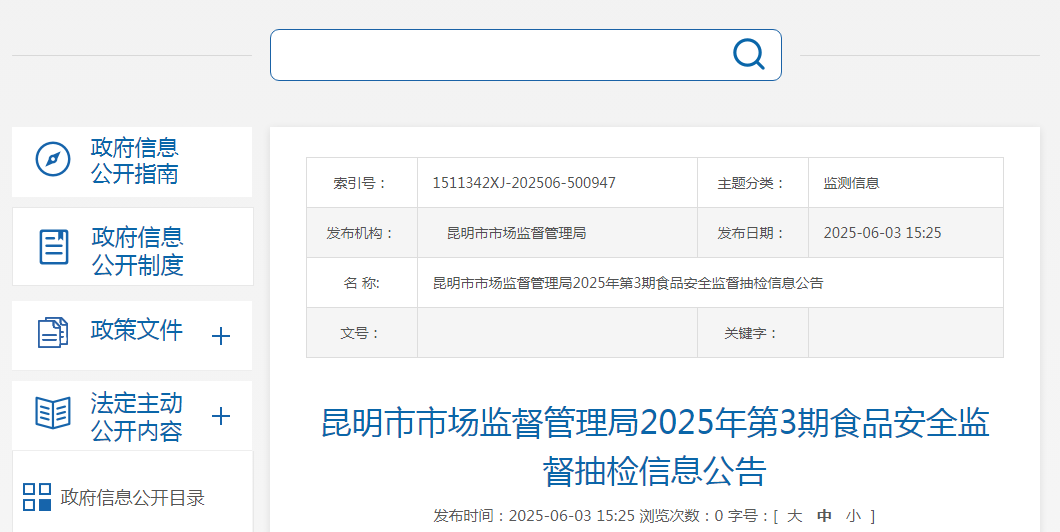
昆明市市场监督管理局2025年第3期食品安全监督抽检信息公告
Zhong Guo Zhi Liang Xin Wen Wang· 2025-06-06 08:37
Group 1 - The announcement is from the Kunming Market Supervision Administration regarding the third food safety supervision and sampling inspection for 2025, focusing on various food products including edible oils, agricultural products, dairy products, and grain processing products [3][4][5] - The inspection is based on national food safety standards, including GB 2760-2024 for food additives, GB 2762-2022 for contaminants, and GB 2763-2021 for pesticide residues [3][4] - The inspection items include indicators such as lead (Pb), benzoic acid and its sodium salt, sorbic acid and its potassium salt, sweeteners, total bacterial count, and coliforms [3][4] Group 2 - A detailed table of sampled products is provided, listing the sampling number, production company name, address, sampled unit name, product name, specifications, and production or purchase date [4][5][6] - The products sampled include a variety of items such as peanuts, eggs, milk, carrot juice, and various oils, indicating a broad scope of food safety monitoring [4][5][6] - Specific companies mentioned include Guangxi Baifei Dairy Co., Ltd., Yunnan Jinbei Food Co., Ltd., and Shanghai Guanshengyuan Food Co., Ltd., among others, highlighting the involvement of multiple manufacturers in the inspection process [4][5][6]