
理肤泉

Search documents
国际化妆品医美公司25年业绩跟踪报告:全球业绩陆续企稳,中国市场曙光现
Shenwan Hongyuan Securities· 2026-03-20 08:19
Investment Rating - The report maintains a "Positive" outlook on international cosmetics and medical beauty companies for 2025 [2]. Core Insights - The global beauty market is expected to grow at a slow pace of 3.5% in 2025, down from 4.5% in 2024 and 8% in 2023, indicating a continued decline in demand [3][13]. - In the Chinese market, the cosmetics retail sales growth is projected to improve to 5.1% in 2025, recovering from negative growth in 2024, with international brands seeing a resurgence [3][18]. - Major international companies like L'Oréal and Procter & Gamble are expected to show stable growth, while others may face revenue pressures [3][14]. Summary by Sections 1. Global Beauty Market Performance - The global beauty market is stabilizing after a period of decline, with a growth rate of 3.5% in 2025 [3][13]. - Demand-side weaknesses continue to challenge international groups, necessitating strategic adjustments [14]. 2. L'Oréal's Performance - L'Oréal's revenue growth for 2025 is projected at 1.3%, with a slight improvement in Q4 compared to Q3 [3][24]. - The company is focusing on brand acquisitions and enhancing its online presence in China to adapt to market changes [21][24]. 3. Estée Lauder's Strategy - Estée Lauder's overall revenue for 2025 is expected to be $14.67 billion, reflecting a 3.3% decline year-over-year, but Q4 shows a positive growth trend [3][47]. - The company is implementing strategic reforms to address previous challenges, particularly in the Chinese market [44][47]. 4. Shiseido's Challenges - Shiseido's revenue is forecasted to decline by 2.1% in 2025, with operating profit turning negative [3][17]. - The company is experiencing fluctuations in performance, particularly in the Chinese market, which is expected to remain volatile [3][18]. 5. Investment Recommendations - The report recommends focusing on companies with strong channel and brand matrices, such as Mao Ge Ping and Shangmei, as well as those with improving performance like Proya and Marubi [4]. - In the medical beauty sector, companies with strong R&D capabilities and product pipelines, such as Aimeike and Langzi, are highlighted as potential investment opportunities [4].



深度|外资美妆,正在重新梳理“中国故事”
FBeauty未来迹· 2026-03-13 13:39
Core Viewpoint - The global beauty industry remains dominated by foreign giants, but in the Chinese market, local brands are rapidly gaining market share, indicating a shift in competitive dynamics [2][21]. Group 1: Global Market Overview - In 2025, L'Oréal leads the global beauty industry with revenue exceeding 356.36 billion RMB, significantly larger than its closest competitors, Unilever and Procter & Gamble, whose revenues are approximately 205.87 billion RMB and around 100 billion RMB respectively [5]. - The top ten companies in the beauty sector show a slowdown in growth, with nearly half experiencing revenue declines due to global consumption slowdowns and inventory adjustments [7]. - Puig and Galderma are notable exceptions, with Puig achieving a 5.3% growth and Galderma a remarkable 17.7% growth, highlighting the resilience of specialized beauty companies [9]. Group 2: Regional Insights - Japanese beauty companies are undergoing structural adjustments, with Shiseido focusing on core brands and improving profitability, while Kao is also seeing growth in its cosmetics business due to a recovery in the Chinese market [10][17]. - Korean beauty companies show a split performance; Amorepacific grew by 8.5% driven by emerging markets, while LG Household & Health recorded a 6.7% decline, reflecting challenges in the Greater China region [10][11]. Group 3: Chinese Market Dynamics - By 2025, domestic brands have captured 57.37% of the Chinese beauty market, a significant increase from less than 30% a decade ago, indicating a structural shift in market dynamics [2][21]. - International beauty companies are increasingly viewing the Chinese market as a critical battleground for testing organizational and innovative capabilities, rather than just a growth engine [23]. - L'Oréal's revenue in North Asia, including China, was approximately 100.75 billion euros, while Estée Lauder reported 27.41 billion USD in China, showing the competitive landscape between foreign and local brands [20]. Group 4: Strategic Adjustments - Estée Lauder has upgraded China to an independent reporting region, reflecting its strategic importance and allowing for more localized decision-making [23]. - Procter & Gamble has established a "Brand Growth Department" in China to enhance agility and responsiveness to market changes [25]. - Companies are adapting to the unique Chinese market ecosystem, with a focus on digital marketing and e-commerce channels, as seen with L'Oréal and SK-II's performance on platforms like Douyin [28].


食饮吾见 | 一周消费大事件(2.9-2.13)
Cai Jing Wang· 2026-02-13 08:34
Regulatory Changes - The State Administration for Market Regulation (SAMR) has introduced new regulations for the bulk transportation of key liquid foods to enhance food safety oversight [1][2] - A comprehensive regulatory framework has been established, including a directory of key liquid foods, management methods for transportation permits, and standards for sanitary requirements [1][2] Food Safety Measures - The new regulations include a directory that categorizes 14 subtypes of liquid foods, specifying the use of dedicated transport containers [2] - A management method for transportation permits has been developed, detailing strict conditions and procedures for obtaining permits [2] - A traceability system has been implemented, requiring all parties involved in the transportation process to maintain accurate records [2] Industry Developments - Nestlé has been prompted to recall specific batches of infant formula due to the detection of Bacillus cereus toxins, with no confirmed cases of poisoning reported in China [3] - The revised Food Recall Management Measures emphasize the responsibilities of food producers and regulatory bodies, enhancing the framework for food recall processes [4] Corporate Strategies - The founder of Pang Donglai has announced that the company will never go public and aims to maintain a youthful management team [5] - Yonghui Supermarket has reported a significant turnaround with a dual increase in same-store sales and customer traffic after a strategic transformation [6][7] Financial Performance - L'Oréal reported a 4% increase in sales to €44.05 billion, with all business sectors showing growth, particularly in professional products [9] - Kraft Heinz announced a pause on its spin-off plans, focusing on returning to profitable growth amid a 3.5% decline in net sales [10] - Coca-Cola's Q4 net profit rose by 5% to $2.316 billion, driven by a 13% increase in sales of its no-sugar products [11][12] - Budweiser APAC reported a 6.1% decrease in revenue to $5.764 billion, with a focus on enhancing non-immediate and O2O channels to improve sales performance [13]


欧莱雅在中国市场遭遇“滑铁卢”,反应慢了?
Xi Niu Cai Jing· 2025-12-16 01:24
Core Insights - 2024 is expected to be a challenging year for L'Oréal, particularly in the Chinese market, which has become a significant concern for the company [2] Group 1: Financial Performance - L'Oréal achieved a record sales figure of €43.48 billion in 2024, representing a year-on-year growth of 5.1% [2] - The operating profit reached €8.688 billion, with a year-on-year increase of 6.7%, resulting in an operating margin of 20% [2] - The North Asia market, which includes China, reported a sales decline of €10.3 billion, down 3.2% year-on-year, making it the only region with negative growth among L'Oréal's five major markets [2] Group 2: Market Dynamics - The growth rate of L'Oréal in the Chinese market has been declining, with previous growth rates exceeding 20% from 2019 to 2021, but dropping to low single-digit growth from 2022 onwards [2] - The first quarter of 2024 showed decent performance, but the second quarter experienced negative growth, which continued into the third and fourth quarters [2] - Factors contributing to the negative growth in the North Asia market include weak selective channels and pressure on travel retail sales [2] Group 3: Competitive Landscape - L'Oréal's revenue in China is primarily driven by mass-market and premium cosmetics, with brands like L'Oréal Paris and Lancôme being significant contributors [3] - The mass-market segment faces intense competition from local skincare brands that are gaining popularity due to the "national trend" and high cost-performance ratios [3] - In the premium segment, consumers are becoming more discerning, often opting for "alternative" products instead of high-end offerings, which diminishes L'Oréal's previous pricing advantages [3][4] Group 4: Adaptability Challenges - Local brands are quicker to respond to market changes and consumer demands due to their advantages in channels and supply chains, putting L'Oréal at a disadvantage [4] - The beauty market's dynamics have shifted, requiring brands to adopt more agile and flexible strategies to keep pace with rapid changes [4] Group 5: Future Outlook - In the first three quarters of 2025, the North Asia market reported sales of €7.35 billion, with a slight year-on-year growth of 0.5%, indicating a low growth state [5] - The Chinese market remains a crucial revenue source for L'Oréal, necessitating a focus on market trends and consumer demand changes to potentially restore high growth in the future [5]
国泰海通:国际美护品牌二季度增速回暖 中国区市场全面增长
智通财经网· 2025-08-03 05:59
Group 1: Market Overview - Recent financial reports from international beauty leaders like L'Oréal and Procter & Gamble indicate a sequential improvement in growth rates for overseas brands in the Chinese market, particularly in functional skincare and medical aesthetics [1] - The beauty sector is experiencing significant changes, with a notable rise in domestic brands, highlighting a clear growth trend and increasing brand differentiation [1] Group 2: L'Oréal Performance - L'Oréal reported a sales figure of €22.47 billion for 1H25, reflecting a year-on-year growth of 3.0%, with Q1 and Q2 growth rates of 2.6% and 3.7% respectively [2] - The net profit for L'Oréal reached €3.783 billion, showing a 1.0% year-on-year increase [2] - The professional hair division led growth with a 6.5% increase, while mass skincare, premium cosmetics, and skin science segments grew by 2.8%, 2.0%, and 3.1% respectively [2] - The Chinese market showed a 3% year-on-year growth in Q2, with skin science and professional hair products performing particularly well [2] Group 3: Procter & Gamble Performance - Procter & Gamble's Q2 sales amounted to $20.889 billion, a 2% year-on-year increase, with net profit rising by 15% to $3.626 billion [3] - The beauty segment saw a slight increase of 0.2% year-on-year, while net profit in this division grew by 4% [3] - The skincare business in China continued to grow, although this was offset by a decline in North America, resulting in flat overall sales for the skincare segment [3] Group 4: Galderma Performance - Galderma reported a net sales figure of $2.448 billion for 1H25, marking a 12.2% year-on-year increase, with Q2 growth at 15.8% [4] - The company raised its full-year sales guidance to 12-14%, up from the previous 10-12% [4] - The injection aesthetics, daily skincare, and skin treatment segments grew by 9.8%, 7.7%, and 26.9% respectively, with botulinum toxin sales increasing by 14.7% [4] - Strong performance was noted in key markets such as Brazil, Canada, and mainland China, particularly in the injection aesthetics business [4]

在华销售额止跌回升!欧莱雅预期全球美容市场增长逐渐改善
Sou Hu Cai Jing· 2025-07-31 10:02
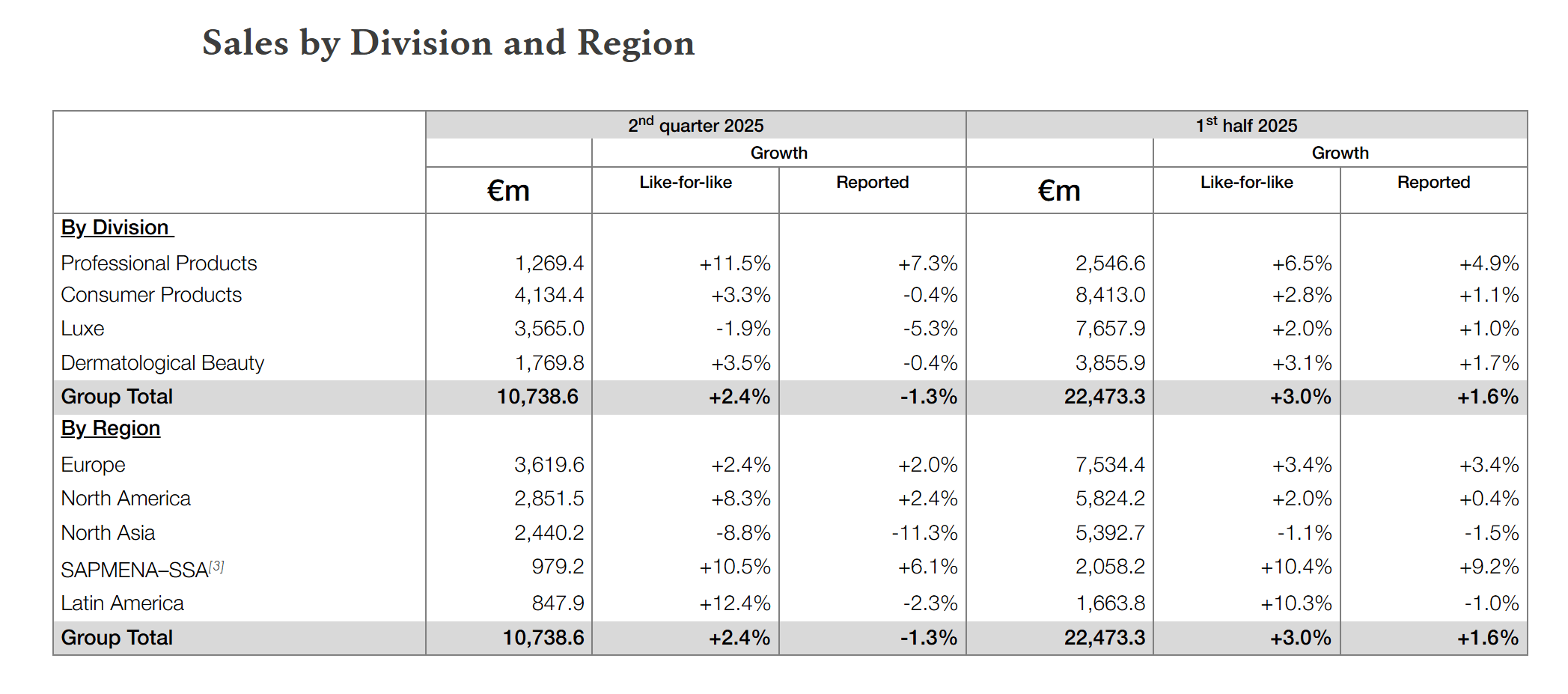
Core Insights - L'Oréal Group reported a sales revenue of €22.473 billion (approximately ¥186.19 billion) for the first half of 2025, reflecting a year-on-year growth of 3% [1] - The operating profit reached €4.74 billion (approximately ¥39.28 billion), with a year-on-year increase of 3.1% [1] Performance Trends - The growth rate of L'Oréal's performance has slowed down in recent years, with a full-year sales revenue of €43.487 billion (approximately ¥329.43 billion) for 2024, marking a 5.6% increase year-on-year [2] - For the first half of 2024, sales revenue was €22.12 billion, showing a year-on-year growth of 7.5%, while operating profit increased by 8% to €4.599 billion [2] - The company's four major divisions experienced growth in the first half of the year, but with significant variations in growth rates [2] Division Performance - The Professional Products division emerged as a growth engine with a year-on-year increase of 6.5%, achieving sales of €2.55 billion (approximately ¥21.16 billion) [2] - The Consumer Products division reported sales of €8.41 billion (approximately ¥69.78 billion), with a growth of 2.8% [4] - The Luxe division saw a decline of 1.9%, while the Dermatological Beauty division grew by 3.5% [4] Regional Performance - The European market recorded sales of €7.534 billion (approximately ¥62.42 billion), with a year-on-year growth of 3.4% [6] - North America experienced a 2% increase in sales, while Latin America and SAPMENA-SSA achieved double-digit growth rates of 10.3% and 10.4%, respectively [6] - North Asia was the only region to experience negative growth, with a sales decline of 1.1% to €5.393 billion (approximately ¥44.48 billion) [6] Strategic Developments - L'Oréal's CEO highlighted the effectiveness of the company's multi-polar strategy, with emerging markets and a slight rebound in mainland China offsetting the expected slowdown in Europe [7] - The company acquired majority stakes in the American haircare brand Color Wow and the British skincare brand Medik8 to strengthen its position in the dermatological and professional haircare sectors [5] Future Outlook - The CEO expressed optimism for the global beauty market, anticipating continued growth in the upcoming quarters [8]
巴黎欧莱雅任命莱蒂西亚?图佩 - 德隆为全球品牌总裁
Jing Ji Guan Cha Bao· 2025-05-14 10:08
Group 1 - Laetitia Toupet-Delon has been appointed as the Global Brand President of L'Oréal Paris, effective July 1 [1] - She will succeed Delphine Viguier-Hovasse, who will take on the newly created role of Chief Innovation and Trends Officer [1] - Viguier-Hovasse was the first woman to hold the position of Global Brand President for L'Oréal Paris since her appointment in 2019 [1] Group 2 - Toupet-Delon joined the L'Oréal Group in 1998 and has held various positions, including Global Brand President of La Roche-Posay and Global President of the Skin Care Division [2] - She will oversee the L'Oréal Paris business, which is projected to generate over €6 billion in annual revenue [2] - The L'Oréal Paris brand operates in 150 countries worldwide [2] Group 3 - In Q1 2025, L'Oréal Group reported a revenue growth of 4.4%, reaching €11.73 billion [3]