
食品召回

Search documents
食饮吾见 | 一周消费大事件(2.9-2.13)
Cai Jing Wang· 2026-02-13 08:34
Regulatory Changes - The State Administration for Market Regulation (SAMR) has introduced new regulations for the bulk transportation of key liquid foods to enhance food safety oversight [1][2] - A comprehensive regulatory framework has been established, including a directory of key liquid foods, management methods for transportation permits, and standards for sanitary requirements [1][2] Food Safety Measures - The new regulations include a directory that categorizes 14 subtypes of liquid foods, specifying the use of dedicated transport containers [2] - A management method for transportation permits has been developed, detailing strict conditions and procedures for obtaining permits [2] - A traceability system has been implemented, requiring all parties involved in the transportation process to maintain accurate records [2] Industry Developments - Nestlé has been prompted to recall specific batches of infant formula due to the detection of Bacillus cereus toxins, with no confirmed cases of poisoning reported in China [3] - The revised Food Recall Management Measures emphasize the responsibilities of food producers and regulatory bodies, enhancing the framework for food recall processes [4] Corporate Strategies - The founder of Pang Donglai has announced that the company will never go public and aims to maintain a youthful management team [5] - Yonghui Supermarket has reported a significant turnaround with a dual increase in same-store sales and customer traffic after a strategic transformation [6][7] Financial Performance - L'Oréal reported a 4% increase in sales to €44.05 billion, with all business sectors showing growth, particularly in professional products [9] - Kraft Heinz announced a pause on its spin-off plans, focusing on returning to profitable growth amid a 3.5% decline in net sales [10] - Coca-Cola's Q4 net profit rose by 5% to $2.316 billion, driven by a 13% increase in sales of its no-sugar products [11][12] - Budweiser APAC reported a 6.1% decrease in revenue to $5.764 billion, with a focus on enhancing non-immediate and O2O channels to improve sales performance [13]


食品召回启动时限作出调整
Xin Lang Cai Jing· 2026-02-11 21:49
Core Viewpoint - The newly revised "Food Recall Management Measures" by the State Administration for Market Regulation introduces a tiered recall system based on the severity of food safety hazards and urgency, adjusting the recall initiation timeframes to 24, 36, and 48 hours from the previous 24, 48, and 72 hours [1][2] Group 1 - The new measures require food producers and operators to establish and implement a food recall management system, mandating cooperation from various stakeholders including food operators, centralized trading market organizers, and third-party online food transaction platforms [1] - The revised regulations clarify the supervisory responsibilities of market regulation departments at different levels, with provincial departments overseeing food producers licensed by municipal departments, and municipal departments supervising those licensed by county departments [1] - The State Administration for Market Regulation is empowered to directly manage significant food recalls and handling on a national scale [1] Group 2 - The new measures categorize recalls into three levels based on food safety hazard severity and urgency, with differentiated initiation timeframes to enhance risk prevention effectiveness and operational feasibility [2]
两部门:督促雀巢(中国)做好召回工作
中国基金报· 2026-01-08 13:13
Core Viewpoint - Nestlé (China) is under pressure from the State Council's Food Safety Office and the Market Supervision Administration to effectively recall specific batches of infant formula milk powder due to potential contamination issues [1][3]. Group 1: Recall Actions - Nestlé has initiated a precautionary recall of certain batches of infant formula milk powder in several European countries, and the Chinese authorities have urged the company to recall affected products sold in China [3][5]. - The recall involves products potentially contaminated with Bacillus cereus, which can cause foodborne illnesses, and is linked to quality issues with a specific oil used in production [5][6]. Group 2: Impact and Response - As of now, there have been no reports of illness related to the affected products in China, and specific brands such as Super Special Medical Use Infant Formula and others are confirmed to be unaffected [6]. - The recall affects at least 50 countries, including major markets in Latin America, Asia, Africa, and the Middle East, with notable brands like Beba and Alfamino involved [6].


【环球财经】美药管局警告零售商下架涉肉毒杆菌污染奶粉产品
Xin Hua She· 2025-12-16 09:07
Core Viewpoint - The FDA has reported multiple cases of botulism poisoning in infants linked to baby formula produced by ByHeart, prompting a nationwide recall of the affected products [1][2]. Group 1: FDA Actions - The FDA issued warning letters to several retailers for failing to promptly remove the recalled baby formula from their shelves [1]. - Over 4,000 inspections were conducted by the FDA in collaboration with state public health departments to ensure that the contaminated products were not sold to consumers [1]. - Retailers, including Walmart, Target, and Kroger, received warning letters emphasizing their critical responsibility in executing food recalls [1]. Group 2: ByHeart Company - ByHeart announced a recall of all "full nutrition infant formula" products, including both canned and single-serve packaging, due to potential botulism contamination [1]. - The company is under investigation alongside the FDA and CDC, with ongoing efforts to track and test related products and cases [2]. Group 3: Health Impact - As of October 10, a total of 51 suspected or confirmed cases of infant botulism have been reported across 19 states [2]. - The CDC has expanded the scope of case tracking in response to the outbreak [2].


Costco expands recall on a potentially dangerous Kirkland product
Yahoo Finance· 2025-11-19 17:03
Core Insights - Food recalls impact all grocery retailers, including both specialty and large-scale retailers like Costco and Kroger [1] - The FDA issues numerous recalls annually due to allergens, bacterial infections, and foreign matter contamination [1] Group 1: Costco's Recalls - As of November 18, 14 food and beverage recalls are listed on the FDA website, with Costco being a significant player affected by these recalls [2] - Costco expanded the recall of its Kirkland Signature Prosecco Valdobbiadene due to the risk of bottles exploding, initially affecting around 400,000 bottles [3][4] - The expanded recall now includes over 941,400 bottles of the Kirkland Signature Valdobbiadene Prosecco DOCG [4] Group 2: Other Recent Recalls - Recent recalls involving Costco include: - Moonlight Companies Yellow Peaches due to potential listeria contamination [5] - Foster Farms Honey Crunchy Jumbo Corn Dogs for potential wooden stick pieces in the batter [5] - Jimmy Dean Pancake and Sausage on a Stick for potential wood chips in the batter [5] - Caesar Salad and Chicken Sandwich with Caesar Salad due to plastic material in the salad dressing [5] - Ritz Peanut Butter Cracker Sandwiches recalled for incorrect labeling as Cheese variety [5] Group 3: Product Details - The recalled Kirkland Signature Prosecco is packaged in a green bottle with a purple foil top and label [6] - The product was sold in multiple states including IA, IL, IN, KY, MI, MN, MO, ND, NE, OH, SD, and WI from April 2025 through August 2025 [7]

食品召回分几种形式?召回的食品如何处置? | 一文读懂守护食品安全新规↓
Yang Shi Wang· 2025-10-11 02:26
Core Viewpoint - The revised "Food Recall Management Measures" clarifies the responsibilities of various stakeholders in the food production and sales process regarding food recalls, emphasizing the need for compliance with food safety standards and the immediate action required upon identifying potential health risks [3][5][10]. Group 1: Scope of Food Recall - The new regulations specify that food producers and operators must recall products that do not meet food safety standards or pose a potential health risk [3]. - The scope of the recall now includes food importers and cross-border e-commerce entities, which are required to adhere to the same recall obligations [8][10]. Group 2: Responsibilities of Stakeholders - The regulations detail the responsibilities of various parties involved in food recalls, including producers, agents, and third-party platforms, mandating them to halt sales and notify relevant authorities upon discovering a recall situation [5][7][11]. - Cross-border e-commerce platforms must ensure compliance from their associated businesses and may face suspension of operations if they fail to act on recalls [13]. Group 3: Types and Levels of Recall - The draft outlines two types of recalls: voluntary recalls initiated by producers and mandatory recalls ordered by regulatory authorities [15][17]. - Food recalls are categorized into three levels based on the severity of the health risk, with specific timelines for initiating recalls depending on the level [20][22]. Group 4: Reporting and Compliance - Producers are required to report the status of recalls at specified intervals based on the recall level, ensuring transparency and accountability in the recall process [22]. - Non-compliance with recall orders can result in significant penalties, including fines and potential revocation of operating licenses [23].
市场监管总局修订《食品召回管理办法》,公开征求意见
Jing Ji Guan Cha Wang· 2025-09-26 09:09
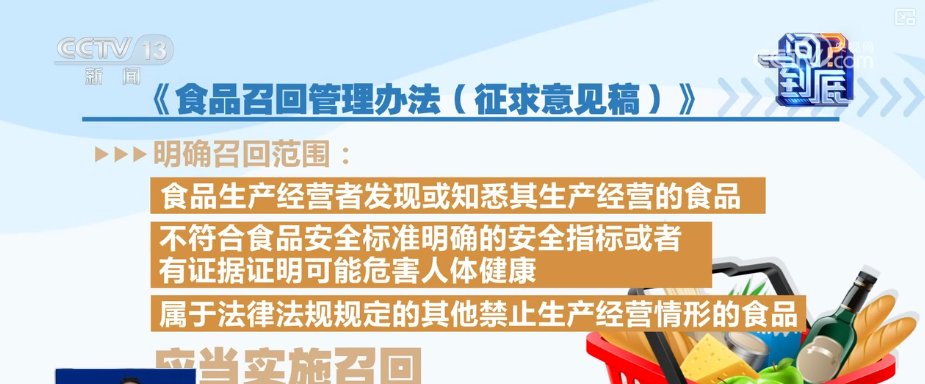
Core Points - The State Administration for Market Regulation has revised the "Food Recall Management Measures (Draft for Comments)" and is now seeking public feedback [1] Group 1: Recall Scope - The draft specifies the recall scope, including food that does not meet food safety standards, has evidence of potential harm to human health, or falls under other prohibited production and operation circumstances as defined by laws and regulations [1] Group 2: Recall Forms - Food recalls are categorized into two forms: voluntary recalls and mandated recalls, with differentiated requirements for announcement processes and recall disposal report submissions to ensure precise and efficient implementation of food recalls [1] Group 3: Responsibilities of Food Producers - Food producers must immediately cease production and implement recalls upon awareness of their products falling under the defined recall categories through self-inspection, public complaints, notifications from other producers, or alerts from regulatory authorities [1] - Producers are required to publish recall announcements on their websites or other media and report the recall and disposal status to market regulation departments within five working days after the recall process is completed [1] Group 4: Enforcement of Mandated Recalls - If a producer fails to voluntarily implement a recall as per the regulations, market regulation departments are authorized to mandate the recall, and the producer must publish a mandated recall announcement on the national food recall information public platform, clearly marked with the word "mandated" [1]
事关食品安全 市场监管总局公开征求意见
Xin Lang Cai Jing· 2025-09-26 09:03
Core Points - The State Administration for Market Regulation has revised the "Food Recall Management Measures (Draft for Comments)" and is now seeking public opinions [1] - The draft clarifies the scope of recalls, including foods that do not meet safety standards, those that may pose health risks, and other legally prohibited production and operation situations [1] - Two forms of food recalls are defined: voluntary recalls and mandated recalls, with differentiated requirements for announcement processes and reporting [1] Summary by Sections - **Recall Scope**: Foods that do not meet safety standards, have evidence of potential health risks, or fall under other prohibited categories are included in the recall scope [1] - **Recall Forms**: The draft specifies voluntary recalls and mandated recalls, with different requirements for public announcements and reporting procedures [1] - **Obligations of Producers**: Food producers must immediately stop production and implement recalls upon awareness of their products falling under recall categories, and must report to market regulation authorities within five working days after disposal [1] - **Mandated Recall Procedures**: If producers fail to voluntarily recall, market regulators will issue a mandated recall, which must be prominently announced on the national food recall information platform [1] - **Responsibilities of Entrusting Parties**: The draft mandates that producers who delegate production must also implement recalls and notify their contractors to cease production [1] - **Import and E-commerce Regulations**: The draft includes specific recall obligations and responsibilities for import food businesses and cross-border e-commerce entities [1] - **Penalties for Non-compliance**: The draft increases penalties for producers who refuse to comply with mandated recalls, allowing fines based on the value of the products involved [1]
FDA发现放射性污染,沃尔玛(WMT.US)在13个州召回虾类商品
Zhi Tong Cai Jing· 2025-08-20 07:00
Core Viewpoint - Walmart has recalled certain shrimp products in 13 states due to radioactive contamination concerns, specifically from cesium-137, as reported by the FDA [1] Group 1: Recall Details - The recall involves frozen shrimp from the "Great Value" brand sold at Walmart stores across Alabama, Arkansas, Florida, Georgia, Kentucky, Louisiana, Missouri, Mississippi, Ohio, Oklahoma, Pennsylvania, Texas, and West Virginia [1] - The FDA noted that while a sample of breaded shrimp tested positive, the affected products "did not enter the U.S. distribution" and investigations are ongoing [1] Group 2: Regulatory Actions - The FDA has placed Indonesian seafood company PT. Bahari Makmur Sejati (BMS Foods) on a chemical contamination import alert list, requiring the company to halt exports to the U.S. until the issues are resolved [1]