
生活护理产品

Search documents
当“银发”遇见“新潮”
Jing Ji Wang· 2026-01-19 02:33
Core Viewpoint - The "silver economy" in China is rapidly evolving, focusing on diverse products and services for the elderly, reflecting a shift from traditional perceptions to a modern consumer landscape that enhances the well-being of older adults [1][2][3]. Group 1: Market Trends - The demand from the elderly demographic is increasingly fashionable, with many older individuals engaging in social media and participating in trendy courses, indicating a shift in consumer behavior [2][3]. - By the end of 2024, the population aged 60 and above in China is projected to reach 310 million, with 161 million of them being internet users by mid-2025, highlighting the significant digital engagement among the elderly [2][3]. Group 2: Consumer Preferences - Older consumers are seeking high-quality food, healthcare services, and smart technology products, showing a willingness to invest in their quality of life and health [3][4]. - The silver economy is no longer limited to basic necessities but encompasses a wide range of sectors including technology, education, entertainment, and fashion [2][3]. Group 3: Policy and Support - The Chinese government has introduced measures to foster the silver economy, focusing on brand development, supply-demand platforms, and optimizing the business environment to support elderly care services [4][5]. - Policies are being implemented to encourage the expansion of products and services for the elderly, with a strong emphasis on financial support for these industries [5][6]. Group 4: Economic Impact - The silver economy is estimated to be worth approximately $1 trillion annually, with significant growth potential as the elderly population continues to expand [6][7]. - From 2015 to 2025, household spending led by individuals aged 60 and above is expected to increase by 129%, indicating a substantial shift in consumer spending patterns [8]. Group 5: Innovation and Investment - There is a growing focus on technological innovation in elder care, with investments in areas such as brain-computer interfaces and robotic nursing, aimed at improving the quality of life for older adults [7][8]. - The aging population is driving demand for health and retirement insurance products, with projections indicating that China will contribute to over 25% of global premium growth by 2030 [7][8].
八部门发文促进银发经济发展 这些赛道迎来风口
Mei Ri Jing Ji Xin Wen· 2026-01-13 16:17
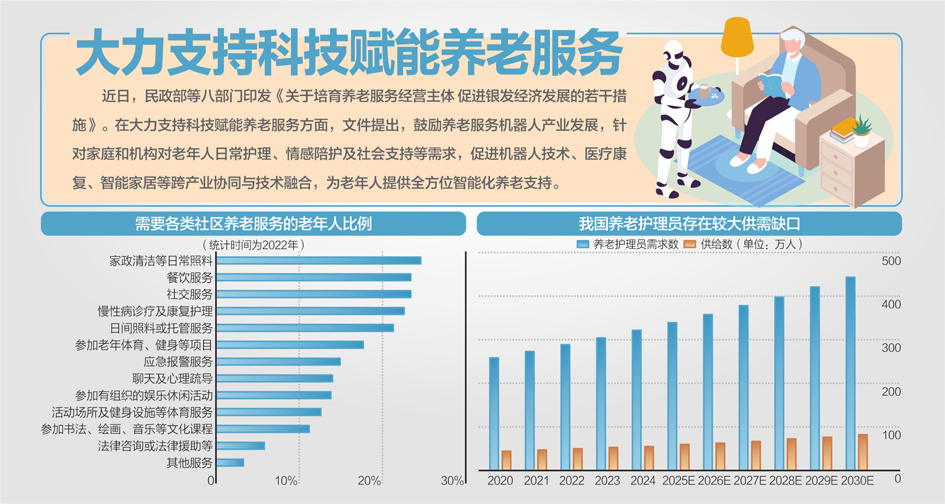
Core Viewpoint - The Ministry of Civil Affairs and eight other departments have jointly issued measures to stimulate the vitality of various elderly care service providers, create a favorable investment environment, and promote the development of the silver economy to better meet the diverse needs of the elderly [1][3] Group 1: Policy Measures - The measures aim to optimize the supply of elderly care services and age-friendly products, encouraging community-based operations and integration of resources to enhance service delivery [4] - The initiative supports the development of home care services for the elderly, including professional medical accompaniment and mobile bathing services [4] - There is a focus on promoting smart rehabilitation aids and age-appropriate food and clothing products, enhancing the living environment for the elderly [4] Group 2: Market Dynamics - By the end of 2025, there will be 41,700 elderly care institutions in China, with 722,000 employees, reflecting a 12.2% year-on-year increase, and 52.2% of these institutions will be privately owned [5] - Social forces are becoming the main contributors to the diversified supply of elderly care services, indicating a shift in the service landscape [5] Group 3: Technological Support - The measures encourage technological advancements in elderly care, integrating big data, AI, and other technologies for health monitoring and personalized services [6] - There is a push for the development of elderly care robots and smart home technologies to meet the daily care and emotional support needs of the elderly [6] - The market is expected to see new opportunities driven by the integration of technology in elderly care, with a focus on smart home products and AI solutions [7]

精准施策推动“银发经济”健康有序高质量发展 进一步激发经营主体活力
Yang Shi Wang· 2026-01-13 09:28
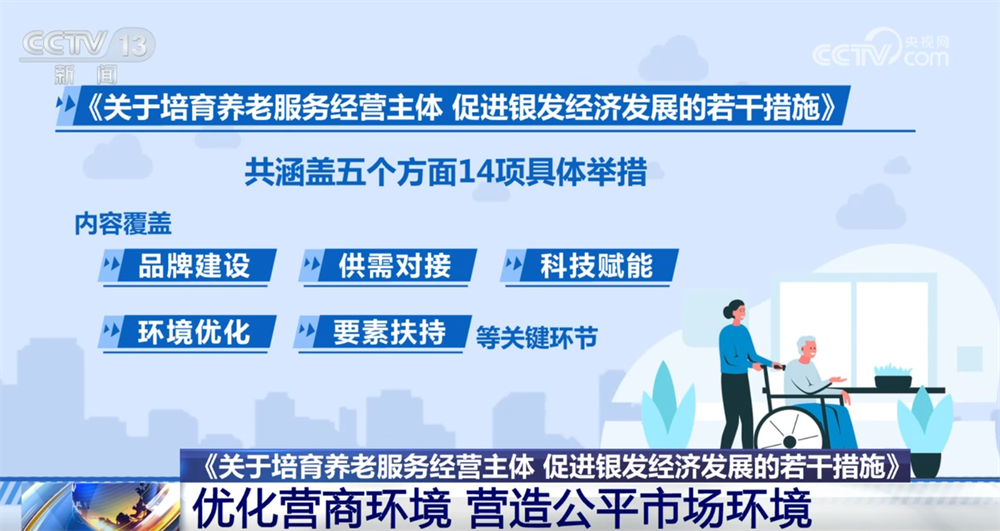
Core Viewpoint - The Ministry of Civil Affairs and seven other departments have jointly issued measures to cultivate the elderly care service industry and promote the silver economy through systematic and targeted policy support, aiming to enhance the vitality of various elderly care service providers and optimize the development environment [1][3]. Group 1: Policy Measures - The measures include 14 specific initiatives across five key areas: brand building, supply-demand matching, technological empowerment, environmental optimization, and support for essential factors [1]. - A fair competitive environment is to be established by accelerating the classification reform of elderly care institutions and optimizing support policies for various types of operators [3]. - The Ministry of Civil Affairs will rationally determine the frequency, methods, and scope of administrative inspections for elderly care institutions, implementing a "double random, one public" regulatory approach to minimize interference with normal operations [5]. Group 2: Standards and Certification - The measures call for the establishment of national standards for elderly products and services, along with a certification system for silver products and services, including a mechanism for tracking certified information and a credit evaluation system [6]. Group 3: Support for Operators - By the end of 2025, there will be a total of 41,700 elderly care institutions in China, with private institutions (including privately-run non-enterprise units) accounting for 52.2% [8]. - The measures propose to regularly publish information on the elderly population, distribution and utilization of elderly care facilities, and support policy lists, providing robust support in terms of land, duration, and funding for elderly care service providers [9]. - There will be an optimization of the licensing process for elderly care institutions, encouraging cross-regional online processing of licenses and exploring the application of electronic licenses [11]. Group 4: Land and Funding Support - Support will be provided from land, duration, and funding perspectives to ensure stable operations of elderly care institutions, prioritizing land supply for elderly care facilities based on local aging population levels [13]. - The Ministry of Civil Affairs aims to resolve site issues for operators, ensuring that elderly care facilities have available land for construction and optimizing funding support through various subsidies [15]. Group 5: Market Demand and Supply Matching - The measures emphasize the establishment of supply-demand matching platforms, encouraging e-commerce platforms and large supermarkets to create dedicated areas for silver consumption [16][18]. - There is a push to support the development of specialized medical accompaniment services for the elderly and promote the use of mobile bathing services in communities [17]. - The Ministry encourages the creation of unique shopping experiences for elderly products and the optimization of e-commerce platforms to cater to the elderly demographic [20].
民政部等八部门:促进养老服务市场化供需对接
Xin Lang Cai Jing· 2026-01-13 02:01
Core Viewpoint - The article emphasizes the need to optimize elderly care services and the supply of age-friendly products, promoting community-based solutions and innovative service models for the aging population [1] Group 1: Elderly Care Services - The initiative encourages the expansion of community-based elderly care services through chain operations of care institutions, integrating local resources to provide comprehensive services [1] - Support is provided for the development of specialized medical accompaniment services for the elderly, ensuring regulated assistance during medical visits [1] - The introduction of mobile bathing services to communities is encouraged, offering convenient in-home assistance for elderly individuals [1] Group 2: Age-Friendly Products - The promotion of fashionable elderly care consumer products, including smart rehabilitation aids and lifestyle care items, is highlighted [1] - There is encouragement for the development of cosmetics suitable for older adults, as well as food products that are low in sugar, high in protein, and easy to chew [1] - The initiative supports clothing companies in launching elderly product lines, focusing on safety features, warmth retention, and specific functionalities [1] Group 3: Market Integration and Support - A platform for supply and demand matching is to be established, enhancing the efficiency of regional elderly care resource utilization [1] - Local governments are encouraged to utilize existing expos and fairs to create dedicated sections for the silver economy, facilitating connections among manufacturers, service providers, and consumers [1] - E-commerce platforms and large supermarkets are urged to host themed shopping festivals and create dedicated interfaces for elderly consumers, promoting both online and offline shopping experiences [1]