电池储能设备

Search documents
超3亿人民币投资,WEG将在巴西建电池储能工厂
鑫椤锂电· 2026-02-09 01:10
关注公众号,点击公众号主页右上角" ··· ",设置星标 "⭐" ,关注 鑫椤锂电 资讯~ 本文来源:综合自外媒、IEST巴西商业 巴西国家经济和社会发展银行( BNDES )于 2026 年 2 月 4 日宣布, 已批准向 万高( WEG ) 公司提供 2.8 亿雷亚尔的融资,用于 其 在圣卡塔琳娜州伊塔雅伊市( Itajaí )建设一座电池储能 设 备 工厂。 电池储能 设备 用于储存电 力 能 源 并在 用电高峰 需要时释放 这些电能 ,有助于稳定 全国范围内 的 电力供应,尤其适用于采用太阳能、风能等间歇性可再生能源的电网。在用电需求较低时,多余电 能可以被储存 起来 ;在用电高峰期再回输至电力系统,从而降低停电风险。 该工厂建成后,将把 WEG 公司 的储能系统年产能提升至最高 2 吉瓦时( GWh ),相当于每年可生 产 400 套 储能系统 、单套容量为 5 兆瓦时( MWh )的储能系统。 此外,该项目还将在巴西首次 引入 "cell-to-pack" (电芯直集成)架构。这一技术已被多家全球大型制造商采用,通过将电芯直 接集成至最终模块中,可显著提升电池的效率和性能。 鑫椤报告预售: 预订电 ...


全球交易台满屏“AI泡沫”! 就连在AI竞赛中落后的法国与德国也难置身事外
Zhi Tong Cai Jing· 2025-11-06 07:17
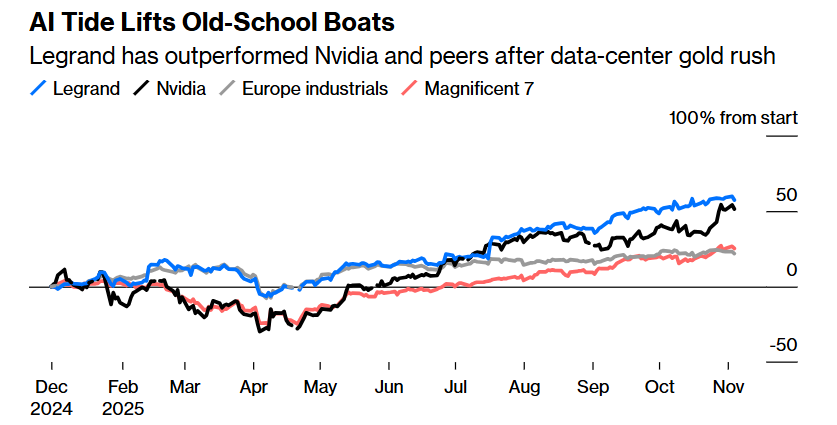
Group 1: AI Investment Bubble - The AI investment frenzy is compared to the 2000 internet bubble, inflating the market value of non-pure AI hardware companies globally, including in countries like India and various European nations that lag in the AI race [1][2] - Despite lacking major AI hardware leaders, India's stock market is seeing significant interest in local data center support companies, with many of these stocks rising over 100% [2][3] - European traditional industrial giants, such as Legrand and Schneider Electric, are benefiting from the AI data center boom, with their stock performance rivaling that of leading AI chip companies like Nvidia [3][4] Group 2: Power Demand and Infrastructure - The demand for electricity driven by AI data centers is projected to increase significantly, with Goldman Sachs revising its forecast for global data center electricity consumption growth to 175% by 2030 [7] - AI applications are expected to be the primary driver of this growth, with global data center electricity demand anticipated to exceed 945 terawatt-hours (TWh) by 2030, more than Japan's total electricity consumption [7][8] - Companies like Schneider Electric are positioned to benefit from this surge, as their products are essential for AI data centers, including power distribution and cooling systems [8][9] Group 3: Market Valuation and Risks - Current valuations for companies like Legrand and ABB are at historical highs, with enterprise values around 20 times their earnings, raising concerns about potential market corrections [10][13] - The sustainability of the AI investment boom in Europe is questioned, with analysts warning of irrational exuberance and the risk of a market downturn impacting the expansion of data centers [10][13] - Despite potential slowdowns in new data center construction, there remains a strong demand for upgrading existing facilities, with significant ongoing infrastructure projects in Europe [13][14]
“听到东方惊雷了吗?那是14亿中国人在笑话美国”
Guan Cha Zhe Wang· 2025-07-04 05:12
Core Viewpoint - The article critiques the "Big and Beautiful" tax and spending bill proposed by President Trump, arguing that it undermines the U.S. energy strategy and future development, particularly in renewable energy sectors, thereby benefiting China in the long run [1][3][4]. Group 1: Impact on Renewable Energy - The bill reduces tax incentives for solar, wind, and electric vehicles, which are seen as essential for enhancing grid capacity and reducing costs [3][4]. - The legislation imposes complex restrictions on battery credits, potentially limiting many projects from utilizing these incentives [4][8]. - The bill is expected to lead to a significant loss of investment in renewable energy, with predictions of 830,000 jobs in the sector being lost or not created by 2030 [8][10]. Group 2: Comparison with China - The article highlights China's aggressive development in renewable energy, noting that it has surpassed the U.S. in total power generation, with over 10 trillion kilowatt-hours compared to the U.S.'s 5 trillion since 2000 [7][11]. - China's solar power capacity has reached over 1,000 GW, accounting for half of the global total, and continues to expand rapidly [10][11]. - The article suggests that the U.S. is ceding its energy future to China, as the bill undermines the potential for clean energy transition in America [8][10]. Group 3: Economic and Strategic Implications - The bill is viewed as a strategic self-harm for the U.S., potentially increasing wholesale electricity prices by 50% by 2035 and raising annual energy costs for consumers by over $16 billion by 2030 [8][10]. - The article argues that the ability to provide cheap, clean electricity is crucial for a country's economic and military strength, particularly in the context of developing AI technologies [7][8]. - Critics, including prominent figures like Elon Musk, express concern that the bill favors outdated industries while damaging future-oriented sectors [6][7].