
电源插座

Search documents
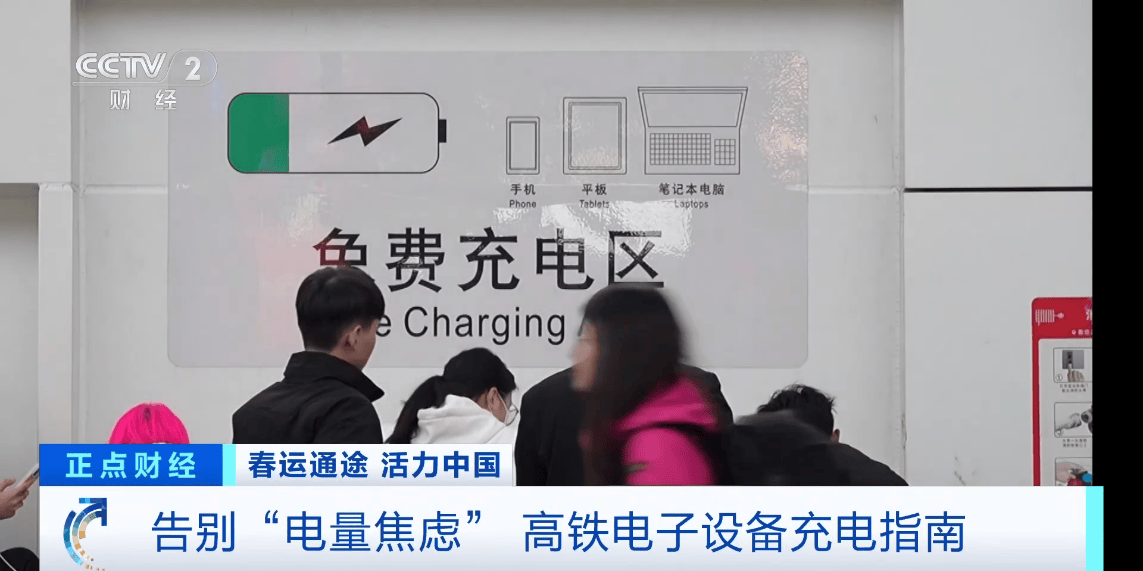
告别“电量焦虑”!高铁电子设备充电指南来了→
Sou Hu Cai Jing· 2026-02-02 08:20
Core Viewpoint - The article discusses the upgrades made to charging facilities at train stations in China during the Spring Festival travel season to accommodate the increasing demand for charging electronic devices among travelers [3][5]. Group 1: Charging Facility Upgrades - The China National Railway Group has initiated a charging facility upgrade project, focusing on nearly 500 major train stations across the country to meet the rising charging needs of travelers [3]. - In the Kunming Railway Bureau, 108 charging devices have been strategically installed at 54 key passenger stations, including Kunming Station and Dali Station [3]. Group 2: Charging Interface Enhancements - New charging stations are becoming standard across major train stations, with an increase in direct interfaces such as USB and Type-C to support fast charging [5]. - On the Fuxing smart train models, both first-class and second-class seats have been equipped with independent USB and Type-C charging ports, while some business class seats feature wireless charging panels [9]. Group 3: Power Distribution on Trains - The distribution of power outlets on trains is closely related to the train model and seating arrangement, with specific designs for different classes of seats [7]. - The railway department has issued a reminder that the power load on trains is limited to small appliances like mobile phones and laptops, prohibiting the use of high-power devices to prevent circuit failures [9].

出口企业“内外兼修”拓市场
Jing Ji Ri Bao· 2025-06-24 21:57
Core Viewpoint - The shift of foreign trade enterprises towards domestic sales is driven by the dual pressures of a complex international environment and the release of domestic demand potential [1][2]. Group 1: Market Dynamics - The increase in demand for high-quality and personalized products in the domestic market provides significant opportunities for foreign trade enterprises to adjust their strategies [2][3]. - Companies like Haiji Technology have begun to adapt their products to meet domestic consumer preferences, resulting in a gradual increase in domestic market sales [2][3]. Group 2: Strategic Adjustments - Many foreign trade enterprises are recognizing the need to diversify their market reliance due to the instability of international trade, leading to a strategic pivot towards domestic markets [2][4]. - Ningbo Changcheng Precision Industry Co., Ltd. has shifted its focus to strengthen its domestic supply chain and customer base, expanding its product range significantly [3]. Group 3: Challenges and Solutions - The transition from export to domestic sales presents challenges such as the need for new resources, channels, and brand recognition, which require substantial investment [5][6]. - Regulatory measures are being implemented to reduce the institutional costs associated with market transition, such as the promotion of "same line, same standard, same quality" for products [6][9]. Group 4: Channel Expansion - Initiatives by platforms like Douyin and Meituan are facilitating the entry of foreign trade products into domestic markets, providing support through marketing and logistics [7][8]. - The establishment of dedicated sections for foreign trade products in retail spaces is enhancing consumer access and driving sales growth [7][8]. Group 5: Long-term Strategy - The integration of domestic and foreign trade is seen as beneficial for the healthy development of the economy, promoting higher product competitiveness and brand value [4][9]. - Recommendations include further alignment of domestic standards with international norms and enhancing the protection of intellectual property to create a favorable environment for market transition [9].
中国外贸企业:提升产品竞争力 拓展多元市场
Zhong Guo Xin Wen Wang· 2025-05-09 06:33
Group 1 - The core viewpoint is that while export orders to the US are under short-term pressure, companies are focusing on diversifying markets and enhancing product competitiveness to navigate challenges [1][2] - Companies like Jiangmen Haiji Technology Co., Ltd. are experiencing instability in orders due to US tariff policies but are actively expanding into European and South American markets while developing domestic markets [1] - The textile industry is accelerating its transformation towards high value-added, green, and intelligent production, with companies planning to open nearly 200 large stores in emerging markets over the next five years [1] Group 2 - The machinery and electrical products sector is a key category for China's exports to the US, with companies adjusting their order models from "inventory-based purchasing" to "emergency purchasing" due to tariffs [2] - Companies are increasing their domestic market share, with one company raising its domestic sales proportion from 40% to over 65% by localizing products for domestic needs [2] - The implementation of national policies to stabilize foreign trade is allowing companies to convert some tariff costs into domestic market promotion funds, highlighting the importance of "hard technology" and "quick response" as core competitive advantages [2]