白银衍生品

Search documents
国际金银价格巨幅震荡,分析认为是国际机构资金的结构性调整与市场对美元走势预期的改变共同作用的结果
Xin Lang Cai Jing· 2026-02-02 13:38
Core Viewpoint - Recent fluctuations in international gold and silver prices, following historical highs, indicate increased volatility in the precious metals market, driven by changes in global liquidity expectations, Federal Reserve personnel shifts, and concentrated speculative positions [1][6]. Market Volatility: "Roller Coaster" Prices - On January 29, both gold and silver prices reached historical highs before experiencing significant drops, with gold futures falling nearly 7% and silver dropping 11% within 28 minutes. By February 2, silver prices had plummeted over 14%, and gold prices fell more than 9% [7][6]. - The sharp declines were exacerbated by automatic stop-loss trades triggered when prices fell below key technical support levels, leading to increased market sell-offs [7][8]. Structural Adjustment of International Institutions - The recent price volatility is linked to structural adjustments in institutional funding, with major banks significantly reducing net long positions before and after the price fluctuations [8][9]. - The mismatch between registered silver inventory and open contracts at the New York Mercantile Exchange contributed to the previous price surge, but the exit of large institutions disrupted this balance [8][9]. Repricing: Shift Towards De-bubbling - Changes in expectations regarding the U.S. dollar's trajectory have also contributed to the recent price volatility. The nomination of Kevin Walsh as the next Federal Reserve Chair has led to expectations of a stronger dollar, which could pressure non-yielding gold and silver prices [10][11]. - Following this nomination, the dollar index rebounded, and the 10-year U.S. Treasury yield increased, indicating a shift in investor focus from interest rate cuts to liquidity contraction risks [10][11]. Market Dynamics and Future Outlook - The precious metals market is undergoing a de-bubbling process, transitioning from purely emotional drivers to more rational macroeconomic data influences. Analysts suggest that while short-term volatility may persist, it could help curb excessive speculation in the long run [11][12].
黄金白银大跌!原因找到了
Sou Hu Cai Jing· 2026-02-02 13:33
Group 1 - Recent fluctuations in international gold and silver prices have been significant, with silver prices dropping by 40% and gold prices by approximately 20% from their historical highs on January 29 [1][3] - Market analysts attribute the volatility to changes in global liquidity expectations, personnel changes at the Federal Reserve, and concentrated speculative positions, indicating a shift in the investment logic that previously supported prices [1][3] - The sharp price declines are characterized as a result of both technical adjustments and changes in policy expectations, marking a transition in market dynamics [1][3] Group 2 - The dramatic price swings were exacerbated by a liquidity squeeze, with major international banks significantly reducing their net long positions in gold and silver prior to the price drops [5][6] - The mismatch between registered silver inventories and open contracts at the New York Mercantile Exchange contributed to the previous price surges, but the exit of large institutions disrupted this balance [5][6] - The forced liquidation in the silver derivatives market reached several hundred million dollars in a single day, indicating a significant deleveraging process [5][6] Group 3 - Changes in expectations regarding the U.S. dollar's trajectory, particularly following the nomination of Kevin Walsh as the next Federal Reserve Chair, have led to a shift in market sentiment, with expectations of a stronger dollar putting pressure on non-yielding assets like gold and silver [7][8] - The market is transitioning from a focus on interest rate cuts to a reassessment of liquidity contraction risks, with funds moving from precious metals to U.S. Treasury bonds [7][8] - The current volatility in the precious metals market reflects a broader restructuring of global asset pricing logic, with a shift from emotional to more rational macro data-driven influences [8]
白银狂飙后跳水
第一财经· 2025-12-29 08:16
Core Viewpoint - The article discusses the significant rise in silver prices driven by increased global central bank purchases, ETF inflows, and geopolitical tensions, with silver prices experiencing substantial volatility and speculation risks [3][5]. Supply and Demand Imbalance - The surge in silver prices is primarily attributed to a severe structural supply-demand imbalance, with global silver demand reaching 1.24 billion ounces while supply is only 1.01 billion ounces [5][6]. - Industrial demand and tight supply conditions are major drivers of the current silver market dynamics, leading buyers to pay a premium for immediate delivery [5]. Market Volatility and Speculation - Retail investors are heavily investing in various silver products, including physical silver bars and ETFs, which has increased trading volumes and market volatility [6]. - The trading volume of the largest silver ETF, iShares Silver Trust, has surged to levels not seen since the Reddit trading frenzy in 2021, indicating heightened speculative sentiment [6]. Risks from Leverage and Margin Increases - Analysts warn of the risks associated with speculation and high leverage in the silver market, as the market is smaller than gold, making it more susceptible to price swings [7][9]. - The Chicago Mercantile Exchange (CME) has raised silver margin requirements, which historically has led to significant price drops in the past [8][9]. Historical Context and Future Outlook - Current silver market conditions are compared to the 2011 bubble, where rapid price increases were followed by a sharp decline due to margin hikes [9]. - The volatility in silver prices poses challenges for industrial sectors that rely on silver, as highlighted by comments from industry leaders like Elon Musk [9].

白银跳水,猜疑四起,有华尔街大行扛不住了?
Hua Er Jie Jian Wen· 2025-12-29 07:05
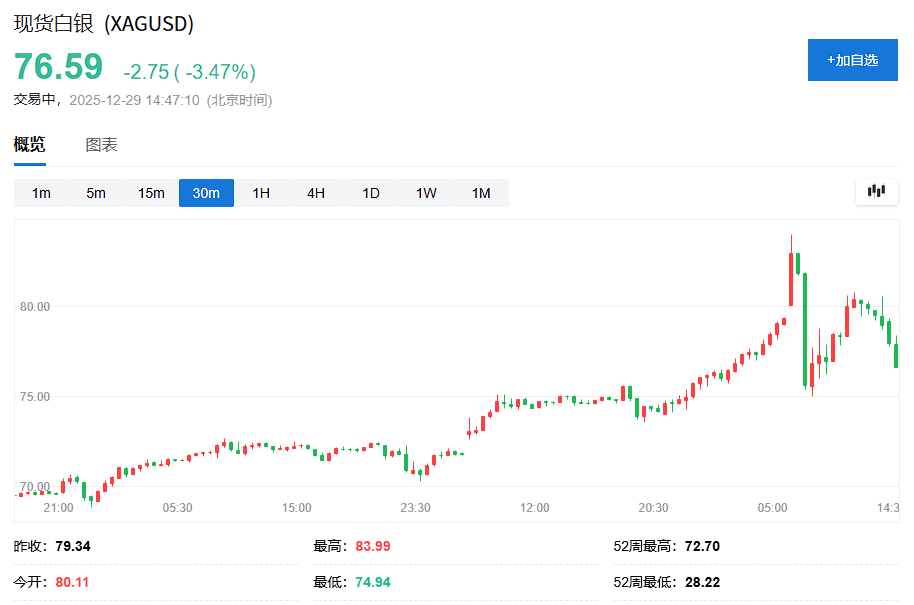
Core Viewpoint - The silver market experienced extreme volatility, with prices soaring by 6% to nearly $84 per ounce before dropping over 3% to $76.59, amid rumors of a "systemically important bank" facing a margin call in silver futures [1][4]. Group 1: Market Reaction - The silver price fluctuated dramatically, reaching a high of nearly $84 per ounce before falling to a low of around $75 per ounce [1]. - A rumor circulated on social media regarding a major bank's failure to meet a margin call, which drew significant market attention [4]. Group 2: Bank's Margin Call Details - A large bank reportedly faced a $2.3 billion margin call due to insufficient liquidity when silver prices exceeded $70 per ounce [6]. - The bank attempted to raise funds by contacting counterparties and selling assets but was unsuccessful, leading to forced liquidation by the exchange [6]. Group 3: Speculation on the Involved Bank - The bank involved is speculated to be one of the largest participants in the precious metals derivatives market, holding significant short positions in silver [5]. - Market speculation points towards a few major European banks, with some analysts expressing doubts about the rumor's authenticity [5][12]. Group 4: Financial Analysis - An analysis indicated that if the rumored bank's short positions were entirely self-held, the potential liquidity pressure could reach approximately $7.75 billion, which is manageable given its high-quality liquid assets [12][13]. - The bank's liquidity position, including $230 billion in cash and $70 billion in core capital, suggests that the liquidity stress is not severe enough to trigger bankruptcy [12][13]. Group 5: Potential Risks - Despite the analysis indicating manageable liquidity pressures, concerns remain about the bank's ongoing integration process and historical risk management failures [15]. - The market's tendency to react with panic could lead to a negative feedback loop affecting stock prices, regardless of the rumor's validity [15].