私人银行服务

Search documents
Banca Monte dei Paschi di Siena (OTCPK:BMDP.F) Update / briefing Transcript
2026-02-27 09:02
Summary of Banca Monte dei Paschi di Siena (MPS) Conference Call - February 27, 2026 Company Overview - **Company**: Banca Monte dei Paschi di Siena (OTCPK:BMDP.F) - **Industry**: Banking and Financial Services - **Key Event**: Presentation of the MPS Business Plan for 2026-2030 Core Points and Arguments Business Plan and Strategy - The business plan aims to create sustainable value and profitable growth for stakeholders, emphasizing client service as a core principle [2][3] - The integration of MPS and Mediobanca is expected to unlock EUR 700 million in synergies, with a focus on corporate investment banking and high-end private banking [4][5] - The group is projected to achieve revenues of EUR 9.5 billion by 2030, with a cost-income ratio below 40% and net profit reaching EUR 3.7 billion [7][35] Financial Performance and Projections - In 2025, the company surpassed previous targets, achieving EUR 8 billion in revenues and serving over 7 million clients [6][34] - The plan anticipates a compound annual growth rate (CAGR) of 4.6% in operating income from EUR 7.6 billion in 2025 to EUR 9.5 billion in 2030 [35][37] - Adjusted net profit is expected to increase from EUR 2.3 billion in 2025 to EUR 3.7 billion in 2030, with a return on tangible equity (ROTE) of 18% by 2030 [36][37] Revenue Breakdown - Revenue contributions by segment are projected as follows: - Retail and Commercial Banking: 30% - Corporate Investment Banking: 21% - Asset Gathering and Wealth Management: 30% - Private Banking: 14% - Consumer Finance: 19% [10] Technology and Innovation - The company plans to invest EUR 1 billion in IT from 2026 to 2030 to modernize and secure its operations, enhancing customer experience and operational efficiency [12][30] - AI technology is expected to improve productivity and customer service, with 90% of client requests resolved end-to-end [12] Market Position and Competitive Advantage - The merger positions the group as Italy's third-largest bank, with a strong competitive force in the market [6][52] - The integration of Mediobanca's capabilities with MPS's commercial reach is expected to enhance advisory services and create a comprehensive corporate investment banking platform [27][28] Dividend Policy and Shareholder Returns - The plan includes a commitment to distribute approximately EUR 16 billion in dividends between 2026 and 2030, representing over 60% of the market cap [53][51] - A 100% payout ratio is expected, with discussions on potential interim dividends and stock option plans for management [57][60] Important but Overlooked Content - The company emphasizes the importance of retaining and empowering its workforce, with over 1,000 new hires and extensive training programs planned [14][32] - The focus on ESG (Environmental, Social, and Governance) is highlighted as a growth driver, integrating sustainable finance and community engagement into the business model [32] Conclusion - Banca Monte dei Paschi di Siena is positioning itself for significant growth through strategic integration, technological investment, and a strong focus on client service, with ambitious financial targets set for 2030. The commitment to shareholder returns and sustainable practices further enhances its market appeal.
Simmons First National (SFNC) - 2025 Q4 - Earnings Call Transcript
2026-01-21 14:32
Financial Data and Key Metrics Changes - The net interest margin (NIM) increased by 94 basis points compared to the previous year, reaching 381 basis points in Q4 [82] - Pre-Provision Net Revenue rose by 60% year-over-year, indicating strong revenue growth [83] - The company reported a return on tangible common equity (ROTCE) of 16% for the quarter, reflecting a strong performance [60] Business Line Data and Key Metrics Changes - Loan growth in Q4 was the highest level of production seen in at least a couple of years, with a reported annualized growth rate exceeding 7% [8][10] - Agricultural loans were down in Q4, while the mortgage warehouse loans also decreased due to divestitures and charge-offs [9] - The pipeline for loans ready to close reached a multi-quarter high, indicating strong future growth potential [10] Market Data and Key Metrics Changes - The company noted that deposit competition remains high, particularly from smaller banks, but it maintains a dominant market share in many areas [22] - The competitive environment for loan pricing has become more challenging, particularly in commercial real estate (CRE) lending [24] Company Strategy and Development Direction - The company is focused on organic growth and investing in business sustainability and profitability as its top priorities [53] - There is a strong emphasis on improving processes and procedures as part of the Better Bank initiative, with ongoing efforts to enhance efficiency and scale [37][39] - The company aims to grow low-cost deposits and is optimistic about expanding its private banking and commercial capabilities [67][69] Management's Comments on Operating Environment and Future Outlook - Management expressed confidence in the stability of credit quality and the overall outlook for the company, citing a stable credit environment [32] - The company anticipates a stable NIM moving forward, with expectations for continued growth in net interest income (NII) without significant loan portfolio growth [18][19] - Management highlighted the importance of adapting to market conditions and leveraging opportunities across its footprint [34] Other Important Information - The company has reduced its square footage by 6%, contributing to cost savings and improved efficiency [42] - There is a focus on hiring talent across various business areas to drive innovation and efficiency [35] Q&A Session Summary Question: What are the drivers behind loan growth in Q4? - Management indicated that the loan growth was driven by a combination of improved pipeline quality and favorable market conditions, rather than aggressive rate cuts [48] Question: What is the outlook for NIM moving forward? - Management suggested that the top end of the NIM range has shifted upwards due to current market conditions, with expectations for stability in the mid-380s [51][52] Question: How does the company plan to grow customer deposits in 2026? - The strategy includes focusing on consumer banking, private banking, and enhancing commercial capabilities to attract deposit-rich customers [66][69] Question: What is the company's approach to asset quality and potential divestitures? - Management reported stable asset quality and indicated that recent divestitures were part of a strategy to clean up legacy non-performers [30][32] Question: How does the company view competition in the deposit and loan markets? - Management noted that while deposit competition is high, particularly from smaller banks, the company maintains a strong market position [22][24]

Bank OZK(OZK) - 2025 Q4 - Earnings Call Transcript
2026-01-21 14:32
Financial Data and Key Metrics Changes - The company reported a significant increase in its allowance for credit losses (ACL), which rose from $300 million to $632 million, reflecting prudent preparation for potential credit losses in a challenging environment [38] - The tangible common equity increased by 35 basis points during the quarter, despite the company buying back $100 million of common stock [56] Business Line Data and Key Metrics Changes - The Corporate and Institutional Banking (CIB) segment has seen growth in fee income initiatives, including loan syndication and interest rate hedging, which are expected to contribute positively to revenue in the coming years [17][19] - The mortgage lending business is gaining traction, with expectations for continued growth in fee income from originating loans for resale in the secondary market [19] Market Data and Key Metrics Changes - The office market is showing positive trends, with good leasing activity and refinancing opportunities, particularly in high-quality buildings [30][32] - The life sciences sector is facing challenges due to macroeconomic factors, but there is a lack of new supply, which may support future demand as capital investment in AI stimulates interest in life science spaces [28][34] Company Strategy and Development Direction - The company aims to diversify its earning assets and increase fee income as a larger part of its revenue over the long term, with a focus on enhancing its trust and wealth business and launching a private banking service [16][19] - The management is cautiously optimistic about the recovery in the commercial real estate (CRE) cycle, expecting 2026 to be near the end of the current cycle with improvements in conditions for sponsors [12][13] Management's Comments on Operating Environment and Future Outlook - Management expressed confidence in the gradual improvement of credit conditions, citing a return of liquidity and a normalization of supply-demand metrics in the office space [12][34] - The company anticipates that the credit charge-offs in 2026 will be similar to those experienced in 2025, with a focus on managing the risks associated with the CRE cycle [66][69] Other Important Information - The company has been actively managing its non-performing assets, with a focus on working collaboratively with sponsors to resolve issues and maximize asset value [50][53] - The company has initiated a stock buyback program, purchasing 2.25 million shares at an average price of $44.45, which is expected to be accretive to earnings and tangible book value [56] Q&A Session Summary Question: Outlook on credit charge-offs and loan sales - Management confirmed that the recent loan sale was at par and does not reflect a change in strategy, emphasizing that they expect credit conditions to improve in 2027 [8][10] Question: Fee income growth potential - Management indicated that while fee income has not been a significant part of the story, there are long-term tailwinds expected from investments in CIB and other initiatives [16][18] Question: Life sciences market recovery - Management noted that the life sciences sector is facing headwinds but is seeing some positive developments, with sponsors willing to support projects [26][28] Question: Resolution timeline for non-performing assets - Management discussed various paths for resolving non-performing assets, emphasizing a collaborative approach with sponsors to maximize value [44][48] Question: Margin outlook and buyback strategy - Management highlighted that the margin performed well in the last quarter and discussed the opportunistic nature of the buyback program, with plans to remain active if trading conditions are favorable [56][58]

蒙特利尔银(BMO)深耕中国市场:以跨境优势搭建中加融桥梁
Cai Fu Zai Xian· 2026-01-16 09:22
Core Insights - BMO is enhancing its role as a key financial bridge between China and North America, aiming to support bilateral trade cooperation [1][4] - The bank has a long history in cross-border transactions, having conducted its first foreign exchange transaction related to China-Canada trade shortly after its establishment in 1817 [2] - BMO has established a significant presence in China, being the first Canadian bank to set up a legal entity in the country, with operations in Beijing, Shanghai, and Guangzhou [2] Company Overview - Founded in 1817, BMO is the oldest bank in Canada and ranks as the seventh largest financial institution in North America, offering diversified financial services [1] - The bank serves millions of customers globally, with a focus on personal and commercial banking, wealth management, and capital markets [1] Cross-Border Operations - BMO provides various financial services to corporate clients, including loans and cash management, to support Chinese manufacturing companies in their international expansion [4] - For individual clients, BMO offers a "one-stop banking experience" with services tailored for high-net-worth individuals and new immigrants, including Mandarin-speaking support [4] Strategic Investments - BMO has made strategic equity investments in the Chinese market, holding approximately 28% of Shanghai Fuguo Fund Management Co. and about 16% of COFCO Trust [2] - These investments reflect BMO's long-term strategy to expand its presence in China's asset management and trust sectors [2] Trade Relations - According to data from the General Administration of Customs of China, the bilateral trade volume between China and Canada reached $61.74 billion from January to August 2025, marking a 7.1% year-on-year increase [4] - China is Canada's second-largest trading partner, with total goods trade expected to reach 117.44 billion CAD in 2024 [4] Future Vision - BMO aims to continue leveraging its connectivity to assist Chinese companies in expanding overseas and to support North American businesses entering the Chinese market [4] - The bank is committed to a vision of "daring to explore and achieving great success" while maintaining prudent operations and a long-term perspective in the Chinese market [4]


“徽”煌二十载 奋斗“圳”当时
Nan Fang Du Shi Bao· 2025-12-27 23:10
Core Viewpoint - Huishang Bank celebrates its 20th anniversary, highlighting its commitment to serving the public and supporting local economic development through reform and innovation [2][3]. Group 1: Company Growth and Achievements - Since its establishment in 2005, Huishang Bank has grown significantly, with assets, deposits, and loans increasing over 45 times, 28 times, and 35 times respectively [3]. - The bank has over 21.5 million personal customers and has seen a 9.1-fold increase in scale, contributing to Anhui's economic growth [3]. - Huishang Bank's loans in Anhui have surpassed 1 trillion yuan, supporting the province's status as an "economic powerhouse" [3]. - The bank has provided over 210 billion yuan in technology loans and over 160 billion yuan in manufacturing loans, demonstrating its support for industrial upgrades [3]. - Green credit balances are nearly 160 billion yuan, and loans to private enterprises and small businesses exceed 255 billion yuan and 170 billion yuan respectively [3]. Group 2: Innovation and Reform - Huishang Bank emphasizes reform and innovation as key strategies, transitioning from traditional banking to a modern financial group [4]. - The bank has successfully launched a new core system and increased its technological investments, significantly enhancing its digital capabilities [4]. - It has improved its ranking in the global banking sector, now positioned at 101 among the world's top 1,000 banks [4]. Group 3: Regional Development and Community Engagement - The Shenzhen branch of Huishang Bank has experienced rapid growth since its establishment in 2020, with total deposits and loans nearing 50 billion yuan [6]. - The branch has developed a diversified business model, integrating traditional banking with investment and wealth management services [6]. - It has received numerous awards for its contributions to local economic development and community service, enhancing its brand influence [7]. Group 4: Future Outlook - Moving forward, Huishang Bank aims to continue its commitment to national strategies and regional development, aspiring to become a leading modern commercial bank [8]. - The bank plans to maintain its focus on the political and public nature of financial work while fostering a spirit of innovation and integrity [8].

Flagstar Financial, lnc.(FLG) - 2025 Q3 - Earnings Call Transcript
2025-10-24 13:02
Financial Data and Key Metrics Changes - The company reported an adjusted net loss of $0.07 per diluted share, a significant improvement compared to the previous quarter [4][16] - The net interest margin (NIM) expanded for the third consecutive quarter, increasing by 10 basis points to 1.91% [5][18] - Operating expenses decreased year-over-year by $800 million on an annualized basis [5][18] - Criticized and classified assets declined by $600 million or 5% on a linked quarter basis and by $2.8 billion or 20% year-to-date [5][25] Business Line Data and Key Metrics Changes - The Commercial and Industrial (C&I) business originated $1.7 billion in new loan outstandings, with overall net loan growth of $448 million in the C&I portfolio [5][15] - Multifamily and Community Reinvestment Act (CRA) payoffs totaled $1.3 billion, continuing a trend of exceeding forecasts [5][16] - The provision for loan losses decreased by 41%, while net charge-offs declined by 38% [5][25] Market Data and Key Metrics Changes - The company has seen a significant reduction in overall Commercial Real Estate (CRE) balances, which have declined by $9.5 billion or 20% since year-end 2023 [22] - The CRE concentration ratio decreased by 95 basis points to 407% since year-end 2023 [22] Company Strategy and Development Direction - The company is focused on transforming into a top-performing regional bank, emphasizing a customer-centric relationship-based culture [28] - Plans to originate new high-quality CRE loans in diverse geographic areas are set to begin in the fourth quarter [15][37] - The company aims to diversify its loan portfolio to a mix of one-third CRE, one-third C&I, and one-third consumer [22] Management's Comments on Operating Environment and Future Outlook - Management expressed optimism about the trajectory of C&I loan growth, projecting a run rate of $1.7 billion to $2.2 billion in originations per quarter [40][57] - The company anticipates balance sheet growth starting in Q1 2026, with a target of reaching approximately $108 billion by the end of 2027 [81] Other Important Information - The company completed a holding company reorganization, which simplifies its corporate structure and is expected to reduce operating expenses by approximately $15 million [28] - The CET1 capital ratio stands at 12.45%, ranking among the highest among regional bank peers [20] Q&A Session Summary Question: NII guidance for the year - Management indicated that the balance sheet would likely stabilize in Q4 and expects continued NIM expansion due to various factors, including the management of funding costs [33][35] Question: C&I production outlook - Management expects C&I production to continue growing, with a run rate of $1.7 billion to $2.2 billion per quarter anticipated [40][46] Question: Regulatory relief from holding company elimination - The elimination of the holding company is expected to reduce regulatory burdens and streamline operations, leading to cost savings [58] Question: Expense management and future cost savings - Management highlighted significant reductions in non-interest expenses and identified further opportunities for cost savings in FDIC expenses and vendor costs [68][70] Question: Non-interest-bearing deposit growth - Management expects growth in non-interest-bearing deposits from new C&I relationships, private banking, and retail branches [72][74]
股份行私人银行业务稳健增长:客户数与资产管理规模双升
Zhong Guo Jing Ying Bao· 2025-09-11 08:14
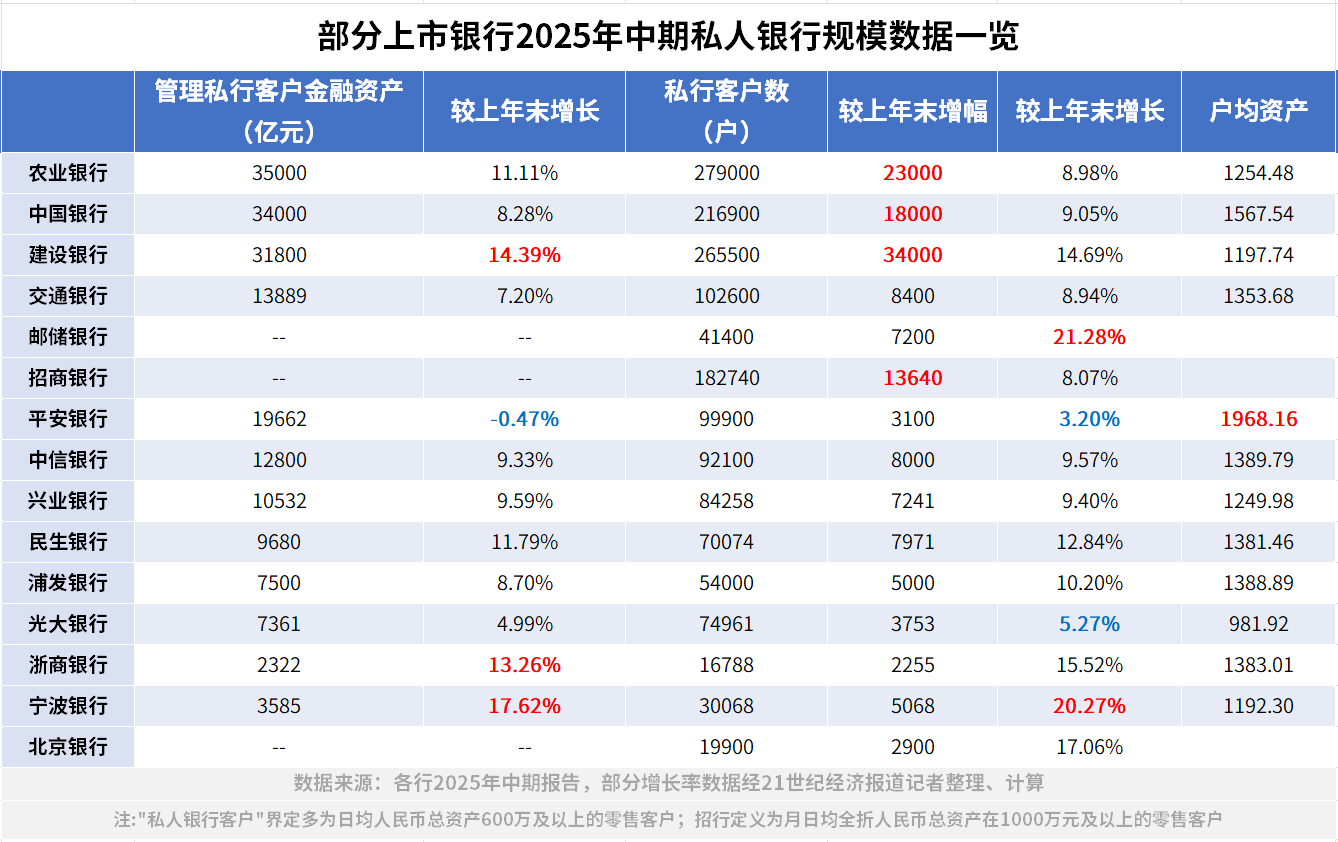
Core Viewpoint - The private banking business of several joint-stock banks in China has shown strong growth momentum in the first half of 2025, with significant increases in both asset management scale (AUM) and client numbers compared to the end of last year [1][2]. Group 1: Private Banking Performance - Among 12 joint-stock banks, 6 disclosed their private banking AUM and client numbers, with a total AUM of 4.65 trillion yuan as of June 30, 2025, up 4.49% from 4.45 trillion yuan at the end of last year [2]. - The total number of private banking clients for these banks reached 315,700, reflecting a growth of 7.53% compared to the end of last year [2]. - Notably, Minsheng Bank reported an AUM growth of 11.79% and a client number increase of 12.84%, while Zhejiang Commercial Bank saw AUM growth of 13.26% and client number growth of 15.52% [2]. Group 2: Strategies for Growth - Zhejiang Commercial Bank has implemented four key strategies to enhance its private banking business: 1. Strengthening the private banking system and upgrading service frameworks since 2024 [3]. 2. Expanding client acquisition channels through targeted activities for specific demographics, such as senior clients, and enhancing cross-border service capabilities [3]. 3. Focusing on family office services, which have seen significant growth in coverage and scale since 2024 [3]. 4. Expanding the range of customized and multi-strategy products to improve client asset allocation success rates [3]. Group 3: Family Trust and Office Business - Joint-stock banks are increasingly investing in family trust and family office services, with CITIC Bank emphasizing a comprehensive solution for ultra-high-net-worth clients [4]. - Zhejiang Commercial Bank's family office services are a core part of its private banking strategy, leveraging an expert service system and a fully online management system [4]. - In the first half of 2025, Zhejiang Commercial Bank signed 692 family trust agreements, adding 5.6 billion yuan in managed assets, and has successfully launched 62 elder care service trusts, marking a significant step towards scalable development in this area [5].

7家上市银行私行管理资产余额均超万亿元
Zheng Quan Ri Bao· 2025-09-04 16:18
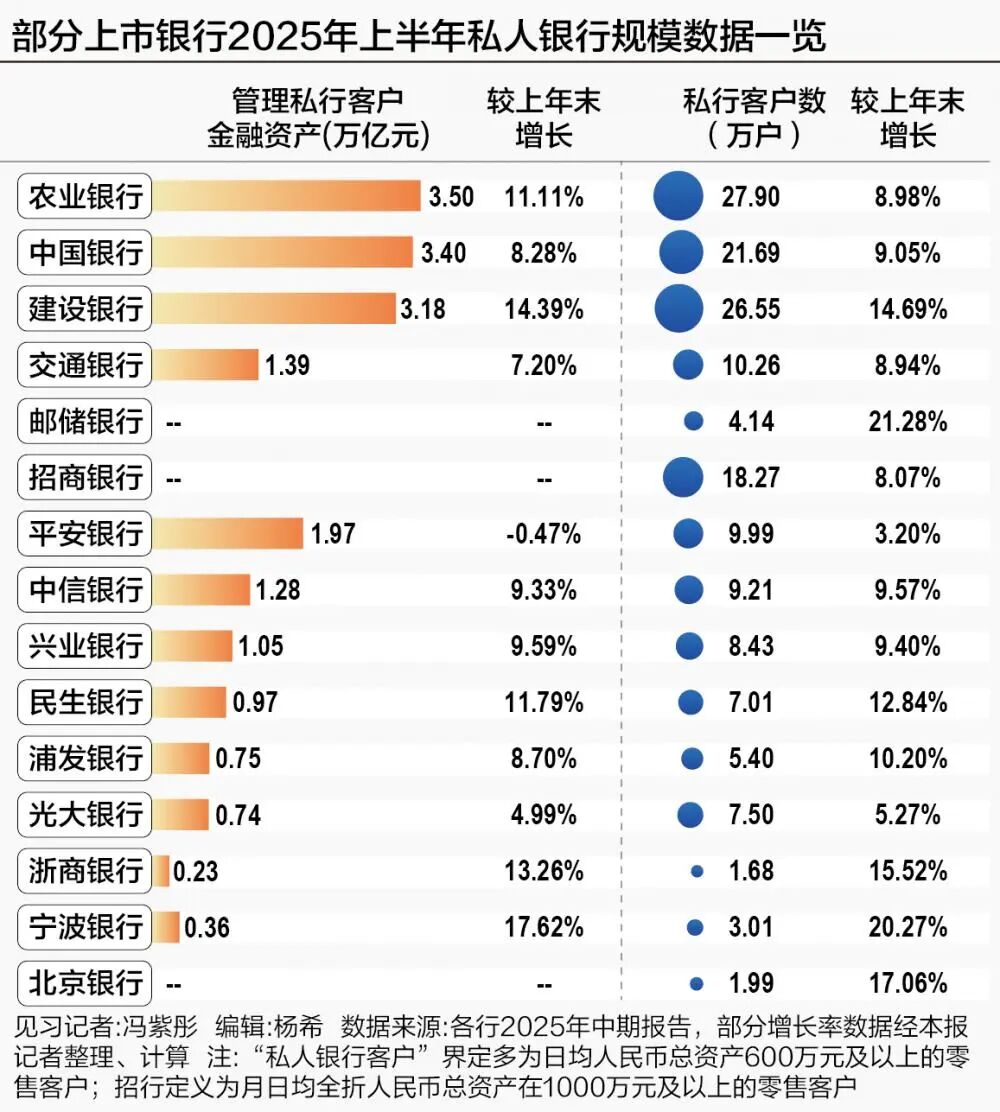
Core Insights - The private banking sector is identified as a key area for value extraction within retail banking, reflecting the strength of banks' wealth management capabilities [1] - As of mid-2023, most banks reported growth in both the number of private banking clients and assets under management (AUM), indicating a continuous expansion of the high-net-worth wealth management market [1][2] Client Growth - Among the 13 listed banks that disclosed private banking client data, Agricultural Bank, China Bank, and Construction Bank lead with over 200,000 clients each, with respective figures of 279,000, 265,500, and 216,900 [2] - Construction Bank saw a 14.69% increase in private banking clients compared to the end of 2022, while China Bank surpassed the 200,000 client mark [2] - Among national joint-stock banks, China Merchants Bank leads with 182,700 clients, followed by Ping An Bank and CITIC Bank, both exceeding 90,000 clients [2] AUM Performance - Of the 13 banks analyzed, 11 disclosed AUM data, with Agricultural Bank, China Bank, and Construction Bank each exceeding 3 trillion yuan in AUM, at 3.5 trillion, 3.4 trillion, and 3.18 trillion yuan respectively [3] - Traffic Bank's AUM reached 1.39 trillion yuan, reflecting a 7.20% growth since the end of 2022 [3] - Among national joint-stock banks, Ping An Bank, CITIC Bank, and Industrial Bank are part of the "trillion yuan club," with AUM figures of 1.97 trillion, 1.28 trillion, and 1.05 trillion yuan respectively [3] Service Optimization - Private banking has become a significant profit growth point for banks, especially as traditional retail banking growth slows [4] - The sector is evolving from a single financial advisory model to a comprehensive service ecosystem, incorporating diverse products such as family trusts and cross-border asset allocation [4] - Major banks are enhancing their private banking services through product optimization and resource integration, aiming to build a robust service ecosystem [4] Future Directions - The future of private banking is expected to focus on three main areas: deepening digitalization, creating service ecosystems, and expanding global investment options [6] - Digital transformation will leverage technologies like AI and blockchain to enhance client service processes and risk management [6] - The integration of external resources such as legal and tax services will be crucial in developing a comprehensive service framework, particularly for family office and legacy planning services [6]



私人银行半年新增15万高净值客户
2 1 Shi Ji Jing Ji Bao Dao· 2025-09-04 05:32
Core Insights - The private banking sector has shown remarkable growth in the first half of 2025, becoming a standout area within the wealth management segment of banks despite a complex economic environment [1][4] - The total number of private banking clients across 15 banks exceeded 1.63 million, with an increase of nearly 150,000 clients, reflecting a growth rate of over 10% [1][4] - Major banks have reported significant increases in Assets Under Management (AUM), with Agricultural Bank leading at 3.5 trillion yuan, followed closely by Bank of China and China Construction Bank [2][4] Growth Metrics - Private banking AUM for Agricultural Bank reached 3.5 trillion yuan, up 11.11% from the previous year, with client numbers increasing by 23,000 to 279,000 [4][5] - Bank of China reported AUM of 3.4 trillion yuan and 216,900 clients, while China Construction Bank's AUM grew to 3.18 trillion yuan with a 14.39% increase [4][5] - The private banking sector is experiencing a shift from rapid expansion to a focus on deepening client relationships and enhancing service quality [1][5] Client Segmentation and Services - Banks are increasingly focusing on ultra-high-net-worth clients and diversifying their service offerings, including family trusts and retirement financial planning [1][8] - Citic Bank has reported a 40.96% increase in ultra-high-net-worth clients, while Everbright Bank is targeting families, women, and business owners with tailored services [7][8] - Family trusts have become a key area of growth, with Everbright Bank's family trust assets increasing by 56.12% year-on-year [8] Revenue Generation and Business Model - The establishment of private banking centers is accelerating, with China Construction Bank setting up 248 centers and Bank of China 205 centers, enhancing client retention and AUM [10][11] - Private banking is becoming a significant contributor to banks' intermediary income, with Beijing Bank reporting a 16.89% increase in product sales, driving a 17.77% rise in intermediary income [10][11] - The focus on personalized services and data-driven client profiling is expected to further enhance revenue streams for banks [11]
半年新增15万高净值客户 私人银行成中收增长动力
2 1 Shi Ji Jing Ji Bao Dao· 2025-09-03 11:10
Core Insights - The private banking sector has shown robust growth in the first half of 2025, with many banks reporting double-digit increases in both client numbers and assets under management (AUM) despite a complex economic environment [1][2][5] - The total number of private banking clients across 15 banks exceeded 1.63 million, with an increase of nearly 150,000 clients, reflecting a growth rate of over 10% [1] - Major banks like Agricultural Bank and China Bank have maintained significant AUM, with Agricultural Bank reaching 3.5 trillion yuan, marking an 11.11% increase year-on-year [2][4] Private Banking Growth - The private banking industry is experiencing steady expansion, with major banks leading the market due to their strong client bases and resource networks [2][5] - Agricultural Bank's AUM reached 3.5 trillion yuan, with a client increase of 23,000 to 279,000, while China Bank followed closely with 3.4 trillion yuan AUM and 216,900 clients [2][4] - Construction Bank reported a 14.39% increase in AUM, reaching 3.18 trillion yuan, and a 14.69% rise in client numbers [2][4] Client Quality and Asset Management - Despite the growth in client numbers and AUM, average assets per client have generally declined, indicating a shift from rapid expansion to a focus on deeper client engagement [5][6] - Only Agricultural Bank and Industrial Bank reported increases in average client assets, while other banks experienced varying degrees of decline [5] Strategic Focus Areas - Banks are increasingly focusing on high-net-worth clients, family trusts, retirement finance, and enhancing private banking centers to differentiate themselves in a competitive market [1][6][8] - For instance, Citic Bank is enhancing its services for ultra-high-net-worth clients, while Everbright Bank is targeting family-oriented and female clients [7][8] Family Trusts and Lifecycle Services - Family trusts have become a key area for private banking, with significant growth reported in this segment; Everbright Bank's family trust assets grew by 56.12% year-on-year [8] - Agricultural Bank has launched a retirement finance management center, adding 12,000 clients and managing 1.3 trillion yuan in assets [8] Private Banking Centers and Revenue Generation - The establishment of private banking centers has accelerated, with Construction Bank setting up 248 centers and China Bank 205 centers, contributing to improved client retention and AUM [9][10] - Private banking is increasingly driving middle-income revenue, with Beijing Bank reporting a 16.89% increase in product sales, boosting its middle-income revenue by 17.77% [10]