税务策略工具

Search documents
美股散户疯狂“抄底”软件股,“扫货”资金量创历史新高
智通财经网· 2026-02-19 02:06
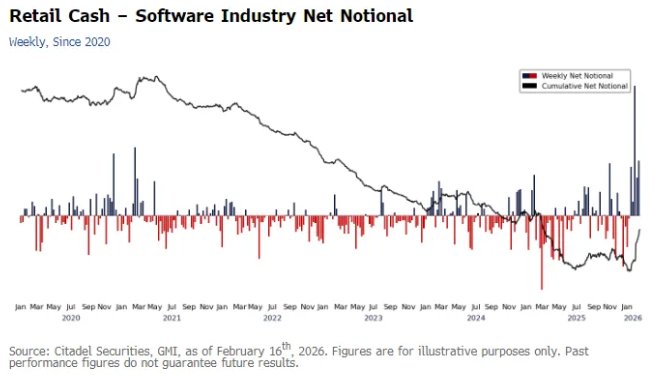
Group 1 - The software sector is experiencing a sell-off due to fears of being replaced by artificial intelligence tools, prompting Wall Street to reassess the potential for overselling, while retail investors are buying the dip [1][2] - Retail traders on the Castle Securities platform have reached a record high in spending on software stocks, with net nominal amounts hitting unprecedented levels, indicating strong demand from retail investors [1] - The sell-off has affected a wide range of companies, from small software developers to large wealth management firms, particularly after the launch of AI tools tailored for legal teams [1] Group 2 - The sell-off in the software sector has led to a broader market impact, with investors selling stocks perceived to be at risk from AI technology, despite minimal actual risk [2] - Retail demand has expanded beyond the tech sector, with increased interest in materials, real estate, finance, communication services, and industrial sectors [2] - Retail participation in the options market has reached historical highs, with daily options trading volume up nearly 50% compared to the average from 2020 to 2025, and 15% higher than the same period last year [2]
城堡证券:美股散户疯狂“抄底”软件股,“扫货”资金量创历史新高
智通财经网· 2026-02-19 01:11
Group 1 - The core viewpoint of the articles highlights a significant sell-off in software stocks due to fears of AI tools threatening these companies, leading to a reevaluation by Wall Street of the potential for overselling [1][2] - Retail investors are actively buying into software stocks at historically high levels, with spending on these stocks on the Castle Securities platform reaching unprecedented amounts since tracking began in 2017 [1] - The sell-off has affected a wide range of companies, from small software developers to large wealth management firms, particularly after the launch of AI tools tailored for legal teams [1] Group 2 - The sell-off in the software sector has extended across the market, with investors selling stocks perceived to be at risk of being replaced by AI technology, even if the risk is minimal [2] - From January 2 to February 13, the average daily dollar demand for U.S. stocks on the Castle Securities platform was approximately 25% higher than the peak in 2021, and double the average from 2020 to 2025 [6] - Retail demand has diversified beyond the tech sector, with increased interest in materials, real estate, finance, communication services, and industrial sectors, alongside a historical high in retail participation in the options market [6]

高盛推出“抗AI冲击”主题投资组合:做多算力与安全,做空可被替代的软件股35/64
美股IPO· 2026-02-14 04:12
Core Viewpoint - Goldman Sachs has launched a new software stock long-short portfolio, betting on companies that are less likely to be replaced by AI or that will benefit from the growth in AI demand, while shorting companies that may be automated or replaced internally due to AI advancements [1][3]. Group 1: Long Position - The long side of the portfolio focuses on companies that require physical execution, are heavily regulated, or need human accountability, which makes them less susceptible to AI disruption [3]. - Companies included in the long position are Cloudflare, CrowdStrike, Palo Alto Networks, Oracle, and Microsoft, which are expected to benefit directly from the rising adoption of AI [3][4]. Group 2: Short Position - The short side targets software-driven companies whose workflows may increasingly be automated or rebuilt internally due to AI capabilities. Companies in this category include Monday.com, Salesforce, DocuSign, Accenture, and Duolingo [3][4]. - The recent launch of AI tools by companies like Anthropic and Altruist has led to significant declines in the stock prices of legal and financial software firms, indicating a shift in market sentiment towards a defensive stance [4]. Group 3: Market Sentiment and Valuation - The recent sell-off has reset valuation levels, with the price-to-earnings ratio for software stocks dropping from approximately 51 times a year ago to about 27 times currently [5]. - Despite the decline in valuations, earnings expectations remain stable, with the software and services sub-sector projected to achieve around 14.1% earnings growth by 2026, which is lower than the overall tech sector's expected growth of 31.7% but still above the S&P 500's 13.7% growth forecast [5].


AI颠覆风暴席卷美股旅游休闲板块!在线预订平台惨遭屠戮,酒店股逆势狂飙
Zhi Tong Cai Jing· 2026-02-13 13:05
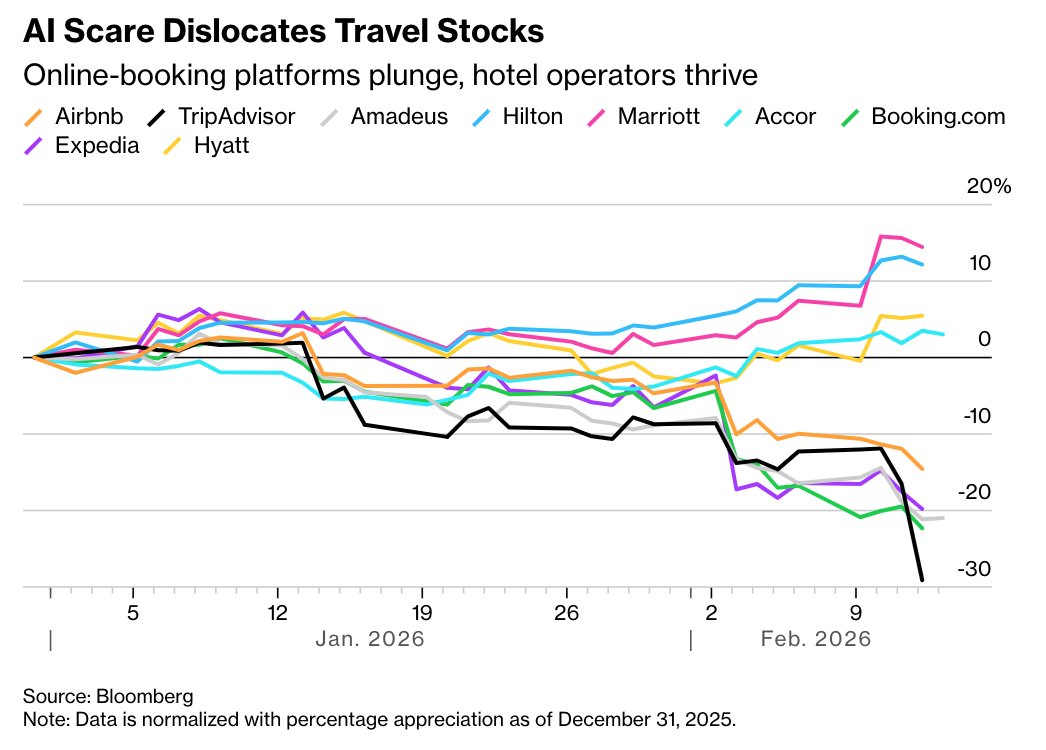
Group 1 - Concerns about AI disruption have led to significant divergence in the travel and leisure industry, with online travel platform stocks plummeting while traditional hotel operators' stocks surged [1] - TripAdvisor's stock has fallen 29% this year, hitting a historical low after disappointing earnings, while Booking Holdings and Amadeus IT Group have seen declines of 22% [1] - In contrast, Marriott's stock has risen 14% and Hilton's stock has increased by 12% this year, with analysts raising target prices following Hilton's earnings report [1] Group 2 - The sell-off in travel stocks accelerated in early February as investors fled companies perceived to be vulnerable to AI disruption, initially triggered by a new tool from Anthropic [4] - The sell-off has spread to IT services, wealth management, real estate platforms, and logistics sectors, with significant drops in stocks like Charles Schwab and LPL Financial [4] - Concerns about AI's impact on office space demand have led to declines in commercial real estate stocks, with major firms like CBRE and JLL experiencing drops of 8.8% and 7.6% respectively [4] Group 3 - The market is currently characterized by a "sell first, ask questions later" mentality, as fears of AI disruption escalate with the rollout of AI products [4] - The Dow Jones Transportation Average has outperformed the S&P 500 by 13 percentage points over the past month and a half, driven by strong economic data and a trend of reducing exposure to tech giants [4] - Investors are increasingly seeking alternatives to AI-related stocks, with strong economic conditions reinforcing positive investment logic in traditional sectors [5] Group 4 - The software sector has experienced significant sell-offs, presenting a buying opportunity for investors, as many software stocks are considered severely oversold [6] - Despite recent declines in software stocks, there is a belief that market turmoil is creating favorable conditions for savvy investors [6] - A significant divergence in growth prospects and fundamental expectations among software companies is anticipated, rather than a uniform rebound across the market [6]
华尔街新交易逻辑:抛售处于AI冲击范围内的股票
Xin Lang Cai Jing· 2026-02-11 09:52
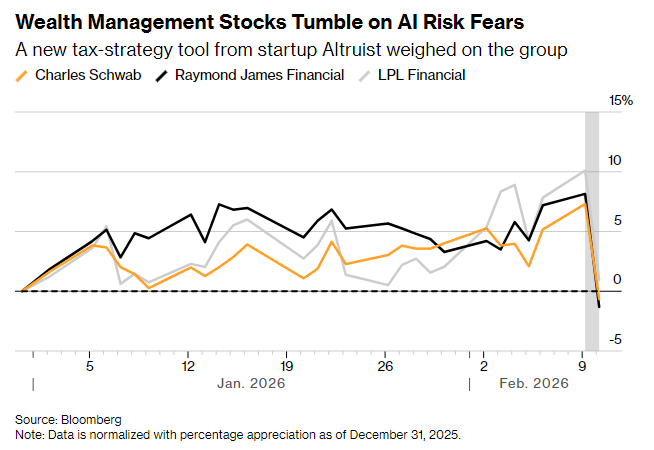
Core Viewpoint - Concerns about artificial intelligence (AI) are escalating on Wall Street, leading to significant sell-offs across various sectors, particularly in companies perceived to be at risk of disruption by AI technologies [1][14]. Group 1: Market Reactions - A recent sell-off was triggered by the launch of a tax strategy tool by Altruist Corp, resulting in stock price declines of over 7% for major financial firms like Charles Schwab and Raymond James [1][14]. - The sell-off extended to European wealth management firms, with companies like AJ Bell and St. James's Place experiencing simultaneous declines [1][14]. - This downturn is noted as one of the most significant since the market turmoil in April, reflecting a "sell first, ask questions later" mentality among investors [1][14]. Group 2: Investor Sentiment - Investors are shifting focus from identifying potential winners to avoiding any companies that exhibit even a slight risk of being replaced by AI [4][17]. - The narrative around AI has evolved from skepticism about its practical applications to a recognition of its disruptive potential, as evidenced by the rapid deployment of powerful AI tools [6][20]. - The market's reaction indicates a heightened sensitivity to negative news, with stock prices plummeting by 10% on minor adverse signals, a phenomenon unlikely to occur in markets with lower valuations [27]. Group 3: Industry Implications - The software industry has been particularly affected by AI-related anxieties, with fears spreading to other sectors such as finance, insurance, and legal services following the introduction of new AI tools [8][21]. - Altruist's CEO noted the unexpected market reaction, which resulted in the evaporation of billions in market value for several investment firms, highlighting the competitive threat posed by their new product [22][21]. - The architecture used to develop Altruist's tool is perceived as capable of replacing roles within the wealth management industry, suggesting a significant shift in operational dynamics [10][24]. Group 4: Future Outlook - Experts express uncertainty about the future impact of AI, with some suggesting that the actual disruption may occur more slowly than anticipated [25][26]. - The current market environment reflects a broader anxiety about the sustainability of high valuations driven by AI investments and the resilience of the U.S. economy [27][12]. - The ongoing developments in AI are still in their infancy, and making definitive predictions about their long-term effects remains challenging [13][12].
AI“淘汰焦虑”愈演愈烈!华尔街如今的交易逻辑:只要怕被AI替代,先抛了再说
美股IPO· 2026-02-11 04:01
Core Viewpoint - The market is experiencing heightened anxiety regarding the potential disruption caused by artificial intelligence (AI), leading to significant stock sell-offs across various sectors, particularly those perceived to be at risk of being replaced by AI technologies [1][3][4]. Group 1: Market Reactions - A recent sell-off was triggered by the launch of a tax strategy tool by Altruist Corp, resulting in stock price declines of over 7% for major firms like Charles Schwab, Raymond James, and LPL Financial, marking some of the largest single-day drops since last April [3]. - The market sentiment has shifted from seeking AI winners to rapidly withdrawing from any companies that exhibit even a slight risk of being replaced by AI [8]. - The introduction of AI products has led to widespread panic, with significant declines in stock prices across software, financial services, asset management, and legal services sectors [9][10]. Group 2: Industry Perspectives - Gabelli Funds manager John Belton noted that companies facing potential disruption are experiencing indiscriminate sell-offs, reflecting a broader market fear [4]. - The software industry is particularly affected, with AI companies like Anthropic launching new tools that have caused stock prices to plummet across multiple sectors [9]. - There is skepticism regarding the market's rapid shift from fearing an AI bubble to fearing its disruptive potential, with some experts suggesting that the actual impact of technological disruption often unfolds more slowly than anticipated [11][12]. Group 3: Future Outlook - The future of AI technology adoption remains uncertain, with historical challenges in the banking sector from cryptocurrencies and electronic services failing to disrupt its dominance [10]. - Experts caution against premature conclusions about AI's impact, emphasizing that the AI revolution is still in its early stages and that the market is eager to make judgments without sufficient evidence [13].

AI“淘汰焦虑”愈演愈烈!华尔街如今的交易逻辑:只要怕被AI替代,先抛了再说
智通财经网· 2026-02-11 02:49
Core Viewpoint - The market is experiencing heightened fear regarding the potential disruption caused by artificial intelligence (AI), leading to significant stock price declines across various sectors, particularly in wealth management and software companies [1][3]. Group 1: Market Reaction - A recent sell-off was triggered by the launch of a tax strategy tool by Altruist Corp, resulting in stock price drops of over 7% for major firms like Charles Schwab, Raymond James, and LPL Financial [1]. - This sell-off reflects a broader market sentiment of "sell first, ask questions later," as concerns grow over the potential for AI to disrupt entire industries [1][3]. - The stock market has seen significant volatility, with companies facing indiscriminate selling if they are perceived to have any risk of being replaced by AI [3][4]. Group 2: Industry Impact - The introduction of AI products has shifted investor focus from identifying AI winners to quickly exiting any companies that may face replacement risks [3]. - The software industry is particularly affected, with stock prices plummeting across various sectors, including financial services and legal services, following the launch of new AI tools [3][4]. - Altruist's CEO highlighted that the technology used in their product could potentially replace many roles in wealth management, emphasizing the competitive threat posed by AI [4]. Group 3: Market Sentiment and Future Outlook - There is skepticism among analysts regarding the rapid shift from concern over an AI bubble to fear of its disruptive potential, with some suggesting that technological disruption often takes longer to materialize than anticipated [4][5]. - The current market reaction indicates a heightened sensitivity to any negative signals, with stock prices dropping significantly on minor adverse news [5]. - Experts caution against making premature conclusions about the long-term impact of AI, noting that the AI revolution is still in its early stages [5].