
商业地产服务

Search documents
AI正从美股增长引擎变成“估值粉碎机”?
财富FORTUNE· 2026-02-14 10:08
Core Viewpoint - The article discusses a significant downturn in the U.S. stock market, particularly the S&P 500 index, which fell by 1.4%, marking its largest drop since November of the previous year. This decline is attributed to fears surrounding AI's impact on various sectors, raising concerns that AI may no longer be a growth engine but rather a "valuation crusher" [1][3]. Group 1: Market Reactions - The S&P 500 index experienced a notable increase in abnormal stock fluctuations, with over 40 stocks showing deviations exceeding three standard deviations, indicating a potential collapse of market confidence [3]. - The logistics sector was heavily impacted, with C.H. Robinson experiencing an eight-fold standard deviation drop, leading to a "death spiral" of automated stop-loss orders and panic selling [3]. - Major tech companies, including Apple, Amazon, Microsoft, and Meta, were significant contributors to the index's decline, with Amazon hitting a nine-day losing streak, marking its longest since 2006 and entering a technical bear market [3][4]. Group 2: AI's Impact on Employment and Market Sentiment - A statement from Microsoft's AI CEO suggested that most white-collar jobs could be fully automated within 18 months, causing immediate market panic and a sell-off of stocks related to potentially disrupted industries [4]. - The market's fear extends to the return on investment for massive capital expenditures by tech giants, with a combined projected spending of $650 billion on AI infrastructure by Google, Meta, Microsoft, and Amazon, raising concerns about their financial health [4]. Group 3: Competitive Landscape and Pricing Power - Chinese AI companies have made significant advancements, launching competitive products that challenge the pricing and performance of existing models, which could reshape global investor expectations [5][6]. - The emergence of low-cost AI solutions, such as MiniMax's M2.5 model, threatens the pricing power of established tech giants, leading to a reevaluation of their market positions and business models [8]. - The article highlights a shift from a positive growth narrative to a negative cycle of demand shrinkage and profit contraction, as AI efficiency gains may lead to reduced overall employment [7]. Group 4: Future Market Outlook - Goldman Sachs warns that if the S&P 500 index falls below 6707 points, it could trigger systemic sell-offs amounting to $80 billion, indicating a fragile market environment [8]. - The current market situation serves as a "stress test" for business models in the AI era, determining which companies can adapt and which may struggle to maintain their competitive advantages [8].







AI颠覆风暴席卷美股旅游休闲板块!在线预订平台惨遭屠戮,酒店股逆势狂飙
Zhi Tong Cai Jing· 2026-02-13 13:05
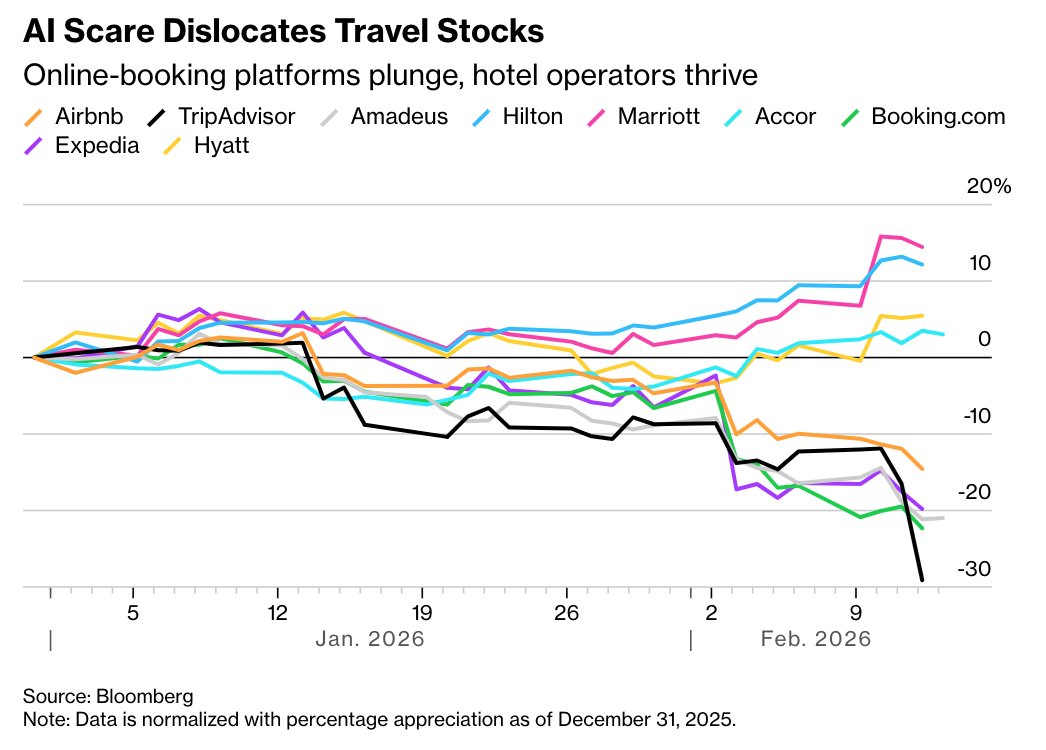
Group 1 - Concerns about AI disruption have led to significant divergence in the travel and leisure industry, with online travel platform stocks plummeting while traditional hotel operators' stocks surged [1] - TripAdvisor's stock has fallen 29% this year, hitting a historical low after disappointing earnings, while Booking Holdings and Amadeus IT Group have seen declines of 22% [1] - In contrast, Marriott's stock has risen 14% and Hilton's stock has increased by 12% this year, with analysts raising target prices following Hilton's earnings report [1] Group 2 - The sell-off in travel stocks accelerated in early February as investors fled companies perceived to be vulnerable to AI disruption, initially triggered by a new tool from Anthropic [4] - The sell-off has spread to IT services, wealth management, real estate platforms, and logistics sectors, with significant drops in stocks like Charles Schwab and LPL Financial [4] - Concerns about AI's impact on office space demand have led to declines in commercial real estate stocks, with major firms like CBRE and JLL experiencing drops of 8.8% and 7.6% respectively [4] Group 3 - The market is currently characterized by a "sell first, ask questions later" mentality, as fears of AI disruption escalate with the rollout of AI products [4] - The Dow Jones Transportation Average has outperformed the S&P 500 by 13 percentage points over the past month and a half, driven by strong economic data and a trend of reducing exposure to tech giants [4] - Investors are increasingly seeking alternatives to AI-related stocks, with strong economic conditions reinforcing positive investment logic in traditional sectors [5] Group 4 - The software sector has experienced significant sell-offs, presenting a buying opportunity for investors, as many software stocks are considered severely oversold [6] - Despite recent declines in software stocks, there is a belief that market turmoil is creating favorable conditions for savvy investors [6] - A significant divergence in growth prospects and fundamental expectations among software companies is anticipated, rather than a uniform rebound across the market [6]
美股极其脆弱!从SaaS、PE到保险、物业甚至物流“轮流大跌”,高盛交易员“疲惫且震惊”
华尔街见闻· 2026-02-13 11:09
Core Viewpoint - The U.S. stock market is experiencing a rare and widespread panic sell-off, with AI disruptions impacting various industry sectors like a domino effect [1] Market Sentiment - The latest trigger for market panic was a statement from Microsoft's AI business leader, suggesting that most white-collar jobs could be replaced by AI within 12 months, leading investors to reassess the scope and speed of AI disruption [3] - Investors are showing a lack of willingness to buy the dip, with hedge funds and long institutions selling off but at smaller scales, indicating a growing sense of fatigue [3] Market Performance - The breadth of the market is deteriorating, with 350 out of 500 S&P component stocks declining, significantly impacted by major companies like Apple, Amazon, Microsoft, Meta, and Cisco [4] - Goldman Sachs trading activity levels surged from 4/10 to a high, with inquiry volumes reaching their highest in two weeks [5] Sector Rotation - There is an extreme factor rotation occurring, with defensive sectors becoming safe havens while previously strong tech sectors are collapsing [6] - The most notable market characteristic is investors' complete unwillingness to buy into any AI-related sharp declines, a sentiment that spans all industry sectors [7] Industry-Specific Impacts - The logistics sector has become a recent casualty, with financial and healthcare sectors also under pressure, while technology faces widespread collapse [8] - AI has been sweeping through industries, identifying potential "losers," as seen in the sell-off of CH Robinson, which was previously viewed as an AI beneficiary [9] Financial Sector Dynamics - The logic of super regional banks being attractive havens in the financial sector is unraveling, as alternative asset management companies shifted from gains to losses [10] - Defensive REITs continue to rise, but strong earnings from commercial real estate service company CBRE failed to boost its stock price, indicating that performance is currently deemed unimportant in the prevailing market environment [10] Healthcare Sector Challenges - The contract research organization (CRO) sector in healthcare has plummeted by 32% this month, following Pfizer's announcement to use AI for most clinical trials, with ICLR dropping 38% in a single day [11] - The technology, media, and telecommunications sectors, except for storage chips, are facing significant declines, with previous "winner" stocks being sold off amid risk-averse sentiment [11]

凌晨突发,重挫670点!黄金白银,闪崩暴跌
Zhong Guo Ji Jin Bao· 2026-02-13 00:23
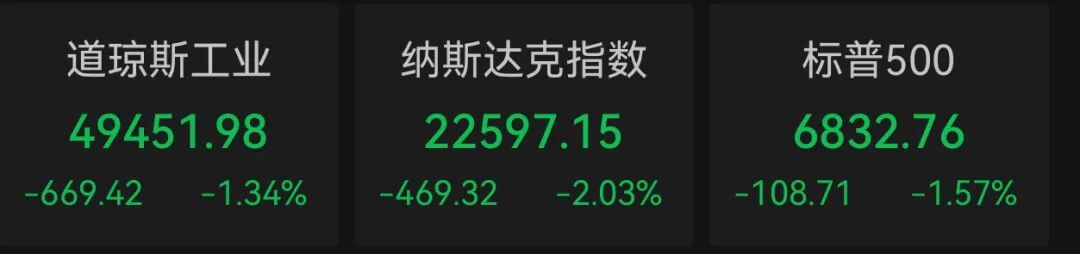
Market Overview - The US stock market experienced a significant decline, with the Dow Jones Industrial Average dropping nearly 670 points, closing down 1.34% at 49,451.98 points. The S&P 500 index fell 1.57% to 6,832.76 points, and the Nasdaq Composite dropped 2.03% to 22,597.15 points [2] Company Performance - Cisco saw a sharp decline of over 12%, while Disney fell more than 5%, leading the losses in the Dow [4] - Major tech stocks also faced significant losses, with Apple down 5%, marking its largest daily drop since April 2025. Facebook decreased nearly 3%, and Nvidia fell over 1% [4][6] Commercial Real Estate Sector - The commercial real estate sector experienced a sharp decline, with major companies like CBRE Group falling 8.8%, JLL down 7.6%, and Cushman & Wakefield dropping 11.63%. Concerns about the impact of artificial intelligence on office space demand contributed to this downturn [7][9] Precious Metals Market - Gold prices fell over 3%, dropping below $5,000, while silver plummeted nearly 11%. This decline reflects a shift in market sentiment, with investors moving towards US Treasury bonds as a safe haven [10][11]

AI恐慌扩散,科技股再度拖垮美股,地产股连日重挫,苹果一日蒸发2000亿
Hua Er Jie Jian Wen· 2026-02-12 23:25
Group 1 - The core viewpoint of the articles highlights a significant market downturn driven by fears surrounding the disruptive impact of artificial intelligence (AI) on traditional industries, leading to panic selling among investors [1][4][12] - Major U.S. stock indices fell over 1%, with the Nasdaq dropping approximately 2%, marking a three-day decline, while the Dow Jones Industrial Average closed below the 50,000 mark for the first time in a week [1][2] - The technology sector was identified as the primary culprit for the market decline, with Cisco's stock plummeting 12% due to disappointing gross margin guidance, and the "big seven" tech companies all experiencing losses [2][8] Group 2 - Concerns about the return on AI investments have intensified, with major tech firms like Amazon, Google, Meta, and Microsoft expected to spend around $650 billion on AI this year, raising doubts about whether such capital expenditures will yield tangible returns [4][6] - The narrative in the market has shifted from identifying beneficiaries of AI to recognizing potential victims, with sectors such as software, insurance brokerage, asset management, and commercial real estate facing significant pressure [6][11] - The commercial real estate sector has been particularly hard hit, with companies like CBRE and Jones Lang LaSalle seeing stock declines exceeding 25% over two days, as fears grow that AI could automate key functions and reduce demand for human brokers [5][12] Group 3 - The market sentiment has transitioned from "AI euphoria" to "AI phobia," with investors reassessing whether AI capital expenditures are overheated and if the commercialization of AI is lagging behind expectations [6][10] - Analysts have noted that the recent sell-off appears disproportionate to the actual risks, suggesting that the market may be overreacting to AI-related concerns [12] - Despite the overall downturn, some segments within the semiconductor industry, such as storage chip stocks, have managed to maintain gains, indicating a divergence within the tech sector [8][10]
道指重挫逾600点!AI抛售潮重燃,商业地产遭遇“黑色星期四”
Di Yi Cai Jing· 2026-02-12 23:24
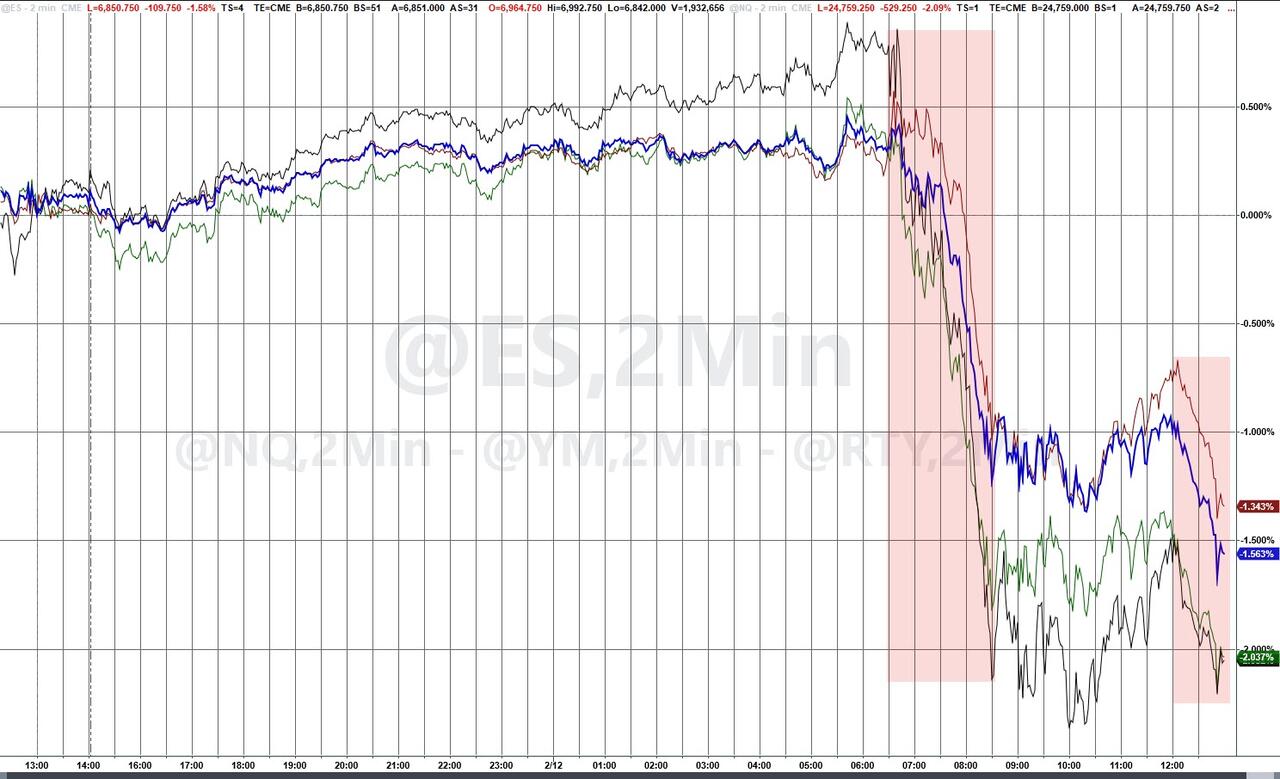
Market Overview - US stock market experienced a significant decline, driven by concerns over the accelerated penetration of artificial intelligence impacting the software industry and office space demand [1] - The Dow Jones Industrial Average fell by 669.42 points, a decrease of 1.34%, closing at 49,451.98 points; the S&P 500 dropped by 108.71 points, down 1.57%, closing at 6,832.76 points; the Nasdaq Composite decreased by 469.32 points, a decline of 2.03%, closing at 22,597.15 points [1] Technology Sector Performance - Major tech stocks faced pressure, with Apple experiencing a sharp decline of 5%, marking its largest single-day drop since April 2025, following claims by the US Federal Trade Commission regarding Apple's suppression of conservative content [3] - Other tech giants also saw declines: Meta Platforms down 2.82%, Amazon down 2.20%, Tesla down 2.62%, Nvidia down 1.64%, Microsoft down 0.63%, and Alphabet's Class C shares down 0.63% [3][4] Commercial Real Estate Impact - The sell-off in the US stock market focused on commercial real estate and related financial services, with fears that increased use of AI tools could structurally weaken demand for office space, impacting leasing and valuation systems [5] - Major commercial real estate service companies saw significant stock price drops, with CBRE Group down 8.8%, JLL down 7.6%, and Cushman & Wakefield down 11.5% [6] - Analysts noted that the discussion around AI reducing office demand has been ongoing, and the recent sell-off in brokerage stocks has led investors to reassess commercial real estate risks more directly [6] Transportation and Logistics Sector - The transportation and logistics sector also faced significant pressure, with the Dow Jones Transportation Average dropping over 4%, marking its worst day since the US announced tariff increases in April of last year [6] - Among the 20 components of the Dow Jones Transportation Average, 17 stocks declined, with Landstar System and C.H. Robinson experiencing the largest drops of 15.6% and 14.5%, respectively [7] - Concerns were heightened following Algorhythm Holdings' disclosure that its SemiCab division increased customer freight volumes by 300% to 400% without a corresponding increase in workforce, raising fears about AI's impact on labor demand in the logistics industry [7] Global Market Reactions - The impact of the US market decline extended to European markets, with Swiss logistics group Kuehne + Nagel's stock falling by 13% and Danish logistics firm DSV A/S dropping over 10% [8] Economic Data and Interest Rates - Recent labor market data showed a smaller-than-expected decline in initial jobless claims, leading to fluctuating market expectations regarding the Federal Reserve's interest rate path for the year [8] - The yield on 10-year US Treasury bonds fell by 8.1 basis points to 4.102%, marking the largest single-day drop since October, while the yield on 2-year bonds decreased by 4.8 basis points to 3.464% [8] Commodity Market Performance - International oil prices saw a notable decline, with light crude oil futures for March dropping by $1.79 to $62.84 per barrel, a decrease of 2.77%, and Brent crude oil futures for April falling by $1.88 to $67.52 per barrel, down 2.71% [9] - Precious metals also faced pressure, with spot gold down 3.26% to $4,918.36 per ounce and silver down 10.89% to $75.0942 per ounce [9]


新港联行龙虎榜:异常期间涨跌幅累计达到120.20%,成交金额0.76万元
Jin Rong Jie· 2025-08-14 10:38
Core Viewpoint - The stock of Sichuan Xinguang Lianhang Real Estate Co., Ltd. has experienced significant volatility, with a cumulative price change of +120.20% over a recent abnormal trading period, leading to its appearance on the "龙虎榜" [1] Group 1: Stock Performance - The stock was listed on the "龙虎榜" due to an abnormal trading period where the cumulative price change reached +120% and -60% within three trading days [1] - During this abnormal period, a total of 3,542 shares were traded, amounting to a transaction value of 0.76 million yuan [1] Group 2: Trading Activity - The top buying activity was recorded from Citic Securities Co., Ltd. with a purchase amount of approximately 7,503.56 yuan, followed by Huatai Securities Co., Ltd. with 1,100 yuan [1] - On the selling side, the leading seller was GF Securities Co., Ltd. with a sale amount of 7,503.56 yuan, and Guotai Junan Securities Co., Ltd. with 110 yuan [1] Group 3: Company Overview - Sichuan Xinguang Lianhang Real Estate Co., Ltd. specializes in comprehensive commercial real estate services, including commercial positioning and planning, leasing, design, development management, operational management, sales agency, and e-commerce [1] - The company's main products include agency sales, leasing and operational services, and consulting and planning services [1]
李凌:十五运将为广州创造长期价值|十五运365天365人
2 1 Shi Ji Jing Ji Bao Dao· 2025-07-29 05:00
Core Viewpoint - The 15th National Games, scheduled for November 2025 in the Guangdong-Hong Kong-Macao Greater Bay Area, is not only a sports event but also a significant opportunity to promote national fitness and high-quality development in the sports industry [1][2]. Group 1: Event Significance - The event will be jointly hosted by the three regions for the first time, marking a milestone in collaborative sports management [1]. - The "15th Games 365 Days 365 People" initiative aims to highlight stories from athletes, entrepreneurs, experts, and the public, enhancing awareness and engagement with the event [1]. Group 2: Economic Impact - Major sports events are seen as critical turning points for urban development, with past events like the 2008 Olympics and 2010 Asian Games serving as examples of how such events can drive economic and cultural growth [1][2]. - The "City Partner" program launched in Guangzhou aims to leverage the event to attract flagship stores and enhance the city's appeal to global visitors, showcasing local cuisine and tourism [2]. Group 3: Long-term Value - The success of the 15th National Games is expected to create long-term value for Guangzhou, focusing on commercial prosperity, industrial upgrades, and asset appreciation throughout the event cycle [2].
世邦魏理仕李凌:服务在穗企业“坐广州、卖全球”
2 1 Shi Ji Jing Ji Bao Dao· 2025-07-24 11:10
Group 1 - The "City Partner" initiative in Guangzhou aims to foster long-term cooperation between the city and enterprises, focusing on mutual benefits and resource integration [2][3] - The first batch of 15 city partner companies includes prominent firms like CBRE, Deloitte, and Didi Group, representing various sectors including modern services and emerging industries [2][3] - CBRE views the "City Partner" program as a strategic opportunity to combine international experience with local practices, enhancing its long-term development in China [2][3] Group 2 - Major sporting events are seen as pivotal for urban development, with past events like the 2008 Olympics and 2010 Asian Games significantly impacting local economies and urban landscapes [3][4] - CBRE plans to leverage its role as a "city brain" to organize thematic salons and collaborate with various professional institutions to boost industry and resource focus in Guangzhou [4][5] - The company aims to facilitate sustainable development by promoting a "venue+" model for post-event operations, integrating commercial and cultural tourism elements [4][5] Group 3 - CBRE intends to act as a "招商引擎" (investment engine) during the event, attracting flagship stores to core business districts to showcase Guangzhou's culinary and tourism appeal [5][6] - The focus will be on the "12218" modern industrial system, particularly the 21 strategic emerging industries, to align international enterprises with local projects [5][6] - CBRE will establish a dedicated service network for Guangzhou, enhancing efficiency in attracting investments and supporting local enterprises' growth [5][6] Group 4 - CBRE emphasizes the importance of "connection" in commercial real estate, aiming to integrate global resources with local needs to enhance collaboration [6][7] - The company has experience in planning and investment for major cities worldwide, which will be applied to Guangzhou's development [6][7] - CBRE plans to attract high-quality brands that align with urban upgrades and the event economy, capitalizing on the international exposure from the games [7][8] Group 5 - The 15th National Games is positioned as a critical moment for the restructuring of China's commercial real estate market, with potential for both immediate and long-term benefits for Guangzhou [8] - The event is expected to enhance the city's operational capabilities and leave a lasting legacy beyond the games themselves [8] - CBRE aims to help Guangzhou achieve commercial prosperity and asset appreciation throughout the event cycle, reinforcing its role as a city development partner [8]

戴德梁行发布《2024年度可持续发展报告》
Zhi Tong Cai Jing· 2025-07-18 08:59
Core Viewpoint - The 2024 Sustainability Report by the company highlights significant progress in reducing carbon footprint, enhancing energy efficiency, and building prosperous communities, achieving key milestones ahead of schedule [1][2] Group 1: Achievements in Sustainability - The company provided sustainability services for over 11.8 billion square feet across 85,000 buildings in 2024 [1] - Greenhouse gas emissions for Scope 1 and Scope 2 were reduced by over 50% compared to 2019, achieving targets six years early [1] - 87% of the company's office electricity comes from renewable sources [1] Group 2: Corporate Values and Employee Engagement - The company launched a new set of corporate values emphasizing continuous improvement, resilience, inclusivity, foresight, and innovation [1] - In an employee survey, 91% of employees reported understanding the corporate values [1] - A new Environmental, Health, and Safety (EHS) strategy and a global 360-degree EHS model were introduced [1] Group 3: Strategic Commitment to Sustainability - The company views driving a more sustainable future as a key strategic priority, ensuring alignment of sustainability with other important strategies [2] - This commitment aims to enhance resilience, create business growth opportunities, and set new performance and responsibility benchmarks in the commercial real estate sector [2]