糖蒜

Search documents
一个月连遭两起食安事件,门店增速放缓,锅圈食汇怎么了?
Bei Ke Cai Jing· 2025-11-04 06:41
Core Viewpoint - The company, Guoquan Shihui, known as the "Mi Xue Bing Cheng of hot pot ingredients," is facing significant food safety issues, including complaints about foreign objects in their products, which could impact their brand reputation and growth potential [1][2][5]. Group 1: Food Safety Issues - Recent complaints have surfaced regarding food safety, including the discovery of a cigarette butt in a dried mushroom product and a fly in a beef tripe package [2][3]. - Consumers have reported various issues on complaint platforms, such as expired products and foreign objects in food items, raising concerns about the company's quality control [2][3][4]. Group 2: Business Growth and Challenges - Guoquan Shihui has rapidly expanded its store count, reaching over 10,000 locations within six years, primarily through a franchise model [3][4]. - The franchise model, while effective for rapid growth, has led to increased management challenges, including inconsistent product quality and service levels across locations [5][6]. Group 3: Market Competition - The hot pot industry is becoming increasingly competitive, with established players like Haidilao and Xiaobawang lowering their average customer spending [6][7]. - Guoquan Shihui faces competition not only from traditional hot pot restaurants but also from online grocery platforms, which could further pressure its market position [6][7]. Group 4: Product Strategy and Market Position - Experts suggest that Guoquan Shihui needs to optimize its product structure and may need to explore international markets or develop a second brand to sustain growth [6][7]. - The company is perceived as a typical pre-prepared food business, and as consumer expectations rise, it must ensure its products meet safety and quality standards [7][8].
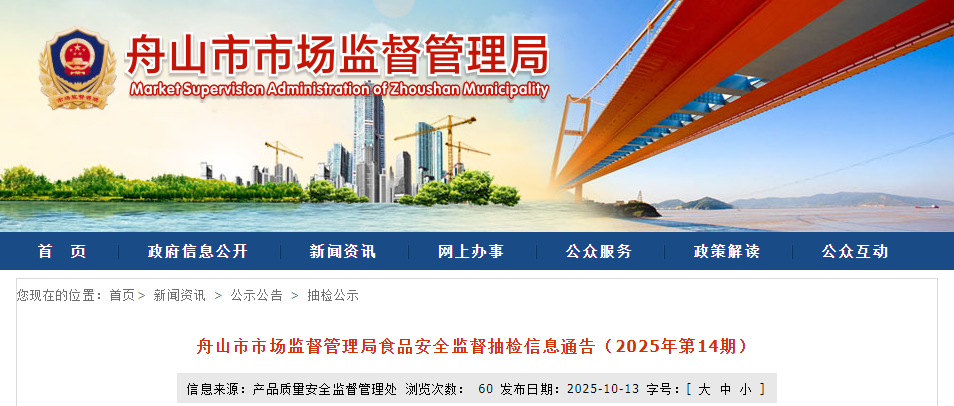
浙江省舟山市市场监督管理局食品安全监督抽检信息通告(2025年第14期)
Zhong Guo Zhi Liang Xin Wen Wang· 2025-10-14 07:41
Core Viewpoint - The Zhoushan Market Supervision Administration conducted a food safety inspection, revealing that out of 283 food samples tested, 273 passed while 10 were found to be non-compliant with national food safety standards, primarily due to excessive food additives, pesticide residues, and quality indicators not meeting standards [3][4]. Food Safety Inspection Results - A total of 283 food samples were tested across 22 categories, including grain products, restaurant foods, and dairy products [3]. - 273 samples were compliant, while 10 samples failed the inspection [3]. Non-compliance Issues Food Additives Exceeding Standards - Sugar garlic sold by Ayong Food Supermarket in Zhoushan's Dinghai District contained acesulfame K above the permissible limit [4]. - Old Beijing sesame cakes sold at Huazhi You Supermarket, produced by Xiangyuan Food Factory, had dehydroacetic acid and its sodium salt levels exceeding national standards [4]. Pesticide Residues Exceeding Standards - Multiple vendors selling yam in Zhoushan were found to have residues of mefenoxam and manganese salt above the acceptable limit [4]. - Fresh ginger sold by a vendor in Shengsi County was found to contain thiamethoxam above the permissible level [4]. Quality Indicators Not Meeting Standards - Peanuts sold by Zhoushan Fuyitai Trading Company had peroxide values exceeding the national standard [4]. - Small fried dough sticks sold by a local food store did not meet the peroxide value standards [4]. - Cotton candy produced by Guangdong Yingsheng Food Co. failed to meet the standard for reducing sugar content [4]. Regulatory Actions - The Zhoushan Market Supervision Administration has mandated local market supervision departments to take immediate action, including removing non-compliant products from shelves [4]. - A report on risk control measures must be published within seven days, and a follow-up report on the handling of these issues is required within three months [4].

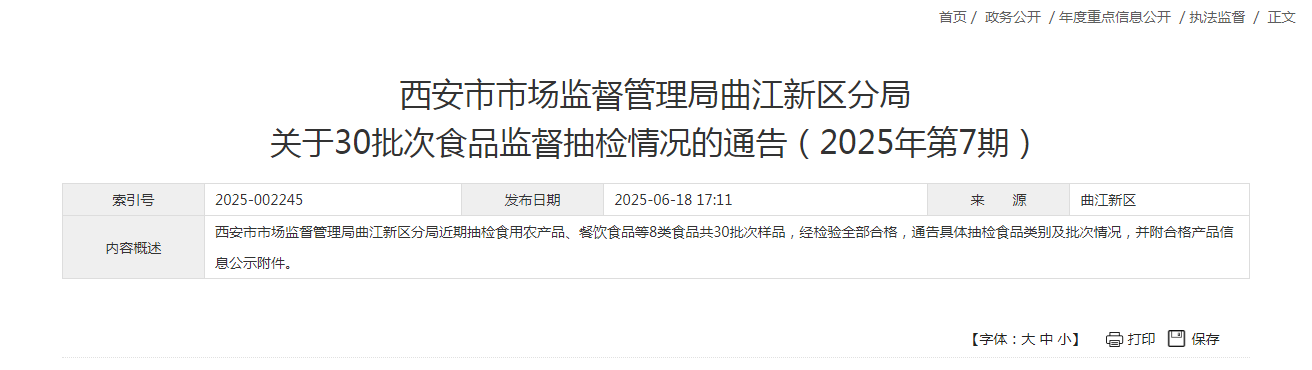
西安市市场监督管理局曲江新区分局关于30批次食品监督抽检情况的通告(2025年第7期)
Zhong Guo Zhi Liang Xin Wen Wang· 2025-06-30 09:58
Core Points - The Xi'an Market Supervision Administration's Qujiang New District branch conducted a food safety inspection, testing 30 batches of food samples across 8 categories, all of which passed the safety standards [2][3]. Group 1: Inspection Overview - A total of 30 food samples were tested, including categories such as edible agricultural products, catering food, condiments, bean products, vegetable products, starch and starch products, edible oils and fats, and beverages [2]. - All 30 batches of samples were found to be compliant with national food safety standards and relevant enterprise standards [2]. Group 2: Sample Breakdown - The breakdown of the tested samples includes: - 18 batches of edible agricultural products - 3 batches of catering food - 2 batches of condiments - 2 batches of bean products - 2 batches of vegetable products - 1 batch of starch and starch products - 1 batch of edible oils and fats - 1 batch of beverages - All categories reported compliance with safety standards [2].