纪念章

Search documents
【冬奥漫笔】从“一墩难求”到“一鼬难求”
Xin Lang Cai Jing· 2026-02-09 20:19
Core Viewpoint - The popularity of the Olympic mascots Tina and Milo at the Milan-Cortina Winter Olympics highlights their role in enhancing local identity and generating significant commercial revenue through merchandise sales [1][2][3]. Group 1: Mascot Popularity and Cultural Significance - Tina and Milo, the mascots of the Milan Winter Olympics, are widely embraced by visitors, with plush toys being the most sought-after merchandise [1]. - The mascots are designed based on a creative drawing by Italian children, reflecting local culture and enhancing community recognition [1]. - The history of Olympic mascots dates back to the 1972 Munich Olympics, evolving into important symbols that embody the spirit of the host city and country [2]. Group 2: Commercial Impact of Mascots - Successful mascots can significantly boost sales of licensed merchandise, contributing to the overall revenue of the event [3]. - For instance, by the end of 2022, over 5.5 million plush toys of the Beijing Winter Olympics mascot "Bing Dwen Dwen" were sold, generating over 1 billion yuan in revenue [3]. - The emotional connection that mascots create among athletes, spectators, and citizens serves as a bridge between the event and the public, promoting the Olympic spirit [3].
资金短缺的黎巴嫩坐拥金矿,恰逢贵金属价格飙升
Xin Lang Cai Jing· 2026-02-06 08:28
Core Viewpoint - Lebanon is considering utilizing its significant gold reserves to revive its struggling economy, as citizens view gold as a means to protect their diminished assets amid ongoing economic turmoil [1][2][3]. Economic Context - Lebanon's economy is projected to remain stagnant in 2026, with persistent inflation and deteriorating governance, while anti-corruption reforms are delayed [1][3]. - The banking system collapsed in late 2019 during a severe financial crisis, leading to the loss of deposits for many citizens, with approximately half of the 6.5 million population now living in poverty [1][3]. - The financial sector has incurred losses of about $70 billion, compounded by an estimated $11 billion loss from the 2024 conflict with Israel and Hezbollah [1][3]. Gold Reserves - The Central Bank of Beirut has held 286 tons of gold reserves since the 1960s, equivalent to approximately 9 million ounces, making it one of the largest in the region, surpassed only by Saudi Arabia [1][8]. - The value of Lebanon's gold reserves once reached $50 billion, more than double the country's GDP [9]. Government Considerations - The government is contemplating using part of the gold reserves to assist banks and compensate depositors who have lost their savings, a move that contradicts historical practices and a law from the 1980s [2][10]. - Some economists suggest that a small portion of the gold could be used to repair the failing electricity sector or to revitalize the damaged education and healthcare systems [10]. Public Sentiment - There is widespread distrust among the Lebanese population towards the authorities, with many believing that gold should be preserved for future generations rather than being utilized [4][11]. - Citizens are increasingly turning to gold and silver as tangible assets to mitigate their financial losses, with long queues forming outside metal dealers in Beirut [5][12]. Cultural Significance - The tradition of purchasing gold as a hedge against inflation is deeply rooted in Lebanese culture, with many viewing gold as both a decorative and a financial asset [6][13]. - Women often retain gold jewelry as a form of security, reflecting the cultural importance of gold in personal wealth management [13].
十五运会衍生品销售额有望冲10亿元
Guang Zhou Ri Bao· 2025-12-03 01:56
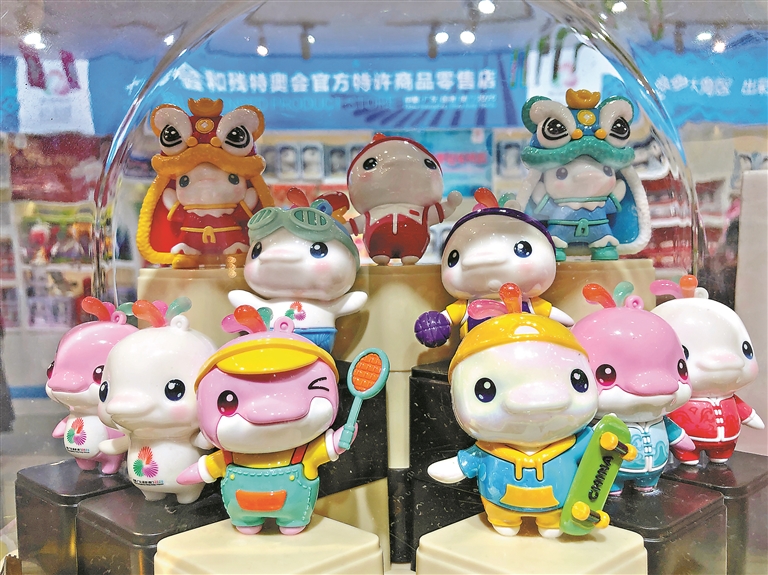
Core Viewpoint - The success of the mascots "Xi Yang Yang" and "Le Rong Rong" from the 15th National Games and the Special Olympics has led to a surge in merchandise sales, exceeding 8 billion yuan and expected to reach 10 billion yuan, highlighting their role as a new economic driver beyond sports [2][7]. Group 1: Merchandise Sales and Popularity - The sales of 15th National Games merchandise have surpassed 8 billion yuan, with expectations to reach 10 billion yuan [2][7]. - The mascots have generated significant online engagement, with approximately 148.8 million reports and 41.197 billion clicks related to the event [2]. - The popularity of the mascots has created a "one dolphin hard to find" phenomenon, similar to the "one panda hard to find" during the Beijing Winter Olympics [7]. Group 2: Consumer Behavior and Market Trends - There has been a notable shopping frenzy for merchandise, with long queues outside stores and limited availability of popular items like blind boxes and bubble-blowing pendants [3][5]. - The flagship store offers nearly 500 officially authorized products, showcasing a variety of merchandise that integrates local cultural elements [6]. - The event has sparked a cultural and economic connection, transforming the mascots into a lasting cultural IP for the Guangdong-Hong Kong-Macao Greater Bay Area [7]. Group 3: Cultural Integration and Economic Impact - The merchandise features high-quality craftsmanship and integrates traditional cultural elements with modern design, enhancing its appeal [6]. - The event has led to over 2000 unique cultural and tourism activities, significantly boosting local consumption and tourism [8]. - The economic impact of the event is substantial, with a reported ratio of 1:13 for direct to indirect spending by out-of-town participants [8].