
绵柔尖庄

Search documents
五粮液:投资者建议给低端产品政策倾斜,发力超高端系列
Xin Lang Cai Jing· 2025-12-13 16:26
Group 1 - The investor suggests that Shanxi Fenjiu's "Bai Fen" is effectively supporting national expansion and channel penetration, while Wuliangye's "Mian Rou Qian Zhuang" seems to focus more on price positioning, losing its defensive capability [1] - The investor recommends that the company consider providing more policy support for low-end products while continuing to develop high-end series like classic Wuliangye, rather than focusing solely on mid-range products [1] - The investor believes that consumers are easily satisfied with quality staple liquor as long as it tastes good, contrasting it with high-end products that carry additional purposes and attributes [1] Group 2 - The company acknowledges the investor's suggestions and expresses gratitude for the feedback [2]

派现100亿元!五粮液三季度净利骤降超65%
Shen Zhen Shang Bao· 2025-10-31 05:20
Group 1 - The core viewpoint of the articles highlights that Wuliangye's financial performance in the first three quarters of 2025 shows significant declines in both revenue and net profit, attributed to the deep adjustment period in the liquor industry and insufficient recovery in effective demand [1][2] Group 2 - For the first three quarters of 2025, Wuliangye reported operating revenue of 60.945 billion yuan, a year-on-year decrease of 10.26%, and a net profit attributable to shareholders of 21.511 billion yuan, down 13.72% [1] - In the third quarter alone, the company achieved operating revenue of 8.174 billion yuan, a substantial decline of 52.66%, with a net profit of 2.019 billion yuan, down 65.62% [1] - The gross margin for the first three quarters was 74.93%, a decrease of 2.13 percentage points from the previous year, while the net margin was 36.45%, down 1.75 percentage points [1] Group 3 - Wuliangye plans to distribute a cash dividend of 25.78 yuan per 10 shares, totaling 10.007 billion yuan, to all shareholders [2] - Among 20 listed liquor companies in A-shares that disclosed their third-quarter reports, Wuliangye's decline was more pronounced compared to Shanxi Fenjiu and Luzhou Laojiao, with only Kweichow Moutai showing a slight increase [2]
光瓶酒冷热分化:牛栏山等失意,玻汾“封神”?
Nan Fang Du Shi Bao· 2025-09-15 03:33
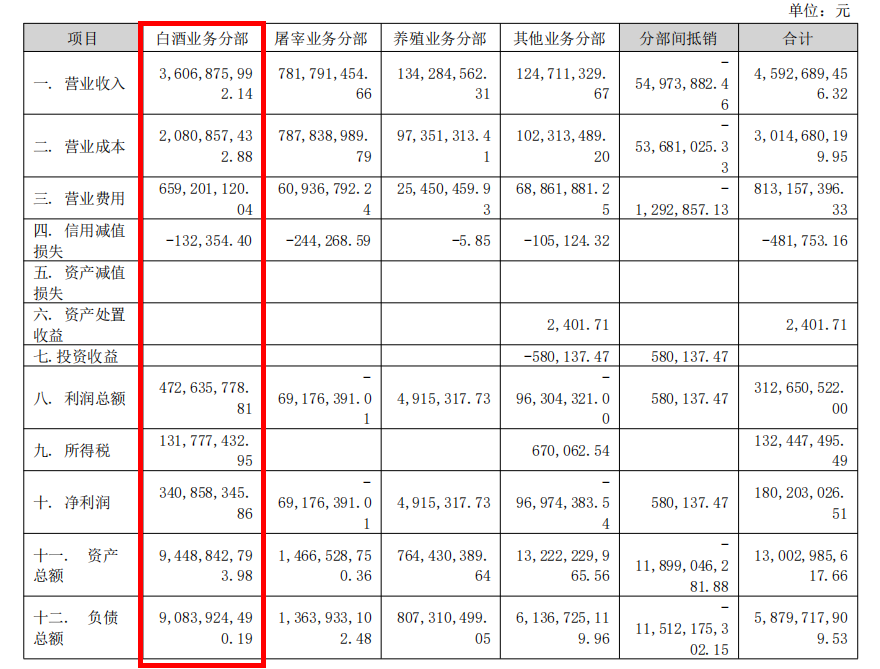
Core Viewpoint - The Chinese liquor market is experiencing a significant divide, with traditional brands like Niulanshan facing revenue declines and profit cuts, while products like Fenjiu's "Guofen" are in high demand, indicating a shift towards quality and value in consumer preferences [1][8]. Group 1: Market Trends - The light bottle liquor market is undergoing a "cold-hot differentiation," driven by industry reshuffling and consumption upgrades, where leading brands leverage quality and brand advantages to meet rational consumer demands [1][7]. - The transition from scale expansion to value competition in the liquor market is evident, with only companies that can ensure quality control, innovate in scenarios, and resonate with brands likely to succeed [1][8]. Group 2: Company Performance - Shunxin Agriculture reported a 19.24% decline in revenue to 4.593 billion yuan for the first half of 2025, with net profit dropping 59.09% to 173 million yuan, primarily due to reduced revenue from its liquor business [2][4]. - The liquor segment of Shunxin Agriculture saw revenue fall over 20% to 3.607 billion yuan, with net profit down more than 40% to 341 million yuan compared to the previous year [2][4]. Group 3: Consumer Preferences - Consumers are shifting from luxury packaging to a focus on quality and cost-effectiveness, particularly among younger demographics, as high-end liquor market growth stagnates [7][8]. - The popularity of Guofen and other light bottle liquors is attributed to their affordability and quality, with Guofen's sales expected to reach over 10 billion yuan by 2025 [5][6]. Group 4: Competitive Landscape - The competition in the light bottle liquor market is intensifying, with major liquor companies and retail giants entering the space, such as the collaboration between Hema and Chuanjiu Group to launch a series of light bottle liquors [9][8]. - New retail giants like Hema and PDD are partnering with liquor companies to accelerate their presence in the light bottle liquor market, reflecting a broader trend of market evolution and consumer behavior changes [9][8].


营收和净利再现个位数增长 五粮液许下的“宏愿”未达成
Sou Hu Cai Jing· 2025-05-01 03:50
Core Viewpoint - Wuliangye's 2024 annual report shows a revenue of 89.175 billion yuan, a year-on-year increase of 7.09%, and a net profit of 31.853 billion yuan, up 5.44%, indicating a slowdown in growth rates for both revenue and profit, marking the first time since 2015 and 2016 respectively that these figures have shown single-digit growth [1][4][10]. Financial Performance - In Q1 2024, Wuliangye achieved a revenue of 36.94 billion yuan, a year-on-year increase of 6.05%, and a net profit of 14.86 billion yuan, up 5.80%, reflecting a trend of single-digit growth in quarterly reports for the first time in nearly a decade [3][4]. - For the first three quarters of 2024, Wuliangye's net profit reached 24.931 billion yuan, a year-on-year increase of 9.19%, but the fourth quarter saw a decline in net profit by 6.17% to 6.922 billion yuan despite revenue growth [2][4]. Industry Context - The white liquor industry is currently undergoing a deep adjustment period characterized by increased volatility and intensified competition, which has impacted Wuliangye's performance [2][10]. - The overall production of major white liquor companies in 2024 is projected to decline by 1.8%, while sales revenue is expected to grow by 5.3%, indicating challenges within the industry [10]. Sales and Marketing Strategy - Wuliangye has increased its sales expenses significantly, with total sales expenses exceeding 10 billion yuan for the first time, reaching 10.69 billion yuan, a year-on-year increase of 37.2% [18][20]. - The company has focused on enhancing market investment to boost dealer confidence, with promotional expenses alone rising to 6.76 billion yuan, up 48.9% [18][20]. Product Mix and Market Position - Wuliangye's high-end products accounted for 76% of its revenue in 2024, totaling 67.875 billion yuan, while lower-tier products generated only 15.251 billion yuan, highlighting a lack of mid-tier product support [12][10]. - The company plans to stabilize market prices and ensure channel profitability by adjusting its production strategy in response to market demand changes [10][12]. Future Outlook - Wuliangye's 2025 goals include consolidating and enhancing stable development, promoting brand value, and aligning revenue growth with macroeconomic indicators, reflecting a more conservative outlook compared to previous years [12][24].
