
绿票通

Search documents
金融与生态同频共振
Jin Rong Shi Bao· 2026-01-06 03:34
Core Viewpoint - The People's Bank of China Suqian Branch is focusing on integrating green finance with rural revitalization, aiming to enhance ecological and industrial development in rural areas by optimizing financial support mechanisms [1][2]. Group 1: Financial Support for Rural Revitalization - As of October 2025, the agricultural loan balance in Suqian reached 287.92 billion yuan, accounting for 38% of total loans, the highest in the province [1]. - The green loan balance in Suqian reached 139.01 billion yuan by September 2025, showing a year-on-year growth of 44%, surpassing the overall loan growth rate by 34 percentage points [1]. - The Suqian Branch has issued a plan to enhance financial support for green and rural revitalization, promoting actions that guide financial institutions to increase funding in key areas [1][2]. Group 2: Innovative Financial Products - The branch has allocated 4.7 billion yuan for specialized re-loan quotas to support rural and green development, introducing products like "Re-loan + Flower Loan" and "Re-loan + Green Enterprise Loan" [3]. - Since 2025, financial institutions have utilized "Re-loan +" products to issue 17.76 billion yuan in loans for key rural revitalization areas, with 2.7 billion yuan directed towards green ecological projects [3]. - The introduction of "Water Rights Loans" has resulted in 2.26 billion yuan in financing, effectively meeting the needs of water-related enterprises [3]. Group 3: Policy and Incentives for Green Financing - The Suqian Branch is enhancing the promotion of transformation financial policies to encourage enterprises to apply for green financing recognition, establishing a green channel for financial institutions [4]. - Financial incentives include a subsidy for green financing guarantee services, aiming to reduce costs for eligible projects and improve access to financing [4]. - Collaborative efforts with various sectors have led to the launch of "Environmental Protection Loans," providing favorable rates for projects related to pollution control and ecological restoration [4]. Group 4: Green Finance Innovation and Development - The Suqian Branch is actively promoting the establishment of a provincial-level green finance innovation reform pilot zone, focusing on the integration of green finance with rural revitalization [5]. - Four local rural commercial banks have completed annual environmental information disclosure, with one institution exploring climate stress testing, contributing to low-carbon transformation [5].
从三组关键词,透视四川“十四五”金融“成绩单”
Sou Hu Cai Jing· 2025-12-11 16:40
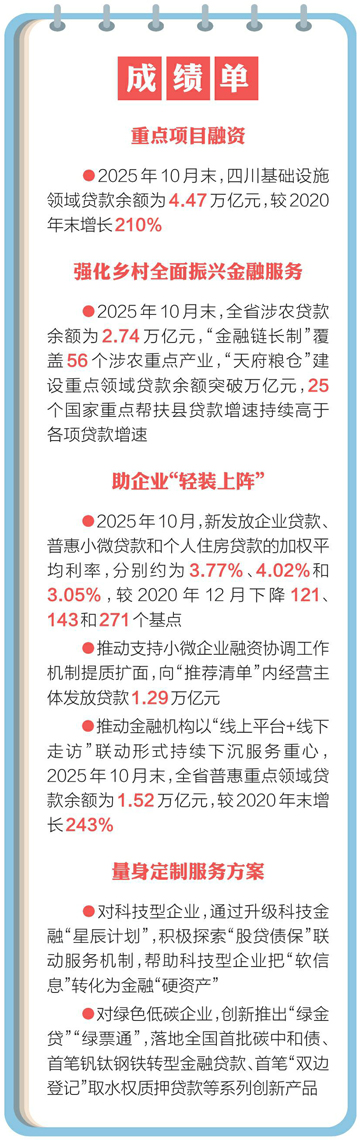
Core Insights - The financial sector in Sichuan has shown significant growth, with the balance of various loans reaching 12.8 trillion yuan by the end of October 2025, marking an 80.7% increase since the end of 2020 [1] - The average annual growth rates for deposits and loans in Sichuan over the past five years were approximately 9.5% and 12.7%, respectively, indicating strong support for the real economy [3] Group 1: Financial Support and Growth - The Sichuan financial system has increased support for the economy, with loan growth outpacing nominal economic growth, effectively meeting the reasonable credit demands of market entities [3] - By the end of October 2025, the loan balance for infrastructure in Sichuan reached 4.47 trillion yuan, a 210% increase from the end of 2020 [3] - Agricultural loans reached 2.74 trillion yuan, with a focus on 56 key agricultural industries, and loans for the "Tianfu Granary" project exceeding 1 trillion yuan [3] Group 2: Structural Optimization - The structure of credit allocation in Sichuan is shifting from heavy asset industries to high-quality development sectors, with significant growth in loans for strategic emerging industries, which doubled since the start of the 14th Five-Year Plan [4] - Personal consumption loans in Sichuan have increased by over 90%, reflecting a focus on promoting consumption and expanding domestic demand [4] Group 3: Cost Reduction and Efficiency Improvement - The financial system in Sichuan has implemented measures to reduce financing costs, with average interest rates for new corporate loans, inclusive of small and micro loans, dropping to approximately 3.77%, 4.02%, and 3.05% by October 2025 [5] - The province has introduced various facilitation measures in the foreign exchange sector, with cross-border RMB settlement volume reaching 1.1498 trillion yuan, a 112.7% increase compared to the 13th Five-Year Plan period [6] Group 4: Diversified Financing Solutions - Sichuan's financial system has established a diverse service network to meet different financing needs, with a total of 187 banks, 110 insurance companies, and 548 securities firms as of the third quarter of 2025 [7] - The bond market has also seen growth, with the outstanding balance of bonds in the interbank market reaching 776.85 billion yuan, a 79.8% increase since the end of 2020 [7] Group 5: Tailored Financial Services - Sichuan has developed customized service plans for various sectors, including the "Star Plan" for technology companies and innovative financial products for green and low-carbon enterprises [8] - The Sichuan regulatory authority is supporting the development of specialized boards for small and medium-sized enterprises, enhancing service efforts for key industries [8]

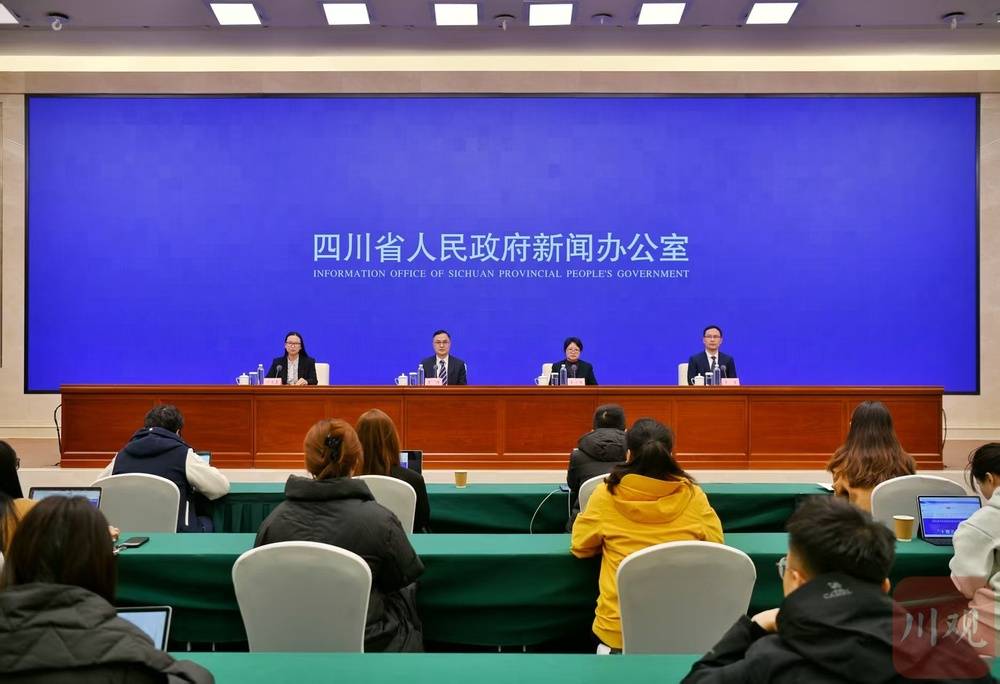
四川亮出“十四五”时期金融支持四川经济高质量发展“成绩单” 金融“活水”更好浇灌高质量发展沃土
Si Chuan Ri Bao· 2025-12-11 00:28
Core Insights - The article highlights the significant growth and structural changes in Sichuan's financial sector over the past five years, emphasizing the support for high-quality economic development through various financial initiatives and policies [3][4]. Group 1: Financial Growth Metrics - As of October 2025, the total balance of various loans in Sichuan reached 12.8 trillion yuan, representing an 80.7% increase compared to the end of 2020 [3]. - The balance of loans in the infrastructure sector was 4.47 trillion yuan, showing a 210% increase from the end of 2020 [4]. - Agricultural loans reached 2.74 trillion yuan, with a notable focus on 56 key agricultural industries [4]. Group 2: Interest Rate Reductions - The weighted average interest rates for newly issued corporate loans, inclusive of micro and personal housing loans, were approximately 3.77%, 4.02%, and 3.05%, respectively, reflecting decreases of 121, 143, and 271 basis points since December 2020 [6][7]. Group 3: Support for Small and Micro Enterprises - Sichuan's financial system has issued 1.29 trillion yuan in loans to businesses on the "recommended list," enhancing support for small and micro enterprises [7]. - The balance of loans in key inclusive finance sectors reached 1.52 trillion yuan, a 243% increase from the end of 2020 [7]. Group 4: Structural Changes in Loan Distribution - The focus of loan distribution has shifted from traditional heavy asset industries to sectors aligned with the "Five Major Financial Articles," which include technology finance, green finance, inclusive finance, pension finance, and digital finance [5][8]. - The financial system has developed a diverse service network to meet the varying financing needs of different enterprises [8]. Group 5: Innovative Financial Products - Sichuan has introduced innovative financial products such as "Green Loans" and "Green Bills" to support green and low-carbon enterprises, along with specialized services for technology companies [8]. - The province has launched the first batch of carbon-neutral bonds and other financial products aimed at facilitating environmental sustainability [8].
构建生物多样性金融 多维度支撑体系
Jin Rong Shi Bao· 2025-10-28 00:36
Core Insights - The report titled "Natural and Biodiversity Finance: Theory and Practice" was released at the 2025 Bund Annual Conference, outlining China's achievements in financial support for biodiversity, establishing a multi-dimensional support system for global biodiversity governance [1] Group 1: Standard System Improvement - Biodiversity finance has been integrated into the sustainable finance framework, with the 2025 revised "Green Finance Support Project Directory" establishing a separate category for "Ecological Protection, Restoration, and Utilization," which supports activities related to nature and biodiversity [2] - Approximately 20% to 30% of green finance business is directed towards biodiversity-related activities, with the scale continuing to expand [2] - The People's Bank of China is developing specific biodiversity finance standards, resulting in a draft "Biodiversity Finance Directory" that includes 87 items across four categories, adding 24 new items compared to the previous directory [2] Group 2: Financial Product Innovation - Financial institutions in China are launching diverse products to attract social capital for biodiversity protection, integrating biodiversity into the green finance policy framework [3] - Innovative financial products include GEP pledge loans, wetland carbon credit loans, and biodiversity performance-linked loans, with breakthroughs in bond issuance for biodiversity-themed green bonds [3] - The ecological compensation mechanism is being advanced, with projects like the Yuanbao Maple project in Guizhou generating over 2000 yuan per mu in annual income, providing a replicable model for ecological project profitability [3] Group 3: Information Disclosure and Risk Assessment - Financial institutions and local governments are exploring assessment methods for nature-related financial risks, embedding biodiversity sensitivity into the entire credit process [4] - The 2025 "Sustainable Development Report Preparation Guidelines" released by the Shanghai and Shenzhen stock exchanges reference the international TNFD framework, laying the groundwork for nature-related information disclosure [4] - 33 companies, including Mengniu and CATL, have joined the TNFD pilot, gradually aligning with international standards [4] Group 4: International Cooperation - China's role in global biodiversity finance governance is evolving from a "participant" to a "co-builder," having chaired the COP15 and facilitated the "Kunming-Montreal Global Biodiversity Framework" [5] - The establishment of the Kunming Biodiversity Fund has projects covering 15 developing countries across six continents [5] - The People's Bank of China is promoting the inclusion of natural and biodiversity issues in G20 sustainable finance discussions, with bilateral cooperation deepening with countries like the UK, EU, and Singapore [6]
成都农商银行晋升全球银行1000强第194位
Mei Ri Jing Ji Xin Wen· 2025-07-02 13:14
Core Insights - Chengdu Rural Commercial Bank has risen to 194th place in the "2025 Global Top 1000 Banks" ranking, an increase of 6 positions from the previous year, reflecting its strong capital strength and risk resilience [1] - The bank's ranking has improved significantly over the past five years, moving up 37 places from 231st in 2021 to 194th in 2025, indicating a consistent high-quality development strategy [1] Financial Performance - In 2024, the bank achieved an operating income of 18.35 billion yuan and a net profit of 6.471 billion yuan, representing year-on-year growth of 5.86% and 11.46% respectively [2] - As of the end of 2024, total assets reached 914.26 billion yuan, a year-on-year increase of 9.72%, solidifying its position as the fifth largest rural commercial bank in China [2] - The bank's total liabilities amounted to 840.64 billion yuan, with over 80% sourced from customer deposits, which totaled 672.72 billion yuan, reflecting a 10.50% increase [2] Asset Quality and Risk Management - Chengdu Rural Commercial Bank has maintained a non-performing loan ratio of 1.02%, ranking third among the top ten rural commercial banks in China, achieving its best asset quality in nearly nine years [3] - The bank's provision coverage ratio has improved to 435.55%, enhancing its risk resistance capabilities [3] Local Economic Contribution - The bank has focused on supporting local economic development, particularly in agriculture and small enterprises, with agricultural loans reaching 101.50 billion yuan, a 12.54% increase year-on-year [4] - It has provided over 600 billion yuan in loans to more than 2,700 enterprises in key industries, demonstrating its commitment to local industrial development [4] Service Network and Accessibility - Chengdu Rural Commercial Bank has established a comprehensive financial service network with over 650 branches, 1,500 self-service machines, and 1,200 village-level financial service stations, enhancing its service capabilities in rural areas [5] - The bank has served over 30,000 enterprises in industrial parks, supporting local economic initiatives [5] Strategic Initiatives - The bank is actively pursuing five key areas: technology finance, green finance, inclusive finance, pension finance, and digital finance, to enhance its service offerings and social responsibility [6] - It has launched various innovative financial products, including "Carbon Credit Loans" and "Green Bonds," to promote sustainable development [6] Future Outlook - Chengdu Rural Commercial Bank aims to continue its steady growth while ensuring asset quality, focusing on developing a unique product system and exploring sustainable development models [8]
跻身全球银行200强!成都农商银行2024年报彰显稳健增长与合规底色
Mei Ri Jing Ji Xin Wen· 2025-05-05 14:09
Core Viewpoint - Chengdu Rural Commercial Bank has demonstrated robust financial performance and strategic resilience in a complex financial environment, achieving significant growth in revenue and profit while maintaining a strong focus on risk management and innovation [1][3]. Financial Performance - In 2024, Chengdu Rural Commercial Bank reported total operating income of 18.35 billion yuan and net profit of 6.471 billion yuan, representing year-on-year growth of 5.86% and 11.46% respectively [1]. - As of the end of 2024, total assets reached 914.263 billion yuan, an increase of nearly 81 billion yuan, with a growth rate of 9.72% [1][3]. - The bank's total liabilities exceeded 800 billion yuan, reaching 840.639 billion yuan, with a year-on-year growth of 9.57% [2]. Market Position - Chengdu Rural Commercial Bank is the fifth largest rural commercial bank in China and has achieved a AAA credit rating for its capital debt, becoming the fourth rural commercial bank to do so [1][2]. - The bank ranked 200th in the "2024 Global Bank 1000" list published by The Banker magazine, improving by 15 positions from the previous year [1]. Growth in Deposits and Loans - The bank's customer deposits reached 672.724 billion yuan, with a year-on-year increase of 10.50%, accounting for over 80% of total liabilities [2]. - Customer loans and advances totaled 487.569 billion yuan, reflecting a year-on-year increase of 14.54% [2]. Risk Management - The non-performing loan ratio decreased by 0.18 percentage points to 1.02%, marking the best asset quality in nearly nine years [3]. - The provision coverage ratio increased by over 81 percentage points to 435.55%, enhancing the bank's risk mitigation capabilities [3]. Focus on Key Sectors - The bank has directed credit resources towards advanced manufacturing and strategic emerging industries, providing loans exceeding 60 billion yuan to over 2,700 enterprises in the industrial chain [5][6]. - In the agricultural sector, the bank's agricultural loans reached 101.498 billion yuan, with a year-on-year growth of 12.54%, leading among financial institutions in Sichuan province [6]. Technological Innovation - Chengdu Rural Commercial Bank has introduced various innovative financial products, including "Science and Technology Loans" and "Green Finance" initiatives, with green loan balances exceeding 47 billion yuan, a growth of 26.70% [7][8]. - The bank has implemented an AI-based risk control platform for agricultural loans, facilitating over 10,000 loans amounting to more than 700 million yuan [9]. Future Goals - The bank aims to achieve the goals of becoming a listed bank, a trillion-yuan bank, and a benchmark bank by 2025, focusing on sustainable growth and service to the real economy [9].