网络安全服务

Search documents
未来10年,这18个赛道将带来48万亿美元收入
创业家· 2026-03-25 10:17
Core Insights - McKinsey's report identifies 18 industry sectors likely to reshape the global business landscape, predicting revenues of $29 trillion to $48 trillion by 2040, contributing 18-34% to global GDP growth [2] E-commerce - By 2040, e-commerce's share of global retail revenue could reach 27%-38%, up from approximately 20% currently [3] - Growth drivers include market expansion in developing countries and new product categories in developed nations, such as healthcare and emotionally valuable products [4] - Significant investments are expected in customer acquisition and last-mile delivery across e-commerce platforms [5] Electric Vehicles - Electric vehicles (EVs) are projected to exceed 50% of global passenger car sales by 2040 [6] - Breakthroughs in battery technology and smart algorithms will significantly influence this sector, prompting increased R&D investments from both EV manufacturers and traditional automakers [7] Cloud Services - The demand for storage and computing power is rising as the world becomes more interconnected, with new AI products requiring substantial computational resources [9] - The cloud services industry experienced a 17% compound annual growth rate from 2005 to 2020, with similar growth expected in the coming decades [10] Semiconductors - Semiconductors are foundational to the digital world, with demand from various sectors driving rapid growth [11] - The semiconductor industry is expected to maintain a 6%-8% compound annual growth rate over the next decade [11] AI Software Services - The rapid development of AI has led to its classification as a distinct sector, with increasing usage of AI assistants [12] - Companies in the AI space are engaged in a competitive race to develop advanced foundational models and applications [13] Digital Advertising - Digital advertising, through search, social media, and media platforms, is expanding in value as internet usage among the middle class increases [14] - Continuous algorithm improvements enhance platforms' abilities to target customers and track advertising costs, although competition for user attention drives platforms to invest heavily in engaging content [15] Streaming Video - Increased investment in customer acquisition and content production may lead streaming platforms to seek new revenue models [17] - Developing countries are expected to contribute to growth in subscription and advertising revenue for streaming services, with projections of over 1 billion households subscribing to long-form video services by 2040 [18] Shared Autonomous Vehicles - The advent of autonomous driving technology may reduce the necessity for personal vehicle ownership [19] - By 2040, shared autonomous vehicles could account for 25%-51% of shared mobility revenue [20] Space Economy - The world is on the brink of entering a space economy era, with advancements in reusable rocket technology changing the aerospace industry [21][22] Cybersecurity - Cybercrime caused approximately $950 billion in direct economic losses in 2020, with indirect losses potentially reaching $4-6 trillion [24] - Increasing awareness of cybersecurity has led businesses to invest more in enhancing their security measures [25] Batteries - Significant advancements in battery technology have tripled energy density over the past few decades [26] - The global energy transition is driving demand for batteries, particularly in electric vehicles, energy storage, and consumer electronics, with EVs expected to represent over 80% of the battery market by 2040 [28] Video Games - By 2030, an estimated 40% of the global population may become video game players [30] - New gaming models, such as mobile and cloud gaming, are accelerating market growth, with free-to-play games generating substantial revenue [32] Robotics - The integration of AI with robotics is creating significant expectations for humanoid robots as potential "ultimate intelligent agents" [33] Industrial and Consumer Biotechnology - Advances in gene editing and other technologies are accelerating the application of biotechnology in agriculture, alternative proteins, consumer products, and bio-materials [37] Modular Construction - Modular construction methods, which involve prefabricating building components, can significantly enhance construction efficiency [38] Nuclear Fission Power - The development of safer, smaller modular reactors may supplement renewable energy sources [39] Air Traffic - Electric vertical takeoff and landing vehicles and delivery drones represent major technological shifts in air traffic [41] Obesity Treatment Drugs - The prevalence of obesity is projected to rise from 15% in 2020 to 24% by 2035, indicating a potential market for effective weight loss products [43]


CrowdStrike第四季度业绩超预期,全年展望符合预期
美股IPO· 2026-03-03 23:34
Group 1 - The company, headquartered in Austin, Texas, reported a fourth-quarter earnings per share of $1.12, exceeding analyst expectations of $1.10. Revenue increased to $1.31 billion, slightly above the market expectation of $1.30 billion [2] - For the first quarter, the company expects earnings per share to be between $1.06 and $1.07, with market expectations at $1.07. Revenue is projected to be between $1.36 billion and $1.364 billion, aligning closely with the market expectation of $1.36 billion [2] - For the full year, the company anticipates earnings per share between $4.78 and $4.90, while market expectations are at $4.84. Revenue is expected to range from $5.87 billion to $5.93 billion, matching the market expectation of $5.87 billion [3] Group 2 - The company's stock price has declined over 15% this year due to concerns about the sustainability of growth for software-as-a-service companies, triggered by the rise of advanced AI models capable of executing complex digital tasks [4] - Analysts suggest that concerns regarding cybersecurity providers may be exaggerated, as cybersecurity remains a core component of enterprise IT spending. Management indicated that the widespread application of AI in enterprises is creating additional demand for security tools, allowing the company to expand in protecting AI workloads and data [5] - The company expects to achieve an annual recurring revenue of $5.25 billion by the end of fiscal year 2026, with a net new recurring revenue of $1.01 billion for the year. The company reported record operating cash flow and free cash flow for both the quarter and the year [5]


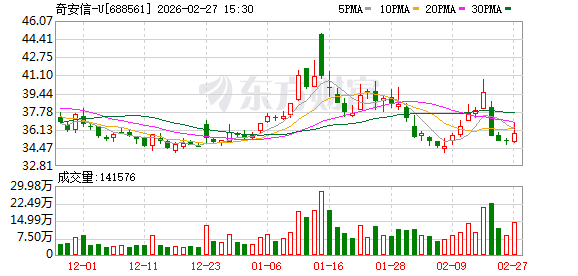
奇安信:2025年亏损12.62亿元
Zhong Guo Zheng Quan Bao· 2026-02-28 01:47
Core Viewpoint - The company Qi An Xin (688561) reported its 2025 performance forecast, showing a slight increase in revenue but continued losses in net profit and net profit excluding non-recurring items compared to the previous year [4]. Financial Performance - The company achieved operating revenue of 4.392 billion yuan, a year-on-year increase of 0.97% [4]. - The net profit attributable to shareholders was a loss of 1.262 billion yuan, an improvement from a loss of 1.379 billion yuan in the same period last year [4]. - The net profit excluding non-recurring items was a loss of 1.509 billion yuan, compared to a loss of 1.612 billion yuan in the previous year [4]. - Basic earnings per share were -1.85 yuan, with a weighted average return on equity of -15.53% [4][18]. Valuation Metrics - The company's price-to-book ratio (LF) is approximately 3 times, and the price-to-sales ratio (TTM) is about 5.45 times [4]. - Historical price-to-earnings ratio trends indicate fluctuations, with the company’s performance being compared to industry averages [5][6][10]. Business Strategy and Operations - The company focuses on high-quality development, emphasizing core customer strategies and optimizing operational processes, resulting in significant large contracts [13]. - In product technology, the company is developing champion products and enhancing AI capabilities, successfully applying new AI-enabled security products in the market [13]. - Management operations have improved, with a 16% year-on-year reduction in three major expenses (sales, research and development, management) [13].

京津冀三地自贸试验区共同发布全产业链协同发展机会清单
Zhong Guo Xin Wen Wang· 2026-02-27 07:51
Core Viewpoint - The Beijing-Tianjin-Hebei Free Trade Zone is focusing on key sectors such as biomedicine, digital economy, and modern logistics to enhance supply chain capabilities and regional collaboration, creating a comprehensive opportunity list for enterprises to integrate into the national market and expand global cooperation networks [1][2] Group 1: Biomedicine Industry - The opportunity list integrates information from various segments of the biomedicine supply chain, including research and development, production, distribution, and clinical applications, highlighting collaboration opportunities in AI drug development, gene editing, cell therapy, clinical trials, and customs services [1] Group 2: Digital Economy Industry - The opportunity list consolidates data from multiple aspects of the digital economy supply chain, such as computing power, data, security, and application scenarios, revealing collaboration opportunities in resource sharing, cross-border data flow, cybersecurity, and industrial digitalization [1] Group 3: Modern Logistics Industry - The opportunity list encompasses information from international logistics, transportation services, supply chain finance, and cold chain storage, showcasing collaboration opportunities in multimodal transport, cold chain logistics, bonded warehousing, and the establishment of logistics information platforms [1] Group 4: Future Initiatives - The Beijing-Tianjin-Hebei Free Trade Zone will continue to build platforms for communication and collaboration, aiming to align supply and demand, leverage technological innovation from Beijing, advanced manufacturing from Tianjin, and geographical advantages from Hebei to foster regional cooperation and innovation [2]
美股异动丨Palo Alto Networks盘前跌7.5%,全年盈利指引低于预期
Xin Lang Cai Jing· 2026-02-18 13:21
Core Viewpoint - Palo Alto Networks reported a mixed financial performance, with adjusted earnings per share exceeding market expectations but a downward revision in future earnings guidance, leading to a pre-market stock decline of 7.5% [1] Financial Performance - For the second fiscal quarter, the company reported adjusted earnings per share of $1.03, surpassing market expectations of $0.94 [1] - Total revenue for the quarter was $2.594 billion, reflecting a year-over-year growth of 15% [1] Future Guidance - The company anticipates adjusted earnings per share for the third fiscal quarter to be between $0.78 and $0.80, which is lower than the previous expectation of $0.92 [1] - For the full fiscal year, adjusted earnings per share are projected to be between $3.65 and $3.70, down from the earlier forecast of $3.87 [1]

2026年中国网络安全服务行业政策、产业链、发展现状、竞争格局及未来发展趋势研判:行业规模有望达328.8亿元,数据安全服务成核心引擎[图]
Chan Ye Xin Xi Wang· 2026-02-15 00:27
Core Insights - The cybersecurity service industry provides comprehensive security assurance for organizations, focusing on technology defense, management enhancement, and emergency response [1] - The market for cybersecurity services is expected to exceed 32.88 billion yuan by 2027, driven by the rapid growth of the digital economy and the transformation towards service-oriented models [1][9] - Key segments within the market include data security services, security operations and managed services, security consulting and assessment, and security training services, each showing distinct growth patterns [10] Industry Overview - Cybersecurity services encompass a full range of systematic security assurance services, from architecture design to incident response, aimed at maintaining the security of cyberspace and data assets [1][3] - The industry is characterized by a shift from hardware-dominated solutions to service-oriented offerings, with a projected market size of 22.93 billion yuan in 2024, reflecting a year-on-year growth of 9.9% [9] Policy Landscape - Multiple policies have been introduced in China to enhance cybersecurity, including the "Data Element x" three-year action plan and the "Digital Business Three-Year Action Plan," which clarify security requirements and expand market demand [5][6] - These policies aim to improve compliance and technical upgrades, driving high-quality development in the cybersecurity service industry [5] Industry Chain - The cybersecurity service industry chain consists of upstream (hardware and software providers), midstream (service providers like Qihoo 360 and Sangfor), and downstream (end-users such as government and financial sectors) [7] - The industry is transitioning from project-based services to subscription and intelligent service models, with a focus on vertical and scenario-based service delivery [7] Market Growth Analysis - The cybersecurity service market is experiencing rapid growth, with data security services projected to reach 6.95 billion yuan by 2025 and 9.82 billion yuan by 2027, driven by market reforms and privacy regulations [10] - Security operations and managed services are expected to grow steadily, reaching 5.4 billion yuan by 2027, supported by continuous operational needs from enterprises [10] Competitive Landscape - The industry features a tiered and diversified competitive structure, with leading companies like Sangfor and Qihoo 360 dominating the market, while tech giants like Huawei and Alibaba are pushing integrated "cloud + security" service models [11] - The cybersecurity assessment and certification market is highly fragmented, with over 80% of the market share held by numerous regional and specialized small to medium-sized enterprises [11] Future Development Trends - The cybersecurity service industry is expected to evolve towards intelligent technology integration, proactive compliance, and collaborative ecosystems [12][13] - AI and data security will form a new paradigm for intelligent protection, while compliance services will shift from reactive to proactive governance [14] - The industry ecosystem is moving towards collaboration and localization, with domestic firms taking the lead in emerging service areas [15]

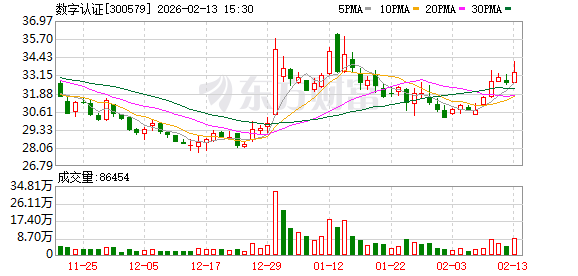
数字认证:公司聚焦主业,在数字中国建设各个领域积极开拓市场
Zheng Quan Ri Bao Zhi Sheng· 2026-02-13 13:46
Group 1 - The company is a leading provider of cybersecurity solutions, offering electronic certification services, cybersecurity products, integration, and services to clients nationwide [1] - The company focuses on its core business and actively explores market opportunities in various fields related to the construction of a digital China [1]

数字认证:积极践行国企社会责任,积极参与乡村振兴工作
Zheng Quan Ri Bao· 2026-02-13 12:29
Group 1 - The company is a leading provider of cybersecurity solutions, offering electronic certification services, cybersecurity products, integration, and services to clients nationwide [2] - The company's products and services are primarily applied in sectors such as government, healthcare, finance, and enterprises [2] - The company actively fulfills its social responsibilities as a state-owned enterprise and participates in rural revitalization efforts [2]
聚力科技自立自强 北京带头建设国际科技创新中心
Zhong Guo Xin Wen Wang· 2026-02-11 14:21
Core Insights - The National Information Innovation Park in Beijing has reached 1,000 resident enterprises, forming a complete industrial chain from hardware to software and application solutions [1][2] - The park is a key part of China's digital economy strategy, transitioning from a "single replacement" phase to a collaborative innovation cycle across the entire industry chain [2] - The park aims to attract companies in AI, 6G, quantum computing, and other cutting-edge technologies, establishing a comprehensive ecosystem from computing power to application scenarios [2][3] Group 1: Industry Development - The National Information Innovation Park covers an area of 1.7 million square meters and includes enterprises in CPU/GPU, operating systems, databases, servers, and cybersecurity [2] - The park will focus on four major areas: AI full-stack ecosystem, next-generation communication technologies, quantum computing, and immersive interaction technologies [2][3] - The Beijing Economic and Technological Development Zone (经开区) is experiencing significant growth in new industrial dynamics, particularly in AI, 6G, and quantum technologies [3] Group 2: Government Initiatives - The Beijing government has set higher requirements for the "Three Cities and One District" development model, emphasizing the transformation of scientific achievements into practical applications [4] - The government aims to strengthen the integration of technology, education, and talent development to create an attractive environment for businesses and residents [4][7] - The city plans to lead in building an international technology innovation center, focusing on original innovation and key core technology breakthroughs [8]
欧盟:全面禁止海运俄罗斯原油,拉黑43艘影子船!
Sou Hu Cai Jing· 2026-02-10 00:26
Core Viewpoint - The European Commission is proposing a comprehensive ban on maritime services for Russian crude oil to further weaken Russia's energy revenue and complicate its ability to find buyers for oil [1][3] Group 1: Sanctions Overview - The new sanctions plan includes adding 43 additional vessels to the "shadow fleet" list, bringing the total number of sanctioned vessels to 640 [3] - The EU aims to further restrict Russia's access to tankers for the "shadow fleet" and impose broad bans on services related to LNG transport and icebreaker maintenance to limit its natural gas export projects [3] - The sanctions also target the Russian financial system by proposing to sanction 20 regional banks and implement measures against cryptocurrency transactions to prevent evasion of sanctions [3] Group 2: Trade Restrictions - The EU plans to impose new export restrictions on goods and services to Russia, including rubber, tractors, and cybersecurity services, with a total value exceeding €360 million [3] Group 3: Economic Impact - According to the European Commission President, Russia's oil and gas revenue is projected to decline by 24% by 2025, reaching the lowest level since 2020 [3] - The revenue for January 2026 is expected to be the lowest since the onset of the Russia-Ukraine war in 2022 [3] - The proposed sanctions are expected to intensify pressure on the Russian economy and impact the global energy trade and shipping markets [3]