腾讯开悟平台

Search documents
2025中国多智能体应用大会举行
Huan Qiu Wang Zi Xun· 2025-12-23 01:36
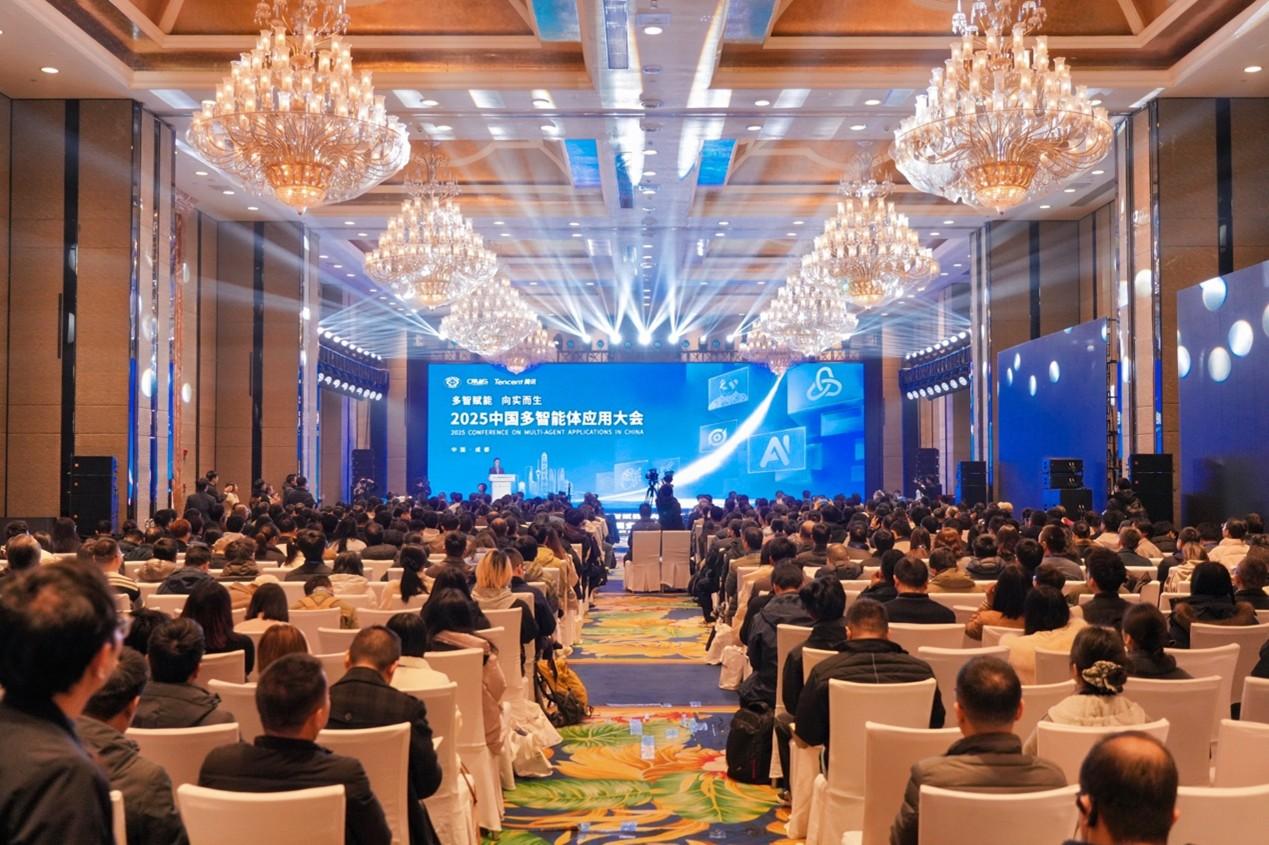
Core Insights - The 2025 China Multi-Agent Application Conference was held in Chengdu, focusing on talent cultivation, technological breakthroughs, industry integration, and ecological construction in the multi-agent technology sector [1][3]. Group 1: Industry Trends - The rapid development of large models has positioned intelligent agents as a defining trend for the next generation of software and operating systems, with 2023 recognized as the inaugural year for large model intelligent agents [3]. - Tencent has been committed to building an AI research ecosystem since launching the Tencent Enlightenment platform in 2019, providing high-fidelity, low-cost experimental environments for global researchers and students [3]. Group 2: Competitions and Collaborations - The conference featured the award ceremony for the 2025 Sichuan-Chongqing University Student AI Competition and the Tencent Enlightenment Global Open AI Competition, attracting nearly 10,000 students from 533 universities across China [5]. - Tencent and Yushu Technology launched the world's first embodied intelligent reinforcement learning motion control track, designed to progressively advance from virtual to real-world applications [5]. - A collaboration plan was announced between the 2026 Tencent Enlightenment Global Open AI Competition and the China University Student Service Outsourcing Innovation and Entrepreneurship Competition to create industry-relevant and challenging topics for youth talent [5][7]. Group 3: Academic Contributions - The main forum included academic reports from prominent figures such as the director of the Shanghai AI Laboratory and a professor from Nanyang Technological University, discussing key breakthroughs and pathways for the application of multi-agent technology [7]. - A roundtable discussion on the evolution of multi-agent paradigms featured experts from Nanjing University and Shanghai Jiao Tong University, focusing on the emergence of system capabilities driven by application scenarios [7]. Group 4: Thematic Discussions - Five specialized sub-forums on "AI Education," "Intelligent Decision-Making," "Large Model Intelligent Agents," "Embodied Intelligence," and "Intelligent Manufacturing" provided comprehensive coverage of key areas in multi-agent technology [9]. - The conference was organized by the China Computer Federation (CCF) with support from the Sichuan Provincial Economic Cooperation Bureau and the IEEE, co-hosted by the CCF's Artificial Intelligence and Pattern Recognition Committee and Tencent [9].


共话光影未来
Jing Ji Ri Bao· 2025-09-16 22:12
Group 1: Cultural Consumption Trends - The film industry is experiencing a transformation where traditional boundaries of production, distribution, and exhibition are being redefined, with audiences seeking immersive and interactive experiences [1] - The industry is encouraged to shift from a focus on short-term box office revenue to building a sustainable consumption ecosystem, emphasizing long-term ecological operations [1] - Content development is expanding beyond traditional narratives to include IP incubation, cross-media derivatives, and offline experiences, with technology acting as an innovation engine [1] Group 2: Technology and Cultural Production - AI is recognized for its potential to challenge previous creative limits, with industry leaders advocating for its development to showcase unprecedented content to audiences [2] - AI is seen as a tool that can significantly reduce production difficulties, as demonstrated in the filming of the series "The Three-Body Problem" [2] - The future of AI in film is expected to bring about interactive movie experiences as spatial intelligence evolves [2] Group 3: Global Cultural Exchange - Effective cross-cultural communication requires not only sharing Chinese stories but also ensuring they are understandable to global audiences [3] - The film industry is urged to innovate and collaborate to create a new global cultural ecosystem, focusing on content production, policy environment, and international dissemination [3] - The industry is advised to understand the evolving consumer mindset, particularly the needs of younger audiences, to drive content creation [3]
北京大学人工智能研究院副院长李文新:加强校企合作,贯通AI人才培养全链条
Mei Ri Jing Ji Xin Wen· 2025-06-12 09:24
Core Viewpoint - The "Artificial Intelligence Empowering Sustainable Development Plan" was officially launched at the second "Belt and Road" Technology Exchange Conference, aiming to bridge the global AI gap and support the construction of a global AI system through collaborative efforts in AI education and standard development [1][2]. Group 1: AI Development and Education - The rapid development of AI presents challenges in talent cultivation, particularly the mismatch between fast technological iterations and slow curriculum development [1]. - Collaboration among academia, enterprises, and government is essential to address the pain points in AI talent cultivation [1][2]. - The plan leverages Tencent's experience with the "KAIWU" platform to accelerate the advancement of AI courses [1]. Group 2: Industry Participation and Standards - Involving enterprises in AI talent cultivation creates a comprehensive training chain, aligning educational programs with industry needs [2]. - The initiative is seen as the first step in a series of plans, with future outputs expected to include higher-level competitions to enhance student engagement and self-improvement [2]. - The establishment of a series of reinforcement learning standards by leading AI research institutions and tech companies aims to reduce technical barriers and collaboration costs, promoting a shift from isolated efforts to collaborative approaches in the AI industry [2].
这项“国家任务”,为何落子成渝?
Mei Ri Jing Ji Xin Wen· 2025-06-11 15:19
Group 1 - The article highlights the significance of the "Belt and Road" initiative in fostering international scientific cooperation, exemplified by the establishment of over 70 joint laboratories, including the China-New Zealand Kiwi "Belt and Road" Joint Laboratory in Sichuan, which has become the largest red-fleshed kiwi germplasm resource bank globally [1][2] - The second "Belt and Road" Science and Technology Exchange Conference is being held in Chengdu, showcasing the region's strategic importance in scientific innovation and collaboration [2] - The Chengdu-Chongqing area has seen its economic output grow from less than 6.3 trillion yuan to 8.6 trillion yuan over five years, indicating a significant increase in its contribution to the national economy [8][14] Group 2 - The article discusses the establishment of major scientific facilities in Sichuan, including the "LHAASO" cosmic ray observatory and the Jinping Underground Laboratory, which are pivotal in advancing research in high-energy physics and dark matter [5][7] - The region is becoming a hub for innovation, with numerous enterprises in pharmaceuticals and artificial intelligence emerging, contributing to the development of cutting-edge technologies [10][12] - The "Double Thousand" plan aims to implement a thousand cooperation projects to meet technological needs of partner countries, enhancing technology transfer and collaboration along the "Belt and Road" [14][15]

汇聚全球智慧,助力AI创新,2025腾讯开悟人工智能全球公开赛正式启动
Sou Hu Cai Jing· 2025-05-02 12:05
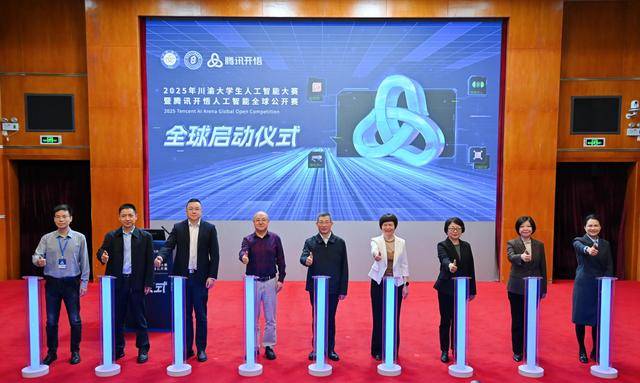
Core Viewpoint - The 2025 Sichuan-Chongqing University Student Artificial Intelligence Competition and Tencent Enlightenment Global Open Competition aims to promote the integration of artificial intelligence with education and industry, fostering talent development and addressing real technological challenges in the industry [2][4][5]. Group 1: Event Overview - The global launch ceremony of the competition was held at the University of Electronic Science and Technology of China, co-hosted by various educational and technological authorities from Sichuan and Chongqing, along with Tencent [2]. - The competition is designed to enhance the collaboration between universities and enterprises, focusing on the integration of AI applications in real-world scenarios [5][7]. Group 2: Objectives and Significance - The competition emphasizes the concept of "learning through competition" and aims to cultivate application-oriented talents that meet the needs of the new era [4][5]. - It seeks to address real technical challenges faced by industries, exploring innovative paths for the deep integration of "AI+" with the real economy [5]. Group 3: Competition Structure and Participation - The competition will feature four main tracks: decision-making algorithms, embodied intelligent reinforcement learning for motion control, AI chip operator development, and intelligent traffic signal scheduling [9]. - The event has attracted 2,038 teams from 388 universities, with over 5,000 participants from 18 countries, making it a significant platform for global AI youth [9]. Group 4: Talent Development and Incentives - A total prize pool exceeding 1 million yuan will be awarded, with cash rewards for nearly 50 teams, aimed at encouraging participation from outstanding AI talents [10]. - The competition will facilitate job opportunities for excellent participants in various fields, including Tencent's projects and top academic institutions [10]. Group 5: Educational Collaboration and Innovation - The event aims to build a collaborative platform for industry, academia, and research institutions, promoting the development of the AI ecosystem and innovation [10][13]. - Various educational institutions are adopting innovative training models to cultivate top AI talents, integrating real industry projects into their curricula [16][17].