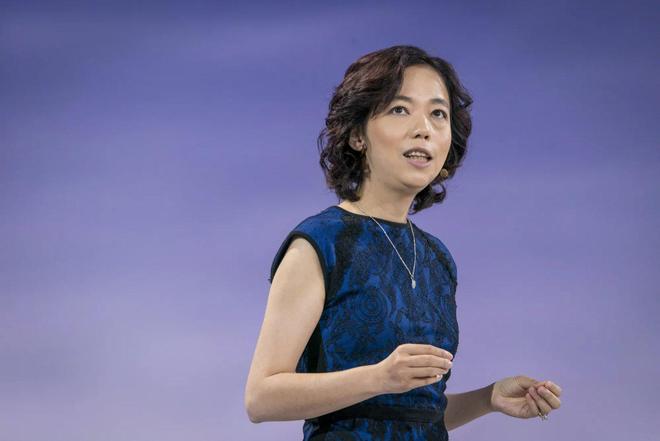
英伟达H100 GPU芯片

Search documents
马斯克猛猛带货太空数据中心,“能耗比地球香太多”
3 6 Ke· 2025-12-15 10:50
Core Viewpoint - The space has emerged as a new battleground for AI infrastructure, with significant interest from tech giants like Elon Musk, Jeff Bezos, and former Google CEO Eric Schmidt in establishing space data centers as a solution to energy and cooling challenges faced by terrestrial data centers [1][16]. Group 1: Space Data Centers - SpaceX plans to deploy data centers in space, with Musk emphasizing that the cost of operating large-scale AI systems in space may become more cost-effective than on Earth within the next 4 to 5 years [4][10]. - The concept of space data centers is gaining traction among Silicon Valley leaders, with Musk leading the charge and suggesting that the energy limitations on Earth necessitate a shift to space [5][6]. - The potential for abundant and stable energy in space, coupled with efficient cooling methods, positions space data centers as a viable alternative to traditional data centers [8][9]. Group 2: Energy and Cooling Advantages - In space, solar panels can provide continuous power due to the absence of weather and day-night cycles, making energy supply reliable [8]. - The cold environment of space allows for efficient heat dissipation through radiation, significantly reducing cooling costs compared to ground-based data centers [9]. - Estimates suggest that energy costs for space data centers could be as low as one-tenth of those for terrestrial solutions, enhancing their economic viability [9]. Group 3: Cost and Launch Economics - The cost of launching payloads into space is decreasing, with current estimates around $1,500 per kilogram using SpaceX's Falcon Heavy rocket, and projections suggest this could drop to $100 per kilogram with the Starship [11][12]. - This reduction in launch costs, combined with the advantages of space energy and cooling, creates a compelling business case for the establishment of space data centers [13]. Group 4: Industry Response and Developments - Companies like Starcloud have already begun testing space data center concepts, successfully launching a satellite equipped with NVIDIA H100 GPUs for training language models in space [16]. - Google is advancing its "Project Suncatcher," which aims to deploy a constellation of solar-powered satellites equipped with tensor processing units (TPUs) for in-orbit testing by 2027 [18]. - Bezos has indicated that moving data centers to orbit will become economically viable within 20 years, while Schmidt has invested in space technology companies, reflecting a consensus among tech leaders that the future of AI infrastructure lies in space [21]. Group 5: Domestic Developments - In China, initiatives are underway to establish space data centers, with plans to develop key technologies and construct a constellation of satellites for computational purposes by 2035 [23].

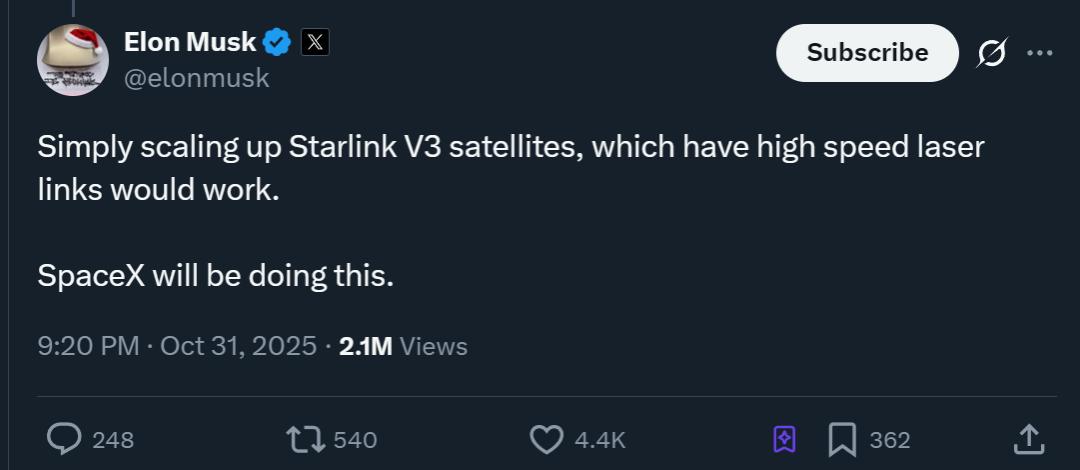
马斯克疯狂带货太空数据中心:“能耗比地球香太多”
Sou Hu Cai Jing· 2025-12-15 07:14
Core Viewpoint - The space data center has emerged as a new battleground for AI infrastructure, with significant interest from tech giants like Elon Musk, Jeff Bezos, and former Google CEO Eric Schmidt, who are exploring the potential of deploying data centers in space to overcome energy and cooling limitations on Earth [1][4][9]. Group 1: Space Data Center Concept - SpaceX plans to deploy data centers in space, with Musk suggesting that the cost of operating large-scale AI systems in space could be more cost-effective than on Earth within the next 4 to 5 years [1][5]. - The concept of space data centers is gaining traction among Silicon Valley leaders, indicating a collective interest in this innovative approach to AI infrastructure [1][9]. - The idea is driven by the belief that energy limitations on Earth will hinder the growth of AI capabilities, making space a viable alternative for energy and cooling solutions [4][5]. Group 2: Advantages of Space Data Centers - Space offers abundant and stable energy from solar power, as solar panels in space can operate continuously without weather interruptions [5][6]. - Cooling in space is more efficient due to the extreme cold temperatures, allowing for effective heat dissipation from GPUs without the need for extensive cooling systems [5][7]. - The cost of launching payloads into space is decreasing, with estimates suggesting that costs could drop to $100 per kilogram in the near future, enhancing the feasibility of space data centers [6][7]. Group 3: Industry Developments - Starcloud, a private startup, successfully launched a satellite equipped with NVIDIA H100 GPU chips, marking a significant step in training large language models in space [9]. - Google is advancing its "Project Suncatcher," which aims to create a constellation of solar-powered satellites equipped with tensor processing units (TPUs) for in-orbit testing by 2027 [11]. - Bezos has expressed that relocating data centers to orbit is a rational move, predicting that costs will surpass terrestrial AI infrastructure within 20 years [14].
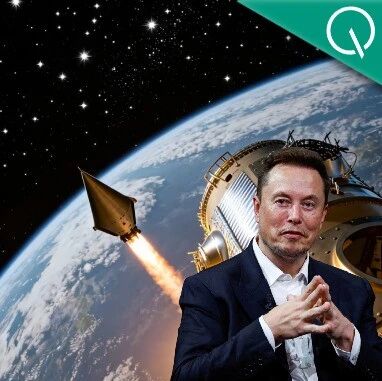
马斯克猛猛带货太空数据中心!“能耗比地球香太多”
量子位· 2025-12-15 05:57
Core Viewpoint - The article discusses the emerging trend of space data centers as a new frontier for AI infrastructure, driven by key figures like Elon Musk and supported by other tech giants such as Amazon and Google [1][12]. Group 1: Space Data Centers and AI Infrastructure - Space data centers are becoming a focal point in discussions within Silicon Valley and beyond, with significant interest from major tech leaders [2][12]. - Elon Musk has been a prominent advocate for space data centers, indicating that SpaceX plans to deploy data centers in space and expressing support for Google's similar initiatives [4][6]. - Musk argues that the energy potential in space is vastly greater than on Earth, suggesting that deploying AI systems in space could be more cost-effective within the next 4-5 years [8][27]. Group 2: Advantages of Space Data Centers - Space offers abundant and stable energy sources, as solar panels in space can provide continuous power without the interruptions caused by weather or day-night cycles [24]. - Cooling in space is more efficient due to the extreme cold temperatures, allowing for effective heat dissipation without the need for complex cooling systems [25]. - The cost of launching payloads into space is decreasing, with estimates suggesting it could drop to $100 per kilogram in the near future, enhancing the feasibility of space data centers [30]. Group 3: Industry Response and Developments - Major companies are actively pursuing space data center projects, with Starcloud successfully launching a satellite to train a language model in space [38]. - Google is working on "Project Suncatcher," which aims to create a constellation of solar-powered satellites equipped with their tensor processing units (TPUs) [41][42]. - Jeff Bezos has also indicated that moving data centers to orbit is a rational approach, predicting that costs will surpass terrestrial AI infrastructure within 20 years [46]. Group 4: Future Prospects and Challenges - The article highlights the potential for space data centers to alleviate the energy shortages projected for data centers on Earth, particularly in the U.S., where demand for electricity is expected to exceed supply due to AI growth [33][34]. - The construction of space data centers could provide a solution to the regulatory and environmental challenges faced by terrestrial data centers, offering a more agile and sustainable approach to meet increasing computational demands [36]. - The article concludes that both domestic and international players are recognizing the potential of space data centers, marking a significant shift in the landscape of AI infrastructure [50][55].

“AI教母”李飞飞的全新世界模型问世!一张英伟达AI芯片就能生成无限3D世界
Tai Mei Ti A P P· 2025-10-17 02:53
Core Insights - World Labs, co-founded by Fei-Fei Li, has launched a new real-time generative world model called RTFM (Real-Time Frame Model) which utilizes large-scale video data for efficient end-to-end training [3][4] - RTFM can generate new 2D images from one or more 2D inputs without relying on explicit 3D representations, marking a significant advancement in AI rendering capabilities [3][4] - The model can render persistent and 3D-consistent scenes in real-time using a single NVIDIA H100 GPU, enabling interactive experiences in both real and virtual environments [4][10] Company Overview - World Labs was founded in March 2023 by Fei-Fei Li and three other scholars, focusing on developing efficient, scalable, and persistent world models [8][10] - The company raised $230 million in September 2023, achieving a valuation of $1 billion within three months of its establishment [10] - The team consists of approximately 24 members, with a significant representation of Chinese individuals [10] Technology and Innovation - RTFM addresses scalability issues that have long plagued world models, enhancing spatial intelligence in machines, which allows for better navigation and decision-making in complex 3D environments [6][7] - The model's efficiency is highlighted by its ability to support interactive frame rate inference with a single H100 GPU, while its scalability allows for continuous optimization as data and computational power grow [8][10] - Future plans include developing a large model (LWM) that comprehensively understands three-dimensional, physical, and temporal concepts, with applications in AR and robotics [10][12] Research and Development - Fei-Fei Li is also spearheading the Behavior 1K challenge, aimed at standardizing tasks in embodied intelligence and robotics research, providing a platform for training and evaluation [11][12] - The Behavior 1K challenge includes 1,000 tasks focused on long-horizon tasks in everyday environments, promoting collaboration and comparison among researchers [12] - The integration of various AI technologies is seen as a transformative moment for society, emphasizing a human-centered approach in AI development [12][13]