荣耀Power 2

Search documents
中端手机春节“生死战”:集体涨价,进退两难
凤凰网财经· 2026-02-06 11:38
Core Viewpoint - The mid-range smartphone market is facing significant challenges due to rising memory prices, leading to increased prices or reduced specifications, which undermines the value proposition of mid-range devices [2][3][19]. Group 1: Market Trends - The mid-range smartphone segment has seen its market share decline from 35% in 2021 to an expected 23% by 2027, while the entry-level market remains stable at 41%-45% [13]. - In January 2026, Android manufacturers launched five mid-range models, indicating a crowded market with intense competition [4]. - The mid-range segment, which once accounted for over half of the smartphone market, now serves around 500 million users in China, with a significant portion of sales concentrated in the 2000-4000 yuan price range [6][12]. Group 2: Product Features and Consumer Preferences - Recent mid-range models emphasize battery life, with many devices featuring batteries over 6000mAh, catering to the increasing reliance on smartphones [7][11]. - Manufacturers are shifting focus from parameter-heavy designs to user experience, with features tailored to specific use cases, such as gaming or photography [11][19]. - The best-selling model recently is the OPPO Reno 15, with sales reaching 1.1875 million units shortly after launch, followed by the Honor 500 series [11]. Group 3: Pricing and Profitability - Rising memory chip prices have significantly impacted mid-range device costs, with LPDDR4X prices increasing by nearly 80% and LPDDR5X prices more than doubling [19][21]. - Many manufacturers have opted to raise prices by 200-600 yuan for new models to maintain profit margins, with the average profit for a 3000 yuan device dropping to just 30 yuan [18][21]. - The introduction of government subsidies has not led to substantial sales increases in the mid-range segment, with growth primarily occurring in high-end and low-end markets [15][24]. Group 4: Future Outlook - The mid-range smartphone market is at a critical juncture, with predictions of a 3%-4% decline in overall smartphone shipments in 2026 [24]. - Companies are exploring strategies to simplify product offerings and enhance competitiveness, such as introducing "super standard versions" to streamline configurations [24][25]. - The ongoing price increases and market saturation may lead to further challenges for mid-range devices, potentially marking 2026 as one of the toughest years for this segment [25].

中端手机春节“生死战”:集体涨价,进退两难
3 6 Ke· 2026-02-06 08:23
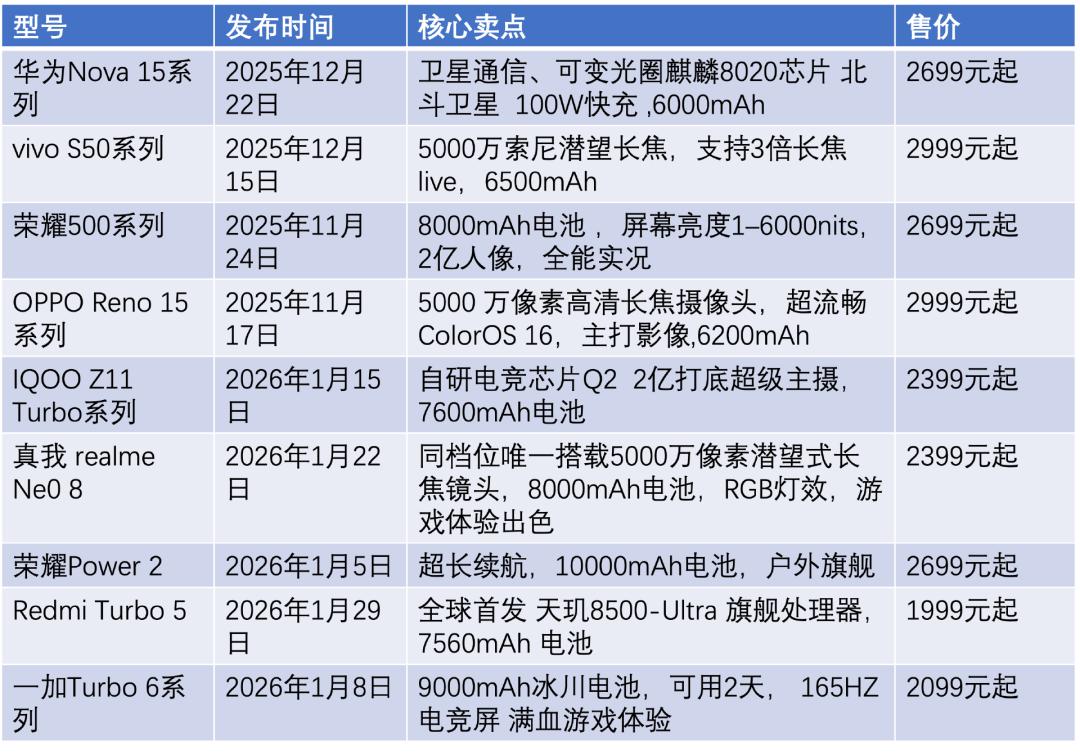
Core Viewpoint - The mid-range smartphone market is facing significant challenges due to rising memory prices, leading to increased prices or reduced specifications across brands, which undermines the value proposition of mid-range devices [1][11][12]. Group 1: Market Dynamics - The mid-range smartphone segment has seen its market share decline from 35% in 2021 to an expected 23% by 2027, while the entry-level market remains stable at 41%-45% [8]. - In January 2026 alone, Android manufacturers launched five mid-range models, indicating a crowded market despite declining demand [1][8]. - The mid-range segment, which once accounted for over half of the smartphone market, now serves around 500 million users in China, with a significant portion of sales concentrated in the 2000-4000 yuan price range [2][8]. Group 2: Product Features and Consumer Preferences - Recent mid-range models emphasize battery life, with all nine newly released models featuring batteries over 6000mAh, catering to the increasing reliance on smartphones [2][3]. - The focus has shifted from parameter competition to user experience, with brands prioritizing features like battery life and specific use-case enhancements [6][7]. - Notable models include the Honor Power 2 with a 10000mAh battery and the OnePlus Turbo 6 with a 9000mAh battery, highlighting the trend towards high-capacity batteries [4][5]. Group 3: Pricing Strategies and Profit Margins - Rising memory chip prices have led to increased costs for mid-range devices, with LPDDR4X prices rising nearly 80% and LPDDR5X prices more than doubling [11][12]. - Many manufacturers have opted to raise prices by 200-600 yuan for new models to maintain profit margins, with some models seeing price increases despite unchanged specifications [13][15]. - The profit margins for mid-range devices have significantly decreased, with some retailers reporting profits as low as 30 yuan for devices priced around 3000 yuan [10]. Group 4: Future Outlook - The smartphone market is expected to shift from growth to decline, with overall shipments projected to decrease by 3%-4% in 2026 [15]. - Companies are adjusting their strategies by reducing production orders and focusing on fewer, more standardized models to maintain competitiveness [15][16]. - The mid-range smartphone market is at a critical juncture, facing pressures from both rising component costs and changing consumer preferences [16].

春节换机潮叠加“国补”,中端机配置全面“旗舰化”
Nan Fang Du Shi Bao· 2026-01-23 06:30
Group 1 - The Chinese smartphone market is entering a competitive phase with a focus on mid-range devices as manufacturers target the demand for high cost-performance products during the pre-Spring Festival sales season [1][3] - The government subsidy policy, which extends until 2026, offers a 15% subsidy for devices priced under 6000 yuan, enhancing the attractiveness of mid-range smartphones [3] - Consumers are shifting their focus from low prices to high cost-performance, with mid-range devices now offering performance and features close to flagship models at 60%-70% of their price [3][7] Group 2 - Major brands like Honor, OnePlus, Redmi, iQOO, and realme are launching new models priced between 2000 yuan and 3000 yuan, indicating a fierce competition in the mid-range segment [3][7] - Battery life is a critical concern for users, leading manufacturers to equip mid-range devices with large-capacity batteries, such as Honor Power 2 with a 10080mAh battery [5][7] - The introduction of high-performance processors, such as Snapdragon 8 Gen 5 and MediaTek's Dimensity 9500S, is becoming standard in new mid-range devices, enhancing their appeal [5][6] Group 3 - The smartphone market in China is transitioning to a phase characterized by slight declines in total volume and structural upgrades, with an expected shipment of 278 million units in 2026, a 2.2% year-on-year decrease [8] - High-end market shares are dominated by Apple, Huawei, and Samsung, with Apple holding nearly 50% of the high-end market share in the first three quarters of 2025 [9] - The rising costs of core components are pressuring manufacturers to either raise prices or reduce specifications, leading to a focus on the 2000-3000 yuan price range for maintaining higher profit margins [9]
荣耀新机高度“撞脸”iPhone引热议
Guan Cha Zhe Wang· 2025-12-31 05:56
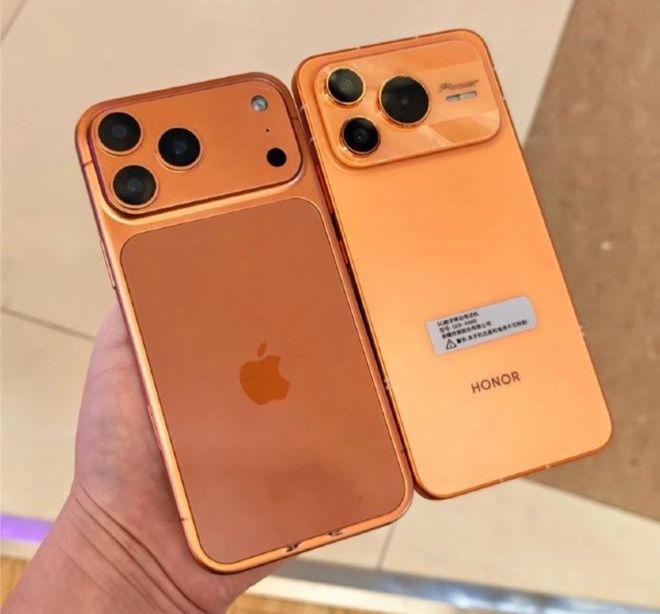
Group 1 - The new Honor Power 2 smartphone has sparked discussions due to its design similarities with the iPhone 17 Pro Max, particularly in the rear camera module and color options [1][4] - The Honor Power 2 features a 6.79-inch 1.5K LTPS display, MediaTek Dimensity 8500 Elite processor, a 16MP front camera, a 50MP main camera with a 5MP secondary camera, and a large 10,080mAh battery with 80W fast charging, expected to be priced around 2,000 yuan [4] - There is a divided opinion among consumers regarding the design; some prioritize performance and value over originality, while others express concerns about the lack of distinctiveness in design affecting brand reputation [8] Group 2 - As of December 21, the iPhone 17 series has sold approximately 14.86 million units in the Chinese market, while Honor's Magic 8 series has sold about 454,000 units, indicating a significant gap in market performance [9] - Other domestic brands have also seen varying sales figures, with OPPO Find X9 series at approximately 747,500 units, vivo X300 series at about 973,600 units, Huawei Mate 80 series at around 1.23 million units, and Xiaomi 17 series at approximately 2.69 million units [9]
国产新机电池卷到10000mAh,iPhone和充电宝沉默了
3 6 Ke· 2025-11-11 10:39
Core Viewpoint - The smartphone industry is witnessing a significant shift towards larger battery capacities, with several manufacturers testing devices featuring batteries exceeding 10,000mAh, potentially alleviating concerns about battery life [1][6]. Group 1: Battery Innovations - The recently released Honor X70 features a record battery capacity of 8,300mAh, but this record is expected to be surpassed soon with new models testing 10,000mAh batteries [1][6]. - The 10,000mAh battery could enhance video playback time to approximately 30 hours and enable daily usage to last up to three days on a single charge, assuming energy efficiency remains constant [6][8]. - The rapid evolution of battery technology has led to a significant increase in capacity, from an average of 4,000-4,500mAh in 2019 to the current trend of 10,000mAh [8][9]. Group 2: Market Trends - The trend of larger batteries is primarily observed in mid-range and low-end smartphones, as these devices can compromise on other specifications to accommodate the larger battery size [14]. - The Honor X70, priced starting at 1,399 yuan, is noted for its industrial-grade waterproofing and enhanced durability, appealing to outdoor users who prioritize battery life and ruggedness over high-end performance [14][15]. - The anticipated rise in prices for DRAM and NAND flash memory could impact the pricing of new smartphones featuring large batteries, particularly in the mid-range segment [15]. Group 3: Technological Advancements - The successful integration of silicon-carbon anode materials has been a key breakthrough, allowing for higher energy density in batteries compared to traditional graphite anodes [9][13]. - The introduction of fast charging technologies, such as 120W and above, addresses the potential slow charging issues associated with larger batteries, creating a balance between capacity and convenience [13]. Group 4: Future Implications - The trend towards larger batteries may not only influence smartphones but could also extend to electric vehicles, suggesting a broader impact on the technology landscape [16].
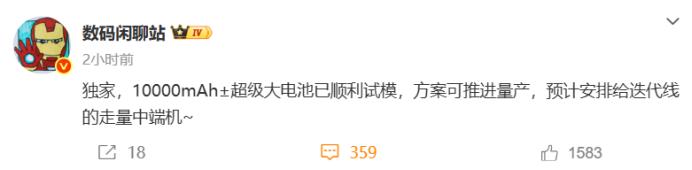
追觅俞浩内部放狠话:造车PK理想,手机跟华为小米三分天下;TP-Link芯片事业部全员解散;马斯克用亲信管理AI公司引发冲突
雷峰网· 2025-09-19 00:37
Group 1 - TP-Link's chip division has been completely dissolved, marking the end of its self-developed chip projects, with layoffs and compensation plans revealed [3][4] - The CEO of ZhiMi, Yu Hao, has made bold statements about competing in the automotive sector against Li Auto and plans to enter the smartphone market, aiming for a share alongside Huawei and Xiaomi [6][9] - Nvidia's investment of $5 billion in Intel has shocked the market, with both CEOs discussing the strategic importance of this partnership [26] Group 2 - The RTX 6000D AI chip from Nvidia has seen disappointing demand in China, leading to comments from CEO Jensen Huang expressing disappointment but understanding of the situation [10][29] - The launch of the iQOO 15 will skip the iQOO 14, with the new model expected to feature a high-quality 2K display [12][13] - Honor is set to release a smartphone with a groundbreaking 10,000mAh battery, marking a significant advancement in battery technology [18][19] Group 3 - DeepSeek's R1 model has gained recognition by being featured on the cover of Nature, highlighting its significance in the AI field [15] - Huawei's Xu Zhijun announced plans for multiple new chips over the next three years, emphasizing the company's commitment to AI infrastructure despite challenges from U.S. sanctions [18] - Groq, an AI chip startup, has raised $750 million, doubling its valuation to $6.9 billion, with ambitions to surpass Nvidia in three years [30]