
融e贷

Search documents
产业成长战略价值优于财务回报 探“赢”青岛财务公司产融协同谋发展路径
Zheng Quan Ri Bao· 2025-07-31 16:06
Core Viewpoint - The article highlights the role of financial companies within large enterprise groups in China, emphasizing their unique model of integrating finance with industry to support the real economy and drive technological advancements in various sectors [1][2]. Group 1: Financial Companies' Role - Financial companies like Shandong Port Financial Company, Haier Financial Company, and Hisense Financial Company are positioned as strategic partners that understand both finance and industry, prioritizing strategic value over financial returns in project evaluations [1][2][4]. - Shandong Port Financial Company has provided over 2 billion yuan in financing for the construction of the automated terminal at Qingdao Port, showcasing its commitment to supporting significant infrastructure projects [3]. Group 2: Technological Advancements - The automated terminal at Qingdao Port has achieved a world record with an average operation efficiency of 62.62 natural boxes per hour, reflecting the successful integration of technology and finance [3]. - The financial support from Shandong Port Financial Company has been crucial in transforming a previously undeveloped area into a leading automated terminal, demonstrating the impact of financial services on technological upgrades [2][3]. Group 3: Innovative Financing Solutions - Haier Financial Company has developed a rapid financing solution called "融e贷," which allows for real-time credit assessments based on dynamic industry data, significantly speeding up the traditional financing process [5][6]. - Hisense Financial Company has tailored financial services for high-tech enterprises, addressing the unique challenges faced by technology-driven small and medium-sized enterprises in securing funding [6][7]. Group 4: Industry Growth and Collaboration - The financial companies are not intended to replace external financial institutions but rather to complement and collaborate with them, enhancing the overall financial ecosystem for industries [7][8]. - As of March 2025, there are 236 financial companies in China, with total assets amounting to 8.52 trillion yuan, indicating the growing importance of these institutions in supporting the real economy [7].
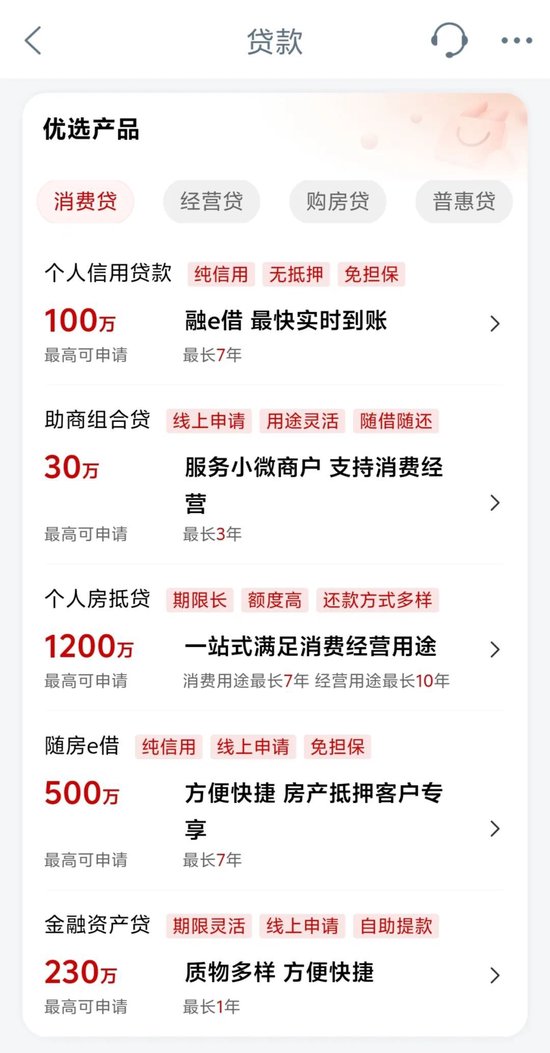
消费贷“价格战”降温后银行开始卷额度?1200万元可借7年,利率回归3%以上
Xin Lang Cai Jing· 2025-07-29 12:37
Core Viewpoint - The implementation of the regulatory notice on consumer finance has led banks to increase the limits and extend the terms of consumer loans, with some products offering limits up to 25 million yuan and terms extending to 7 years [1][7]. Summary by Sections Consumer Loan Limits and Terms - Banks are introducing higher limits for consumer loans, with some products offering maximum amounts of 25 million yuan and terms extending up to 7 years [1][7]. - The new consumer loan products are primarily aimed at high-quality customers, with strict eligibility criteria based on employment, financial status, income sources, and repayment ability [6][8]. Interest Rates - Following a period of declining interest rates, most consumer loan products now have annual rates above 3%, with state-owned banks offering rates around 3% and some joint-stock banks exceeding 4% [1][2]. - The competitive landscape saw a "price war" in consumer loans, but regulatory measures have since halted this trend, leading to a general increase in interest rates [2][8]. Product Offerings - Various banks have launched large consumer loan products, with limits ranging from 100,000 yuan to 2.5 billion yuan, and terms varying from 5 to 7 years [5][6]. - Specific examples include China Bank's "Good Guest Loan" with a maximum of 200,000 yuan and an interest rate of 5.4%-23.725%, and Agricultural Bank's "Net Quick Loan" with a maximum of 1 million yuan at a starting rate of 3.1% [2][3]. Regulatory Framework - The central government has issued guidelines to encourage financial institutions to increase personal consumer loan offerings while ensuring risk control [7][9]. - The regulatory notice allows for higher loan limits and extended terms, aiming to stimulate consumer spending and support economic recovery [7][8]. Market Dynamics - The recent policy changes have invigorated the consumer loan market, allowing banks to better meet diverse consumer needs and enhance consumer confidence [8][9]. - However, experts caution against excessive loan amounts and low interest rates, advocating for a balanced approach to risk management and customer segmentation [9].


财务公司深耕主业服务实体经济
Jing Ji Ri Bao· 2025-07-14 22:02
Core Viewpoint - The article emphasizes the critical role of corporate financial companies in addressing the financing challenges faced by small and micro enterprises in China, particularly in the context of economic recovery and industrial transformation [1][10]. Group 1: Financing Challenges and Solutions - Small and micro enterprises continue to face severe "difficult and expensive financing" issues, which traditional financial institutions struggle to address due to long service chains, high credit standards, and slow approval processes [2][3]. - Corporate financial companies, such as those under Haier and Hisense, leverage their proximity to industries and innovative financial tools to provide timely and efficient financing solutions to these enterprises [1][4]. Group 2: Innovative Financial Models - Haier's financial company has developed a "financial partner" service model and an "intelligent risk control" capability to support the co-development of small and micro enterprises along the industrial chain [2][3]. - Hisense's financial company utilizes a "industry chain + technology risk control" model to offer convenient financing support to specialized and innovative enterprises, significantly reducing financing costs [3][4]. Group 3: Digital Transformation and Efficiency - Digital transformation is a key focus for corporate financial companies, enhancing service experiences and risk management capabilities through technologies like AI and big data [9][10]. - Haier's financial company has established a digital service system that allows for real-time responses and efficient fund allocation, while Hisense is also advancing its financial technology capabilities to better meet the needs of small and micro enterprises [9][10]. Group 4: Industry Impact and Future Outlook - As of March 2025, there are 236 corporate financial companies in China, with total assets of 8.52 trillion yuan, indicating a growing sector that is increasingly supporting small and micro enterprises [11]. - The article suggests that with ongoing policy support and technological advancements, corporate financial companies will continue to play a significant role in facilitating the development of small and micro enterprises in the future [11].
千万资金池激活消费新引擎
Jin Rong Shi Bao· 2025-06-10 03:18
Group 1 - The consumption market in Linyi City, Shandong Province, is experiencing unprecedented growth opportunities driven by initiatives like "Shopping in Linyi Mall" and "Beautifying the Yihe River" [1] - As of the end of Q1, the total consumer loan balance in Linyi reached 338.9 billion yuan, accounting for 29.9% of all loans [1] Group 2 - The People's Bank of China in Linyi has integrated into the automobile trade-in policy, promoting favorable auto loan terms and facilitating a total of 8.24 billion yuan in auto installment and consumption loans in Q1 [2] - The average interest rate for new housing loans in Linyi was 3.13% in Q1, a decrease of 0.76 percentage points year-on-year [2] Group 3 - A financial subsidy pool of 20 million yuan was established to stimulate consumption through a collaborative model involving policy, finance, and consumer scenarios [3] - In Q1, banks in Linyi provided over 2.4 million yuan in consumer finance benefits, driving consumption by over 28 million yuan [3] Group 4 - The People's Bank of China in Linyi is actively involved in key consumption sectors such as e-commerce, culture and tourism, and automotive, with a focus on creating a service system that combines policy, scenario integration, and financial empowerment [4] - In Q1, the Agricultural Bank of China in Linyi issued 1.26 billion yuan in loans focused on the cultural tourism sector [4] Group 5 - The implementation of fee reduction policies has led to a total of 1.43 billion yuan in payment fee reductions for 938,800 market entities, effectively lowering their payment costs [5]