
证券保险ETF(512070)

Search documents
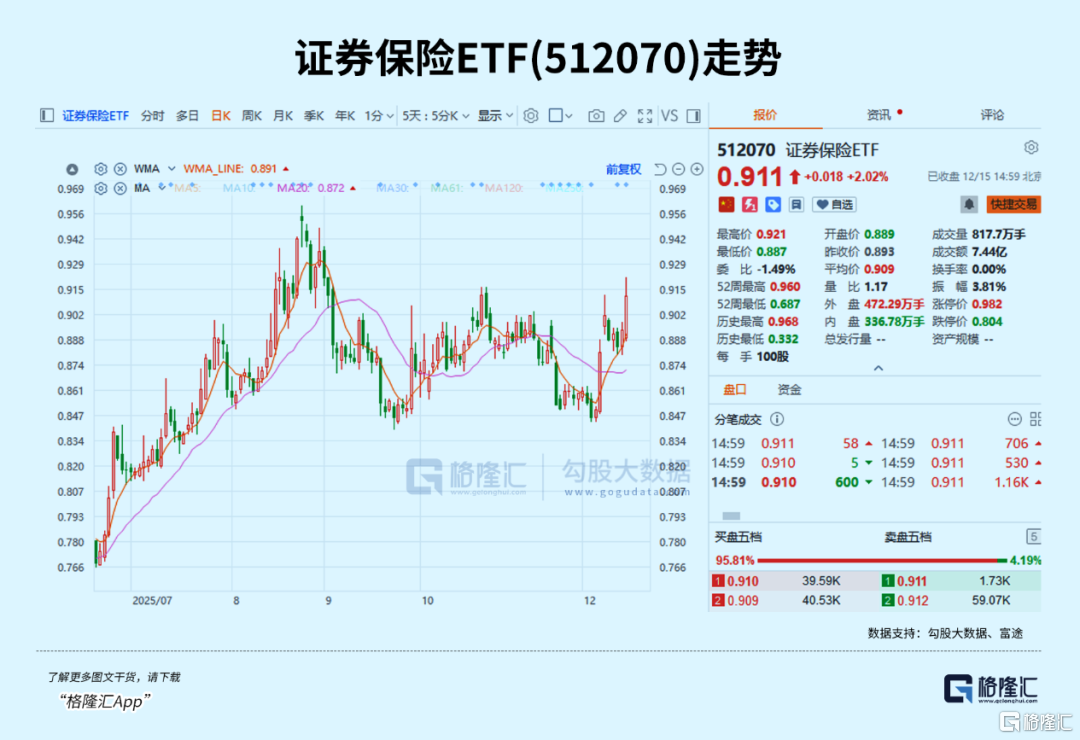
逆势大涨,资金加速布局
Ge Long Hui· 2025-12-15 12:07
Core Viewpoint - The A-share market experienced a decline influenced by the significant drop in the US AI technology sector, but certain sectors like consumer goods and insurance showed resilience and growth amidst the downturn [1][5]. Group 1: Market Performance - The three major indices in the A-share market closed down by 0.55%, 1.1%, and 1.77%, with a total market turnover of 1.79 trillion yuan, a decrease of 324.6 billion yuan from the previous trading day, and over 2900 stocks fell [1]. - Despite the overall market decline, the insurance sector saw a notable increase, with the Securities Insurance ETF (512070) rising by 2.02% on the day and 7.18% over the past week [1]. Group 2: Non-Banking Financial Sector - The non-banking financial sector has become a focal point for investors due to recent favorable policy signals, particularly for brokerages, which are traditionally seen as a barometer of market performance [3][4]. - The China Securities Regulatory Commission (CSRC) has indicated a willingness to expand capital space and leverage limits for quality brokerages, which is expected to enhance capital efficiency and support the growth of margin financing and proprietary trading [6][7]. Group 3: Insurance Sector Developments - The recent reduction in risk factors for insurance companies' investments, particularly in stocks, is expected to release significant capital, potentially adding 108.6 billion yuan to the market if fully allocated to the CSI 300 index [9][11]. - The insurance sector's strong performance is also attributed to a government push to encourage insurance capital to enter the market, which is expected to enhance market valuations [12][15]. Group 4: Investment Trends and Opportunities - The insurance and brokerage sectors are experiencing a valuation recovery, with the insurance industry showing an average PEV of 0.60-0.95 times and PB of 1.15-2.06 times, indicating a significant discount compared to historical averages [26]. - The total investment assets of listed insurance companies reached 21.85 trillion yuan, with an increase in stock allocation from 7.98% at the end of 2024 [21]. - The recent influx of capital into the non-banking financial sector, including a net inflow of 7.202 billion yuan into the Securities Insurance ETF (512070), reflects growing market interest [29]. Group 5: Long-term Investment Outlook - The outlook for the non-banking financial sector remains positive, driven by supportive government policies and the potential for long-term capital inflows into high-dividend assets like banks and insurance [33][35]. - The insurance sector's increased allocation to high-growth technology stocks and other sectors is expected to enhance future investment returns [38].

逆势大涨!资金加速布局
Sou Hu Cai Jing· 2025-12-15 11:01
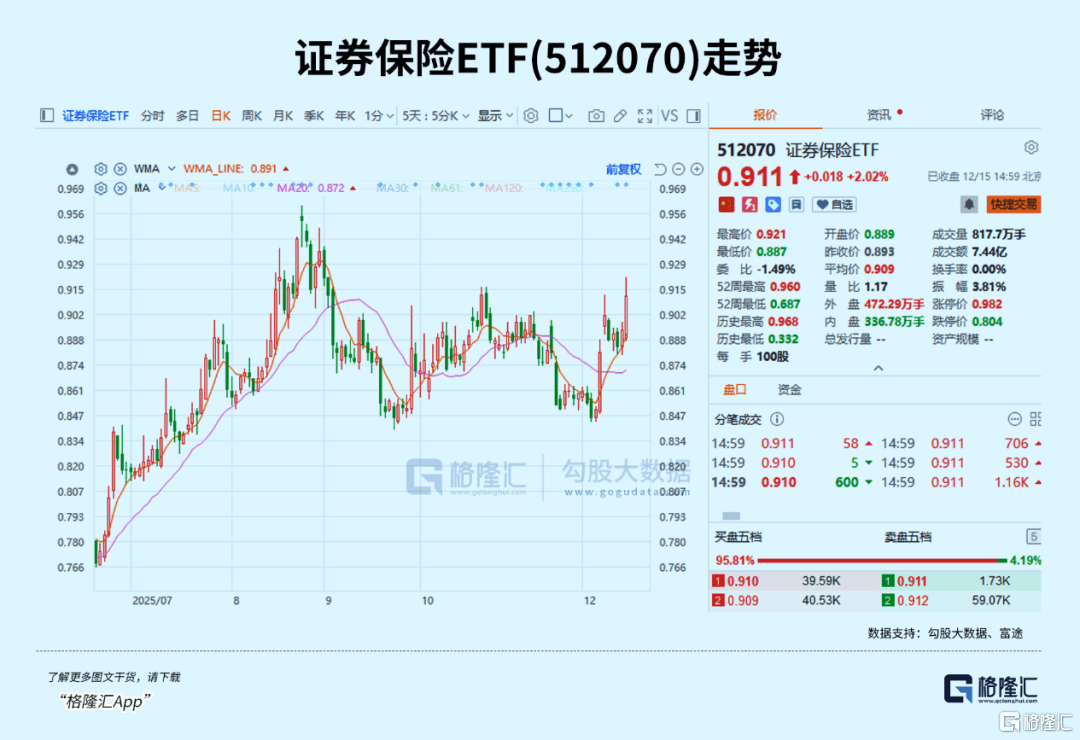
Core Viewpoint - The A-share market experienced a decline influenced by the significant drop in the AI technology sector in the US, but the non-bank financial sector, particularly insurance and brokerage stocks, showed resilience and upward movement due to favorable policy changes and market dynamics [1][3][4]. Group 1: Market Performance - The A-share market indices closed down, with the Shanghai Composite, Shenzhen Component, and ChiNext falling by 0.55%, 1.1%, and 1.77% respectively, with a total market turnover of 1.79 trillion yuan, a decrease of 324.6 billion yuan from the previous trading day [1]. - Despite the overall market decline, sectors such as food and beverage, retail, and insurance saw significant gains, with the securities insurance ETF (512070) rising by 2.02% and 7.18% over the past week [1]. Group 2: Non-Bank Financial Sector - The non-bank financial sector has become a focal point for investors, particularly following a recent policy announcement from the China Securities Regulatory Commission (CSRC) that aims to expand capital space and leverage limits for quality brokerages, enhancing capital efficiency [5][6]. - The current leverage ratio in the brokerage industry stands at 4.42 times, and the policy easing is expected to boost the scale of margin financing and proprietary trading, leading to optimistic expectations for the industry's return on equity (ROE) [6][7]. Group 3: Insurance Sector Developments - The insurance sector received a significant boost from a recent notification by the Financial Regulatory Administration, which lowered risk factors for insurance companies' investments in stocks, particularly for long-term holdings in major indices [8][9]. - This reduction in risk factors is expected to release substantial capital for investment, potentially injecting 108.6 billion yuan into the stock market if fully allocated to the CSI 300 index [10][11]. - The insurance sector's stock prices surged by 5.8% in a single day following the announcement, reflecting strong market expectations for the industry [15]. Group 4: Long-Term Investment Opportunities - The insurance and brokerage sectors are seen as attractive long-term investment opportunities due to their relatively low valuations compared to historical averages, with the insurance industry's average price-to-embedded value (PEV) ranging from 0.60 to 0.95 times [25]. - The ongoing policy support and the shift towards long-term capital inflows into the market are expected to further enhance the appeal of these sectors, especially in a low-interest-rate environment [32][33]. - The insurance sector has increasingly diversified its investments into high-growth technology stocks, indicating a shift in asset allocation strategies that could yield higher returns [35].
非银板块震荡调整,关注证券保险ETF(512070)、证券ETF易方达(512570)等产品布局机会
Sou Hu Cai Jing· 2025-12-09 10:31
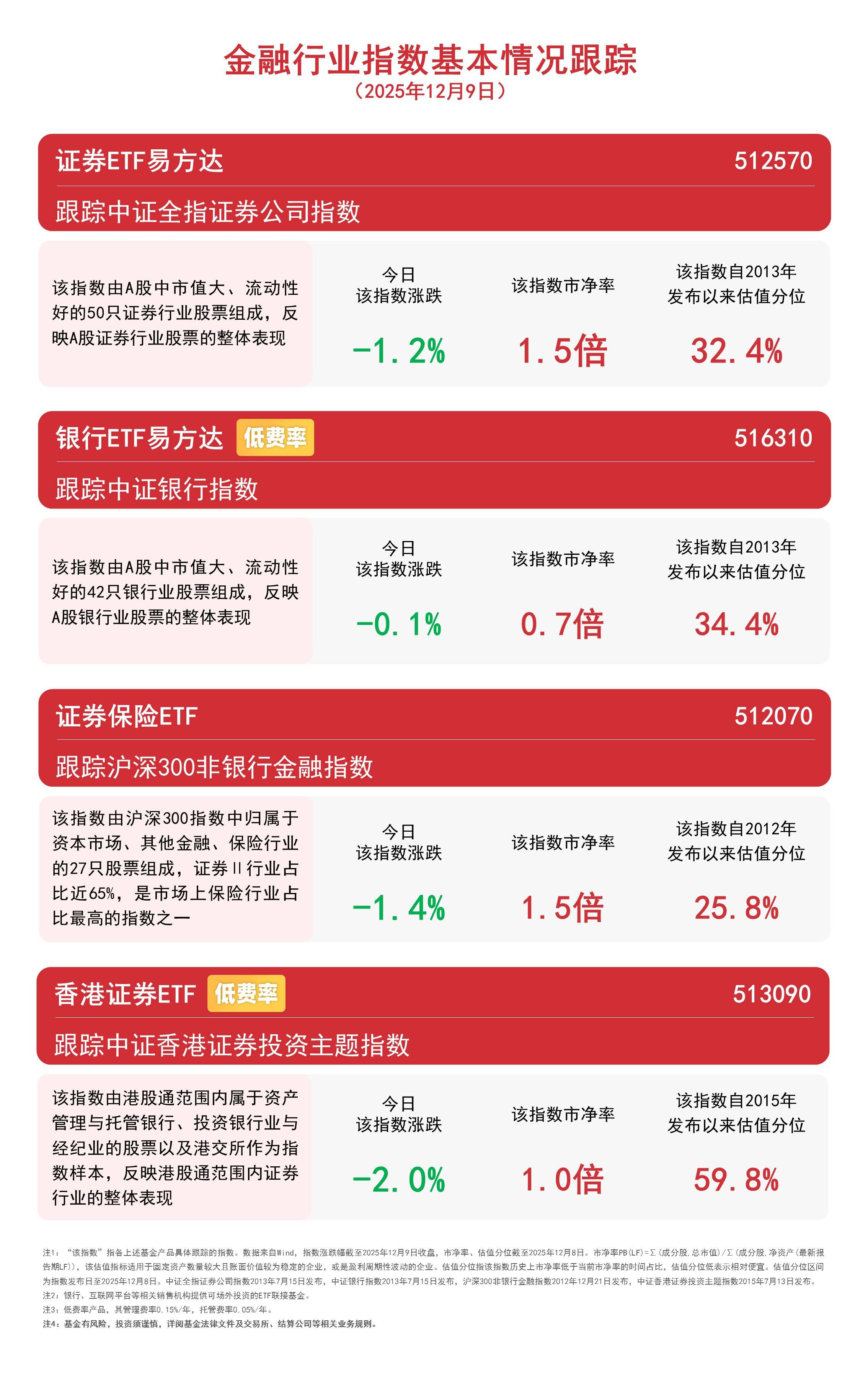
Group 1 - The non-bank sector experienced a pullback after three consecutive days of gains, while the banking sector continued to fluctuate within a narrow range. The China Securities Bank Index fell by 0.1%, the China Securities Company Index dropped by 1.2%, the CSI 300 Non-Bank Financial Index decreased by 1.4%, and the Hong Kong Securities Index declined by 2.0% [1] - Ping An Securities noted that the National Financial Regulatory Administration issued a notice adjusting the risk factors for insurance companies' related business, which lowered the risk factors for long-term holding assets such as the CSI 300, dividend low volatility, and STAR Market. This adjustment is expected to cultivate patient capital and support technological innovation [1] - The implementation of this policy is anticipated to continuously promote the entry of medium to long-term funds into the market, enhancing the equity allocation capability of insurance funds [1] Group 2 - The CSI 300 Non-Bank Financial Index consists of 27 stocks from the CSI 300 Index that belong to the capital market, other financial sectors, and the insurance industry, with the securities industry accounting for nearly 65%, making it one of the indices with the highest proportion of the insurance industry in the market [4] - The Hong Kong Securities ETF tracks the China Securities Hong Kong Securities Investment Theme Index, which reflects the performance of stocks within the asset management, custody banks, investment banking, and brokerage industries in Hong Kong [5][6]
保险新规助力培育耐心资本,证券保险ETF(512070)、证券ETF易方达(512570)标的指数双双三连涨
Sou Hu Cai Jing· 2025-12-08 11:05
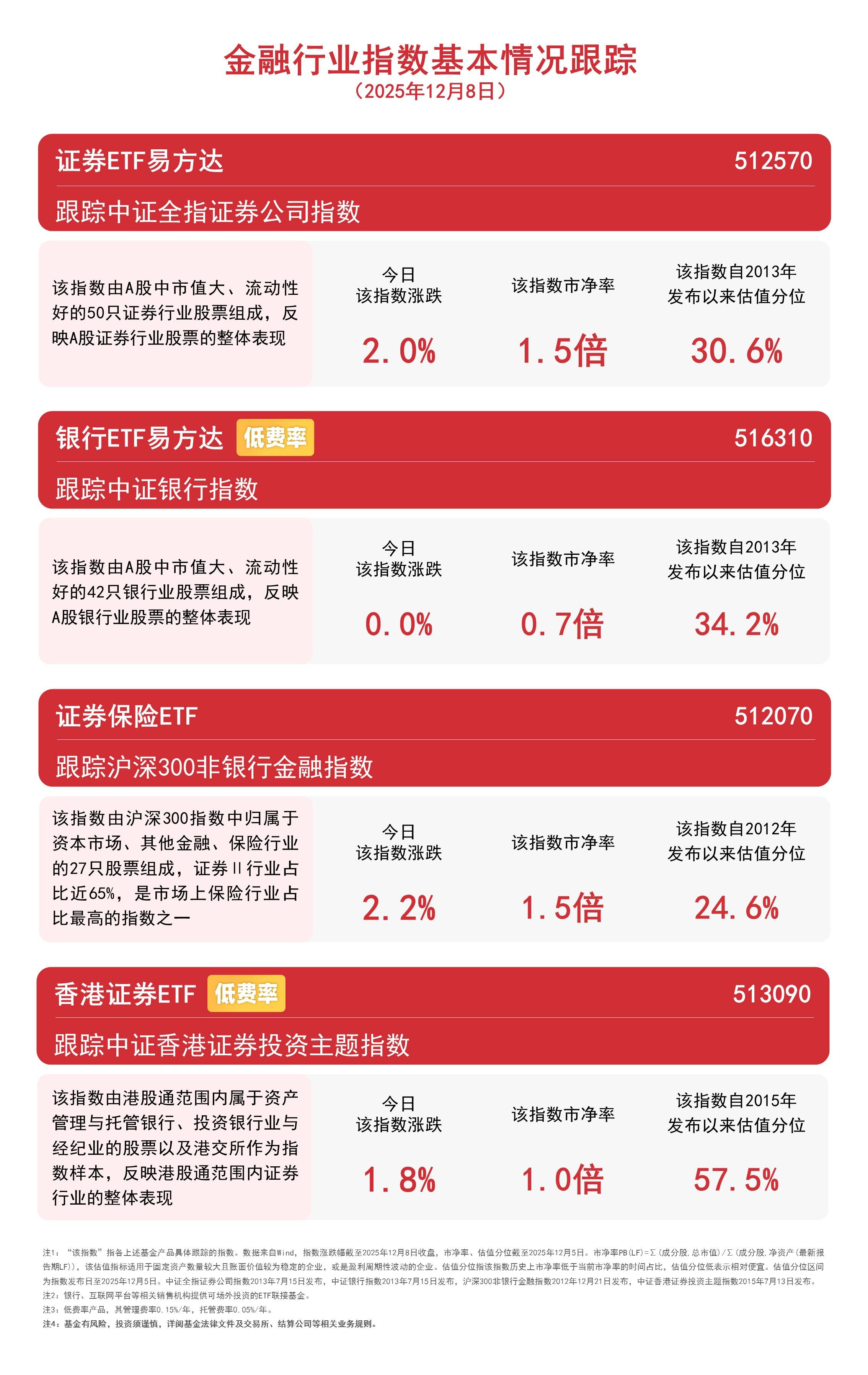
Group 1 - The non-bank sector continued its upward trend, with the CSI 300 Non-Bank Financial Index rising by 2.2%, the CSI All Share Securities Company Index increasing by 2.0%, and the Hong Kong Securities Index up by 1.8% [1] - The National Financial Regulatory Administration's notification to adjust risk factors for insurance companies has lowered the risk factors for long-term holding assets such as the CSI 300, Dividend Low Volatility, and STAR Market, which is expected to cultivate patient capital and support technological innovation [1] - The implementation of this policy is anticipated to continuously drive medium to long-term capital into the market, enhancing the equity allocation capability of insurance funds [1] Group 2 - The CSI 300 Non-Bank Financial Index consists of 27 stocks from the CSI 300 Index related to capital markets, other financial services, and the insurance industry, with the securities sector accounting for nearly 65% [3] - The Hong Kong Securities ETF tracks the CSI Hong Kong Securities Investment Theme Index, which reflects the performance of stocks within the asset management, custody banks, investment banking, and brokerage sectors [4][5]
飙涨近50%!超级合并案来了
Ge Long Hui· 2025-11-20 10:09
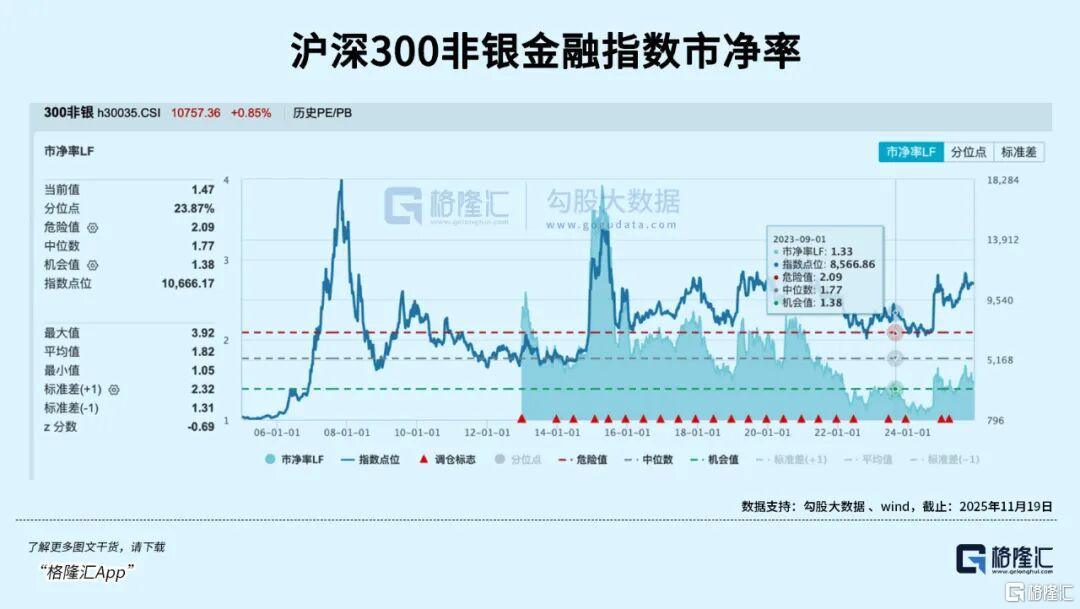
Core Viewpoint - The merger of China International Capital Corporation (CICC) with Dongxing Securities and Xinda Securities marks a significant event in the Chinese securities industry, indicating a trend towards consolidation and high-quality development in response to both domestic and international pressures [5][6][15]. Group 1: Merger Details - CICC will absorb Dongxing Securities and Xinda Securities through a share issuance, with trading suspended from November 20 [1]. - This merger is unprecedented in the history of China's securities industry, signaling more than just asset integration [3]. - The merger is expected to enhance CICC's asset scale, revenue capacity, and business layout, positioning it as a more competitive industry leader [6]. Group 2: Industry Implications - The merger is seen as a catalyst for a deep industry reshuffle, addressing long-standing valuation pressures and underperformance in the brokerage sector [4]. - The consolidation is part of a broader strategy to create "aircraft carrier-level brokerages" to compete with international giants like Goldman Sachs and Morgan Stanley [6]. - The merger is anticipated to reduce internal competition, integrate overlapping business lines, and lower operational costs [7]. Group 3: Historical Context - Historical merger cases, such as the merger of Shenwan Hongyuan and Hongyuan Securities, illustrate the potential benefits of strategic mergers, including enhanced capital strength and improved market positioning [10][12]. - Successful mergers typically focus on business complementarity, regional expansion, and cost savings, which are crucial for the current CICC merger [12]. Group 4: Market Performance - The Hong Kong Securities ETF (513090) has seen a 42.51% increase this year, significantly outperforming A-share securities indices, reflecting positive market sentiment towards the sector [2][27]. - Despite strong earnings growth in the brokerage sector, stock performance has lagged behind broader market indices, indicating a valuation gap [18][20]. - The current valuation of the non-bank financial index is at a historical low, suggesting potential for recovery as market conditions stabilize [24][25]. Group 5: Investment Opportunities - The Hong Kong market has attracted significant capital inflows, with over 1.3 trillion yuan net inflow this year, driven by favorable policies and market conditions [28][29]. - The Hong Kong Securities ETF has become a popular investment vehicle, with substantial net inflows and high liquidity, indicating strong investor interest [30][31]. - The A-share brokerage sector is viewed as undervalued, presenting opportunities for investors as the market adjusts to improved fundamentals [32][35].
证券保险三季报超预期催化,权益市场量价改善趋势下证券保险ETF(512070)备受关注
Xin Lang Cai Jing· 2025-10-29 06:33
Core Viewpoint - The non-bank financial sector is showing strong performance, with significant gains in the securities and insurance indices, indicating potential mid-to-long-term investment opportunities in these sectors as the market stabilizes around the 4000-point mark of the Shanghai Composite Index [1] Group 1: Sector Performance - The non-bank financial sector index rose by 1.71%, the securities company index increased by 1.81%, and the insurance index went up by 1.79% as of 14:00 [1] - The securities and insurance sectors benefit from improved equity beta and increased trading volume, respectively, suggesting a favorable environment for investment [1] Group 2: Earnings Catalysts - China Ping An's Q3 net profit attributable to shareholders increased by 45.4% year-on-year, with a 58.3% year-on-year growth in new business value for life insurance [1] - The upcoming earnings reports for companies like CICC and Xiangcai Securities are expected to further confirm high growth expectations for the sector [1] Group 3: Fund Flow Signals - Public fund reports indicate that current fund holdings in the securities and insurance sectors are underweight, suggesting potential for increased allocation as the equity market improves [1] Group 4: Fundamental Support - The trading activity in the A-share market significantly increased in Q3, with a 191% year-on-year growth in main board trading volume, supporting the performance of both insurance and brokerage firms [1] - The dual drivers of increased trading volume and price in the equity market are enhancing the earnings outlook for the insurance asset investment returns and brokerage revenue [1]