
谷神星一号海射型遥七运载火箭

Search documents
谷神星一号海射型遥七运载火箭发射成功!航空航天ETF天弘(159241)近5日净流入超1亿元,回调机遇备受关注
Sou Hu Cai Jing· 2026-01-19 01:21
Group 1 - The Aerospace ETF Tianhong (159241) has a turnover rate of 14.62% and a trading volume of 1.17 billion yuan, indicating active market participation [1] - The CN5082 index, which tracks the aerospace and aviation industry, has decreased by 1.71%, with component stocks showing mixed performance; Huayin Technology leading with a 5.60% increase [1] - Over the past five trading days, the Aerospace ETF Tianhong has attracted a total of 1.07 billion yuan, with a net inflow rate of nearly 15% [1] Group 2 - The successful launch of the Ceres-1 sea-launched Yaoqi rocket on January 16, 2026, marks the 23rd flight of this rocket, successfully placing the Tianqi constellation's sixth group of satellites into orbit [2] - This launch is part of the Tianqi constellation's scale-up phase, enhancing China's satellite communication capabilities and supporting the growth of the satellite IoT industry [2] - Huaxin Securities suggests that breakthroughs in reusable rockets in 2026 could be a key industry milestone, driven by policy support and the acceleration of domestic satellite constellation plans [2]

行业点评报告:美欧格陵兰岛博弈升温,商业航天发射密集
KAIYUAN SECURITIES· 2026-01-18 14:44
Investment Rating - The industry investment rating is "Positive" (maintained) [1] Core Views - The defense and military industry is currently experiencing a significant increase in demand, driven by geopolitical tensions and advancements in commercial aerospace technology [6][7] - The military index has shown strong performance, with an 8.04% increase over the past two weeks, outperforming the Shanghai and Shenzhen 300 index by 5.84 percentage points [5][14] - The current price-to-earnings ratio (PE-TTM) for the military sector is 85.05 times, indicating a relatively high valuation compared to historical levels [24] Summary by Sections Industry Performance - The military index has ranked 6th among 31 industries over the past two weeks, with aerospace equipment showing the best performance, increasing by 12.28% [15][19] - Year-to-date, the military index has risen by 45.10%, significantly outperforming the Shanghai and Shenzhen 300 index, which increased by 20.25% [16] Valuation - The military sector's current PE-TTM of 85.05 is at the 79.43 percentile since early 2015, reflecting a rise from 78.44 two weeks prior [24][25] - The sector is expected to see a recovery in fundamentals as the "14th Five-Year Plan" becomes clearer, suggesting high allocation value for the military sector [24] News Dynamics - Geopolitical tensions are escalating, particularly regarding Greenland and the Middle East, which may further drive demand for military products [6][26][28] - Significant advancements in commercial aerospace, including successful satellite launches and developments in reusable rocket technology, are expected to enhance the industry's growth prospects [7][31][32] Notable Stocks - Key beneficiaries in the military sector include companies involved in aerospace, satellite payloads, and materials manufacturing, such as Aerospace Power, Guolian Aviation, and China Satellite [9]




新年新气象 实干开新局!我国重大工程、“大国重器”取得阶段性进展
Yang Shi Wang· 2026-01-17 01:46
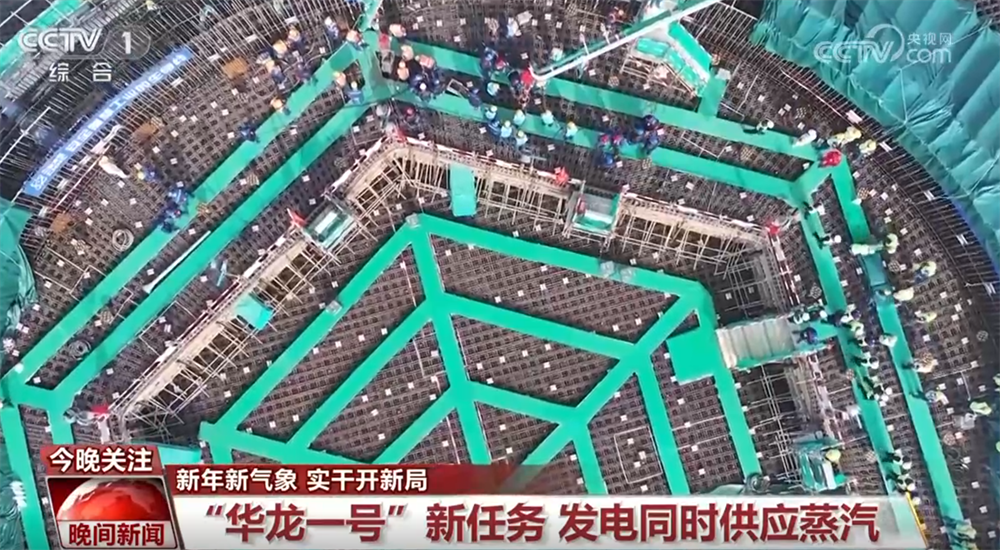
Group 1 - The "Hualong One" project in Jiangsu Lianyungang has entered the main construction phase, marking a significant step in nuclear energy development, combining pressurized water reactors with high-temperature gas-cooled reactors [3] - The first phase of the project is expected to supply 32.5 million tons of industrial steam and generate over 11.5 billion kilowatt-hours of electricity annually, reducing carbon dioxide emissions by 19.6 million tons [3] - This project aims to support the large-scale supply of high-quality low-carbon industrial steam to the trillion-level petrochemical industry base in Lianyungang, promoting a transition in China's nuclear energy from primarily electricity generation to diversified supply [3] Group 2 - The successful launch of the "Vesta-1" sea-launched remote rocket occurred on January 16, with the Tianqi constellation's 06 group of satellites successfully entering their designated orbit [5] - This mission marks the 23rd flight of the Vesta-1 launch vehicle, demonstrating advancements in China's satellite launch capabilities [5]
2026年民营商业航天首飞
21世纪经济报道· 2026-01-16 10:14
Core Viewpoint - The successful launch of the "Tianqi Constellation" satellites marks a significant milestone for China's private space industry in 2026, showcasing advancements in satellite technology and commercial applications in various sectors [1][3]. Group 1: Launch Details - On January 16, 2026, the Xinghe Power Aerospace Company successfully launched four satellites into orbit using the "Gushenxing-1" sea-launched rocket, marking the first commercial space launch of the year in China [1]. - This launch was the 23rd flight of the Gushenxing-1 rocket, which has maintained a 100% success rate across six sea launch missions since its debut in September 2023 [3]. Group 2: Satellite Applications - The satellites belong to the "Tianqi Constellation," operated by Beijing Guodian Gaoke Technology Co., which is China's first low-orbit IoT communication constellation, already deployed in various B-end digital scenarios such as forestry and emergency communication [3][4]. - The recent launch enhances the constellation's capabilities, addressing urgent needs for regional coverage in key application areas, thereby improving service efficiency [3][4]. Group 3: Industry Trends - The satellite IoT sector is emerging as a rapidly monetizing segment within commercial space, with low-orbit IoT satellites offering advantages such as low power consumption, cost-effectiveness, and compact terminal sizes, making them suitable for logistics tracking and outdoor emergency communication [3].

记者手记:从一枚海射火箭 看传统工业大省“入局”商业航天
Xin Hua She· 2026-01-16 09:38
Group 1 - The successful launch of the Gushenxing-1 sea-launched rocket marks a significant milestone in the normalization of sea-based rocket launches in Shandong, with 22 successful missions to date, delivering 137 satellites into orbit [1] - The establishment of the Dongfang Spaceport has led to the development of 32 aerospace projects, enabling an annual production capacity of 50 solid rockets and providing comprehensive support for sea launch operations [1] - The commercial space industry in Shandong is expected to grow significantly, leveraging the province's strong industrial foundation and aiming for a production capacity of 100 rockets and 150 commercial satellites by 2027, with an industry scale target of 50 billion yuan [3] Group 2 - The commercial space industry in Shandong is entering a new phase of large-scale application, supported by a robust industrial system that includes manufacturing and technology [2] - Companies in the first tier of the commercial space sector are positioned for explosive growth, with opportunities for transformation and collaboration across the industry [2] - Local governments are focusing on different aspects of the commercial space industry, such as rocket manufacturing in Yantai and satellite research in Jinan, reflecting a commitment to transitioning to future industries [3]

记者手记:从一枚海射火箭,看传统工业大省“入局”商业航天
Xin Hua She· 2026-01-16 09:19
Core Viewpoint - The successful launch of the Gushenxing-1 sea-launched rocket marks a significant milestone in China's commercial space industry, indicating a shift towards regularized sea-based rocket launches and the establishment of a robust aerospace industry in Shandong province [1][3]. Group 1: Launch Success and Technological Advancements - On January 16, 2023, the Gushenxing-1 sea-launched rocket successfully deployed the Tianqi constellation 06 satellites into their designated orbits, achieving a successful flight test [1][3]. - The successful launch is part of a broader trend towards regular sea-based rocket launches, with Shandong province emerging as a key player in this domain [3]. Group 2: Development of Aerospace Industry in Shandong - Since the first sea launch in June 2019, Shandong has developed the Dongfang Spaceport, which has facilitated the establishment of 32 aerospace projects and a production capacity of 50 solid rockets annually [3][5]. - The Dongfang Spaceport provides comprehensive services for rocket assembly, testing, and launching, supporting the regularization of sea launches with 22 successful missions to date, deploying 137 satellites into space [3][5]. Group 3: Future Prospects and Industry Growth - Shandong aims to form a complete aerospace industry chain by 2027, targeting an annual production capacity of 100 rockets and 150 commercial satellites, with an industry scale reaching 50 billion yuan [6]. - The province's strong industrial foundation positions it well for continued growth in the commercial space sector, with various local companies focusing on different aspects of aerospace, such as rocket manufacturing and satellite development [5][6].
谷神星一号海射型遥七运载火箭发射成功!两融标的卫星产业ETF(159218)涨超3%,中科星图发力领涨
Sou Hu Cai Jing· 2026-01-16 01:57
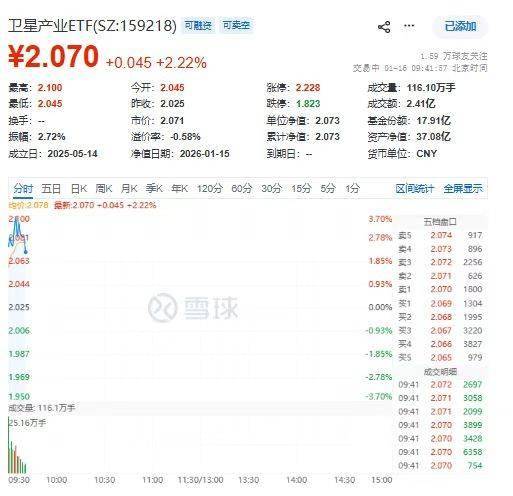
Group 1 - The satellite industry ETF (159218) has seen a significant increase, rising by 3.01% as of 9:36 AM, with leading stocks including Zhongke Xingtong, Zhenlei Technology, and Xinke Mobile-U showing notable gains [1][3] - The ETF is the first in the market to double its returns and tracks the CSI Satellite Industry Index, covering upstream and downstream companies involved in satellite manufacturing, launching, and navigation communication applications [3] - The successful launch of the Tianqi constellation's sixth satellite by the Taiyuan Satellite Launch Center marks a significant milestone in China's satellite communication business, indicating a new phase of large-scale application and ecological collaboration in the satellite IoT industry [2][3] Group 2 - The rise in the satellite industry ETF reflects market sentiment and a consensus on the golden development period for China's commercial aerospace industry, suggesting that the sector will continue to attract long-term investment [3]

海上一箭四星 中国成功发射天启星座06组卫星
Zhong Guo Xin Wen Wang· 2026-01-16 01:28
Core Viewpoint - China successfully launched the Tianqi constellation's 06 group of satellites using the Ceres-1 sea-launched rocket, marking a significant achievement in satellite deployment for global IoT communication services [1][2]. Group 1: Launch Details - The Ceres-1 sea-launched rocket successfully lifted off at 4:10 AM Beijing time on January 16, delivering four satellites into their designated orbits [1][3]. - This mission represents the seventh launch of the Tianqi constellation by the Ceres series of rockets, contributing to the enhancement of the constellation's capabilities [2]. Group 2: Tianqi Constellation Overview - The Tianqi constellation is designed for low Earth orbit IoT communication, characterized by global coverage, miniaturization, low power consumption, and cost-effectiveness [2]. - It provides satellite IoT data services across various sectors, including forestry, agriculture, emergency response, tourism, water management, electricity, oil, marine, ecology, and smart cities, and is expanding into direct satellite markets for automotive, handheld devices, and wearables [2]. Group 3: Rocket and Company Achievements - The Ceres-1 rocket has completed its 23rd flight, with the manufacturing company, Galaxy Power, successfully conducting 21 commercial launches, delivering a total of 89 commercial satellites into their intended orbits [2].
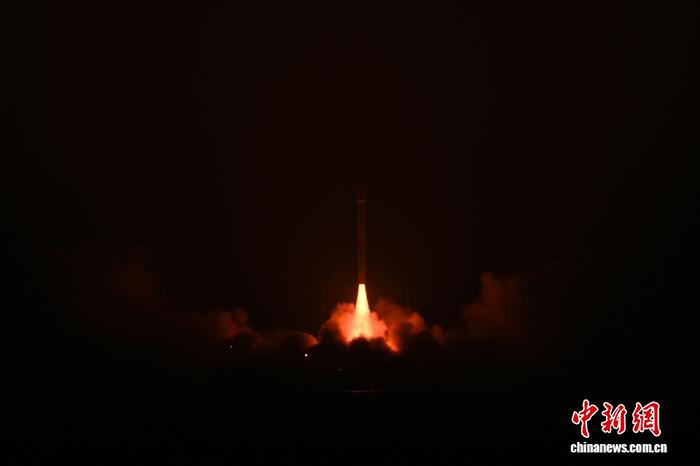
谷神星一号海射型遥七运载火箭发射成功
财联社· 2026-01-16 00:49
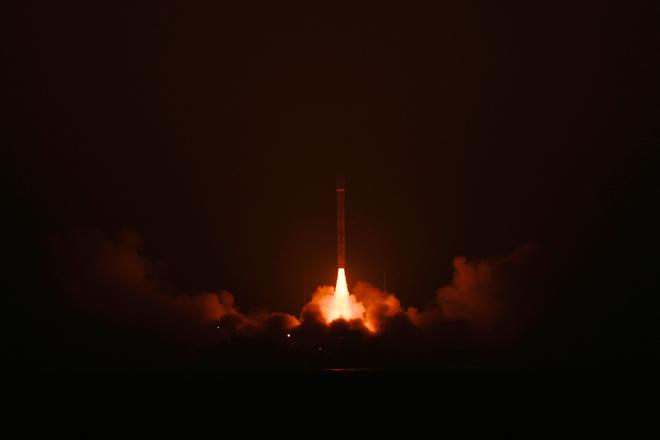
Core Viewpoint - The successful launch of the Vesta-1 sea-launched remote rocket marks a significant achievement in China's satellite deployment capabilities, enhancing the country's position in the aerospace industry [1][2]. Group 1 - The launch took place at the Taiyuan Satellite Launch Center, successfully placing the Tianqi constellation's 06 group of satellites into the designated orbit [1]. - This mission represents the 23rd flight of the Vesta-1 launch vehicle, indicating its reliability and operational experience in the field [2].

工信部协调频轨资源 助力天启星座4颗卫星成功发射
Zheng Quan Shi Bao Wang· 2026-01-16 00:29
Core Viewpoint - The successful launch of four satellites by Beijing Guodian Gaoke Technology Co., Ltd. marks a significant advancement in satellite-based IoT communication services for various industries in China [1] Group 1: Launch Details - The launch took place on January 16 at the Taiyuan Satellite Launch Center, utilizing the Ceres-1 sea-launched rocket [1] - The satellites, known as Tianqi Constellation 37 to 40, were successfully placed into their designated orbits [1] Group 2: Satellite Functions - The satellites are equipped with VHF/UHF frequency band IoT communication experiments and X-band measurement and control data transmission payloads [1] - Their primary function is to facilitate IoT communication trials, providing data collection and transmission services for industries such as agriculture, forestry, electricity, and water conservancy [1] Group 3: Regulatory Support - The Ministry of Industry and Information Technology played a crucial role by completing domestic frequency coordination and issuing space radio station licenses and frequency usage permits [1] - This regulatory support has been instrumental in the successful implementation of the Tianqi Constellation satellite project [1]