天启星座

Search documents
安徽合肥:从“应用”出发托举商业航天梦
Ke Ji Ri Bao· 2026-02-27 00:56
Core Insights - Hefei has emerged as a significant player in the commercial aerospace sector, focusing on practical applications rather than traditional rocket manufacturing, which has led to a robust industry ecosystem over three years [2][6]. Group 1: Industry Development - Hefei's commercial aerospace industry began with only 30-40 related companies three years ago, lacking foundational resources compared to traditional aerospace hubs like Beijing and Shanghai [2]. - The city has strategically chosen to focus on downstream applications such as remote sensing data for land monitoring, environmental supervision, and disaster response, which provide stable cash flow for data service companies [2][6]. - By 2025, the number of aerospace-related companies in Hefei has grown to 165, with the industry scale surpassing 100 billion yuan [6]. Group 2: Government and Capital Collaboration - Hefei's government has actively supported the industry by establishing a dedicated industrial chain promotion group and providing rich urban scenarios for testing and application [3][4]. - A market-oriented fund focused on commercial aerospace was established in 2024, with a scale of 1.3 billion yuan, reflecting a collaborative approach between Hefei's government and capital [4]. - The city has attracted companies like Xinghuo Space, which specializes in liquid small rockets, further enhancing its aerospace ecosystem [5]. Group 3: Future Vision - Hefei aims to create a "giant constellation" system by integrating existing satellite resources to address the challenges of small and scattered low-orbit constellations, thereby establishing a comprehensive space-based information network [6].
银行“上星”拓展金融服务新空间
Jing Ji Ri Bao· 2026-02-01 22:01
Core Viewpoint - The successful launch of satellites by major Chinese banks marks a significant step in enhancing their financial services through advanced technology, particularly in risk management and data communication capabilities [1][2][3]. Group 1: Satellite Launches and Technology - China Merchants Bank launched the "Zhaoyin Jinkui" satellite, while Shanghai Pudong Development Bank launched the "Puyin Shuzhi" satellite, contributing to the formation of a low-orbit satellite communication matrix [1][2]. - The satellites are part of the "Tianqi Constellation," which aims to provide integrated IoT data communication services globally, enhancing capabilities in various sectors such as energy and agriculture [2]. Group 2: Risk Management and Financial Services - Satellite technology enhances banks' risk management capabilities by providing reliable financial information, thus addressing issues of information asymmetry [3]. - China Merchants Bank's self-developed risk management system utilizes high-resolution satellite imagery to monitor construction progress with over 95% accuracy, improving traditional post-loan inspection efficiency [3]. Group 3: Applications in Financial Services - Satellite technology can expand the coverage and precision of financial services, particularly in supply chain finance, rural finance, and green finance [4]. - Ping An Bank uses IoT devices monitored by satellites to track dairy cattle, addressing collateral issues and improving post-loan management [4]. Group 4: Resilience and Stability in Financial Infrastructure - Satellite communication technology helps banks maintain operations during ground communication disruptions, enhancing the resilience of financial infrastructure [5]. - China Merchants Bank is testing low-orbit satellite communication for disaster recovery systems, ensuring critical financial services can be quickly restored in extreme scenarios [5]. Group 5: Digital Transformation and Industry Impact - The satellite launches reflect the deepening digital transformation of the banking sector, enhancing communication systems and supporting the commercial satellite industry [6]. - Participation in the aerospace industry allows banks to improve their financial service capabilities in strategic areas while creating technological barriers [7]. Group 6: Challenges and Future Trends - While satellite technology offers unique advantages, it may lead to data monopolies and compliance risks, necessitating clear legal frameworks [7]. - The trend may result in a tiered ecosystem where major banks develop their satellite constellations, while smaller banks rely on data procurement from third-party services [7].



商业航天“大年”已至,合肥如何下出先手棋?
AI研究所· 2026-01-30 11:01
Core Viewpoint - The article emphasizes the rapid development of commercial aerospace in China, particularly highlighting Hefei's strategic positioning and growth in the sector, which is expected to reach a scale of over 400 billion yuan by 2027 [6][16]. Group 1: Hefei's Development in Commercial Aerospace - Hefei has emerged as a benchmark city for commercial aerospace development in China, leveraging its unique industrial positioning and flexible ecosystem [3][4]. - The city has adopted a "dislocated competition" strategy, focusing on high-value segments like satellite data applications and in-orbit services, avoiding direct competition with traditional aerospace hubs like Beijing and Shanghai [5][6]. - By 2025, Hefei's aerospace industry is projected to exceed 100 billion yuan, with a significant increase in the number of enterprises to 165 [7][16]. Group 2: Key Players and Investments - The rise of Hefei's commercial aerospace sector is supported by leading companies and continuous capital investment, such as the listing of China Science and Technology's subsidiary on the Beijing Stock Exchange [6][7]. - Hefei has seen significant financing activities, including a 50 million yuan angel round for Anhui Xian Dao Ji Xing Technology Co., focusing on advanced semiconductor devices [6][7]. - The city has established a comprehensive industrial ecosystem covering satellite applications, operations, and manufacturing, with major projects like the "Giant Constellation Plan" underway [14][16]. Group 3: Policy Support and Future Outlook - Hefei's rapid growth is bolstered by supportive policies, including substantial subsidies for new rocket and satellite development [15][16]. - The city aims to create an international leading commercial aerospace innovation hub by 2027, with a target of over 300 enterprises [16]. - The competitive landscape of commercial aerospace is intensifying across various cities in China, driven by policy incentives and the strategic importance of the industry [18][19].


北京基础研究投入占比达国际领先水平
Xin Lang Cai Jing· 2026-01-26 00:26
Core Insights - Beijing has made significant progress in establishing itself as an international technology innovation center, with a focus on innovation-driven development and enhancing its global scientific influence [1] Group 1: Innovation and Research Development - Beijing has ranked first globally for nine consecutive years in the "Nature Index - Research Cities" and third in the "International Technology Innovation Center Index" for four years, with the scientific center index ranking first for the first time [2] - By the end of 2025, Beijing is expected to have 145 national key laboratories and 10 new research institutions in cutting-edge fields such as quantum information and brain science [2] - The city has implemented 24 reform measures in Zhongguancun and established special support policies for foreign-funded R&D centers, with 332 foreign-funded R&D centers recognized by the end of 2025 [2] Group 2: Investment and Financial Support - Beijing's municipal investment funds have supported 290 projects with a total investment of 25.68 billion yuan, leveraging an additional 129 billion yuan in social investment [3] - The number of investment events in Beijing increased by 36.9% year-on-year, with early-stage investment events growing by 60.2% [3] Group 3: R&D Funding and Breakthroughs - Research and development funding in Beijing has steadily increased, maintaining an intensity of around 6%, with basic research funding accounting for 16% [4] - Major enterprises in Beijing reported R&D expenses of 369.67 billion yuan in the first 11 months of 2025, a year-on-year increase of 7.1% [4] - Significant breakthroughs have been achieved in key areas such as new-generation information technology and medical health, with Beijing leading in the number of approved innovative medical devices [4] Group 4: Economic Performance and Technology Transfer - In the first 11 months of 2025, high-tech manufacturing and service industries in Beijing generated revenues of 871.3 billion yuan and 4.1 trillion yuan, respectively, with year-on-year growth of 11.5% and 12.5% [5] - The Zhongguancun Demonstration Zone reported a total revenue of 9 trillion yuan, with technology revenue growing by 13.1% [5] Group 5: Collaborative Development - The "Three Cities and One District" initiative has contributed over 40% of the city's revenue and over 60% of R&D expenses, despite accounting for less than 30% of the total number of units [6] - The next phase will focus on accelerating the construction of the Beijing-Tianjin-Hebei International Technology Innovation Center and enhancing the strategic technological capabilities of enterprises [6]
银行探路“航天+”: 一本成本账 一盘生态棋
Zhong Guo Zheng Quan Bao· 2026-01-22 21:51
Core Insights - The article discusses the increasing involvement of commercial banks in the "finance + aerospace" integration, highlighting the significant financial investments required for satellite development, launch, and operation [1] Group 1: Satellite Launches and Applications - Several banks, including China Merchants Bank and Pudong Development Bank, successfully launched satellites, namely "Zhaoyin Jinkui" and "Puyin Shuzhi," which are part of China's first low-orbit satellite IoT constellation, "Tianqi Constellation" [1] - Pudong Development Bank aims to leverage its communication service expertise to innovate applications in financial asset lifecycle management and cross-border asset and trade supervision using the satellite data capabilities [1] Group 2: Technological Integration in Banking - China Merchants Bank has integrated remote sensing satellite technology into its financial risk control system, enhancing efficiency in post-loan monitoring of real estate projects across the country [3] - The bank has initiated the application verification of low-orbit satellite communication technology in its financial disaster recovery systems, establishing a technical foundation for a comprehensive financial emergency communication network [3] Group 3: Value Proposition and Investment Returns - The technology is expected to address three core pain points in traditional banking risk control: remote monitoring of collateral and project progress, application in agricultural finance to reduce data collection costs and loan default risks, and obtaining independent data from space to mitigate information asymmetry [4] - Investment returns from satellite systems are characterized by low initial returns, stable mid-term returns, and increasing long-term value as applications expand into green finance, cross-border finance, and disaster recovery [4] - Differentiated strategies are emerging, with large banks building their satellite systems to control data and create technological barriers, while smaller banks are opting for data service procurement or third-party platform integration for practical participation [4]
多家银行扎堆发卫星上天
2 1 Shi Ji Jing Ji Bao Dao· 2026-01-21 11:25
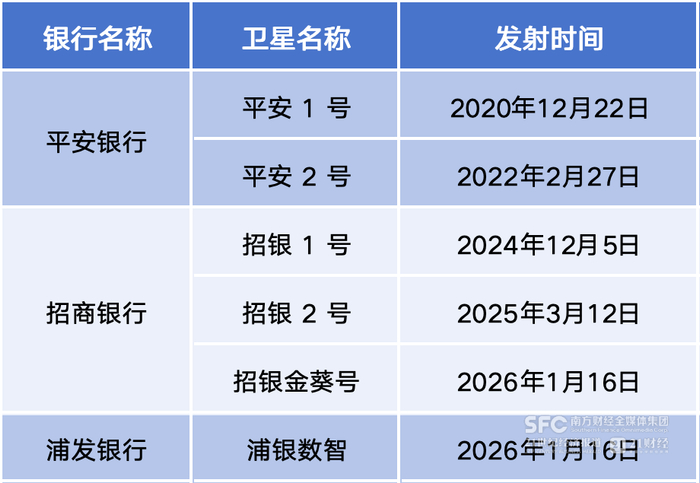
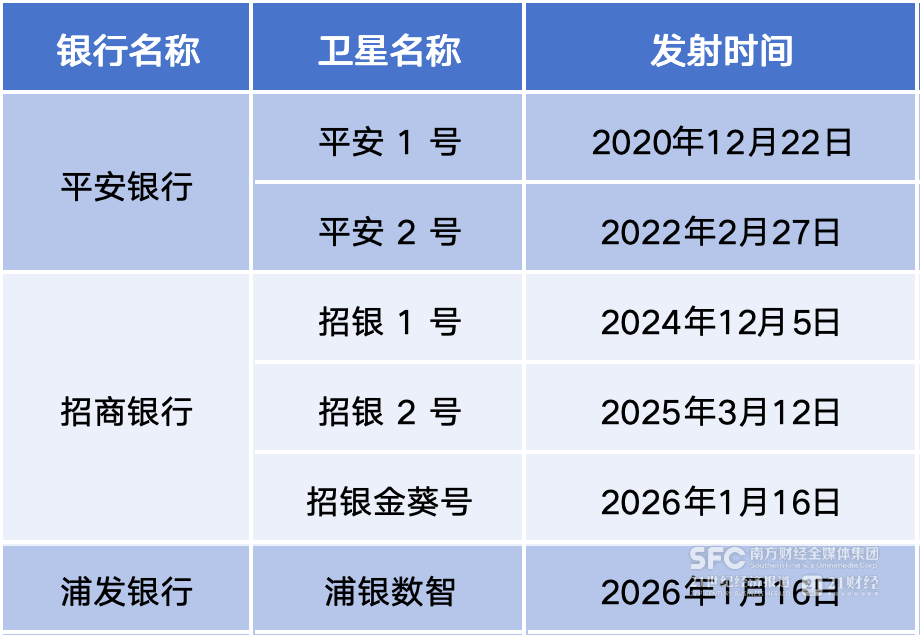
Core Viewpoint - The recent successful launch of satellites by major banks in China, including China Merchants Bank and Shanghai Pudong Development Bank, signifies a strategic shift towards utilizing satellite technology for enhancing financial services and risk management in the banking sector [1][2][5]. Group 1: Satellite Launches and Developments - China Merchants Bank launched the "Zhaoyin Jinkui" satellite on January 16, 2026, as part of the "Tianqi Constellation," which aims to enhance global coverage and communication capabilities [1][5]. - Shanghai Pudong Development Bank's "Puyin Shuzhi" satellite was also launched on the same day, contributing to the "Tianqi Constellation" [5]. - Previous satellite launches by Ping An Bank include "Ping An 1" in December 2020 and "Ping An 2" in February 2022, indicating a growing trend among banks to invest in satellite technology [2][3]. Group 2: Business Logic Behind Satellite Investments - Banks are leveraging satellite technology for remote monitoring of collateral and project progress, significantly improving post-loan management efficiency and reducing credit risk [2][8]. - The ability to maintain business continuity during extreme scenarios, such as natural disasters, is enhanced through satellite communication technology [13]. - By participating in satellite launches, banks are aligning with national strategies and expanding their financial services to support the commercial space industry [14]. Group 3: Applications of Satellite Technology in Banking - Satellite technology allows for real-time monitoring of agricultural and industrial activities, addressing information asymmetry in lending [8][10]. - The integration of satellite data into risk management systems has improved the accuracy of monitoring construction projects, with a reported precision of over 95% in tracking project progress [9][11]. - The use of satellite technology in supply chain finance helps overcome challenges faced by small and medium enterprises, enabling better access to credit [10][12]. Group 4: Future Prospects and Innovations - The ongoing development of satellite technology is expected to further penetrate various banking operations, enhancing risk prevention capabilities in sectors like agriculture and logistics [14][15]. - Innovations such as the "Dashanque" system by WeBank utilize satellite imagery and AI to assess agricultural productivity, providing tailored credit solutions to farmers [15]. - The trend of banks investing in satellite technology reflects a broader commitment to technological innovation and improved service delivery in the financial sector [16].
多家银行扎堆发卫星上天
21世纪经济报道· 2026-01-21 11:06
Core Viewpoint - The article discusses the recent satellite launches by major Chinese banks, highlighting their strategic shift towards utilizing satellite technology for enhancing financial services and risk management [1][4]. Group 1: Satellite Launches and Their Purpose - Three major banks, China Merchants Bank, Shanghai Pudong Development Bank, and Ping An Bank, have successfully launched satellites as part of their strategic initiatives to integrate satellite technology into their operations [4][5]. - The "Zhaoyin Jinqi" satellite launched by China Merchants Bank is designed to enhance global communication capabilities and improve data transmission efficiency, forming a comprehensive low-orbit satellite communication matrix [4][6]. - The "Puyin Shuzhi" satellite, launched simultaneously, is part of the "Tianqi Constellation" and aims to improve the performance and revisit time of the satellite network [4][6]. Group 2: Business Logic Behind Satellite Utilization - Banks are leveraging satellite technology for remote monitoring of collateral and project progress, significantly enhancing post-loan management efficiency and reducing credit risk [7][8]. - The use of satellite technology allows banks to gather unique spatial data, which can transform risk control and business models, addressing issues of information asymmetry in lending [7][9]. - For instance, China Merchants Bank has integrated remote sensing technology into its risk management system, achieving over 95% accuracy in monitoring construction progress of mortgage properties [8][9]. Group 3: Applications in Extreme Scenarios - In extreme scenarios such as natural disasters, satellite communication technology provides a solution to maintain business continuity when ground communication networks fail [12][13]. - China Merchants Bank has tested low-orbit satellite links for disaster recovery, establishing a foundation for an integrated emergency communication network [12][13]. Group 4: Supporting National Strategy and Commercial Space Industry - By participating in satellite launches, banks are aligning with national strategies and expanding financial services to support the commercial space industry [13][14]. - The banks are developing various services and products tailored to the needs of the commercial space sector, such as satellite leasing and financing solutions [14]. Group 5: Broader Industry Impact - The trend of banks utilizing satellite technology is expanding beyond a few players, with other banks also exploring applications in agriculture, environmental monitoring, and supply chain finance [14]. - Innovations such as satellite remote sensing applications are being adopted to enhance risk management and service delivery in various sectors, indicating a shift towards integrating advanced technologies in traditional banking practices [14].

尾焰划破夜空 金融机构为何爱上“发卫星”
2 1 Shi Ji Jing Ji Bao Dao· 2026-01-21 08:05
Core Viewpoint - The recent successful launch of satellites by major banks in China, including China Merchants Bank and Shanghai Pudong Development Bank, signifies a strategic shift towards utilizing satellite technology for enhancing financial services and risk management in the banking sector [1][2][3]. Group 1: Satellite Launches and Their Purpose - China Merchants Bank and Shanghai Pudong Development Bank have joined Ping An Bank in launching satellites, indicating a trend among banks to leverage space technology for business needs [2][4]. - The satellites are part of the "Tianqi Constellation," which aims to provide global coverage and enhance communication capabilities, thereby improving data transmission and supporting more devices [4][5]. - The "Zhaoyin Jinkui" satellite launched by China Merchants Bank is designed to enhance the density of the satellite constellation and reduce revisit intervals, which will significantly improve global communication capabilities [4][5]. Group 2: Business and Risk Management Enhancements - Banks are utilizing remote sensing satellite technology for precise monitoring of collateral and project progress, which enhances post-loan management efficiency and reduces credit risk [3][7]. - The integration of satellite technology into financial risk control systems allows banks to monitor real-time data from various sectors, addressing information asymmetry in lending [7][8]. - For instance, China Merchants Bank has implemented a high-precision construction monitoring system for mortgage projects, achieving over 95% accuracy in monitoring construction progress [8]. Group 3: Applications in Supply Chain and Disaster Recovery - Satellite technology is crucial for expanding supply chain finance by providing timely and effective data transmission, especially in remote areas where traditional communication may fail [9][10]. - In extreme scenarios, such as natural disasters, satellite communication ensures business continuity for banks by maintaining service availability when ground networks are disrupted [11][12]. - The banks' involvement in satellite launches also aligns with national strategies, enabling them to support the commercial space industry while enhancing their service offerings [12][13]. Group 4: Broader Industry Implications - The trend of banks launching satellites is not limited to a few institutions; it is gradually permeating various banking operations, enhancing risk management capabilities across sectors like agriculture and logistics [13][14]. - The adoption of satellite remote sensing technology is becoming a standard practice in the banking industry, reflecting a shift towards innovative financial services that integrate advanced technologies [14].
“希望工程号”海射型火箭发射成功
Zhong Guo Qing Nian Bao· 2026-01-17 00:32
Group 1 - The successful launch of the "Hope Project" rocket represents an innovative practice of integrating aerospace technology with public welfare, embodying the idea that "a strong youth leads to a strong nation" [2] - The "Tianqi Constellation" is China's first low-orbit IoT communication satellite constellation, characterized by global coverage, miniaturization, low power consumption, and low cost, providing satellite IoT data services across various industries [2] - Since its first flight on September 5, 2023, the "Vesta I" sea-launch model has completed six successful sea launch missions, achieving a 100% success rate [2] Group 2 - The collaboration between the China Youth Development Foundation and Star River Power Aerospace is a response to the national strategy of strengthening technology and aerospace, aiming to foster public engagement in dreams and creativity [2] - Star River Power Aerospace, recognized as a national-level specialized and innovative "little giant" enterprise, has conducted 21 commercial launch deliveries, successfully placing a total of 89 satellites into their designated orbits [2]
2026年民营商业航天首飞
21世纪经济报道· 2026-01-16 10:14
Core Viewpoint - The successful launch of the "Tianqi Constellation" satellites marks a significant milestone for China's private space industry in 2026, showcasing advancements in satellite technology and commercial applications in various sectors [1][3]. Group 1: Launch Details - On January 16, 2026, the Xinghe Power Aerospace Company successfully launched four satellites into orbit using the "Gushenxing-1" sea-launched rocket, marking the first commercial space launch of the year in China [1]. - This launch was the 23rd flight of the Gushenxing-1 rocket, which has maintained a 100% success rate across six sea launch missions since its debut in September 2023 [3]. Group 2: Satellite Applications - The satellites belong to the "Tianqi Constellation," operated by Beijing Guodian Gaoke Technology Co., which is China's first low-orbit IoT communication constellation, already deployed in various B-end digital scenarios such as forestry and emergency communication [3][4]. - The recent launch enhances the constellation's capabilities, addressing urgent needs for regional coverage in key application areas, thereby improving service efficiency [3][4]. Group 3: Industry Trends - The satellite IoT sector is emerging as a rapidly monetizing segment within commercial space, with low-orbit IoT satellites offering advantages such as low power consumption, cost-effectiveness, and compact terminal sizes, making them suitable for logistics tracking and outdoor emergency communication [3].