
过桥贷款

Search documents
AI+信贷风险重挫银行板块 KBW银行指数ETF(KBE.US)创去年关税风波以来最大单日跌幅
Zhi Tong Cai Jing· 2026-02-27 23:38
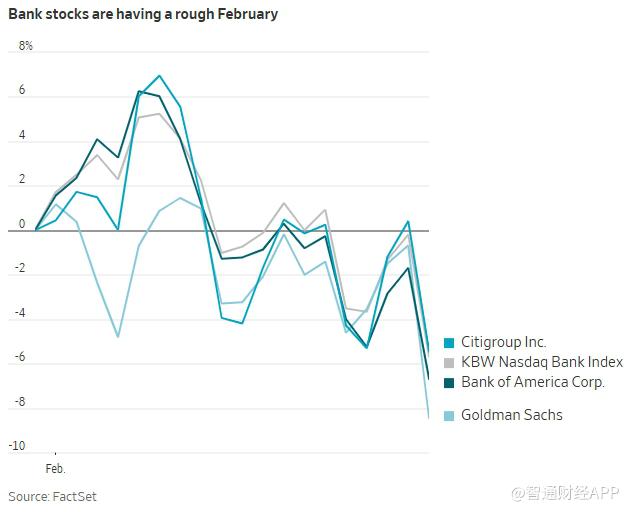
Group 1: Banking Sector Performance - The U.S. banking sector experienced a significant decline, with major banks and investment firms seeing substantial drops in stock prices, reflecting rising investor concerns about the economic outlook [1] - Bank of America (BAC.US) fell over 4%, Citigroup (C.US) and Wells Fargo (WFC.US) both dropped more than 5%, Morgan Stanley (MS.US) declined over 6%, Goldman Sachs (GS.US) fell more than 7%, and JPMorgan Chase (JPM.US) decreased by 1.9% [1] - The KBW Bank Index ETF (KBE.US) dropped 4.95%, marking the largest single-day decline since the tariff turmoil in April of the previous year, indicating that large banks are viewed as economic barometers [1] Group 2: Impact of AI and Credit Risks - Negative expectations surrounding artificial intelligence (AI) have continued to disrupt the market, with payment company Block (XYZ.US) announcing a 40% workforce reduction due to AI efficiency improvements, heightening fears of large-scale job losses [3] - The rise in credit risk has further impacted financial stocks, particularly consumer finance institutions like American Express (AXP.US), First Capital Credit (COF.US), and Synchrony Financial (SYF.US), which were among the biggest decliners [3] - Turmoil in the private credit sector has also caused investor unease, with redemption requests for related investment tools increasing after notable loan losses last year [3] Group 3: Market Sentiment and Future Outlook - Analysts suggest that the weakness in tech stocks and tightening credit conditions may undermine previously optimistic expectations for a recovery in the M&A and IPO markets [4] - Investor sentiment has shifted from optimism at the beginning of the year to facing previously unaccounted risk factors, leading to a spread of panic in the market [4]


信贷市场“蟑螂”阴影再现 MFS危机牵扯华尔街大行数亿敞口
Xin Lang Cai Jing· 2026-02-27 18:02
Core Viewpoint - Market Financial Solutions Ltd. (MFS) is accelerating towards bankruptcy, drawing parallels to previous financial crises and highlighting issues of fraud and risk management in the non-bank financial sector [1][2][3]. Company Overview - MFS, founded in 2006 and led by CEO Paresh Raja, specializes in complex property-backed loans and claims to provide short-term financing for real estate investments [3][9]. - The company once reported a peak loan book of £2.4 billion (approximately $3.24 billion) and had secured £1.3 billion in new institutional financing for 2024 [9]. Financial Issues - MFS is currently facing significant financial distress, with reports of "serious anomalies" and a "major gap" in collateral, leading to potential losses for large banks [2][4]. - The company is under scrutiny for allegedly engaging in "double pledging" of assets, which may have resulted in an unexplained gap of over 80% on approximately £1.2 billion in debt [10][5]. Stakeholder Exposure - Major financial institutions are exposed to MFS, with Barclays having approximately £600 million tied to the company, Atlas SP Partners around £400 million, and Jefferies about £100 million [4][9]. - TPG has a smaller exposure of £44 million, representing less than 2% of MFS's loan exposure [4]. Market Reactions - The financial market has reacted negatively, with Jefferies' stock dropping by 9.8%, Apollo by 4.7%, and Barclays by up to 3.8% following the news of MFS's troubles [12]. - Concerns about the overall credit market have been raised, with comparisons made to pre-2008 financial crisis conditions [3][12]. Industry Context - The incident has sparked discussions about fraud prevention in the financial sector, indicating potential weaknesses in identifying fraudulent activities despite recent efforts [2][8]. - The current situation has led to a broader debate about the stability of private credit markets, with some industry leaders warning of impending risks [6][12].
坏账压顶,Apollo私募信贷基金被迫下调估值
Hua Er Jie Jian Wen· 2026-02-27 13:14
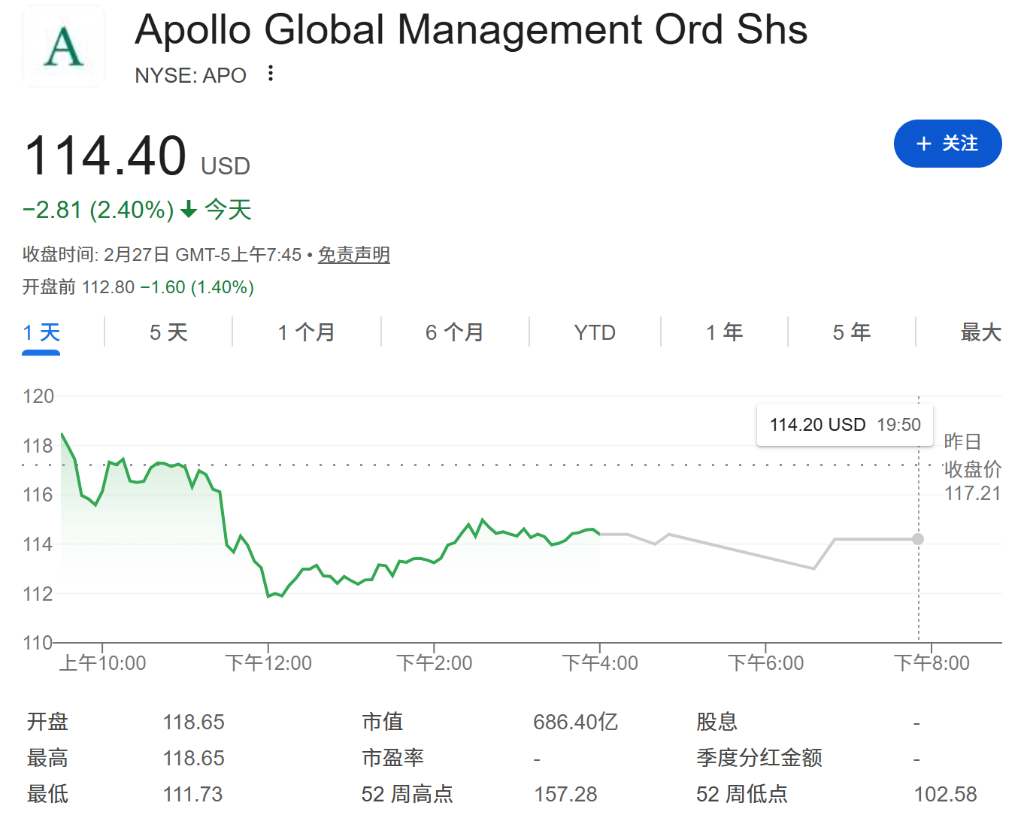
Core Viewpoint - The credit market is experiencing rising default risks, highlighted by the recent collapse of the UK non-bank financial institution Market Financial Solutions (MFS), which has led to significant valuation adjustments and dividend cuts by private credit firms like Apollo Global Management [1][10]. Group 1: Market Reactions - The collapse of MFS has triggered a chain reaction in the capital markets, causing stock prices of related financial institutions to plummet, with Jefferies Financial Group down nearly 9.8% and Apollo's stock declining by 4.7% [1]. - Barclays and Santander also saw their stock prices drop by 3.8% and 1.7%, respectively, following the news of MFS's bankruptcy [1]. Group 2: Details of MFS Collapse - MFS, established in 2006, specialized in complex, real estate-backed loans and had a peak loan volume of £2.4 billion [11]. - The company is facing serious allegations of fraud, including double pledging of assets and misappropriation of funds, which led to its rapid decline [12]. - Barclays has approximately £600 million linked to MFS, while Apollo's risk exposure is around £400 million, and Jefferies' exposure is about £100 million [11]. Group 3: Broader Implications - The MFS incident is not isolated, as it mirrors issues faced by other companies like Tricolor Holdings and First Brands Group, raising concerns about asset write-downs among major banks [13]. - Financial leaders, including JPMorgan's CEO Jamie Dimon, have expressed concerns about similarities between the current market conditions and those preceding the 2008 financial crisis [13]. - The private credit sector is also feeling the strain, with firms like Blue Owl Capital halting redemptions in retail funds, leading to sell-offs in asset management stocks [14].
奈飞(NFLX.US)为世纪收购“储备弹药”:启动590亿美元银团贷款再融资,置换部分高成本过渡性贷款
智通财经网· 2025-12-22 13:44
Group 1 - Netflix has refinanced part of its $59 billion bridge loan using lower-cost, longer-term debt to strengthen its financial proposal for acquiring Warner Bros Discovery [1] - The refinancing includes a $5 billion revolving credit facility and two delayed-draw term loans of $10 billion each, leaving $34 billion in funds to be syndicated [1] - The acquisition deal values Warner Bros' production and streaming assets at $82.7 billion, amidst a competitive bidding war with Paramount Global [1] Group 2 - Despite having the support of Warner Bros' board, Netflix faces regulatory and political hurdles, with concerns raised by Senator Elizabeth Warren labeling the acquisition as an "antitrust nightmare" [2] - Bridge loans are typically used to fill immediate financing gaps and are replaced by more permanent, lower-cost debt shortly after [3] - Wells Fargo, BNP Paribas, and HSBC are among the banks providing unsecured bridge loans to Netflix, with the debt set to mature in phases [4] Group 3 - Netflix's ability to access cheaper financing channels has improved since upgrading to blue-chip status in 2023, moving away from reliance on junk bond markets [4] - The revolving credit facility is expected to mature in 2030 or three years after the transaction closes, while the delayed-draw term loans will mature in two and three years, respectively [4] - Netflix's debt is likely to be rated investment-grade due to its Moody's A3 and S&P A ratings [4]


企业到香港或美国IPO上市费用不够怎么办?
Sou Hu Cai Jing· 2025-10-20 11:35
Core Insights - The article discusses strategies for companies facing challenges with insufficient funds during the IPO process, particularly when seeking to list in Hong Kong or on NASDAQ Group 1: Funding Strategies - The primary strategy is to actively seek new funding [3] - Initiate a Pre-IPO financing round aimed at covering listing expenses and strengthening the balance sheet to enhance attractiveness during roadshows [4] - Potential investors include: - Existing shareholders (VC/PE) who may be willing to invest more to avoid IPO failure [5] - Strategic investors or hedge funds focused on Pre-IPO investments for short-term gains [5] - Industry partners who may invest for strategic alignment [5] - Arrange bridge loans, which are short-term, high-interest loans contingent on successful IPO issuance [6] - This approach relies on a strong confidence in the IPO's success [7] Group 2: Cost Optimization - Simultaneously optimizing and restructuring costs is crucial while raising IPO funds [8] - Communicate transparently with intermediaries (lawyers, auditors) to negotiate installment payments, easing cash flow pressure [9] - Streamline the IPO plan to improve efficiency: - Consider reducing the fundraising target to lower underwriting fees and facilitate completion [10] - Optimize the roadshow by focusing on key financial centers or increasing online presentations to save on travel and venue costs [10] - Focus on a concise prospectus to minimize unnecessary descriptions and reduce costs associated with revisions and translations [10] - Demonstrating strong crisis management, transparent communication, and clear strategic thinking can enhance respect from capital markets and increase problem-solving potential [11]

民生银行福州分行“画饼”续贷,919万过桥款打水漂!最高法终审判赔超千万本息
Xin Lang Cai Jing· 2025-07-14 23:59
Core Viewpoint - The case highlights the issue of fraudulent promises made by banks regarding loan renewals, leading to significant financial losses for individuals involved in bridge financing [1][10][12]. Summary by Sections Background of the Case - The case originated from a loan application by Xinwang Supermarket to Minsheng Bank's Fuzhou branch, where the actual controller Lin claimed a credit limit of 9.4 million yuan, secured by collective properties [3]. - Lin was later investigated for embezzlement, leading to the bank's lawsuit for loan recovery due to overdue payments [3][4]. Bridge Financing Arrangement - Lin sought bridge financing from Lin Mouhe, promising high interest rates and claiming the funds would be used for loan renewal [4]. - Lin Mouhe verified the renewal promise with the bank, where a bank employee assured that the loan would be renewed without re-approval [4][9]. Bank's Actions and Consequences - After Lin Mouhe transferred 15 million yuan, the bank deducted 9.44 million yuan for overdue loans but refused to renew the loan, citing collateral issues, resulting in Lin Mouhe losing 9.19 million yuan [4][10]. - The court found that the bank had engaged in fraudulent behavior by misleading Lin Mouhe about the loan renewal [10][12]. Legal Proceedings - The initial court ruling favored the bank, stating that Lin Mouhe lacked legal standing and that the bank had not committed fraud [8][10]. - The higher court later determined that the bank's actions constituted fraud, leading to a ruling that the bank must compensate Lin Mouhe for his losses [10][12][13]. Final Judgment - The Supreme Court ruled that Minsheng Bank's Fuzhou branch must compensate Lin Mouhe 9,192,394.01 yuan for the principal and an additional 2,413,884.25 yuan in interest from the date of the loan renewal promise until the judgment [12][13].
