重质含硫原油

Search documents
委内瑞拉原油或重返市场 加拿大油砂巨头面临价差走阔风险
Ge Long Hui A P P· 2026-01-05 13:52
Core Viewpoint - Morgan Stanley's analysis indicates that U.S. military actions and efforts to oust Maduro in Venezuela may be a negative factor for most oil producers, particularly those focused on Canadian oil sands [1] Group 1: Impact on Oil Market - Venezuela primarily produces heavy sour crude oil, which is similar in quality to Canadian heavy crude (WCS) [1] - Although Washington's aggressive stance has limited short-term supply impacts, a potential easing of sanctions on Venezuela could exacerbate the already oversupplied oil market [1] - This situation may lead to an expanded discount of WCS relative to U.S. West Texas Intermediate (WTI) crude [1] Group 2: Company-Specific Impacts - Empire Oil and Cenovus Energy are expected to be most affected by changes in the WCS-WTI price differential [1] - Suncor Energy and Canadian Natural Resources are considered to have stronger resilience against these risks [1]
抓总统、控石油!特朗普为何对委内瑞拉下狠手?
Guo Ji Jin Rong Bao· 2026-01-04 09:00
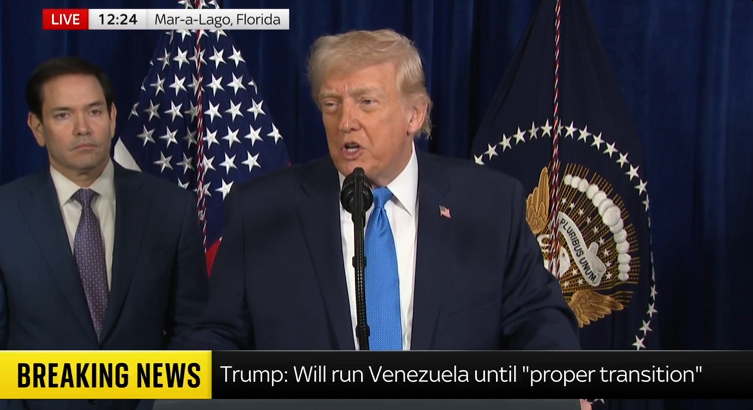
Core Viewpoint - The U.S. military action against Venezuela, including the capture of President Maduro, marks a significant escalation in U.S. foreign policy and reflects a shift towards a more aggressive stance in the region, particularly regarding Venezuela's oil resources [1][5][10]. Group 1: U.S. Military Action and Political Implications - The U.S. has initiated military action against Venezuela, leading to widespread condemnation from multiple countries, including China and Russia, which view it as a violation of international law and Venezuelan sovereignty [1][7]. - The U.S. government has characterized its actions as necessary for regional security and has indicated a willingness to escalate military involvement if deemed necessary [1][5]. - The Venezuelan government has declared a national emergency in response to the U.S. actions and has called for an urgent meeting of the United Nations Security Council to address the situation [7][11]. Group 2: Energy and Economic Interests - Venezuela possesses the largest proven oil reserves globally, estimated at approximately 300 billion barrels, which is about 17% of the world's total, making it a strategic target for U.S. interests [13][14]. - The U.S. aims to control Venezuela's oil resources, which are crucial for its refining industry, particularly for heavy crude oil that is essential for producing diesel and asphalt [14][15]. - The U.S. military actions are seen as a means to secure energy dominance and enhance U.S. energy security, while also potentially benefiting American oil companies through investments in Venezuela's oil infrastructure [13][16]. Group 3: Market Reactions and Oil Price Implications - The military actions are expected to create short-term volatility in the oil market, with potential price increases due to geopolitical risk premiums [18][19]. - Despite the immediate concerns, analysts suggest that Venezuela's current oil production levels are relatively low, and any supply disruptions may not significantly impact the global oil market in the long term [19][20]. - The future trajectory of oil prices will largely depend on the political stability in Venezuela and the ability of any new regime to restore oil production capacity [20][21].
委内瑞拉,一个世纪的资源争夺与宿命
Feng Huang Wang Cai Jing· 2026-01-04 07:02
Core Viewpoint - The military intervention by the U.S. in Venezuela is a culmination of over a century of conflict over oil resources, highlighting the strategic importance of Venezuela's vast oil reserves, which are the largest in the world [1][3][19]. Group 1: Oil Wealth and Historical Context - Venezuela has proven oil reserves of approximately 300 billion barrels, accounting for 17% of the global total, surpassing Saudi Arabia and the U.S. [3][5]. - The oil boom in the mid-20th century did not benefit the general population, leading to significant wealth disparity, with profits primarily flowing to international oil companies and a small elite [5]. - The "Bolivarian Revolution" initiated by Hugo Chávez in 1999 aimed to nationalize the oil industry, reclaiming resource sovereignty through reforms such as the Hydrocarbons Law of 2001, which mandated majority ownership by the state oil company PDVSA in joint ventures [5][7]. Group 2: U.S. Response and Geopolitical Tensions - U.S. interests were threatened by Venezuela's nationalization efforts, leading to sanctions and support for opposition movements, including a failed coup in 2002 [9][11]. - Following Chávez's death in 2013, Nicolás Maduro continued the nationalization policies, but U.S. relations deteriorated, especially after the 2018 elections, which the U.S. did not recognize [11][13]. - In 2025, the U.S. escalated its approach from economic sanctions to military threats, including a $50 million bounty on Maduro, reflecting the strategic importance of Venezuelan oil to U.S. interests [13][18]. Group 3: Impact on Global Oil Market - The military intervention is expected to disrupt Venezuela's oil exports, which have already plummeted from a peak of 3.5 million barrels per day to around 1 million barrels per day, representing only 0.8% of global production [13][19]. - Despite the geopolitical tensions, the global oil market is currently characterized by oversupply, with the International Energy Agency projecting a supply increase of 3 million barrels per day in 2025, which may mitigate the impact of Venezuela's supply disruption [20][22]. - The U.S. military control over Venezuelan oil resources could weaken OPEC+'s influence in the global oil market, potentially altering production coordination among oil-producing nations [22]. Group 4: Broader Economic Implications - The geopolitical turmoil is likely to create volatility in oil prices, with potential short-term spikes due to supply concerns, while long-term price pressures may remain limited due to existing supply surpluses [19][20]. - The military actions may also affect precious metals and shipping markets, with increased risk aversion likely driving up gold prices, which have already seen significant gains in 2025 [23][24]. - The situation may lead to increased logistics costs for energy and commodities due to military blockades, impacting supply chains and market dynamics [24].