金刚烷胺

Search documents
西湖大学2026年首篇Science:曹龙兴/解明岐团队从头设计小分子调控的蛋白寡聚体,给蛋白质装上“遥控开关”
生物世界· 2026-01-02 02:03
Core Viewpoint - The research presents a novel computational method for designing small molecule-regulated protein oligomers, expanding the toolkit for manipulating complex biological processes [2][3]. Group 1: Research Background and Significance - The study focuses on small molecule-regulated protein oligomerization technology, which allows for precise control of biological processes through spatial proximity of proteins [5]. - Despite over 30 years of development, the number of small molecule-responsive oligomerization systems remains limited, primarily restricted to dimerization, which constrains their application in biological processes requiring multiple protein components [5][6]. - There is a growing demand for more diverse small molecule-responsive protein oligomers in cell engineering and therapeutic development [5]. Group 2: Methodology and Innovations - The research introduces a new computational approach that starts from monomeric protein building blocks to design ligand-responsive oligomers, overcoming the limitations of dimerization [6]. - The method employs a "docking-while-binding" strategy to optimize both protein-protein and protein-ligand interactions during the docking process, enabling the creation of ligand binding pockets directly at the protein-protein interface [6]. - The team successfully designed homomeric trimers that respond to the FDA-approved drug amantadine, demonstrating enhanced response capabilities with the design of both single and dual ligand-binding homomeric trimers [6][10]. Group 3: Applications and Potential - Utilizing the inducibility and multivalency of these homomeric trimers, the research team developed transcription activation systems and reversible protein condensation systems, showcasing broad functional applications [7]. - The optimized systems achieved precise spatiotemporal control of protein localization and gene expression, highlighting their potential in biomedical applications [7][10]. - The use of amantadine, which has favorable oral bioavailability, allows for non-invasive, dose-dependent gene expression control in mouse models, emphasizing the system's strong potential for practical applications [7][10].


东北制药: 核心板块挑大梁 新板块开新局
Zhong Guo Zheng Quan Bao· 2025-12-23 21:50
Core Viewpoint - Northeast Pharmaceutical is focusing on market trends, leveraging its two core sales segments, raw materials and formulations, to achieve significant results and ensure stable performance for the company [1] Raw Material Segment - Northeast Pharmaceutical is a key global supplier of raw materials, enhancing its international market competitiveness, particularly in the EU and Japan/Korea, with market share increasing year by year [2] - The raw material sales company demonstrated strong market capabilities in Q4, with profits exceeding planned targets for two consecutive months in October and November, particularly in November [2] - Key products such as Vitamin C and L-Carnitine exceeded sales targets, while other products like Amantadine and Piracetam also performed well, enhancing the product matrix's competitiveness [2] - The company actively participated in major industry exhibitions to connect with core customer needs and adjust market strategies based on competitor insights [2][3] Formulation Segment - Northeast Pharmaceutical's formulation products rank first in domestic sales, contributing to economic benefits and enhancing brand recognition [4] - The formulation sales company is focusing on maintaining and expanding the market competitiveness of key products, with systematic planning for products like Gut Health and Pain Relief tablets [4] - Efficient execution and collaboration among teams have led to achieving monthly performance targets, providing confidence for year-end goals [4][5] Expansion into New Fields - In Q4, Northeast Pharmaceutical made significant strides in the health sector by launching new products such as health biscuits and advancing the development of additional health-oriented snacks [6] - The company is exploring the beauty sector with functional skincare products, leveraging its pharmaceutical-grade standards in product development [6] - The company aims to optimize its health product matrix and explore comprehensive health services, creating new growth points [6]

东北制药:核心板块挑大梁 新板块开新局
Zhong Guo Zheng Quan Bao· 2025-12-23 20:18
Core Insights - The company is focusing on market trends, with its two core sales segments, raw materials and formulations, playing a significant role in stabilizing performance and achieving important results in market penetration [1][2] - The company is actively expanding in the health sector, launching new products that contribute to comprehensive health services, providing confidence and direction for future work [1][4] Raw Material Segment - The company is a key global supplier of raw materials, enhancing its international market competitiveness, particularly in the EU and Japan, with market share increasing year by year [1][2] - In Q4, the raw material sales company demonstrated strong market capabilities, exceeding profit targets in October and November, with notable performance in November [1][2] - Key products such as Vitamin C and L-Carnitine significantly outperformed sales targets, indicating a strengthening product matrix [1][2] Market Expansion and Management - The raw material sales company has actively participated in major industry exhibitions to engage with core customers and align market orders, while also monitoring industry trends and competitor dynamics [2] - Internal management has been enhanced, with a focus on accountability and improving business capabilities, leading to effective collaboration across departments [2] Formulation Segment - The company has several formulation products that rank first in domestic sales, contributing to economic benefits and enhancing brand recognition [3] - A systematic approach has been adopted to boost sales of key products, with effective execution leading to monthly performance improvements [3] New Product Development - In Q4, the company made significant strides in the health sector by launching new products such as health-oriented biscuits, while also developing additional products to meet diverse health needs [4] - The company is leveraging its experience in R&D and quality control to explore the health food sector, including functional skincare products that integrate pharmaceutical technology [4][5] Strategic Focus - The company aims to leverage its comprehensive advantages in innovation, resource allocation, and market positioning to optimize its health product matrix and explore new growth points in the health sector [5]
流感“K毒株”来势汹汹,疫苗还有用吗?
3 6 Ke· 2025-12-05 09:13
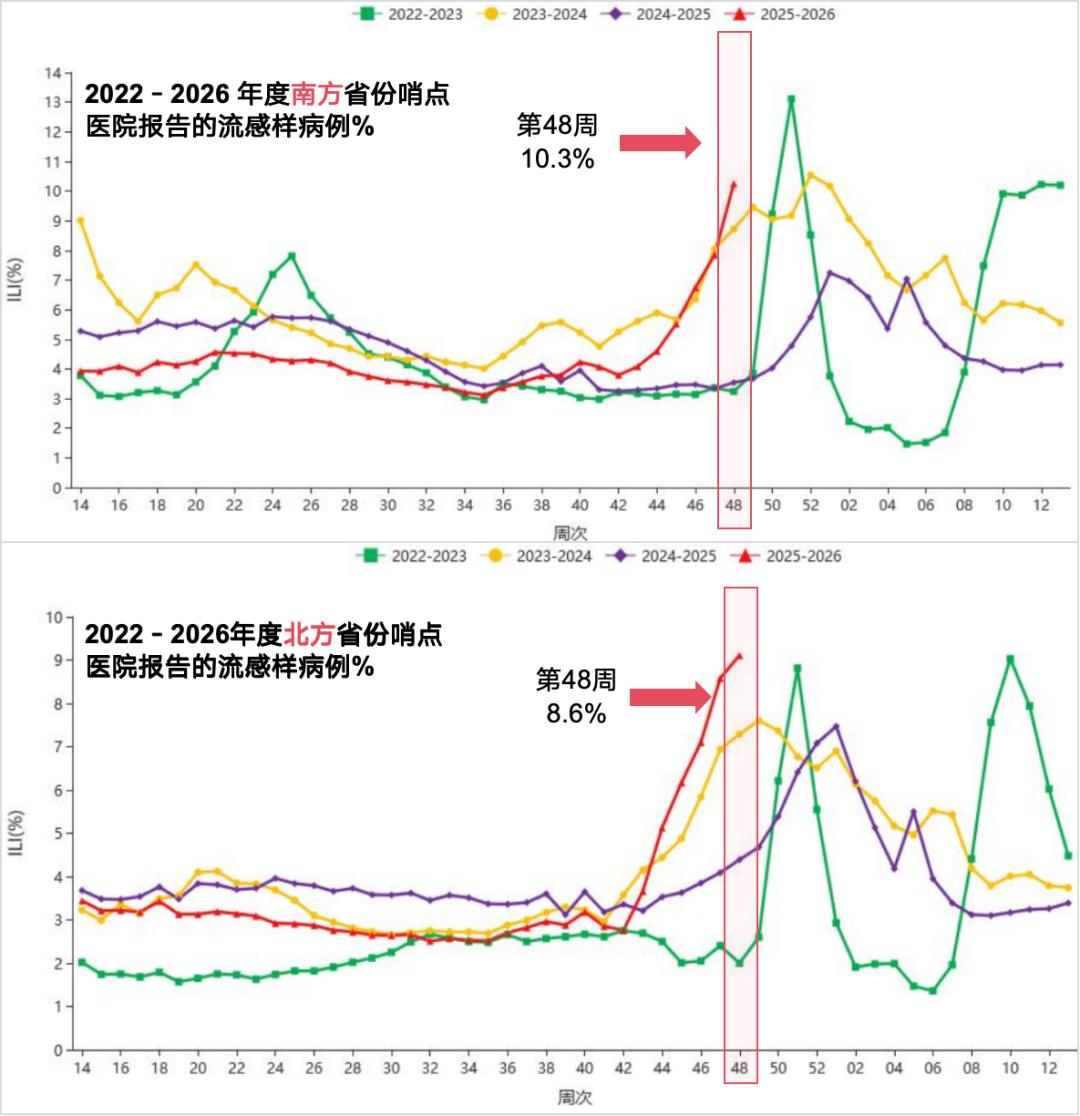
Core Insights - The flu season this year is notably more severe and earlier than in previous years, with a significant increase in flu-like cases reported [1][3][4]. Group 1: Flu Activity and Statistics - Flu-like cases in outpatient settings have been rising, with an expected peak around mid-December [1]. - In the 48th week of 2025, there were 1,541 reported outbreaks of flu-like cases, a stark increase from just 31 outbreaks in the same week of 2024, representing nearly a 50-fold increase [5]. - The proportion of flu virus detected in respiratory samples has surged to 51.1% in the 48th week of 2025, compared to only 7% in the same week of 2024 [7]. Group 2: Virus Strains and Resistance - The H3N2 strain accounts for over 99% of the flu cases, with reports of drug-resistant strains emerging [5][12]. - There is a notable increase in the sales of antiviral medications, with a reported over 500% increase in purchases of flu antiviral drugs in mid-November [10]. Group 3: Vaccination and Prevention - Vaccination remains an effective method to reduce flu risk, with various flu vaccines being safe and effective [5][16]. - Current seasonal flu vaccines are based on egg-cultured antigens and are categorized into inactivated vaccines and live attenuated vaccines, both of which are deemed safe for different populations [20][22]. - Despite concerns about the effectiveness of vaccines against the K subclade, existing vaccines still provide significant protection against flu-related complications, especially in children [31][32]. Group 4: Public Health Recommendations - Good hygiene practices, such as handwashing and wearing masks, are essential in preventing the spread of the flu [33]. - Individuals are encouraged to seek timely medical attention if flu-like symptoms appear, and to adhere to prescribed antiviral treatments [35][36].
普洛药业(000739.SZ):拥有奥司他韦、金刚烷胺、头孢系列等多种可用于治疗流感的药品
Ge Long Hui· 2025-11-04 07:22
Core Viewpoint - The company has a range of medications available for the treatment of influenza, including Oseltamivir, Amantadine, and a series of Cephalosporins [1] Company Summary - The company, Prolog Pharma (000739.SZ), has confirmed its possession of various antiviral drugs effective against influenza [1]

普洛药业:公司拥有奥司他韦、金刚烷胺、头孢系列等多种可用于治疗流感的药品
Mei Ri Jing Ji Xin Wen· 2025-11-04 03:46
Core Viewpoint - The company, Pro Pharmaceutical (000739.SZ), confirmed its production of various antiviral medications, including Oseltamivir, Amantadine, and a series of Cephalosporins, which are used for treating influenza, particularly in light of the recent outbreak of a new strain of influenza A [1] Company Summary - Pro Pharmaceutical has a portfolio that includes Oseltamivir, which is a well-known antiviral drug for influenza treatment [1] - The company also produces Amantadine and a range of Cephalosporin antibiotics, indicating a diverse product line in the antiviral and antibiotic sectors [1]
帕金森病:从个体困境到治疗困局的突围之路
Yang Shi Wang· 2025-07-25 05:25
Core Viewpoint - The article discusses the complexities and challenges associated with diagnosing and treating Parkinson's disease, highlighting the increasing prevalence due to aging populations and the limitations of current treatment options [2][6][11]. Diagnosis Challenges - Parkinson's disease diagnosis lacks a "gold standard," relying on clinical assessments rather than specific biomarkers [3][4]. - Key diagnostic criteria include the presence of at least two core motor symptoms, with the requirement of bradykinesia [3][4]. - Non-motor symptoms such as olfactory dysfunction and sleep disturbances can also aid in diagnosis, but early-stage symptoms may not be recognized [4][5]. Treatment Difficulties - Current treatment strategies emphasize a multidisciplinary approach, with medication as the primary method, but there is no "one-size-fits-all" prescription [6][7]. - The treatment landscape includes six major classes of drugs, with dosages tailored to individual patient needs [6][7]. - The phenomenon of "treatment window crisis" arises as the disease progresses, complicating medication management and leading to fluctuating symptoms [7][11]. New Drug Developments - New medications, such as the third-generation MAO-B inhibitor, have emerged, but challenges remain, including the persistent feeling of drug shortages and the inability of current treatments to halt neuronal death [11][12]. - The need for "disease-modifying therapies" that not only alleviate symptoms but also repair neurons and slow disease progression is emphasized as a critical area for future research [11].