
鑫元中证800红利低波动ETF

Search documents
中国神华股价涨5.13%,鑫元基金旗下1只基金重仓,持有21.38万股浮盈赚取46.39万元
Xin Lang Ji Jin· 2026-03-02 05:58
Group 1 - China Shenhua Energy Co., Ltd. saw a stock price increase of 5.13%, reaching 44.43 CNY per share, with a trading volume of 2.585 billion CNY and a turnover rate of 0.36%, resulting in a total market capitalization of 882.758 billion CNY [1] - The company, established on November 8, 2004, and listed on October 9, 2007, is primarily engaged in the production and sale of coal and electricity, as well as railway and port transportation, shipping, and coal-to-olefins business [1] - The revenue composition of the company is as follows: coal 75.23%, power generation 29.35%, railway 15.52%, port 2.51%, coal chemical 2.11%, shipping 1.19%, and undistributed projects 0.31% [1] Group 2 - Xinyuan Fund has one fund heavily invested in China Shenhua, specifically the Xinyuan CSI 800 Dividend Low Volatility ETF (563980), which held 213,800 shares in the fourth quarter, accounting for 1.76% of the fund's net value, making it the fourth-largest holding [2] - The Xinyuan CSI 800 Dividend Low Volatility ETF (563980) was established on October 24, 2025, with a current size of 493 million CNY and has generated a year-to-date return of 3.14%, ranking 3746 out of 5577 in its category, while it has an overall loss of 0.91% since inception [2] Group 3 - The fund managers of the Xinyuan CSI 800 Dividend Low Volatility ETF are Mo Zhigang and Liu Yutao, with Mo having a tenure of 7 years and 46 days, managing assets totaling 1.216 billion CNY, achieving a best return of 71.7% and a worst return of -50.4% during his tenure [3] - Liu Yutao has a tenure of 3 years and 165 days, managing assets of 3.573 billion CNY, with a best return of 52.95% and a worst return of -8.59% during his tenure [3]

鑫元基金旗下4只基金增聘莫志刚
Zhong Guo Jing Ji Wang· 2026-02-11 08:05
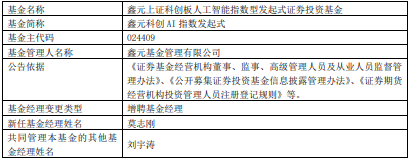
Core Viewpoint - Xin Yuan Fund announced the appointment of Mo Zhigang as a new fund manager for several of its funds, indicating a strategic move to enhance management expertise and potentially improve fund performance [1][3][4]. Fund Performance Summary - **Xin Yuan Sci-Tech AI Index Fund**: - Year-to-date return: 13.86% (A), 13.82% (C) - Since inception return: 27.98% (A), 27.79% (C) - Cumulative net value: 1.2798 (A), 1.2779 (C) [1] - **Xin Yuan CSI 800 Dividend Low Volatility ETF Link**: - Year-to-date return: 2.31% (A), 2.26% (C) - Since inception return: 5.56% (A), 5.06% (C) - Cumulative net value: 1.0556 (A), 1.0506 (C) [1] - **Xin Yuan CSI 800 Free Cash Flow Index**: - Year-to-date return: 6.25% (A), 6.21% (C) - Since inception return: 16.30% (A), 16.13% (C) - Cumulative net value: 1.1630 (A), 1.1613 (C) [2] - **Xin Yuan CSI 800 Dividend Low Volatility ETF**: - Year-to-date return: 2.70% - Since inception return: -1.34% - Cumulative net value: 0.9867 [2] Management Changes - Mo Zhigang has been appointed as a new fund manager for multiple funds, including the Xin Yuan Sci-Tech AI Index Fund and the Xin Yuan CSI 800 Dividend Low Volatility ETF Link, while Liu Yutao has been relieved from his duties as a fund manager for the latter [3][4].

年化超10%的中证800红利低波,真的很能打!
Sou Hu Cai Jing· 2025-12-04 10:27
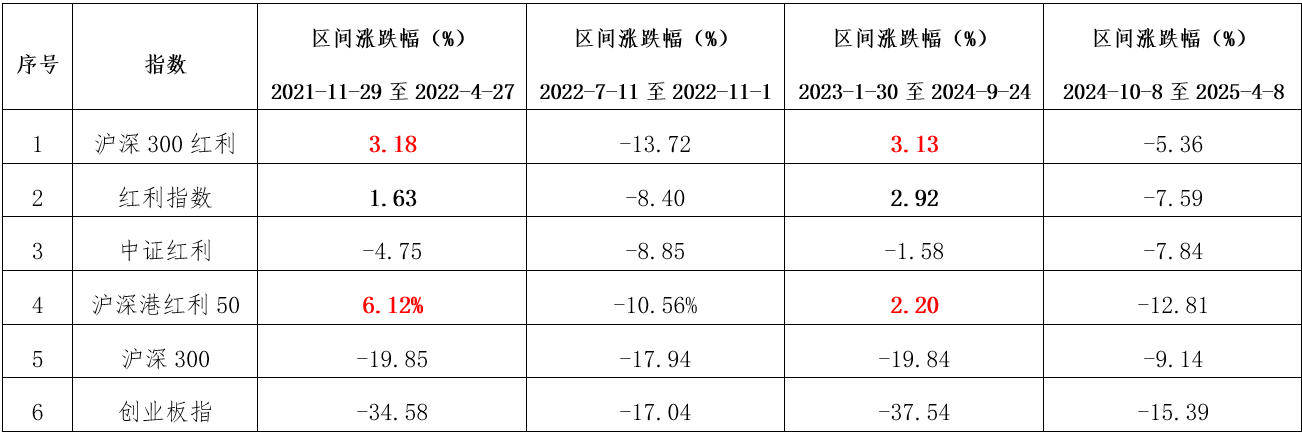
Core Viewpoint - Dividend assets are not only defensive but also exhibit strong offensive capabilities in the current slow bull market, as evidenced by significant index performance since September 24, 2024 [1][3]. Group 1: Performance of Dividend Assets - From September 24, 2024, to November 30, 2025, the Hang Seng and Shanghai-Hong Kong Dividend 50 Index increased by 35.67%, while the CSI 800 Dividend Low Volatility Index rose by 18.84% [1][3]. - Since the end of 2021, the main dividend indices have shown a smaller decline compared to the overall market during periods of significant market adjustments [2]. Group 2: Year-End Market Trends - Historical data indicates that the year-end market, particularly December, is favorable for dividend assets, with higher win rates compared to growth-oriented styles [4]. - Key sectors with high win rates in December include home appliances (approximately 80%), banks (about 65%), and oil and petrochemicals (around 60%) [4]. Group 3: Low Volatility Dividend Strategy - The combination of dividend and low volatility strategies enhances asset stability and investment experience, optimizing risk-return profiles [6]. - The CSI 800 Dividend Low Volatility Index employs a four-step screening process to ensure the selection of stable, high-dividend companies while minimizing exposure to high volatility stocks [6][7]. Group 4: Characteristics of CSI 800 Dividend Low Volatility Index - The CSI 800 Dividend Low Volatility Index has shown a 223% increase since its base date (December 31, 2013), outperforming the CSI 800 Index by 130% [8]. - The average dividend yield of the CSI 800 Dividend Low Volatility Index is 4.48%, with a three-year average yield of 5.39%, providing substantial cash flow in a low-interest-rate environment [8]. - The index has a nearly 91% annual win rate over the past eleven years, with ten years showing positive returns [8]. Group 5: Industry Distribution - The CSI 800 Dividend Low Volatility Index is primarily focused on bond-like dividends, with banks making up about 26.5% of the index, followed by utilities and transportation [9]. - This balanced industry distribution allows the index to maintain defensive characteristics while capturing growth opportunities from cyclical and consumer sectors [9]. Group 6: Investment Products - Xinyuan Fund has launched the Xinyuan CSI 800 Dividend Low Volatility ETF and its associated funds, providing convenient investment options that track the index closely [10]. - These products are suitable for various investor preferences, offering a combination of high dividend yields and low volatility characteristics to enhance investment safety [10].
12月轮到红利股上场?投哪些才能跟上行情?鑫元基金给你划重点
中国基金报· 2025-12-03 09:21
Core Viewpoint - The current market is in a "slowing slope, mean reversion" phase, making dividend low-volatility funds a worthy focus for foundational investment choices [4][7]. Market Analysis - The market at around 4000 points has a total market capitalization exceeding 100 trillion yuan, compared to approximately 50-60 trillion yuan a decade ago, indicating a need for greater trading volume to support price levels [8]. - The investor structure has fundamentally changed, with institutional holdings now accounting for about 50% of the total market capitalization, compared to a 90% retail penetration a decade ago [8]. Mean Reversion Evidence - Calendar effects show that in December or the fourth quarter, dividend low-volatility styles typically outperform growth styles, with a less than 25% chance that the top-performing style in Q3 will continue to lead in Q4 [9]. - The price ratio between technology and dividend indices reached a ten-year extreme in October, indicating a potential mean reversion as funds shift towards dividend stocks [9]. - Public fund quarterly report effects suggest that when a sector's holdings exceed 20%, it often underperforms in the following six months, indicating a potential shift of funds towards low-volatility dividend strategies [10]. Dividend Investment Strategy - Dividend investment focuses on high dividend yield stocks, typically selecting those with yields above 4% [12]. - Dividend funds generally distribute dividends, with frequencies ranging from annual to quarterly, depending on the fund's contract [13][14]. - The dividend yield is a critical indicator for selecting dividend funds, with higher yields indicating better value [14]. Stock Selection Logic - The low-volatility index employs a dual screening process, first filtering for high dividend stocks and then selecting those with the lowest volatility, enhancing the potential for long-term excess returns [19]. - Different dividend indices, such as CSI 800 and CSI 300, have distinct selection criteria based on their respective market segments [21]. Investment Timing and Strategy - The key to improving the investment experience in dividend indices is to follow the principle of "buying low is better than chasing high," avoiding purchases when the deviation from the moving average is excessive [22]. - The current market environment favors dividend strategies due to a decline in risk appetite, with high dividend stocks becoming more attractive as a stable investment option [24]. Recommended Products - The XinYuan CSI 800 Dividend Low-Volatility ETF is highlighted for its strong performance, high dividend yield, and favorable risk-return profile, making it suitable for both conservative and growth-oriented investors [27][28]. Long-term Outlook - Short-term mean reversion, mid-term adjustments in public fund allocations, and long-term inflows from insurance capital into dividend low-volatility strategies create a favorable environment for these investments [31].

【ETF观察】12月1日风格策略ETF净流出2.16亿元
Sou Hu Cai Jing· 2025-12-01 22:30
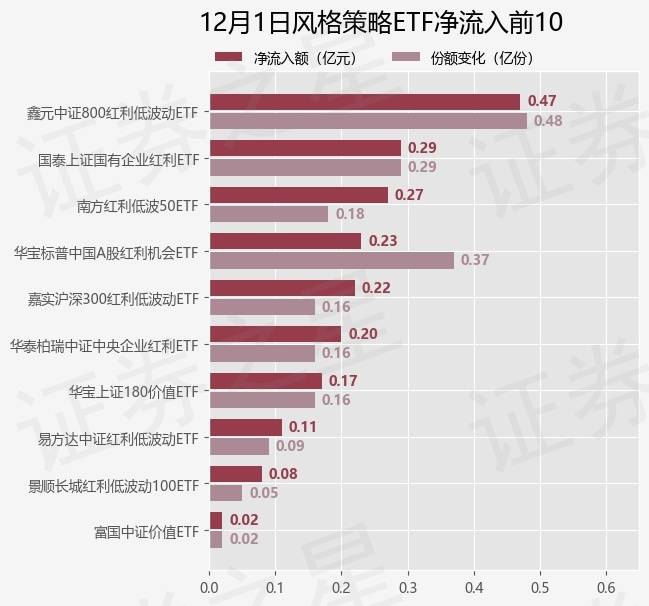
Core Insights - On December 1, style strategy ETFs experienced a net outflow of 216 million yuan, while the cumulative net inflow over the past five trading days was 809 million yuan, with three days showing net inflows [1] - The top inflow was seen in the Xinyuan CSI 800 Dividend Low Volatility ETF (563980), which saw an increase of 48 million shares and a net inflow of 47.27 million yuan [1][3] - Conversely, the top outflow was from the Huatai-PB CSI Dividend Low Volatility ETF (512890), which had a reduction of 153 million shares and a net outflow of 185 million yuan [4][5] Fund Performance Summary - The Xinyuan CSI 800 Dividend Low Volatility ETF (563980) had a price increase of 0.51%, with a net inflow of 47.27 million yuan and a total size of 2.08 billion yuan [3] - The Guotai CSI State-Owned Enterprises Dividend ETF (510720) increased by 0.40%, with a net inflow of 29 million yuan, bringing its total size to 21.51 billion yuan [3] - The Southern Dividend Low Volatility 50 ETF (515450) rose by 0.62%, with a net inflow of 27 million yuan, resulting in a total size of 138.75 billion yuan [3] Outflow Details - The Huatai-PB CSI Dividend Low Volatility ETF (512890) had a price increase of 0.58%, but saw a significant outflow of 185 million yuan, with a total size of 259.81 billion yuan [5] - The Huatai-PB Shanghai Dividend ETF (510880) experienced a net outflow of 99 million yuan, despite a price increase of 0.46%, leading to a total size of 176.69 billion yuan [5] - The China Merchants CSI Dividend ETF (515080) had a price increase of 0.63% but faced a net outflow of 52 million yuan, with a total size of 82.09 billion yuan [5]
11月以来公告上市股票型ETF平均仓位20.97%
Zheng Quan Shi Bao Wang· 2025-11-19 03:18
Core Insights - Two stock ETFs have announced their listing, with the highest stock position being 46.74% for the Bosera National Industrial Software Theme ETF [1] - A total of 17 stock ETFs have announced listings in November, with an average position of only 20.97% [1] - The average fundraising for the newly announced ETFs is 422 million shares, with the leading funds being the China Merchants National Hong Kong Stock Connect Technology ETF and others [1] ETF Positioning - The Bosera National Industrial Software Theme ETF has the highest stock position at 46.74%, followed by the Southern CSI Hong Kong Stock Connect Internet ETF at 45.33% and the China Merchants CSI 800 Free Cash Flow ETF at 44.72% [1] - The lowest positions are held by the Tianhong CSI Agricultural Theme ETF and the Industrial Technology ETF, both at 0.00% [1] Institutional Ownership - The average shareholding by institutional investors is 11.11%, with the highest being 31.99% for the Guolian An Hong Kong Stock Connect Technology ETF [2] - The Tianhong National Hong Kong Stock Connect Technology ETF has the lowest institutional ownership at 0.59% [2] Fundraising and Listing Dates - The newly established stock ETFs have varying fundraising sizes, with the Bosera National Industrial Software Theme ETF raising 613 million shares and the Tianhong CSI Agricultural Theme ETF raising 445 million shares [3] - Listing dates for these ETFs range from November 6 to November 24, 2025 [3]
12只ETF公告上市,最高仓位45.33%
Zheng Quan Shi Bao Wang· 2025-11-11 03:00
Core Insights - Two stock ETFs have announced their listing, with Jiashi's ETF holding 19.99% and Yifangda's ETF holding 10.02% [1] - A total of 12 stock ETFs have announced listings in November, with an average holding of 20.01%, and the highest being 45.33% for Nanfang's ETF [1] - The average fundraising for the newly announced ETFs is 4.35 million shares, with the largest being 9.35 million shares for the Zhaoshang ETF [1][2] ETF Holdings - Institutional investors hold an average of 13.40% of the shares, with the highest being 31.99% for Guolianan's ETF [2] - The ETFs with the lowest institutional holdings include Tianhong's ETF at 0.59% and Yifangda's ETF at 3.54% [2] ETF Listing Details - Jiashi's ETF was established on November 6, 2025, with a fundraising of 9.26 million shares and a holding of 19.99% [2] - Nanfang's ETF was established on October 29, 2025, with a holding of 45.33% and a fundraising of 2.70 million shares [2] - The average holding for newly listed ETFs is 20.01%, with significant variations among different funds [1][2]
10只ETF公告上市,最高仓位45.33%
Zheng Quan Shi Bao Wang· 2025-11-10 03:38
Core Insights - Four stock ETFs have recently announced their listing, with varying stock positions, indicating a diverse investment strategy among these funds [1] - The average stock position for newly listed ETFs in November is 21.02%, with the highest being 45.33% for the Southern CSI Hong Kong Internet ETF [1][2] - Institutional investors hold an average of 14.84% of the shares in these newly listed ETFs, with some funds having significantly higher institutional ownership [2] Group 1: ETF Listings and Positions - The Guolianan Hong Kong Stock Connect Technology ETF has a stock position of 0.06% [1] - The Huabao CSI Hong Kong Stock Connect Information Technology Comprehensive ETF has a stock position of 16.34% [1] - The Tianhong National Index Hong Kong Stock Connect Technology ETF has a stock position of 11.20% [1] - The招商中证800自由现金流ETF has a stock position of 44.72% [1] - The highest stock position among newly listed ETFs is 45.33% for the Southern CSI Hong Kong Internet ETF [1][2] Group 2: Fund Size and Institutional Ownership - The average number of shares raised for newly listed ETFs in November is 3.80 million [2] - The largest share amounts are for the 招商国证港股通科技ETF (9.35 million shares), Tianhong National Index Hong Kong Stock Connect Technology ETF (6.45 million shares), and 兴业中证金融科技ETF (4.07 million shares) [2] - Institutional ownership is highest in the Guolianan Hong Kong Stock Connect Technology ETF (31.99%), followed by the Huabao CSI Hong Kong Stock Connect Information Technology Comprehensive ETF (29.99%) [2]
凸显看好态度 多路资金竞相加码权益资产
Shang Hai Zheng Quan Bao· 2025-11-09 15:26
Group 1 - Multiple funds are increasing their investments in Chinese equity assets, with several newly launched equity funds raising over 3 billion yuan, indicating strong market interest [1][2] - The recent surge in equity fund issuance has led to a notable increase in the number of funds exceeding 3 billion yuan in size, with several funds selling out on the first day of issuance [2][3] - The performance of the A-share market has improved, enhancing investor sentiment and leading to a shift in household investment preferences towards public funds [3] Group 2 - Existing funds are also attracting significant inflows, with over 100 billion yuan flowing into ETFs, prompting some high-performing funds to impose purchase limits [4][5] - The net subscription amount for equity ETFs reached approximately 118.4 billion yuan since October, reflecting investor optimism about the market [4][5] - Notable inflows into securities-themed ETFs indicate a positive outlook among investors, with specific ETFs attracting substantial net subscriptions [5][6]
近一个月22只ETF公告上市,最高仓位98.80%
Zhong Guo Jing Ji Wang· 2025-11-04 05:09
Core Insights - Two stock ETFs have recently announced their listing, with aerospace stocks holding a position of 24.05% and the Xinyuan CSI 800 Dividend Low Volatility ETF at 19.25% [1] - In the past month, 22 stock ETFs have announced their listings, with an average position of only 31.88%. The highest position is held by the Chuangjin Hexin CSI State-Owned Enterprises Dividend ETF at 98.80% [1][2] - The average fundraising for the newly announced ETFs is 421 million shares, with the leading funds being the GF CSI Satellite Industry ETF, the CMB National Index Hong Kong Stock Connect Technology ETF, and the Huaan National Index Hong Kong Stock Connect Consumer Theme ETF, with shares of 1.171 billion, 935 million, and 639 million respectively [1] ETF Positioning - The average institutional investor holding is 15.39%, with the highest proportions in the Penghua Hong Kong Stock Connect Low Dividend ETF (97.57%), the Fortune Creation Board New Energy ETF (66.53%), and the Harvest Hang Seng Index Hong Kong Stock Connect ETF (59.52%) [2] - The lowest institutional holding proportions are found in the Southern CSI Hong Kong Stock Connect 50 ETF (0.57%), the GF CSI Satellite Industry ETF (1.31%), and the Chuangjin Hexin CSI State-Owned Enterprises Dividend ETF (2.20%) [2] Fund Details - The newly listed ETFs include the Aerospace ETF with a position of 24.05%, the Guoshou Anbao CSI A500 Dividend Low Volatility ETF at 0.00%, and the Xinyuan CSI 800 Dividend Low Volatility ETF at 19.25% [2][3] - Other notable ETFs include the CMB National Index Hong Kong Stock Connect Technology ETF with a position of 31.14%, and the Boshi Securities Company ETF at 70.09% [2][3] - The Chuangjin Hexin CSI State-Owned Enterprises Dividend ETF has the highest position at 98.80%, indicating a strong focus on state-owned enterprises [3]