
铝制换热器

Search documents
别只盯着铜,铝时代可能要来了
阿尔法工场研究院· 2026-01-19 02:02
Core Viewpoint - The shift from copper to aluminum is not merely a cost-cutting tactic but a strategic response to global resource changes, geopolitical tensions, and technological advancements, fundamentally altering the supply-demand dynamics and long-term pricing logic of copper and aluminum [4][24]. Group 1: Supply Chain and Market Dynamics - Recent months have seen a dramatic surge in copper prices driven by a global supply chain crisis, with a current supply-demand gap of 500,000 tons in the copper market [5]. - The copper industry faces significant challenges, including a high dependency on foreign resources, with over 80% of copper ore being imported, which poses risks to supply chain security [9][10]. - In contrast, China dominates the aluminum sector, with projected electrolytic aluminum production reaching 44.0046 million tons in 2024, accounting for 58% of global output [12]. Group 2: Strategic Shift to Aluminum - The transition to aluminum from copper has evolved into a national strategy aimed at ensuring industrial security, as highlighted by government initiatives promoting aluminum consumption in various applications [13]. - The copper-aluminum price ratio has reached a 20-year high, with the current ratio at 4.21, significantly exceeding the traditional economic threshold of 3.5, making aluminum a more attractive alternative [17][20]. - The cost advantages of using aluminum over copper are substantial, with potential savings of 20%-25% in air conditioning and 30%-40% in electric vehicles [20][34]. Group 3: Technological Advancements - The evolution of aluminum as a substitute for copper has progressed through four key phases: from early exploration (2015-2018) to technological breakthroughs (2019-2022), followed by large-scale validation (2023-2025), and finally to widespread adoption in the future [25][28][30]. - Innovations in aluminum processing, such as the introduction of silicon-sulfur neutralization technology, are expected to significantly reduce China's reliance on imported bauxite from 90% to below 50% [21][22]. Group 4: Capital Market Implications - The disparity in price movements between copper and aluminum suggests that the aluminum sector is poised for growth, while copper may face a demand ceiling due to the rise of aluminum as a substitute [35][37]. - The shift towards aluminum is expected to attract more global capital, as the supply-demand balance for aluminum transitions from loose to tight, enhancing its financial attributes [38]. Group 5: Future Outlook - The transition from copper to aluminum reflects broader changes in global resource dynamics and energy transitions, with aluminum's lightweight and recyclable properties making it essential in green industries [39]. - The future landscape will likely see copper and aluminum coexisting, each serving distinct roles in high-performance and cost-sensitive applications, thereby reshaping the competitive dynamics of the manufacturing sector [39][40].

周十条丨多地陶企宣布涨价、王宁担任居然之家董事长兼CEO、友邦吊顶筹划控制权变更……
Sou Hu Cai Jing· 2025-12-29 09:17
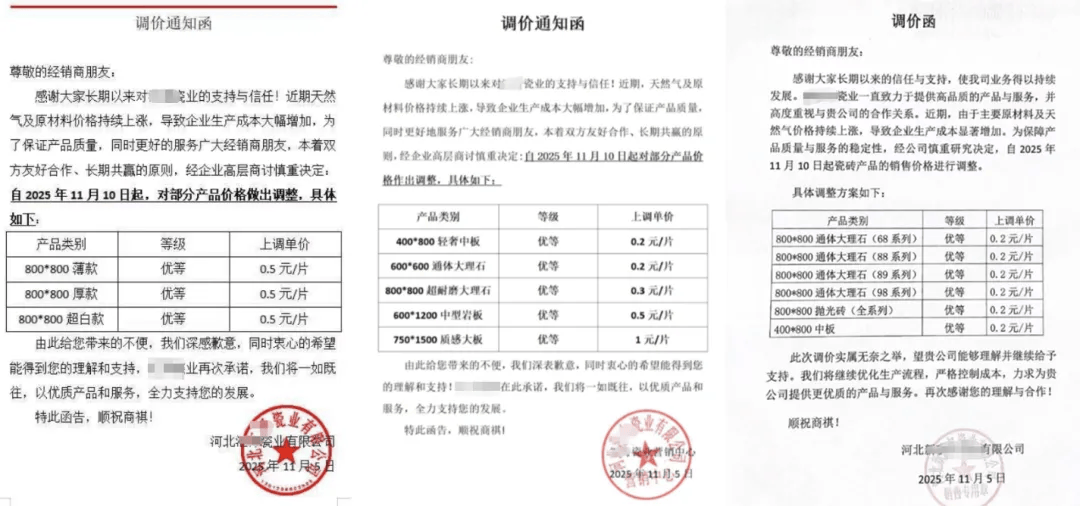
Price Increase in the Ceramics Industry - The ceramics industry is experiencing a wave of price increases as companies in Shandong, Hebei, Sichuan, Guangxi, and Chongqing announce price hikes for tiles and roofing products [1] - The primary reasons for the price increase are seasonal rises in energy costs, such as natural gas, and the upward trend in raw material costs, which are increasing production pressure on companies [1] - Additionally, some companies facing operational challenges have reduced or halted production, leading to a shift in supply and demand dynamics [1] Specific Price Adjustments - Various product categories have seen price adjustments, including: - 800*800 thin tiles: increased by 0.5 yuan per piece - 800*800 thick tiles: increased by 0.5 yuan per piece - 800*800 ultra-white tiles: increased by 0.5 yuan per piece - 400*800 luxury medium boards: increased by 0.2 yuan per piece - 600*600 full-body marble: increased by 0.2 yuan per piece - 800*800 ultra-wear-resistant marble: increased by 0.3 yuan per piece - 600*1200 medium-sized boards: increased by 0.5 yuan per piece - 750*1500 large boards: increased by 1 yuan per piece [3] - Additional adjustments include: - 800*800 full-body marble (68 series): increased by 0.2 yuan per piece - 800*800 full-body marble (88 series): increased by 0.2 yuan per piece - 800*800 full-body marble (89 series): increased by 0.2 yuan per piece - 800*800 full-body marble (98 series): increased by 0.2 yuan per piece - 800*800 polished tiles (entire series): increased by 0.2 yuan per piece - 400*800 medium boards: increased by 0.2 yuan per piece [4] Corporate Developments - Aoyuan Ceiling announced a suspension of trading due to plans for a change in control, which may lead to a change in the company's controlling shareholder [5] - Juran Home announced a board reshuffle, electing Wang Ning as the new chairman and CEO [8] - Bull Group is suing a competitor for 4.2 million yuan over misleading advertising claims [10] - Several home furnishing companies, including Gujia Home and Arrow Home, have announced guarantees for their subsidiaries, reflecting a trend of financial support as year-end funding needs rise [12] - Mona Lisa Group provided a guarantee of up to 100 million yuan for its wholly-owned subsidiary, indicating ongoing financial strategies to support business operations [18]


空调行业“铝代铜”问题再引关注,格力董明珠最新回应
Xin Lang Cai Jing· 2025-12-15 08:17
Group 1 - Gree Electric's Chairman Dong Mingzhu reiterated the company's stance against using aluminum instead of copper in air conditioning, citing that aluminum has not yet reached the same technical standards and reliability as copper [1][2] - The company acknowledges the rising copper prices and the potential cost benefits of using aluminum, which is significantly cheaper, but emphasizes that the performance and reliability of aluminum have not been sufficiently proven [1][2] - Gree Electric has stated that copper constitutes about 20% of the cost of air conditioners, and while aluminum costs about one-tenth of copper, its physical properties such as thermal conductivity and corrosion resistance are inferior [1][2] Group 2 - China is the largest producer and consumer of air conditioners globally, but it relies on imports for about 80% of its copper, while it produces 60% of the world's electrolytic aluminum, indicating a stronger control over raw material supply [2] - The air conditioning industry is accelerating the development of standards for aluminum use, but there are significant technical challenges, particularly in compensating for aluminum's performance shortcomings compared to copper [2] - A group of leading air conditioning companies, including Haier, Midea, and TCL, has committed to a self-regulatory agreement regarding the use of aluminum heat exchangers, although Gree Electric did not participate in this initiative [3]
