
银耳面膜

Search documents
全国每10朵银耳有9朵来自这座福建小城
Xin Hua She· 2026-01-13 05:44
Core Viewpoint - Gutian County, known as the "Mushroom Capital of China," has become a leading producer of edible fungi, particularly silver ear mushrooms, with 90% of the national output coming from this region [1][4]. Industry Overview - By 2025, the total output value of the edible mushroom industry chain in Gutian County is projected to reach 31.5 billion yuan, with products exported to over 20 countries and regions including Southeast Asia and Europe [2]. - The fresh edible mushroom production in Gutian County is expected to exceed 1 million tons, with silver ear mushrooms accounting for over 450,000 tons [4]. Production Techniques and Innovations - Gutian has transitioned from traditional cultivation methods to modern techniques, including the use of photovoltaic greenhouses, which enhance control over temperature and humidity, reduce pest issues, and lower electricity costs [3]. - The introduction of intelligent cultivation systems has allowed for year-round production, doubling yields while significantly reducing labor costs [9]. Industry Ecosystem - The silver ear industry in Gutian has developed a complete ecosystem from research and development of strains to cultivation, processing, and sales, encompassing over 60 product series across various categories [5]. - The county has established stable supply relationships with major supermarkets and pharmaceutical companies, and over 400 e-commerce enterprises facilitate the export of Gutian silver ear products [5]. Economic Impact - More than 70% of the agricultural population in Gutian is engaged in the edible mushroom industry, which contributes to 70% of the county's agricultural output value and 70% of farmers' cash income [5][6]. - The development of the silver ear industry has transformed the local economy and dietary habits, significantly improving the livelihoods of the residents [7][8]. Future Directions - Gutian County is actively promoting diversification in the industry, including the integration of silver ear products with ecological tourism to attract visitors and enhance consumer engagement [13]. - The county is also focusing on high-quality transformation and upgrading of the edible mushroom industry, aiming to build a modern industrial highland [11]. Challenges and Strategies - Despite rapid growth, the industry faces challenges such as talent shortages, weak brand building, and intense market competition [12]. - To address these issues, Gutian is implementing a "Mushroom Talent Revitalization Plan" in collaboration with local universities to cultivate expertise in various fields related to the industry [14].
中国经济样本观察·县域样本篇丨全国每10朵银耳有9朵来自这座福建小城
Xin Hua Wang· 2026-01-13 02:22
Core Insights - The article highlights that 90% of the country's silver fungus comes from Gutian County, which is referred to as the "Mushroom Capital of China" [1][2] - By 2025, the total output value of the edible fungus industry chain in Gutian County is projected to reach 31.5 billion yuan, with products exported to over 20 countries and regions [2] - The silver fungus industry in Gutian has evolved into a comprehensive ecosystem, including research, cultivation, processing, and sales, contributing significantly to local agriculture and economy [5][6] Industry Overview - Gutian County has established itself as a leader in the edible fungus industry, with over 70% of its agricultural population engaged in this sector and 70% of agricultural output value derived from it [5][6] - The county has developed a complete silver fungus industry chain, producing over 100,000 tons of fresh edible fungus by 2025, with silver fungus accounting for more than 45,000 tons, representing over 90% of national production [4][5] Technological Advancements - The introduction of modern cultivation techniques, such as intelligent cultivation systems, has significantly increased production efficiency and reduced costs [10][11] - Continuous investment in research and development, with 3% to 5% of annual sales allocated to enhance product variety and processing capabilities, has been a key strategy for growth [11][16] Market Dynamics - The silver fungus industry has faced challenges such as market saturation and price drops, prompting a shift towards deep processing and innovation to maintain competitiveness [10][13] - The rise of e-commerce and live streaming has expanded the market reach of Gutian silver fungus, allowing it to penetrate new consumer segments [12][17] Future Directions - Gutian County is actively pursuing diversification in its industry, including the integration of silver fungus with ecological tourism to attract visitors and enhance consumer engagement [14][15] - The establishment of partnerships with educational institutions aims to address talent shortages and foster innovation within the industry [16]
四川县域经济“十四五”画像 从“金字塔型”迈向橄榄型
Si Chuan Ri Bao· 2025-11-21 00:19
Core Viewpoint - The economic development of counties in Sichuan is transitioning from an unbalanced structure to a more balanced "olive-shaped" model, with significant growth in the middle-tier counties and a reduction in the number of lower-tier counties [4][6]. Economic Growth - The average GDP of counties (cities, districts) in Sichuan is projected to reach 35.37 billion yuan in 2024, an increase of 8.81 billion yuan from 2020 [3]. - The number of counties with an economic total exceeding 60 billion yuan will rise to 27 by 2024, up from 14 in 2020 [5]. - The number of counties with GDP below 20 billion yuan is expected to decrease from 106 in 2020 to 78 in 2024 [6]. Structural Changes - The economic structure is evolving from a "pyramid" shape to an "olive" shape, indicating a healthier distribution of economic strength among counties [4][6]. - The number of counties with GDP between 20 billion and 60 billion yuan has increased by 15, now totaling 78, which constitutes 42.6% of all counties in Sichuan [6]. Development Strategies - The provincial government is implementing a strategy of "grasping the strong, strengthening the middle, and uplifting the weak" to foster county-level economic development [7][9]. - Specific policies are being tailored for each county to support industrial development and infrastructure, with a focus on creating "single champions" in niche markets [7][8]. Future Outlook - The next five years will focus on maintaining growth across all 183 counties, ensuring that no county is left behind [10][12]. - The development strategy will continue to emphasize innovation and collaboration among counties with complementary industries [10][11].


“大伙儿的精气神提起来了!”——来自三省七县脱贫村的调研之二
Ren Min Ri Bao· 2025-08-22 08:43
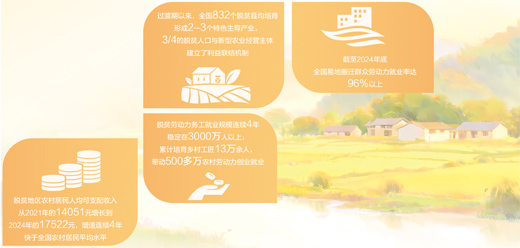
Core Viewpoint - The article emphasizes the transformation of poverty-stricken areas and their residents from merely surviving to actively pursuing development, highlighting the importance of internal motivation and capabilities for sustainable growth in rural revitalization [1][2]. Group 1: Changes in Mindset - Residents have shifted from "waiting for food" to "striving for the future," with significant improvements in their living conditions and aspirations [2][4]. - The establishment of a complete education system in areas like the Baijiawan settlement has led to improved educational outcomes, with students achieving higher academic performance [2][5]. Group 2: Economic Development - The article illustrates how individuals like Li Guozhi have expanded their agricultural practices, leading to increased income and community engagement in farming [4][5]. - The establishment of cooperatives and the introduction of new agricultural practices have transformed local economies, as seen in places like Hebei's Dajingzi Village, where potato farming has become profitable [4][5]. Group 3: Skills and Capabilities - There is a notable shift from merely having jobs to excelling in them, with local talent and skills becoming crucial for rural industry development [6][7]. - Training programs and local initiatives have empowered residents to enhance their skills, leading to better job performance and entrepreneurship [8][9]. Group 4: Industry and Innovation - The development of new industries, such as the silver ear mushroom industry in Tongjiang County, showcases how local resources can be leveraged for economic growth [9][10]. - The integration of tourism and agriculture in places like Yunnan's Baozang Village demonstrates the potential for creating diverse revenue streams and enhancing local economies [10][11]. Group 5: Overall Impact - The cumulative effect of these changes is a significant reduction in the gap between impoverished and other regions, with rural revitalization efforts gaining momentum [11].
来自三省七县脱贫村的调研:“大伙儿的精气神提起来了!”
Ren Min Ri Bao· 2025-08-22 07:27
Core Insights - The article emphasizes the transformation of poverty-stricken areas and communities, highlighting the shift from merely surviving to actively pursuing development and prosperity [1][2][5]. Group 1: Changes in Mindset - There is a notable shift in the mindset of the impoverished communities from "waiting for basic needs" to "striving for a better future," as evidenced by improved living conditions and increased employment opportunities [1][2]. - The educational improvements in these areas have led to better academic performance among children, reflecting a broader change in community aspirations [2]. Group 2: Economic Development - The article illustrates how individuals like Li Guozhi have expanded their agricultural practices, leading to increased income and community engagement in farming and livestock raising [4][5]. - The establishment of cooperatives and the introduction of new agricultural practices have enabled local farmers to enhance their productivity and profitability [4][5]. Group 3: Skills and Capabilities - There is a growing emphasis on skill development and technical training, which has empowered local residents to improve their capabilities and contribute to the local economy [6][8]. - The return of skilled workers from urban areas has facilitated the transfer of knowledge and expertise, further driving local industrial growth [7][8]. Group 4: Industry and Innovation - The article highlights the emergence of new industries and business models in rural areas, such as the development of tourism and agribusiness, which are diversifying local economies [10][11]. - Local governments are actively promoting industrial clusters and modern agricultural practices to enhance economic resilience and sustainability [9][10]. Group 5: Community Engagement - The involvement of local communities in decision-making and development initiatives has fostered a sense of ownership and responsibility, leading to more sustainable growth [5][11]. - The integration of cultural and ecological values into economic activities is becoming a key strategy for rural revitalization [10][11].