
风乌

Search documents
AI让气象预报更准确,期待人工智能更好地落地生根
Ren Min Ri Bao· 2026-01-27 01:36
Core Insights - Artificial intelligence (AI) is rapidly transforming various sectors, including agriculture, healthcare, and logistics, by enhancing productivity and service delivery [1] - The "Fenghe" system represents a significant advancement in AI-driven meteorological services in China, showcasing the integration of complex knowledge systems with diverse user needs [1] - The future of AI in industries hinges on the effective connection between technology and demand, aiming to elevate AI from being merely usable to truly transformative [1] Group 1: AI in Meteorology - The application of AI in meteorology is expanding, with new models emerging to enhance the industry's capabilities [2] - Prior to "Fenghe," the China Meteorological Administration launched several AI models, including "Fenglei" for severe weather prediction and "Fengqing" for global forecasting [2] - The introduction of AI technology, combined with traditional forecasting methods and expert experience, is improving the accuracy of weather predictions [2] Group 2: Advancements in Meteorological Services - AI models are being developed for extreme precipitation forecasting, severe weather warnings, and data assimilation, contributing to the digital and intelligent transformation of meteorological services [3] - These advancements are providing essential support for better meteorological services, enhancing their role in daily life and production [3]
让创新技术更好地落地生根(快评)
Ren Min Ri Bao· 2026-01-08 22:50
Core Insights - Artificial intelligence (AI) is rapidly transforming various sectors, including agriculture, healthcare, and logistics, by enhancing productivity and service delivery [1] - The Fenghe system represents a significant advancement in AI-driven meteorological services, showcasing the integration of complex knowledge systems with diverse user needs [1] Group 1: AI in Meteorology - The application of AI in meteorology is expanding, with new models and scenarios emerging to empower the industry [2] - Prior to Fenghe, the China Meteorological Administration launched several AI models, including Fenglei for severe weather forecasting and Fengqing for global short to medium-term forecasting [2] - In 2024, the China Meteorological Administration will initiate a demonstration plan for AI weather forecasting models, highlighting the integration of forecasting models with innovative meteorological services [2] Group 2: Enhancements in Weather Forecasting - The integration of AI with traditional meteorological techniques and the expertise of forecasters has improved forecasting accuracy [3] - AI models have emerged in areas such as extreme precipitation prediction, severe convective weather warnings, and meteorological data assimilation, driving the digitalization and intelligence of meteorological services [3] - These advancements provide crucial support for enhancing meteorological services that benefit production and daily life [3]
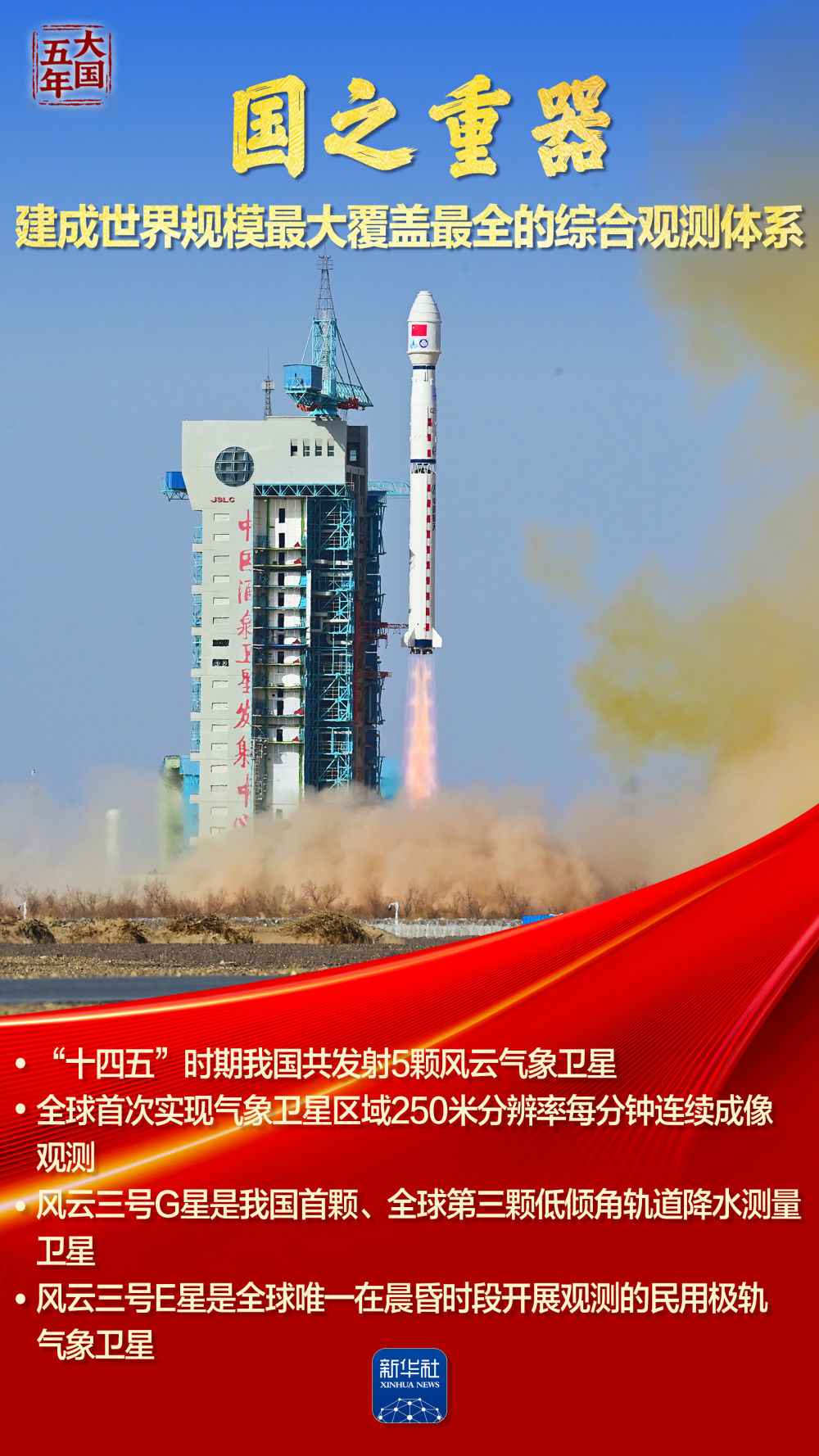
大国五年丨观云识天,护航国计民生
Xin Hua She· 2025-12-05 09:20
Core Insights - Meteorological services have become a crucial support for meeting public expectations and promoting economic and social development during the 14th Five-Year Plan period [1] Group 1: Technological Advancements - The global first achievement of meteorological satellite with a regional resolution of 250 meters for continuous imaging every minute [3] - Fengyun-3G satellite is China's first and the world's third low-inclination orbit precipitation measurement satellite [3] - Fengyun-3E satellite is the only civil polar meteorological satellite conducting observations during dawn and dusk [3] - High-level self-reliance and strength achieved through meteorological detection equipment and technologies such as Fengyun satellites, Beidou sounding, and weather radars [7] Group 2: Forecasting Accuracy - The monitoring rate for hazardous weather has increased to 83% [10] - The lead time for severe convective weather warnings has been advanced by 13% [10] - Regional heavy rain, high temperature, and cold wave events can be forecasted 3 to 7 days in advance [10] - National significant weather events can be predicted 15 days ahead, and global climate anomalies can be forecasted 6 months in advance [10] - Climate annual outlook products can be released 1 year in advance [10] Group 3: Service Expansion - The life meteorological service index has increased to over 70 types, covering various aspects of daily life [21] - Refined meteorological services encompass clothing, food, housing, transportation, tourism, shopping, and entertainment, covering over 50,000 scenic spots nationwide [21] - Health meteorological warning products for high temperatures and pollen allergies are popular among the public [21] - Meteorological information is integrated into major media, mainstream information, and life service platforms [21] Group 4: Economic Impact - Economic losses due to meteorological disasters have decreased by an average of 0.12 percentage points of GDP during the 14th Five-Year Plan period [14] - Artificial rainfall and snow operations have cumulatively increased precipitation by approximately 1,677 million tons [14] - Early warnings for winter wheat dry hot wind have contributed to an increase in grain production by 8.3 billion jin [15] - The optimization of the "One Road Three Parties" warning linkage mechanism has led to a 51% reduction in traffic accidents on improved road sections [15] Group 5: Data Sharing and Collaboration - A seamless and comprehensive intelligent digital meteorological forecasting business system has been established, with spatial resolution refined to 5 kilometers globally and 1 kilometer nationally [12] - 17 industries have achieved the integration and rapid release of 82 types of warning information, with alerts delivered to emergency responders within 1 minute [18] - Over 12 categories and 100 types of meteorological data products have been shared with society, serving 153 countries and regions, and nearly 1.3 million users across 21 industries in China [25]

AI洞悉“天机” 风云不再“莫测”
Ke Ji Ri Bao· 2025-10-23 23:48
Core Viewpoint - The rapid development of artificial intelligence (AI) technology is enhancing the accuracy and efficiency of weather and climate predictions, with AI models expected to match or exceed traditional physical models in both temporal and spatial resolution [1]. Group 1: AI Weather Models - AI weather models, such as Pangu, Fengwu, and Fuxi, are increasingly being utilized in typhoon prediction and short-term climate forecasting, showcasing their potential to improve prediction accuracy and efficiency [2]. - The advantages of AI weather models include faster computation times, higher accuracy in forecasts (e.g., typhoon path predictions), and built-in optimization modules for various predictive studies [2][3]. - AI models have successfully predicted the El Niño-Southern Oscillation (ENSO) phenomenon for over 18 months, significantly surpassing traditional models [2]. Group 2: Integration of AI and Traditional Methods - Current AI weather models face challenges, such as unclear physical mechanisms behind predictions and insufficient temporal resolution, with some models refreshing data only every six hours compared to traditional models that do so in minutes [4]. - The integration of high-performance computing (HPC) with AI is proposed as a solution to enhance prediction accuracy and overcome computational limitations [4][5]. - Future developments in weather forecasting are expected to rely on a combination of HPC and AI, requiring advanced supercomputing systems capable of handling massive computational demands [5].